How do I grow a cleaning business?
Learn how to grow a cleaning business with a 90-day plan for local demand, repeat customers, lead tracking, reliable cleaner capacity, and service quality.
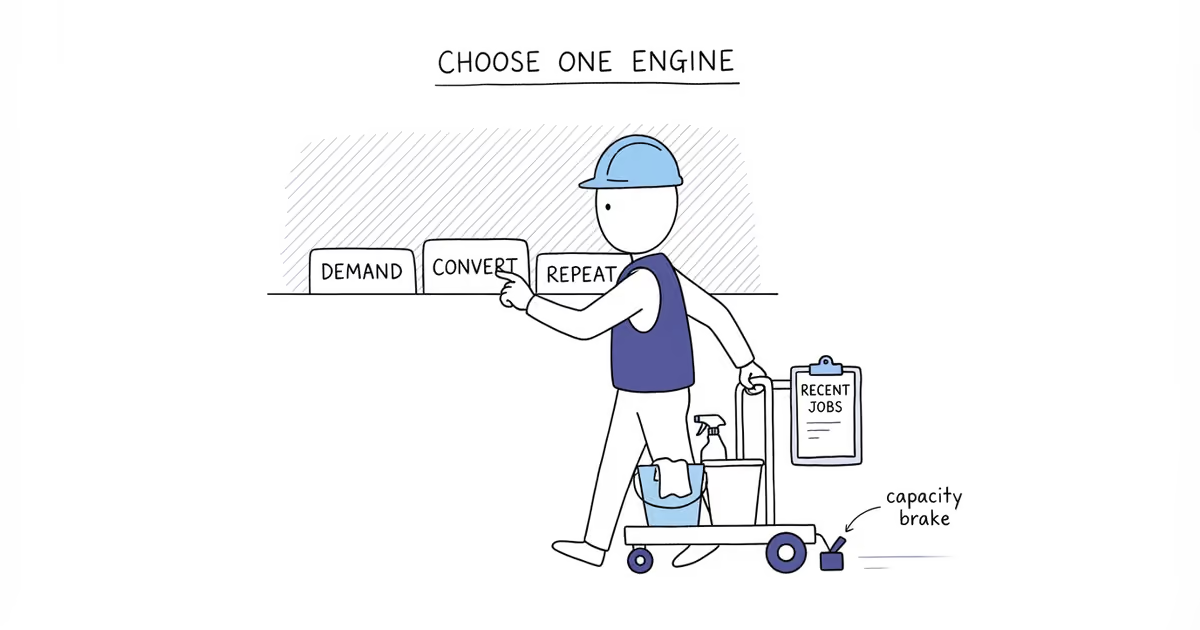
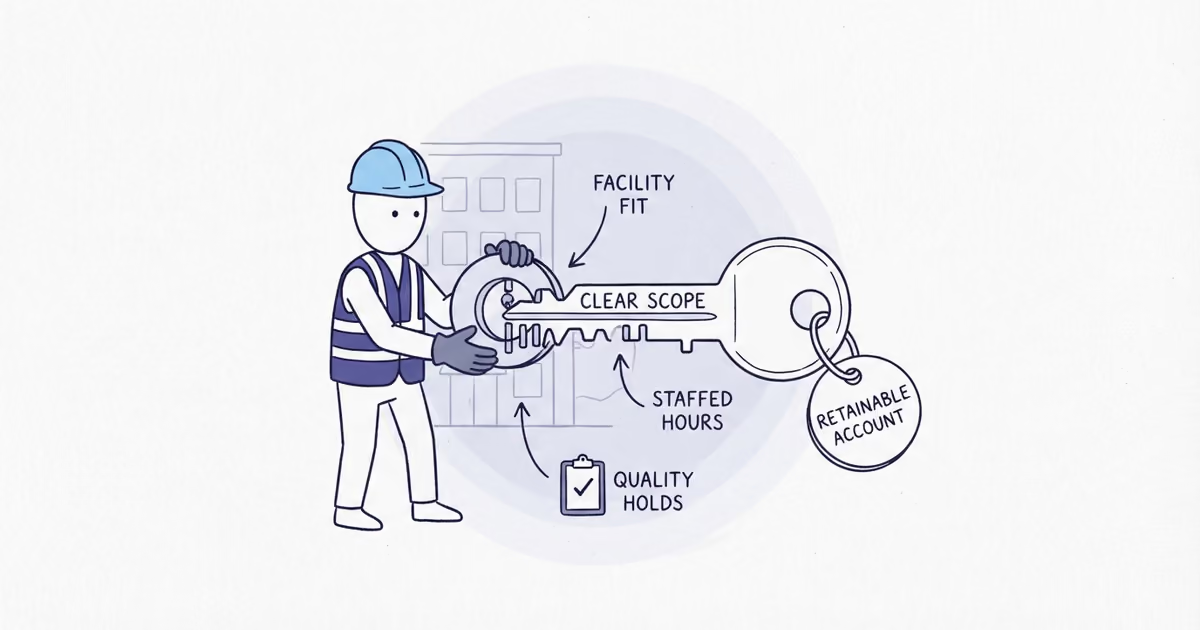
To grow a cleaning business, pick one primary growth engine for the next 90 days: residential cleaning, commercial cleaning, or a deliberately separated mix with one side treated as primary. Then improve demand, conversion, repeat work, and delivery capacity in that order. Growth is not more inquiries, more services, or a wider territory. It is more repeatable work that produces enough contribution and can be delivered to the same standard every time.
Last verified: August 28, 2026 (United States).
Residential vs commercial cleaning business growth
Residential and commercial cleaning do not share the same buyer, sales process, schedule, or capacity problem. Use your recent work to choose the model that deserves the next 90 days.
| Model | Best fit for the next 90 days | Buyer and buying process | Offer and payment question to inspect | Proof and owned demand path | Repeat pattern | Staffing and capacity risk |
|---|---|---|---|---|---|---|
| Residential | Existing homeowner demand in a real area with consistent daytime capacity | A homeowner needs a clear quote path, in-home trust, and an available time | Inspect scope, frequency, payment timing, travel, and direct costs | Accurate local visibility, homeowner reviews, permission-cleared proof, referrals, and reactivation | Move suitable one-off jobs to a recurring frequency or rebooking point | Travel, access, unreliable cleaner hours, and recleans |
| Commercial | A defined facility type whose service window and quality needs you can support | A decision-maker may need qualification, a site walk, written scope, proposal, and follow-up | Inspect scope, service window, direct labor, supplies, payment terms, and account concentration | Relevant references, scope and quality proof, local visibility, and qualified account outreach | Scheduled service depends on scope control, delivery, issue handling, and account reviews | Restricted windows, supervision, inspections, issue response, and account concentration |
| Deliberately mixed | Both sides have real demand and capacity, with one still selected as primary | Homeowners and facility buyers use separate sales paths | Keep separate offers, costs, payment patterns, and capacity records | Separate pages, intake, proof, attribution, and follow-up | Count recurring homes and commercial accounts separately | Combined revenue can hide weak work and schedule conflicts |
Mixed service is not a hedge against making a decision. Keep separate offers, website paths, intake, schedules, lead sources, economics, and capacity. If you cannot assign opportunities, hours, recleans, and repeat work to one model, you cannot tell which side is growing.
Days 1-14 of a cleaning business growth plan
Audit the last 60 to 90 days of actual work. Create one row per job or account and record:
- Residential or commercial customer type
- Service and actual service area
- Lead source
- Revenue, direct cleaner labor, and job-specific supplies
- Cleaning hours and material travel or non-cleaning time
- Quote, site-walk, and payment timing
- One-off, recurring, lost, or follow-up status
- Complaint, missed task, reclean, credit, or avoidable cancellation
- Cleaner hours that were reliably available in the required service window
Do not repair missing records with guesses. Mark the field as missing and start capturing it now.
Use the audit to select one target segment, one priority offer, and one real service area. Define the offer in customer language: who it is for, what is included, what is excluded, how the quote or site walk works, when the work can be performed, and what completion proof the customer receives. Adding carpet, windows, pressure washing, restoration, or every other adjacent service does not fix a vague core offer.
Set a delivery standard from quote through issue resolution. Set capacity from reliable cleaner time in the required service windows, not hoped-for hires.
Deliverable by Day 14: a one-page model decision, a baseline scorecard, a named priority offer, a real service area, a delivery standard, and a current capacity ceiling.
Days 15-30 for local cleaning business visibility and leads
Start with one eligible, real Google Business Profile. Check that the real-world business name, primary category, services, hours, phone, website, photos, and address or service-area treatment match the business customers actually deal with. If customers are not served at the address, follow Google’s service-area-business rules. Do not create locations you do not operate or add keywords to the business name.
Google says local results are mainly based on relevance, distance, and prominence. Accurate information helps Google understand the business, but no profile field guarantees a Maps position.
Build one clear conversion path for the priority offer. Its service page should answer:
- What is cleaned, for whom, and in which actual area
- What is included and excluded
- How a homeowner requests a quote or how a facility requests a site walk
- Which quote inputs, access, supplies, timing, or frequency details the customer must provide
- How to call or submit the request
Add area pages only when each page serves customers in a place the company genuinely covers and contains useful, place-specific information. Mass-producing near-identical city pages is not a local growth system.
Make intake fit the selected model. Residential intake should capture the home, requested service, frequency, area, access, timing, and quote inputs. Commercial intake should capture facility type, location, scope or size inputs, service window, decision process, and whether a site walk is needed.
Give every qualified opportunity an owner and next action. Use a response target the team can meet. Track it until booked, lost with a reason, or assigned a dated follow-up.
Build a small proof set from completed work. Use identifiable customer evidence and photos only with permission. Residential proof should show consistency and in-home trust; commercial proof should show scope control, supervision, and issue handling. Use credentials and service claims only when current, true, and supported.
If the website, Google profile, reviews, listings, and follow-up path all need work and the first priority is unclear, review ShiftFlow’s growth services to choose the setup or audit that resolves the current bottleneck.
Deliverable by Day 30: one accurate path from local discovery to a quote or site walk, with model-specific intake, response ownership, opportunity tracking, and permission-cleared proof.
Days 31-60 for cleaning business marketing and reviews
Improve the priority service page and the few real area pages needed for the selected market. Answer buyer questions directly: what is included, what changes the quote, what the customer must provide, how scheduling works, which frequencies are available, what is excluded, and what happens if something is missed.
Then run the demand branch that matches the model:
If the owner wants to build qualified demand without returning to paid lead lists, the getting customers without paid leads guide turns the chosen offer, area, proof, and capacity into a weekly acquisition routine.
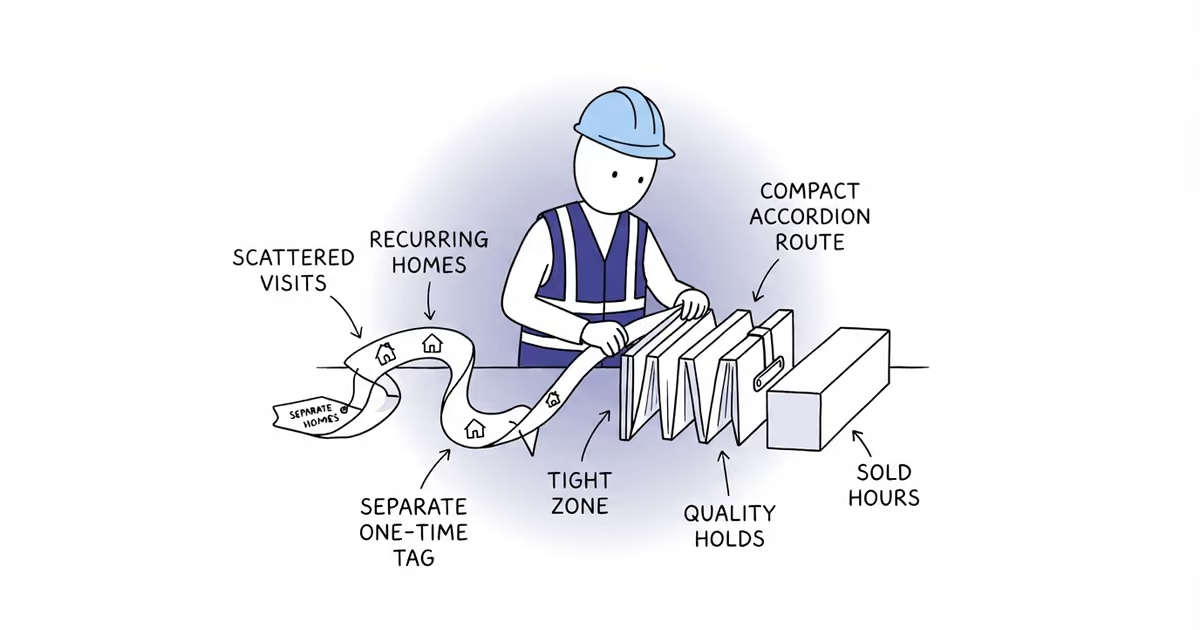
- Residential: improve owned local discovery, reactivate suitable past customers, invite completed customers to choose an appropriate recurring frequency, use neighborhood proof, and ask for referrals. Keep detailed route design and recurring-home economics for the house-cleaning growth plan.
- Commercial: define one facility niche, build a small qualified account list, make useful contact, schedule appropriate site walks, send proposals, and give every open proposal a follow-up owner and date. Keep bidding, contracts, onboarding, and renewal mechanics for the commercial-cleaning growth plan.
- Mixed: run both paths separately. A residential referral is not a commercial lead, and an unsigned commercial proposal is not recurring revenue.
Run the same small set of buyer questions through search-enabled AI tools. Record whether the business appears accurately and which public pages are cited. Correct missing or unsupported facts on priority pages and profiles you control.
Google says its normal SEO requirements apply to AI features and that no special AI file or schema is required. OpenAI’s crawler documentation distinguishes permission for search inclusion from an outcome: access does not guarantee crawling, citation, rank, or a local recommendation. Direct answers and first-party proof make the business easier to verify; they do not force a recommendation.
After completed work and issue resolution, ask eligible customers for a review under the same neutral rule. Google provides a direct review link or QR code. Stop reminders sensibly, protect private information, and never buy reviews, gate requests, suppress negative feedback, or reward positive sentiment. Use commercial references only with permission.
Deliverable by Day 60: one weekly demand routine that records source, qualified opportunity, outcome, completed-work quality, AI-search accuracy, and genuine review requests.
Days 61-90 for repeat cleaning customers and capacity
Every completed job needs a next transaction or a closed reason.
For residential work, offer a suitable recurring frequency or set a rebooking point. Reactivate past customers whose history fits the offer and area. For commercial work, schedule an account review, record issue resolution, and prepare the next scope or renewal conversation.
Standardize the operating handoff before adding demand. Document the priority-service checklist, quote-to-schedule transfer, customer access notes, completion proof, complaint and reclean process, and the person responsible for the quality check.
Compare sold cleaning hours with reliable available cleaning hours in the same service window. Add labor only after you can show repeatable demand, sufficient contribution after direct job costs, reliable hours to sell, a written cleaning standard, and a named trainer or quality owner. Hiring rules, worker classification, wages, insurance, and local employment requirements need separate professional and jurisdiction-specific guidance.
Deliverable by Day 90: a decision on every segment, offer, and demand source, plus the next 90-day primary model and a capacity plan that can actually deliver it.
Cleaning business growth metrics to track weekly
Keep residential and commercial figures separate even when both appear on the same sheet.
| Measure | What to record |
|---|---|
| Qualified opportunities by source | Count only inquiries or accounts that fit the chosen customer, priority service, real area, and workable timing. Keep every source separate. |
| Booking or account close rate | Divide booked residential jobs or signed commercial accounts by qualified opportunities for the same model and period. Never combine the models. |
| Job contribution per cleaning labor hour | Compare completed work using the formula below. Use the same cost definition each week. |
| Repeat base | Record active recurring residential homes or active commercial accounts and upcoming account reviews separately. |
| Quality leakage | Count recleans, missed tasks, complaints, service credits, and avoidable cancellations in a consistent format. |
| Capacity coverage | Compare cleaning hours sold with reliable cleaning hours available in the required service window. |
Use this formula:
Job contribution per cleaning labor hour = (job revenue - direct cleaner labor - job-specific supplies) / cleaning labor hours
This compares jobs; it is not net profit. Overhead, taxes, owner pay, insurance, marketing, equipment, travel, and other costs may remain outside it.
Do not import an industry target for any scorecard row. Establish your own baseline, keep the definition stable, and watch what changes when you adjust the offer, area, intake, follow-up, or schedule.
Cleaning business growth mistakes to avoid
- Launch every service or serve every town
- Combine residential and commercial results
- Buy leads you cannot attribute through booking and completed work
- Scale ads before the offer, response owner, conversion tracking, maximum test budget, and delivery capacity are clear
- Publish mass-produced city pages
- Chase unsupported AI-search shortcuts
- Buy reviews, gate review requests, or reward positive sentiment
- Hire before the work standard, demand record, contribution, and reliable capacity need exist
Frequently asked questions about growing a cleaning business
Is residential or commercial cleaning more profitable?
Neither model is universally more profitable. Compare delivered job contribution per cleaning labor hour, repeat patterns, payment timing, quality leakage, and reliable service-window capacity using separate residential and commercial records.
Can I grow a cleaning business without buying leads?
Yes. Improve accurate local discovery, reactivate suitable past customers, offer relevant recurring service, and ask for genuine reviews and referrals after resolved work. Track each source through qualified inquiry, booking, and completed work.
When should a cleaning business hire another cleaner?
Hire when repeatable demand consistently exceeds reliable available cleaning hours and completed jobs leave enough contribution after direct costs. Have a written work standard, a named trainer or quality owner, and usable service-window capacity before adding labor.
Sources
- Google: Guidelines for representing your business
- Google: Tips to improve your local ranking
- Google: Ask for and manage reviews
- Federal Trade Commission: The Consumer Reviews and Testimonials Rule - Questions and Answers
- Google Search Central: AI features and your website
- OpenAI: Overview of OpenAI crawlers
- Google Search Central: Spam policies - doorway abuse
How to choose which cleaning business growth work to keep
Keep a model, offer, or source only when it produces qualified demand the team can convert, deliver to standard, repeat, and absorb at acceptable job contribution. Fix one named bottleneck. Stop work that repeatedly fails the scorecard. Defer expansion that current proof or reliable capacity cannot support.
- local-seo-foundations
- how-to-grow-a-cleaning-business
- cleaning-business-growth-plan
- grow-a-residential-cleaning-business
- grow-a-commercial-cleaning-business
- get-recurring-cleaning-customers