How do I grow a commercial cleaning business?
Learn how to grow a commercial cleaning business with a 90-day plan for winning profitable accounts, managing crew capacity, and improving client retention.
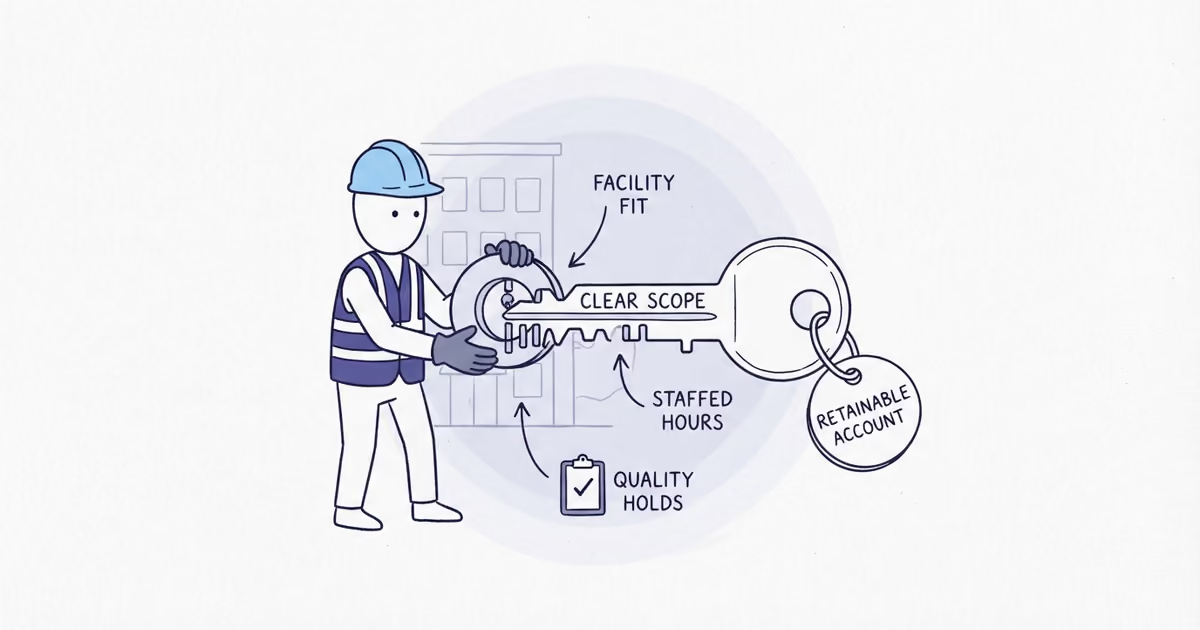
Grow a commercial cleaning business by winning and retaining profitable accounts, not by collecting residential-style leads. Target suitable facilities, create qualified buyer conversations, turn walkthroughs into clear proposals, and deliver the scope inside the labor budget.
Last verified: August 28, 2026 (United States).
Choose an ideal commercial cleaning account
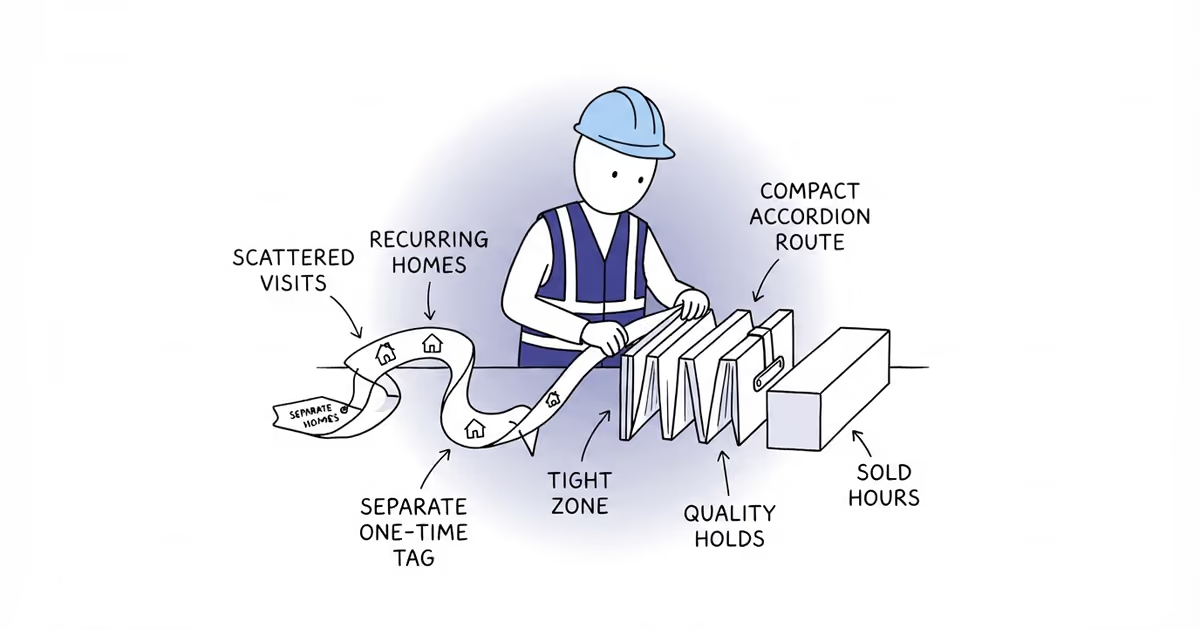
Start with the facility, not the marketing channel. Pick one account pattern for the next 90 days so the buyer, scope, service window, proof, crew, and equipment requirements repeat often enough to improve.
Write down:
- Facility type and a tight operating area
- Required frequency and service window
- Cleanable areas and likely periodic work
- Access, keys, alarms, parking, and security conditions
- The current service problem
- Decision-maker, other stakeholders, and vendor requirements
- Likely walkthrough, bid, and start timing
- Crew, supervision, supplies, and equipment needed
An office, managed common area, or retail facility may fit. A medical, industrial, school, disinfection, or specialist account does not unless the company can meet its training, service, documentation, insurance, and facility requirements.
Use demand, existing proof, competition, service-window fit, and account economics to choose the first segment. The SBA’s market-research guidance supports checking the customer group, location, alternatives, demand, and competitive position instead of picking from a generic niche list.
Set no-fit rules now. A facility is out when the route, service window, specialist work, vendor conditions, or direct-cost contribution does not fit. Test a second segment later.
Assume the target is a small multi-tenant office property on the current evening route. Every number is illustrative, not a market rate or benchmark.
Check account contribution and capacity during days 1-14
Do the math before outreach. A large monthly contract can still be a bad account when labor, supervision, supplies, travel, or access consumes the revenue.
Use two formulas:
Account contribution dollars =
  monthly contract revenue - direct account costs

Account contribution margin =
  account contribution dollars / monthly contract revenue
Direct account costs include cleaner labor, supervision, job-specific supplies, equipment, and travel. These operating measures do not replace the owner’s accounting statements, include every overhead item, or provide tax advice.
Suppose the office contract produces $5,000 monthly revenue. Planned cleaner labor and supervision are $3,100. Supplies, equipment, and travel add $600. Planned contribution is $1,300, or 26%. These figures only demonstrate the calculation. The owner decides what is acceptable after considering costs outside this account view.
Now check the service window. The office needs 68 cleaner hours and 6 supervision hours each month between 6 p.m. and 10 p.m. The business has 90 reliable staffed hours left in that same window. That leaves 16 hours for absence coverage, onboarding, or unexpected site needs. If those 90 hours depend on an unconfirmed hire, they are not capacity.
Output: one ideal-account sheet, contribution model, no-fit list, and service-window capacity view.
Gate: do not start selling until the target account can fit the route, direct-cost model, supervision, backup coverage, equipment, access, and start-date cash needs.
Build commercial cleaning buyer trust during days 15-30
A facility buyer may inspect the company before answering an email or agreeing to a walkthrough. Give them enough accurate information to decide whether a conversation is worthwhile.
Check the Google Business Profile, listings, and website against the real operation. The name, phone, hours, website, service area, and services should agree. Google says local results are mainly based on relevance, distance, and prominence. Complete information, reviews and replies, and current photos are useful, but none guarantees a position.
Create one commercial-cleaning page for the chosen segment and real operating area. It should answer these questions in visible text:
- Which facilities and locations do you serve?
- Which tasks and frequencies do you scope?
- Which service windows can you staff?
- What happens before, during, and after a walkthrough?
- How do inspections and issue reporting work?
- What does the buyer need to provide?
- How does someone request a walkthrough?
Add proof a commercial buyer can inspect: permission-cleared photos, a sample scope or quality process, relevant first-party account evidence, and truthful insurance, training, or certification information where applicable. Do not claim capabilities the company has not established.
If the company lacks a clear page where a facility buyer can verify fit, proof, and the walkthrough path, ShiftFlow’s free website setup can turn those facts into a usable buyer-verification page.
For AI-search visibility, use clear service facts, visible answers, consistent business information, and real proof. Google’s AI-features guidance requires no special AI file or markup. Structured data should match visible content. Ordinary SEO still applies, and appearance is not guaranteed.
Test a fixed set of buyer questions in search-enabled tools, such as “commercial cleaner for a multi-tenant office in [area].” Record whether the company is described accurately and which sources appear. Correct unsupported or missing facts on owned pages and profiles. Do not chase citations with thin facility or copied city pages.
Output: one accurate profile-to-service-page path, a commercial proof set, and a simple AI-search accuracy record.
Gate: a buyer should be able to confirm the facility fit, area, service process, proof, and contact path without guessing.
Build a named commercial account list during days 15-30
Commercial acquisition starts with accounts, not an anonymous lead count. Research local facilities, facility or property managers, commercial real estate contacts, general contractors, and complementary vendors.
Give each account a record:
- Facility, location, and likely fit
- Buyer and other stakeholders
- Credible reason for contact
- Known cleaning problem, vendor-list timing, or rebid window
- Relationship or referral path
- Last contact, next action, and next-action date
- Source and outcome
Prioritize introductions, referrals, relationships, and relevant one-to-one outreach. Do not scrape a list and send the same message to everyone.
Use this outreach framework:
Subject: Cleaning coverage for [facility]
Hi [name], I am contacting you because we handle [relevant facility pattern] in [area]. I noticed [credible reason for contact]. Are you reviewing cleaning coverage or dealing with a service issue at this property? If the timing is relevant, I can ask a few scope questions and arrange a short walkthrough. If not, tell me when the next vendor review is likely.
Business-to-business commercial email still falls under CAN-SPAM. Use accurate sender and subject information, a valid postal address, a working opt-out, and honor opt-out requests. Check the rules for the actual channel and jurisdiction; this is not legal advice.
Qualify B2B cleaning leads during days 31-60
A response is not a forecasted win. Before scheduling a walkthrough, record:
- Facility and locations
- Approximate cleanable scope
- Requested frequency and service window
- Decision-maker and other stakeholders
- Current cleaning problem
- Bid process and due date
- Vendor requirements
- Realistic start timing
- Fit with staffed capacity
If the opportunity does not pass this gate, decline it or give it a dated follow-up. If the buyer goes quiet, keep the account as a nurture item with a next-action date. Do not put expected revenue in the pipeline because someone opened an email.
For the illustrative office, the property manager confirms three evening visits, a walkthrough, two proposal reviewers, a decision date, and a start window. It remains qualified only after access, scope, vendor requirements, and available evening hours are confirmed.
Output: qualified opportunities with known stakeholders, timing, fit, and dated next actions.
Gate: schedule walkthroughs only for accounts that fit the segment, service window, capability, and current capacity.
Turn walkthroughs into cleaning proposals during days 31-60
Use a walkthrough when practical. The proposal needs a task-and-frequency scope, exclusions, customer responsibilities, quality and issue process, price and options, service term, decision date, follow-up owner, and documented next step.
When the account has passed qualification and is ready for a detailed walkthrough and proposal, use the commercial cleaning bid guide to build the production-rate, labor, price, and proposal worksheet instead of guessing from square footage.
Never remove labor, supervision, or profit silently to win a recognizable account. Change the scope, frequency, operating plan, or price. If the buyer’s requirements still do not fit, decline the proposal.
Every open proposal should show who owns the next action and when it is due. Record wins and losses with reasons. “No response” is a state to work, not a reason to assume the buyer chose price.
Output: scoped proposals with decision dates, owners, expected monthly revenue, and loss reasons.
Gate: accept only work that passes facility fit, contribution, vendor requirements, and service-window capacity.
Onboard new commercial cleaning accounts during days 61-90
Winning starts the delivery test. Build a site-specific task list, launch check, access record, inspection schedule, issue log, and buyer communication plan. Assign every issue an owner and resolution.
Compare planned and actual cleaner and supervision hours during launch. In the office example, actual labor rises above the bid because evening access takes longer and the first scope missed a common-area task. Record the cause. Fix an internal handoff when the miss is yours. If the building or requested work changed, use the agreed scope-change process. Do not make the crew skip work to rescue the contribution figure.
Review account cost and contribution after separating startup work from normal service. An account that repeatedly misses the labor plan, quality standard, or buyer expectation needs repair, revised scope, reprice, or exit.
Output: a stable account record with actual labor, inspections, issues, buyer check-ins, and renewal or notice dates.
Gate: add another location or periodic service only after the core account meets its quality, relationship, contribution, and capacity checks.
Retain and renew commercial cleaning contracts
Commercial growth compounds when an account stays healthy. Keep these controls visible:
- Site-specific task list and launch record
- Inspection results and open issues
- Issue owner, action, and resolution date
- Planned versus actual service and supervision hours
- Last buyer check-in and next review
- Scope changes and customer responsibilities
- Renewal and notice dates
- Renewal, reprice, expansion, or exit decision
Ask for a public review after an authorized contact has enough experience to judge the service. Use a neutral rule, ask for honest feedback, and do not screen for likely-positive reviewers or condition an incentive on praise. A private reference or facility introduction is separate and requires permission.
Use a weekly commercial cleaning scorecard
Set targets from the company’s baseline and staffed capacity. Do not import a national close-rate, margin, or outreach quota.
| View | Field to update weekly | Decision it supports |
|---|---|---|
| Pipeline | Qualified target accounts by source | Shows whether the list and channel produce suitable facilities |
| Pipeline | Live buyer conversations | Shows whether outreach creates real buying discussions |
| Pipeline | Walkthroughs scheduled and completed | Exposes qualification or attendance problems |
| Pipeline | Proposals sent, open, and next-action date | Prevents proposals from going unowned |
| Pipeline | Expected monthly contract revenue | Shows the size of qualified proposal exposure, not guaranteed revenue |
| Pipeline | Wins and losses with reason | Shows which fit, scope, proof, or timing problem to repair |
| Account | Planned versus actual service and supervision hours | Finds weak bids, access delays, and delivery drift |
| Account | Direct account cost and contribution dollars/margin | Shows whether the account works economically |
| Account | Open quality issues and owner | Prevents unresolved service failures from disappearing |
| Account | Last buyer check-in | Shows whether the relationship is being managed |
| Account | Renewal and notice date | Protects the next decision window |
| Capacity | Staffed hours remaining in the required service window | Prevents sales from outrunning deliverable hours |
Frequently asked questions
How long should I follow up on a commercial cleaning proposal?
There is no universal cadence. Give every open proposal an owner, a real next-action date, and an accepted, declined, or open status. Stop when the buyer declines or requests no further contact. Keep a no-response account in a dated nurture queue instead of forecasting it as a win.
Should I accept a commercial cleaning contract before hiring?
No. Accept it only when the required service-window hours, supervision, backup coverage, equipment, access, and startup cash fit genuinely staffed capacity. An intended hire is a plan, not capacity.
When should I ask a commercial cleaning client for a referral?
Ask an authorized contact after the account has enough service history for an honest judgment and any open issues are being handled. Keep a public review separate from a private reference or introduction, and get permission before naming the facility.
Sources
- SBA: Market research and competitive analysis
- Google: Tips to improve your local ranking
- Google: AI features and your website
- FTC: CAN-SPAM Act compliance guide
- FTC: Soliciting and paying for online reviews
Make weekly commercial account decisions
Continue, repair, or stop a source based on qualified movement. Accept, revise, or decline a proposal based on facility fit, contribution, and staffed service-window capacity. Retain, reprice, expand, or exit an account based on actual labor, quality, relationship health, and contract terms.
- local-seo-foundations
- how-to-grow-a-commercial-cleaning-business
- how-do-i-grow-a-commercial-cleaning-business
- how-to-get-commercial-cleaning-contracts
- commercial-cleaning-clients
- commercial-cleaning-marketing-strategy
- commercial-cleaning-client-retention