How do I grow a house cleaning business?
Learn how to grow a house cleaning business with recurring customers, tighter route density, stronger retention, and a sold-work hiring gate in 90 days.
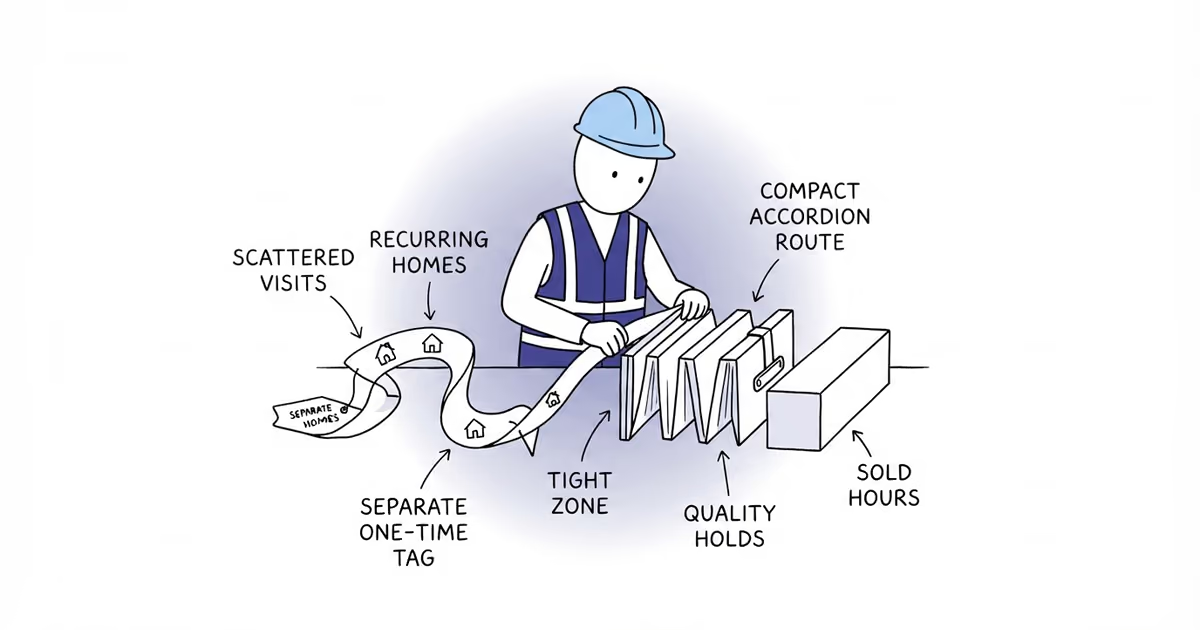
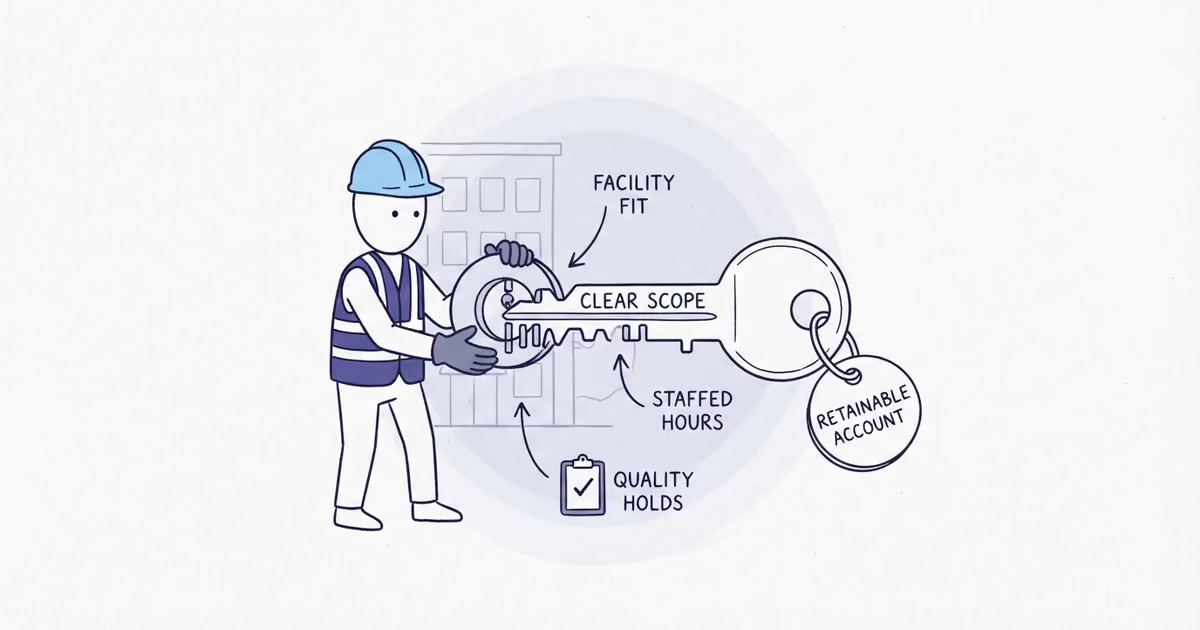
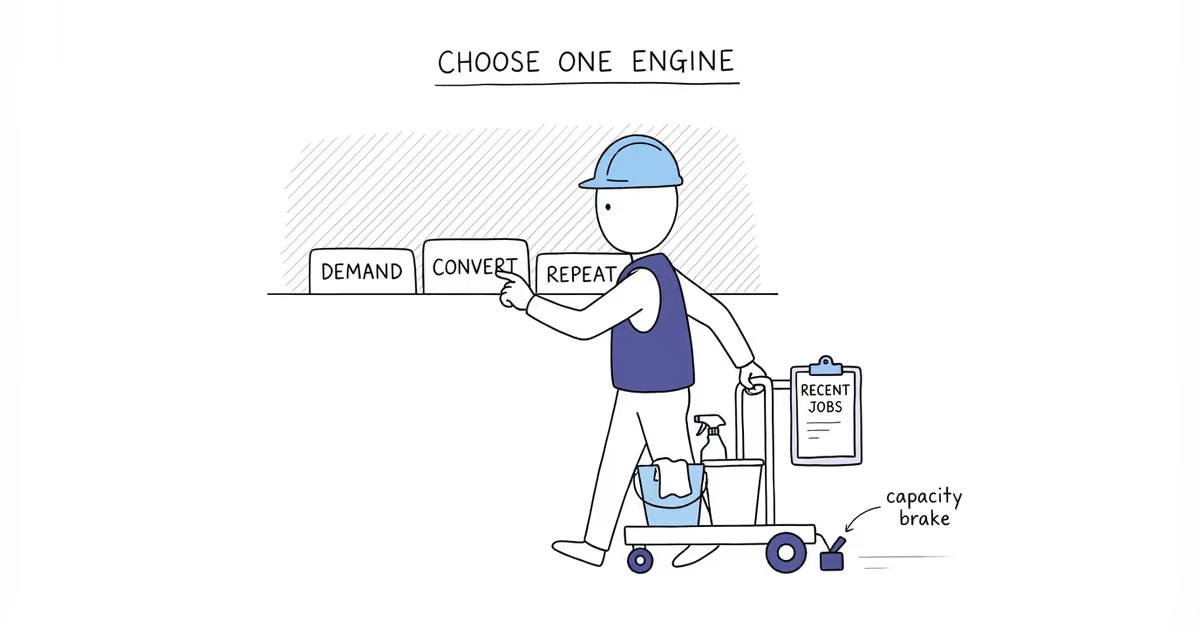
Grow a house cleaning business by stacking recurring households into tight service zones, keeping those customers through consistent work, and adding cleaner capacity only when recurring hours are already sold or have a committed start date. A calendar full of scattered one-time cleans is busy. It is not a stable recurring route.
Last verified: August 28, 2026 (US).
Track four house-cleaning business growth metrics
Use one 13-week paper sheet or spreadsheet. Show standing visits by zone and service day, open recurring slots, committed starts, and available crew hours. Keep first cleans, deep cleans, and move-in or move-out work visible in a separate row. They become recurring capacity only when the next visits are booked.
Put these four numbers at the top:
| Number | Formula | What it tells you |
|---|---|---|
| First-to-second booking rate | Eligible first-time household customers who book another visit / eligible first-time household customers completed | Whether first-time work is turning into repeat work |
| Recurring retention | Starting recurring households still active at period end / recurring households at period start | Whether quality and fit are keeping routes full |
| Route density | Cleaning hours / total paid crew hours for that route day, including drive time between homes | Which service days lose the most paid time to travel |
| Capacity fill | Recurring cleaning hours booked for the next four weeks / recurring crew hours made available for those weeks | Whether recurring work, rather than hoped-for leads, supports more capacity |
Set eligibility rules first; a move-out customer who left the area may not qualify for a second booking. Handle declared temporary pauses the same way every time when calculating retention. These are internal operating measures, not industry benchmarks. Compare your own route days and periods.
Build the offer, routes, and quality baseline in Days 1-14
Start with one recurring offer that a customer and a cleaner can both understand. Write down:
- What a standard recurring visit includes.
- What requires a first clean, deep clean, or paid add-on.
- Which weekly, biweekly, or other standing frequencies you can support.
- How customers provide access and what pet notes the crew needs.
- How rescheduling works and when payment is due.
- Which standing slots are actually available by zone and day.
Do not use a recurring discount until you have checked the real job cost and margin. A standing schedule should create predictable work, not hide a weak route.
Map every active recurring household. Draw a few zones that reflect where you really work, then assign each zone to one or more service days. Fill a zone and day before opening another. When a new household is flexible, offer the nearest viable standing slot instead of placing it wherever the calendar looks empty.
Route density is not a target copied from another company. If Tuesday has five hours of cleaning inside seven paid crew hours and Thursday has five hours inside nine, Thursday is the route to examine. Look at gaps, drive time, and slot placement before widening the service area.
Quality has to be visible on the same board. Create one room-by-room standard, keep access and home notes with each customer, and make the cleaner handoff clear. After a visit, use a short check-in that gives the customer an easy way to report a missed item. Assign one person to acknowledge the issue, arrange the appropriate recovery, confirm completion, and record the cause.
Use reason codes for callbacks, re-cleans, pauses, and cancellations. Review them weekly. More leads will not grow the route if preventable quality failures keep emptying it.
Audit the Google Business Profile, real service-area pages, household answers, photo permissions, and current reviews while building the baseline. By day 14, the board should show the recurring offer, active households, target zones, open slots, available hours, baseline metrics, quality standard, and recovery owner.
Turn finished cleans into standing visits in Days 15-30
Do not wait several weeks to ask a satisfied first-time customer about recurring service. Once the clean is complete, confirm that the work met the agreed scope, then offer two real standing slots. Book the next date while the service is still fresh. If the customer needs time, set one follow-up and record the answer.
If the standing offer is ready but the reminder and booking path is not, the customer rebooking guide helps turn a legitimate next-service trigger into a confirmed booking or request-for-review workflow.
Use a plain offer:
Hi [Name], I wanted to confirm today’s clean met the scope we agreed. If you would like to keep the home on a standing schedule, I currently have [day/time option 1] or [day/time option 2] available for [frequency]. Would either work for your next visit?
Do not force deep cleans and move-out cleans into the recurring model. The customer, home, frequency, scope, and route still have to fit. Record accepted, declined, not ready, or follow-up due instead of leaving the lead in an undefined message thread.
Next, work the past-customer list by target zone. Reference only the service you actually completed and offer only slots you can honor:
Hi [Name], we last cleaned your home on [date/service]. I have an opening in your area on [option 1] and [option 2]. If you would like another clean, I can confirm the scope and see whether either slot fits. No problem if you do not need one right now.
Ask current customers for nearby introductions without turning the request into pressure or a rating ask:
We are filling a few standing spots in this area. If a neighbor asks who cleans your home, you are welcome to share our details. There is no obligation, and I will confirm their scope and schedule separately.
Prioritize responses near the route you are filling. A distant referral can be a good household and still be the wrong next booking for the current route. No incentive is required.
Set the review workflow now. Choose a neutral eligibility rule, such as asking after a completed first clean or at a defined point in a recurring relationship. Apply it without selecting only customers expected to be positive. Do not ask for a specific rating, offer an incentive for positive sentiment, or ask a recurring customer after every visit. Make the review link easy to use, reply professionally, and move any service complaint into recovery.
If the team needs that eligibility rule, request timing, link, and response ownership set up as one repeatable process, ShiftFlow’s Google review management can put the workflow in place.
By day 30, first-time customers should have a recorded standing-schedule outcome, the past-customer list should be worked by zone, and every open recurring slot should have a day, zone, and available hours. Review cancellations, callbacks, and recoveries every week.
Fill one house-cleaning route with local SEO in Days 31-60
Local discovery should send suitable households into the route plan, not create a separate marketing project.
Keep the Google Business Profile aligned with the real business. Use the actual name, a small set of accurate categories, current hours, correct contact information, and the residential service area you truly cover. Add real work photos only with permission. Google says complete information, accurate service areas, photos, and reviews can help customers understand and find a local business. None of those fields guarantees a Maps position or a lead.
Create a useful recurring house-cleaning page and service-area pages only for places you genuinely serve. Answer the questions households ask before booking:
- What is included in a recurring visit?
- When is a first or deep clean needed?
- What products does the company use?
- How are pets, access, keys, and alarms handled?
- What happens when a customer needs to reschedule?
- Which frequencies and standing slots are available?
Use direct answers backed by your real process, photos, and customer evidence. Get permission before publishing anything from a home. Clear first-hand information may also make the page easier for search and answer systems to understand, but do not promise an organic ranking or an AI citation.
Respond to each suitable residential lead with the two closest real standing-slot choices. Record the source, response, first-clean booking, target zone, and standing-schedule outcome. If intake is slow or vague, repair it before paying to send more people into it. Consolidate the weakest route day before opening another area, and use genuine reviews from the neutral workflow as proof rather than as a target count.
By day 60, the chosen zone should have accurate local information, useful household answers, permissioned proof, fast intake, a neutral review process, and referrals directed toward real openings.
Improve retention and decide when to hire in Days 61-90
Now compare route days using your own baseline. Start with the weakest-density day. See whether open slots can be filled in that zone, flexible customers can move to a closer viable day, or scattered one-time work is disguising an empty recurring route. Keep customer promises intact. The goal is less paid driving between homes, not constant rescheduling.
Review every recurring loss by reason. Separate price, schedule, move, temporary pause, service mismatch, communication failure, and quality failure. If retention falls or callbacks rise, pause expansion, repair the handoff or recovery process, and adjust the room checklist when a repeated cause shows the standard is unclear.
Then apply the sold-work hiring gate. Add cleaner capacity only when all of these are true:
- Booked recurring work plus committed recurring start dates form a practical block of work.
- Existing routes cannot absorb that block with current recurring capacity.
- The business can fund onboarding before the new work is collected.
- The room standard, home notes, cleaner handoff, quality check, and recovery owner are ready.
- The owner can supervise the new capacity without abandoning intake or existing customers.
Keep one-time hours separate when calculating capacity fill. A busy week of deep cleans does not prove that a new cleaner has a standing route. Capacity fill is a planning ratio, not a universal hiring threshold.
At day 90, make a written decision: hire, defer the hire, keep filling the current route, change which slots are offered, or review price after checking job cost and margin. Do not hire for leads you hope to generate later.
Use a weekly house-cleaning scorecard to choose the next action
Review the board on the same day each week. Track:
- Qualified residential leads by source and whether they received a useful response.
- First-clean bookings and first-to-second booking rate.
- Active recurring households and recurring hours or revenue booked for the next four weeks.
- Recurring retention, pauses, and cancellations with reason codes.
- Route density by service day, including paid drive time.
- Callbacks, re-cleans, recovery owner, and repeated causes.
- Neutral review requests and resulting reviews.
- Open standing slots by zone and capacity fill for the next four weeks.
Use the bottleneck to choose the work:
- If first-to-second booking is weak, fix the standing offer, slot choices, follow-up, or first-clean experience before adding leads.
- If retention falls or callbacks rise, repair quality and recovery before filling more slots.
- If one route day is much less dense, fill or consolidate that route before opening a wider area.
- If capacity looks tight only because of one-time work, reshape the calendar instead of calling it recurring hiring demand.
- Hire only when sold or committed recurring hours, cash, onboarding, quality, and supervision pass the gate together.
Frequently asked questions about growing a house cleaning business
Can I use this plan to grow a commercial cleaning business?
No. Residential house cleaning is built around household schedules, compact home routes, and repeat visits. Commercial cleaning uses different buyers, bids, contracts, staffing patterns, access requirements, and retention systems, so it needs a separate growth plan.
Should I discount recurring house cleaning to win more customers?
There is no universal recurring discount. Check the real job cost, route impact, scope, and margin before changing the price. A standing schedule should improve predictability without turning a poorly priced job into a permanent commitment.
Sources
- Google: Tips to improve your local ranking
- Google: Manage service areas
- Google: Manage Business Profile categories
- Google: Get more reviews
- FTC: Soliciting and Paying for Online Reviews
- Google Search Central: Creating helpful, reliable, people-first content
What not to do while growing a house cleaning business
Do not open a second city, spread the service area, chase commercial bids, add unrelated specialty services, hire for hypothetical demand, send paid traffic into slow intake, or offer a recurring discount that has not been checked against real job cost and margin. Fill the current residential route, hold the quality standard, and let sold recurring work determine the next move.
- local-seo-foundations
- how-to-grow-a-house-cleaning-business
- how-do-i-grow-a-house-cleaning-business
- recurring-house-cleaning-customers
- house-cleaning-route-density
- house-cleaning-customer-retention
- when-to-hire-another-cleaner