
Employee Performance Reviews: How to Conduct Them
95% of managers are dissatisfied with performance reviews. Learn how to conduct effective reviews, what to include (with templates), common mistakes to avoid, and modern alternatives to annual cycles.
What Is an Employee Performance Review?
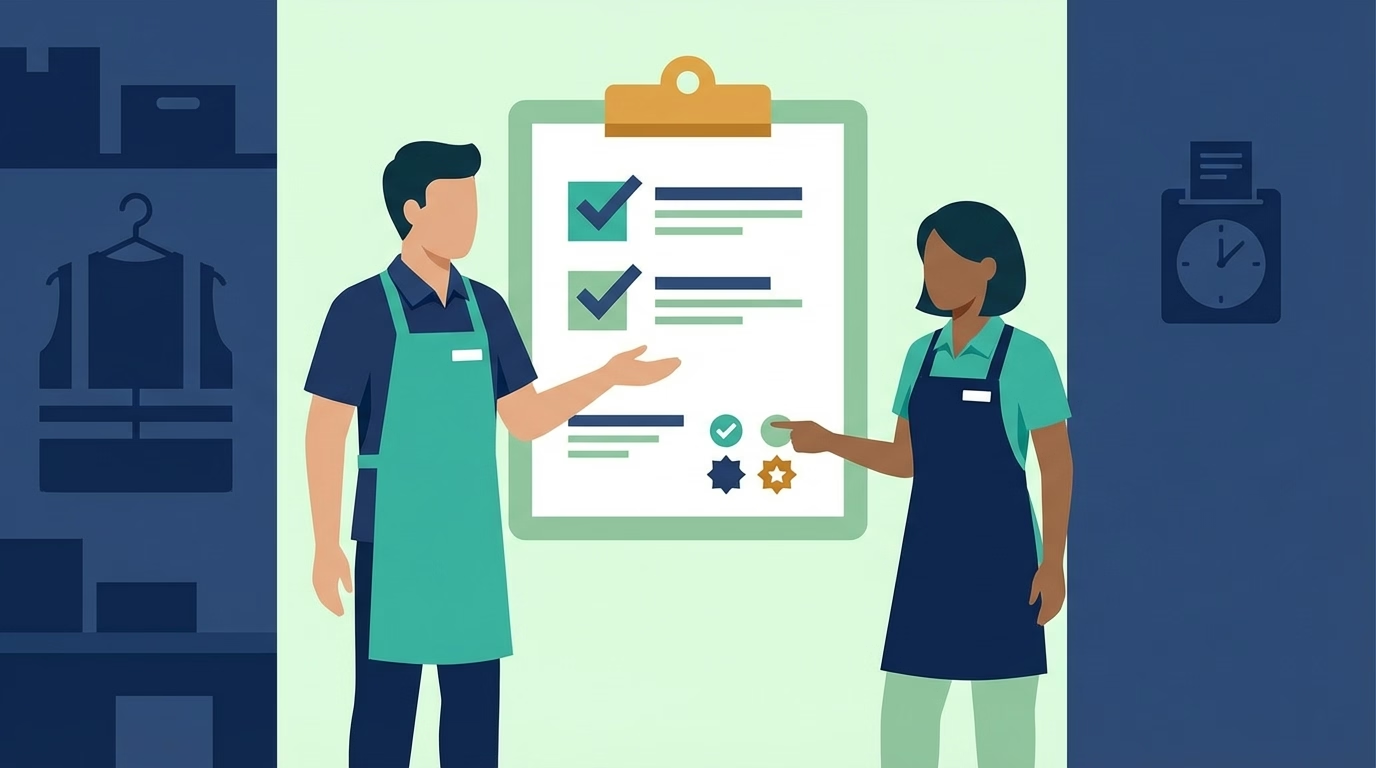
An employee performance review (also called a performance appraisal or eval) is a structured process where a manager sits down with an employee to assess job performance, provide feedback, set goals, and discuss career development. In theory, it’s a valuable conversation. In practice? Most people dread them.
Performance reviews have evolved significantly by 2026. Traditional annual reviews still exist—usually at companies that haven’t gotten the memo—but leading organizations have shifted to continuous performance management: quarterly formal reviews combined with monthly or bi-weekly one-on-ones for ongoing feedback.
But here’s the uncomfortable truth: Despite this evolution, Gallup research shows only 14% of employees strongly agree that performance reviews inspire them to improve. And 95% of managers remain dissatisfied with their review processes.
Why the disconnect? Many companies still cling to outdated approaches—rigid annual cycles that surprise employees with feedback they should have heard months ago, forced rankings that pit teammates against each other, ratings disconnected from actual skills or contribution. They haven’t adapted to how work actually happens in 2026: fluid, collaborative, and fast-moving.
Quick Answer
Employee performance reviews are scheduled evaluations where managers assess job performance, provide feedback, and set future goals. Effective reviews use specific examples, two-way dialogue, and ongoing documentation rather than once-a-year surprises. Frequency is shifting from annual to quarterly or continuous feedback.
Why Do Companies Conduct Performance Reviews?
Provide Structured Feedback
Without formal reviews, feedback becomes sporadic and inconsistent. Some managers give frequent input; others avoid difficult conversations until problems escalate.
Reviews create accountability for managers to deliver feedback and for employees to receive it.
Document Performance for Legal Protection
Performance reviews create paper trails documenting employee performance, goals set, feedback given, and improvement plans. This documentation protects organizations in wrongful termination lawsuits or discrimination claims.
If you terminate an employee for poor performance but have no documented reviews showing you communicated concerns and gave opportunities to improve, you’re legally vulnerable.
Make Compensation and Promotion Decisions
Many companies tie raises, bonuses, and promotions to performance review ratings. Reviews provide (theoretically) objective data to justify compensation decisions.
Without reviews, compensation decisions can appear arbitrary or biased.
Identify Development Needs
Reviews surface skill gaps and training needs. If multiple employees struggle with the same competency, that signals a training or process problem requiring organizational attention.
Reviews also help employees articulate career goals and map development paths.
Align Individual Work with Organizational Goals
Effective reviews connect daily work to company objectives. They answer: “How does your work contribute to what the organization is trying to achieve?”
This alignment helps employees understand priorities and focus effort on high-impact activities.
What Should a Performance Review Include?
Evaluation Against Clear Criteria
Don’t evaluate on vague impressions. Assess performance against:
- Goals and objectives set during the previous review period (use SMART goals: Specific, Measurable, Achievable, Relevant, Time-bound)
- Core competencies for the role (technical skills, communication, teamwork, problem-solving)
- Job responsibilities from the position description
- Behavioral expectations (attendance, professionalism, adherence to policies)
Each criterion should have clear standards defining what “meets expectations,” “exceeds expectations,” and “needs improvement” look like.
Specific Examples and Evidence
The most common complaint about performance reviews: they’re too general. “You need to improve communication” doesn’t help. “In the March project debrief, you didn’t share the budget overrun information until the client asked directly, which surprised the team” is actionable.
Document specific examples of performance—both positive and negative—throughout the year so reviews reference concrete incidents, not vague feelings.
Two-Way Dialogue
Performance reviews shouldn’t be monologues where managers talk and employees listen. Build in time for employees to:
- Share their perspective on their performance
- Discuss challenges they faced
- Identify resources or support they need
- Express career goals and interests
Research from Harvard Business Review shows that employees who feel heard during reviews have higher engagement and retention—even when the feedback itself is critical.
Recognition of Accomplishments
Don’t focus exclusively on problems. Acknowledge what employees did well, projects they completed successfully, and contributions they made.
Recognition during reviews reinforces positive behaviors and shows you notice good work, not just mistakes.
Clear Goals for the Next Period
Reviews should end with clarity about what success looks like moving forward. Set 3-5 specific, measurable goals for the next review period.
Poor goal: “Improve customer service”
Strong goal: “Achieve customer satisfaction score of 4.5/5.0 or higher on post-service surveys by Q2, with no more than one escalated complaint per month”
Development Plan
Discuss how the employee will develop skills, address gaps, or prepare for future roles. Identify:
- Training or certifications needed
- Stretch assignments or projects
- Mentoring or shadowing opportunities
- Books, courses, or resources to explore
Development conversations signal investment in the employee’s future, improving retention.

How Do You Conduct an Effective Performance Review?
Step 1: Prepare Thoroughly
Don’t wing performance reviews. Preparation includes:
- Review documentation: Notes from one-on-ones, project outcomes, metrics, attendance records, customer feedback, peer input
- Assess goal achievement: Compare actual results to goals set at last review
- Gather 360-degree feedback: Input from peers, direct reports (if applicable), and other managers who worked with the employee
- Reflect on development: Consider growth over the review period, not just recent performance (avoid recency bias)
Managers should spend 2-4 hours preparing for each performance review to ensure thorough, fair evaluations.
Step 2: Schedule Adequate Time
Don’t rush performance reviews between meetings. Schedule 60-90 minutes per review to allow for discussion, questions, and dialogue.
Give employees advance notice—at least one week—and encourage them to prepare by reflecting on their own performance and goals.
Step 3: Create a Comfortable Environment
Choose a private, quiet space where you won’t be interrupted. Sit beside the employee rather than across a desk (removes psychological barrier).
Start by explaining the review structure and emphasizing that it’s a conversation, not a lecture.
Step 4: Start with the Employee’s Self-Assessment
Ask the employee to share their perspective first: “How do you think this review period went? What are you most proud of? Where did you face challenges?”
This surfaces their awareness of strengths and weaknesses and makes them active participants rather than passive recipients of judgment.
Step 5: Discuss Performance Using Specific Examples
Walk through each evaluation criterion with concrete examples. Use the structure:
- What happened: Specific situation or behavior
- Impact: How it affected outcomes, team, or customers
- Assessment: Whether this met, exceeded, or fell short of expectations
For critical feedback, use the SBI model (Situation-Behavior-Impact):
- Situation: “In the January client meeting…”
- Behavior: “…you interrupted the client multiple times…”
- Impact: “…which made them visibly frustrated and they cut the meeting short.”
Avoid generalized criticism like “you’re unprofessional” or “you have a bad attitude.” Describe observable behaviors.
Step 6: Discuss Development and Future Goals
Shift from evaluating the past to planning the future:
- “What skills do you want to develop?”
- “What projects interest you?”
- “What support do you need from me?”
Set clear, measurable goals for the next review period and document the development plan.
Step 7: Allow Time for Questions and Reactions
After sharing feedback and discussing goals, pause and ask: “What questions do you have? How are you feeling about this conversation?”
Employees may need time to process critical feedback. Don’t expect immediate agreement—just acknowledgment that they heard and understood.
Step 8: Document Everything
Write up the performance review within 24 hours while details are fresh. Include:
- Ratings or assessments for each criterion
- Specific examples discussed
- Goals set for next period
- Development plan
- Employee comments or disagreements
Both manager and employee should sign the document. Signature means “I received this,” not necessarily “I agree with everything in it.”
What Are Common Performance Review Mistakes?
The Recency Effect
Managers over-weight recent performance and forget what happened earlier in the review period. An employee might excel for 11 months but make a mistake in month 12, and the review focuses on that one mistake.
Solution: Take notes throughout the year. Review notes from all months when preparing evaluations.
Avoiding Difficult Conversations
Managers give inflated ratings to avoid confrontation. This creates two problems:
- Employees don’t know they need to improve
- If you later terminate them for poor performance, documentation shows positive reviews—which undermines your legal position
Solution: Be direct but respectful. Critical feedback delivered professionally is a gift—it gives employees a chance to improve.
No Surprises Rule Violation
If the first time an employee hears about a performance problem is during their annual review, you’ve failed as a manager. Performance issues should be addressed immediately, not saved up for reviews.
Solution: Use regular one-on-ones for ongoing feedback. Reviews should summarize what’s already been discussed, not introduce new concerns.
Focusing Only on Weaknesses
Reviews that list everything wrong without acknowledging accomplishments are demoralizing and ineffective. Employees tune out after the third criticism.
Solution: Balance feedback. Start with strengths, discuss areas for development, then end with encouragement and clarity about next steps.
Comparing Employees to Each Other
“Sarah handles customer complaints better than you” creates resentment and doesn’t provide actionable guidance.
Solution: Evaluate each employee against the standards for their role, not against other employees.
Vague Feedback
“You need to be more proactive” or “your attitude needs work” doesn’t tell employees what to change.
Solution: Describe specific behaviors and desired changes. “I’d like you to raise potential problems during planning meetings before we commit to deadlines, rather than flagging them after schedules are set.”
How Performance Reviews Are Changing in 2026
Continuous Performance Management (Now Mainstream)
By 2026, continuous performance management has moved from cutting-edge to standard practice at forward-thinking organizations:
- Weekly or bi-weekly one-on-ones for real-time feedback and coaching
- Project-based reviews immediately following major deliverables
- Monthly goal check-ins using OKR or similar frameworks
- Quarterly structured reviews (30-45 minutes vs. traditional 90-minute annual marathons)
Companies like Adobe, Deloitte, and GE pioneered this shift. By 2026, mid-market companies are increasingly adopting similar models, enabled by performance management platforms that make frequent feedback scalable.
Skills-Based Performance Reviews (2026 Trend)
As organizations shift to skills-based talent models, reviews increasingly focus on competency progression rather than role-based ratings:
- Performance evaluated against skill requirements for current and target roles
- Skills assessments integrated into review cycles
- Development plans mapped to specific skills gaps
- Transparent skills pathways showing progression from current to desired competencies
This approach aligns reviews with career mobility and internal talent marketplace models.
360-Degree Feedback
Rather than only manager evaluation, 360-degree reviews collect input from:
- Direct manager
- Peers and colleagues
- Direct reports (if applicable)
- Customers or stakeholders
- Self-assessment
Multiple perspectives provide more complete pictures of performance and reduce individual bias. However, 360 reviews are time-intensive and can feel overwhelming if feedback isn’t aggregated and summarized effectively.
OKRs (Objectives and Key Results)
Popularized by Google, OKRs are a goal-setting framework separate from performance evaluation. Employees set ambitious objectives and measurable key results, reviewed quarterly.
OKRs focus on forward-looking goals rather than backward-looking evaluation. Some companies use OKRs for goal-setting but still conduct separate performance reviews; others replace reviews entirely with OKR check-ins.
Skills-Based Assessments
Instead of rating overall performance, focus on specific skills and competencies. Use skills matrices showing proficiency levels (beginner, intermediate, advanced, expert) for each required skill.
Skills-based assessments work well for technical roles and trades where competencies are clearly defined.

How Do Different Industries Approach Performance Reviews?
Corporate and Office Environments
Typically use annual or bi-annual formal reviews with structured rating scales (1-5 or “exceeds/meets/needs improvement”). Often tied to compensation decisions and promotion eligibility.
Increasing adoption of quarterly check-ins and continuous feedback models.
Healthcare
Focus on clinical competencies and patient safety metrics. Many healthcare organizations use skills checklists and peer review processes.
Reviews often connect to credentialing and privileging requirements for licensed professionals.
Retail and Hospitality
More frequent turnover leads to shorter review cycles—often 90-day reviews for new hires, then quarterly or semi-annual thereafter.
Performance heavily tied to observable metrics: sales, customer feedback scores, attendance tracked through time tracking systems, and mystery shopper results.
Manufacturing and Trades
Emphasis on safety, quality, and productivity metrics. Reviews assess technical skills, adherence to standard operating procedures, and safety record.
Often use competency-based assessments tied to advancement through skill levels or pay grades.
Startups and Tech Companies
Moving away from traditional reviews toward continuous feedback and OKR models. Many avoid numerical ratings, focusing instead on narrative feedback and development conversations.
More frequent manager-employee check-ins (weekly or bi-weekly) replace annual reviews.
What’s the Bottom Line?
Performance reviews serve important purposes—feedback, documentation, goal-setting, development planning—but traditional annual reviews often fail to deliver these benefits effectively.
The key to effective performance reviews:
- Frequency: More frequent, shorter reviews beat annual marathons
- Specificity: Concrete examples trump vague assessments
- Dialogue: Two-way conversations beat one-way lectures
- Ongoing documentation: Year-round notes beat memory-based evaluations
- Forward focus: Development plans and future goals matter more than dwelling on past mistakes
If your organization still uses traditional annual reviews, you can improve them by incorporating these principles. If you’re building a performance management system from scratch, consider continuous feedback models supplemented by quarterly formal reviews.
Performance reviews done well improve employee development and engagement. Done poorly, they’re bureaucratic exercises everyone dreads that produce no meaningful change.
Looking for tools to track team performance and goal progress? Explore ShiftFlow’s workforce management solutions or see pricing for your team size.
Sources
- Gallup – Moving Beyond Annual Performance Reviews
- Harvard Business Review – The Performance Management Revolution
- AIHR – Skills Matrix Guide
- Society for Human Resource Management – Performance Management
Further Reading
- Employee Evaluation Methods and Best Practices – Comprehensive approaches to assessing employee performance
- Training Effectiveness: Measuring Development Impact – How to evaluate whether training improved performance
- Workforce Management: Optimizing Team Performance – Broader strategies for managing frontline teams
Frequently Asked Questions
What is an employee performance review?
An employee performance review is a structured evaluation process where a manager assesses an employee’s job performance against goals and expectations, provides feedback on strengths and areas for improvement, and discusses development plans and future objectives.
How often should performance reviews be conducted?
Traditional annual reviews are being replaced by more frequent check-ins. Best practices in 2026 include quarterly formal reviews supplemented by monthly or bi-weekly one-on-one meetings for ongoing feedback. Frequency should match business pace and employee needs.
What should be included in a performance review?
Effective reviews include: assessment of goals achieved, evaluation of core competencies and job responsibilities, specific examples of performance (positive and negative), feedback from multiple sources, discussion of career development, and clear objectives for the next review period.
How long should a performance review take?
Schedule 60-90 minutes for each performance review meeting to allow thorough discussion. Managers should spend 2-4 hours preparing for each review. Rushing reviews produces superficial evaluations that don’t improve performance.
What is the difference between a performance review and an employee evaluation?
The terms are often used interchangeably. Employee evaluation is the broader category encompassing various assessment methods. Performance review typically refers to the specific periodic meeting where manager and employee discuss performance. Some organizations use “evaluation” for the formal annual process and “review” for informal check-ins.
Can performance reviews be used for termination decisions?
Yes. Performance reviews create documentation of performance issues, feedback given, improvement opportunities provided, and progress (or lack thereof). This documentation is critical for defending termination decisions. However, reviews shouldn’t be the only documentation—ongoing notes from one-on-ones and performance improvement plans are also important.
What is 360-degree feedback?
360-degree feedback collects performance input from multiple sources: the employee’s manager, peers, direct reports (if applicable), and sometimes customers or stakeholders, plus self-assessment. It provides more complete performance pictures than manager-only reviews but is more time-intensive.
How do you give negative feedback in a performance review?
Use specific examples (SBI model: Situation-Behavior-Impact), describe observable behaviors rather than personality traits, focus on impact, and offer clear guidance for improvement. Deliver critical feedback respectfully and professionally, and balance it with recognition of strengths. No surprises—performance issues should have been discussed before the formal review.
- performance-review
- employee-evaluation
- performance-management
- employee-feedback
- 360-review
- annual-review
- performance-appraisal