What Is a Firefighter Schedule in 2026?
Firefighters work 24/48 schedules (24 hours on, 48 off) or 48/96 schedules averaging 56 hours weekly. Learn about Kelly days, sleep deprivation concerns, FLSA overtime exemptions allowing 212 hours per 28 days, and 2026 NFPA 1010 standards.
What Is a Firefighter Schedule in 2026?
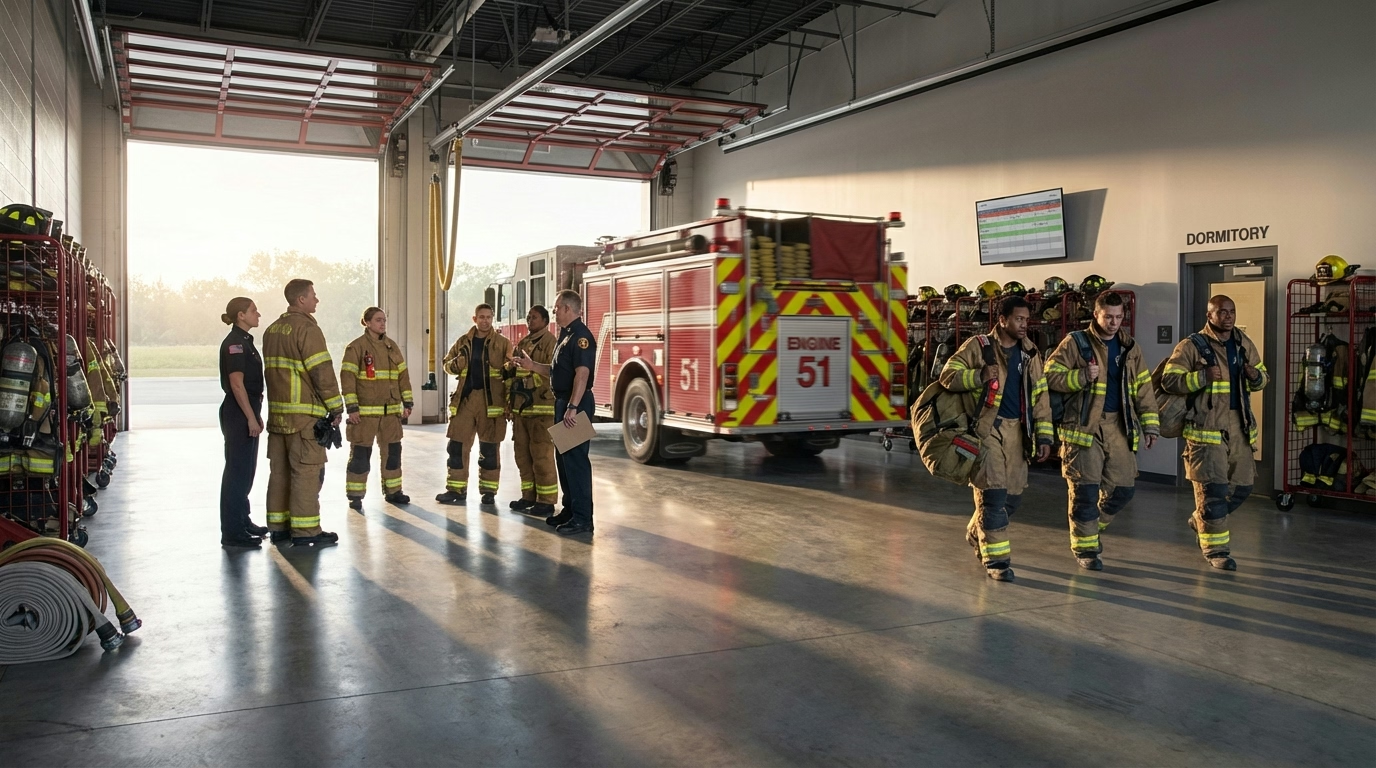
A firefighter schedule is built around providing 24/7 coverage with shift patterns that keep firefighters at the station for extended periods. The most common is the 24/48 schedule—24 hours on duty, 48 hours off. Firefighters live at the station during their shift, sleep there (when not responding to calls), eat there, and essentially treat it as home for that 24-hour period.
The schedule averages about 56 hours per week—significantly more than a standard 40-hour workweek. And here’s something unique: Congress allows firefighters to work 53 hours per week (212 hours in a 28-day cycle) without triggering overtime under FLSA. Firefighting is the only profession with this special exception.
Quick Answer
Firefighters typically work 24/48 schedules (24 hours on, 48 hours off) or 48/96 schedules (48 on, 96 off), averaging 56 hours weekly. The 24/48 is most common. FLSA allows 212 hours per 28-day cycle before overtime—an exception unique to firefighters. Kelly days provide extra rest every ninth day. Staffing challenges affect 72% of fire departments in 2026. NFPA 1010 consolidates training standards effective June 1, 2026.
What Is a 24/48 Schedule?
Most fire departments run on the 24/48 schedule. You show up at 8 AM Monday and don’t leave until 8 AM Tuesday. Twenty-four straight hours at the station. When the alarm goes off at 2 AM, you go. Between calls, you’re sleeping, eating, training, maintaining gear—basically living there.
Then you get 48 hours off. Tuesday 8 AM to Thursday 8 AM, you’re home. Sleep in your own bed, see your family, catch up on life. Thursday morning, you’re back for another 24.
The rotation keeps cycling. Work Monday, then Thursday, then Sunday, then Wednesday. The days shift constantly—you’re never on the same weekly pattern.
Why stick with 24-hour stretches? Crew continuity matters when lives are on the line. The team that starts the shift together stays together. You know your teammates, your equipment, your truck inside and out. No confused handoffs in the middle of an active fire.
Do the math and it averages 56 hours per week. That’s 2,912 hours annually compared to the standard 2,080-hour year. Firefighters clock an extra 832 hours just from their regular schedule—essentially built-in overtime that doesn’t count as overtime.
What Is a 48/96 Schedule?
The 48/96 is becoming more popular, though it’s not for everyone.
You work 48 straight hours—basically two 24-hour shifts back-to-back. Show up Monday 8 AM, don’t go home until Wednesday 8 AM. Sleep at the station two nights running.
Then you get 96 hours off. Four full days—Wednesday 8 AM through Sunday 8 AM—completely free.
The appeal is obvious: double the number of 4-day weekends compared to 24/48. Those long breaks let you actually recover from sleep deprivation, travel somewhere, spend real time with family, or pick up side work. If your commute sucks, cutting your trips to the station by half is huge.
The catch: Two consecutive 24-hour shifts mean potential for serious sleep deprivation. If you get one call during the night of the first shift, you typically start day two with only mild sleep deprivation. But if you’re at a busy station with two or more calls each night without rest opportunity, cognitive fatigue by the end of that 48-hour stretch is real.
Call volume matters: Busy stations averaging more than three calls per night should not use 48/96 schedules. The accumulated fatigue becomes a safety issue. This schedule works best for moderate-volume stations where firefighters can actually sleep between calls.
Staffing limitation: You can’t easily fill the second shift during major or extended incidents. If a wildfire or building collapse requires all-hands response, you’ve just exhausted your entire shift for two days. With 24/48, relief is only 24 hours away.
24/48 vs 48/96: Side-by-Side Comparison
Here’s how the two main firefighter schedules compare:
| Factor | 24/48 Schedule | 48/96 Schedule |
|---|---|---|
| On-duty time | 24 hours continuous | 48 hours continuous (two 24-hour shifts back-to-back) |
| Off-duty time | 48 hours (2 days) | 96 hours (4 days) |
| Work pattern | Work 1 day, off 2 days | Work 2 days, off 4 days |
| Days worked per week | Approximately 2-3 | Approximately 1-2 |
| Average hours/week | 56 hours | 56 hours |
| Extended time off blocks | 48-hour blocks | 96-hour blocks (100% more 4-day weekends) |
| Sleep deprivation risk | Moderate (one night of disrupted sleep) | High if busy (two consecutive nights) |
| Best for stations with | Any call volume | Low to moderate volume ( less than 3 calls/night) |
| Recovery time | 2 days before next shift | 4 days before next shift |
| Commute frequency | Higher (more days at work per month) | Lower (fewer trips to station) |
| Shift relief during incidents | 24 hours away | 48 hours away (harder to cover extended emergencies) |
| Adaptation period | Standard transition | Requires time to adjust to 48-hour stretches |
| Family/personal life | Shorter but more frequent time off | Longer uninterrupted personal time |
| Fatigue by end of shift | Moderate (24 hours) | Potentially severe (48 hours at busy stations) |
| Recruiting appeal | Traditional standard | Attractive for work-life balance seekers |
| Kelly day frequency | Every 9th day typically | Varies by department implementation |
Bottom line: 24/48 is safer and more flexible for most departments. 48/96 works well for lower-volume stations and appeals to firefighters who value extended personal time, but creates serious fatigue risks at busy stations.

What Are Kelly Days?
Kelly days are an extra day off built into the 28-day work cycle. Named after Lieutenant Colonel William H. Kelly who implemented them in the 1960s, they serve a specific purpose: keeping firefighter work hours compliant with FLSA limits.
Remember, FLSA allows firefighters to work 212 hours in a 28-day cycle before overtime kicks in. A pure 24/48 schedule without Kelly days puts you over that limit. Kelly days bring you back into compliance.
How often: Typically every ninth day in a 24/48 schedule (some departments: every seventh tour or every three weeks). The exact frequency depends on how the department structures the work cycle.
The result: You get a day off that breaks up the rotation, giving you an extra 24 hours of rest. It’s not just a nice benefit—it’s mathematically necessary to avoid paying constant overtime under FLSA rules.
What Are the Sleep Deprivation Concerns?
Here’s the elephant in the room: firefighters are chronically sleep-deprived.
You can’t guarantee uninterrupted sleep at the station. Even if you go to bed at 11 PM, an alarm at 2 AM wakes everyone up for a call. You spend an hour on scene, get back to the station at 3:30 AM, fall back asleep by 4 AM, and then the next call comes at 5 AM. Repeat throughout the night. Some nights you get lucky and sleep through. Other nights you barely sleep at all.
Chronic sleep deprivation increases health risks: hypertension, cancer, ulcers, heart attack, and stroke. This isn’t just “firefighting is dangerous” risk—this is “the schedule itself damages your health” risk. Studies identify sleep deprivation as significantly the most recurring disadvantage of shift work for firefighters.
Cognitive performance suffers. Sleep-deprived firefighters make slower decisions, miss details, have worse situational awareness. In a profession where seconds matter and lives are at stake, cognitive fatigue is dangerous.
The 48/96 advantage: With longer rest periods between shifts, firefighters have more recovery time. If you’re sleep-deprived after a tough shift, you’ve got four full days to catch up before the next one. With 24/48, you only get two days off—and if your next shift is another rough one, the deficit accumulates.
The 48/96 disadvantage: Two consecutive nights of broken sleep can leave you dangerously fatigued by the end of a 48-hour shift, especially at busy stations.
What Are the Staffing Challenges in 2026?
Fire departments can’t find enough people. It’s that simple.
72% of public safety professionals point to hiring and staffing as their biggest headache. Nearly three-quarters of departments are scrambling to fill positions and coming up short.
Staffing has dropped to levels not seen in decades. Tight budgets, growing service demands, younger workers who want different things, rising wages in competing fields—it all adds up to a serious recruitment crisis.
Millennial workers want different things: work-life balance, emotional and physical wellbeing, diverse and inclusive workplace environments. The traditional “firefighting is a calling, not a job” approach doesn’t resonate the same way. Younger workers evaluate schedules, compensation, and quality of life carefully.
The 48/96 schedule as a recruiting tool: Some departments use 48/96 specifically to attract recruits who want more consecutive days off. That four-day block is appealing to people with families, second jobs, or who value extended personal time.
Where 48/96 doesn’t work: Departments with heavy call loads (excess of 10 per shift), frequent large-scale prolonged incidents, or existing vacancies struggle with 48/96. You simply can’t maintain adequate coverage when everyone’s exhausted after 48 hours straight.
What’s New for Firefighter Schedules in 2026?
NFPA 1010 transition effective June 1, 2026. This consolidates multiple professional qualification standards into one framework and introduces a new foundational certification level: Fire Support Person. Training and scheduling need to adapt to new certification requirements.
Recruitment strategies evolve. Departments are finally modernizing their approach—offering competitive salaries, comprehensive healthcare coverage, retirement plans, and tuition reimbursement programs. The “we’re a brotherhood, that should be enough” mentality is dying. Agencies that don’t offer attractive compensation and reasonable schedules lose recruits to departments that do.
Work-life balance becomes competitive advantage. Departments that can offer better schedules (whether that’s 48/96 for more time off or innovations like Kelly day++ models) are winning the recruitment war. Staffing is tight enough that schedule quality matters.
AI transforms training and operations. In 2026, AI serves as a force multiplier across the fire service—assisting with training, leadership development, community risk reduction, and real-time situational awareness. Virtual, augmented, and mixed-reality systems combined with digital twins let firefighters rehearse catastrophic incidents with added realism without burning fuel or risking injuries. It’s stress inoculation that actually works.
Wearables monitor firefighter safety. Passive monitoring of dangerous vital signs, 3D tracking, and augmented views in emergency conditions are seeing widespread adoption. These aren’t gimmicks—they’re tools that help incident commanders know when firefighters are in physiological distress before collapse becomes imminent.
Cross-training addresses staffing gaps. Departments are increasingly cross-training EMS and fire personnel, adjusting shift rotations, and adopting flexible deployment strategies. The goal: build sustainable teams even with fewer total personnel.
Mental health support programs expand rapidly. In 2026, 68% of fire departments now offer peer support programs specifically designed for the unique stresses of firefighting schedules, up from just 41% in 2024. More departments are providing access to therapists who understand shift work challenges, PTSD from traumatic calls, and the cumulative impact of sleep deprivation. This is driven partly by recognition that mental health issues are a major factor in the staffing crisis.
Schedule predictability technology improves. New scheduling software in 2026 uses AI to predict optimal staffing based on historical call patterns, weather forecasts, and local events. Departments using predictive staffing report better work-life balance for firefighters (fewer last-minute mandatory shifts) while maintaining adequate coverage. The technology helps avoid both understaffing and overstaffing, making schedules more stable and predictable.

What About Overtime and Pay?
The compensation picture is complicated:
FLSA exception for firefighters: Congress allows firefighters to work 212 hours in a 28-day cycle (about 53 hours per week) before overtime is required. This is unique to firefighters—no other profession gets this exemption. Why? Because 24-hour shifts inherently put you over 40 hours per week, and Congress recognized that traditional FLSA rules don’t fit the fire service model.
Kelly days keep you under the limit. Without those periodic days off, a straight 24/48 schedule exceeds 212 hours per cycle. Kelly days mathematically bring you back into compliance.
Overtime still happens regularly. When someone calls in sick, you get mandated to cover their shift. During major incidents, everyone works extended hours. Wildfire season, natural disasters, or just high call volume means many firefighters exceed even the 212-hour threshold and earn overtime at 1.5x rate.
Average hours: Full-time paid firefighters commonly work 56-hour average workweek with standard schedules. This is baked into the job and reflected in annual salary rather than hourly wages. You’re not paid hourly for those 56 hours—you’re salaried based on the schedule.
How Do You Manage Firefighter Schedules Effectively?
For fire department leaders dealing with staffing and scheduling:
Match schedule to call volume. Busy stations (more than 3 calls per night) need 24/48 or shorter shifts. Lower-volume stations can consider 48/96. Don’t implement 48/96 just because it’s trendy—analyze your actual call data.
Track fatigue and incidents. Monitor accident rates, near-misses, and injuries by shift type and time into shift. If you’re seeing patterns (more accidents at hour 40 of a 48-hour shift), adjust schedules.
Use scheduling software that understands fire service. Your needs are unique—24-hour shifts, Kelly days, FLSA’s 212-hour rule, minimum staffing per apparatus, specialty certifications. Generic employee scheduling tools don’t cut it. You need fire-specific solutions that prevent understaffing and track compliance.
Build in flexibility for major incidents. Have clear policies for shift extensions during large-scale events. Know when you’ll call in off-duty personnel versus extending current shift. Balance the risk of fatigued firefighters against the need for adequate response.
Prioritize sleep opportunities. Create station environments conducive to rest—dark sleeping areas, quiet zones, policies about when non-emergency activities can wait until morning.
Consider compression with adequate staffing. Some progressive departments experiment with compressed schedules (fewer shifts per month, but longer periods of consecutive work followed by extended recovery). This only works if you have enough personnel to sustain it.
Focus on retention as much as recruitment. Your staffing crisis isn’t just about getting new firefighters—it’s about keeping experienced ones. Schedule quality, reasonable overtime demands, and demonstrated respect for work-life balance all affect whether your senior firefighters stay or retire early.
What’s the Bottom Line?
Firefighters work 24/48 schedules (24 hours on, 48 hours off) or 48/96 schedules (48 hours on, 96 hours off), averaging 56 hours weekly. The 24/48 is most common. FLSA allows 212 hours per 28-day cycle (53 hours/week) before overtime—an exception unique to firefighters. Kelly days provide extra rest every ninth day to maintain FLSA compliance.
The quick breakdown:
- 24/48 schedule most common: 24 hours on duty, 48 hours off
- 48/96 gaining popularity: 48 hours on, 96 hours off (4-day break)
- Average 56-hour workweek (2,912 hours annually vs. 2,080 standard)
- FLSA allows 212 hours per 28 days before overtime (only profession with this exception)
- Kelly days: extra day off every 9th day to maintain compliance
- 72% of fire departments cite staffing as greatest challenge in 2026
- 48/96 only works for stations with less than 3 calls per night average
- NFPA 1010 consolidates training standards, effective June 1, 2026
- Sleep deprivation is the most recurring disadvantage of firefighter schedules
Ready to manage fire department scheduling more effectively? ShiftFlow’s scheduling tools are built for 24/7 operations, handling 24-hour shifts, Kelly days, minimum staffing requirements, and FLSA compliance for firefighters. Explore our solutions or view pricing.
Sources
- Fire Rescue 1 – Firefighter shift schedules: Is the 48/96 shift a health hazard?
- IAFF – SHIFTWORK AND FIRE FIGHTERS
- USFA – THE IMPACT OF SHIFT WORK ON FIREFIGHTERS
- BLS – Firefighters: Occupational Outlook Handbook
- Hero Schedule – Kelly Days
- Firefighter Now – What Is A Kelly Day? Explained by a Firefighter
- Alabama Fire College – NFPA 1010 Standards Consolidation
- Emergent – EMS And Fire Department Staffing Shortages
- Firefighter Nation – Engine Company Staffing & NFPA 1710/NIST Research
- Firehouse – Fire Tech Brief: 5 Fire Service Technology Trends for 2026
- Emergent – Trends in the Fire Service: How the Fire Service Is Evolving
Further Reading
- On Call Schedule Explained – Managing on-call requirements and compensation
- Working Night Shift Guide – Health impacts of overnight work
- Rotating Schedule Patterns – Managing shift rotations for 24/7 coverage
Frequently Asked Questions
What is a firefighter schedule?
Firefighters typically work 24/48 schedules (24 hours on duty, 48 hours off) or 48/96 schedules (48 hours on, 96 hours off). The 24/48 is most common, resulting in approximately 56 hours per week average. Firefighters work at the station for entire shifts, sleeping there during downtime. FLSA allows firefighters to work 212 hours in a 28-day cycle (53 hours per week) before overtime kicks in—the only profession with this exception.
What are Kelly days?
Kelly days are an extra day off in the 28-day work cycle, typically falling every ninth day in a 24/48 schedule. Named after Lieutenant Colonel William H. Kelly who implemented them in the 1960s, their goal is to reduce overtime hours and keep work hours compliant within the FLSA 212-hour window. Kelly days help departments manage staffing levels while giving firefighters additional rest.
What is a 48/96 firefighter schedule?
A 48/96 schedule means 48 hours on duty followed by 96 hours (4 days) off. Firefighters work two consecutive 24-hour shifts at the station, then get four full days off. This provides 100% more 4-day rest periods compared to 24/48, giving more time to recover from sleep deprivation. However, it only works well for stations with moderate call volume. Stations averaging more than 3 calls per night should not use 48/96 due to accumulated fatigue.
How many hours do firefighters work per week?
Firefighters average 56 hours per week with standard 24/48 or 48/96 schedules. This equals 2,912 hours annually compared to the standard 2,080-hour work year. FLSA allows firefighters to work up to 212 hours in a 28-day cycle (about 53 hours per week) before overtime pay is required. This is a special exception that applies only to firefighters—no other profession has this FLSA exemption.
Why do firefighters work 24-hour shifts?
Firefighters work 24-hour shifts to maintain crew continuity and ensure adequate 24/7 coverage. A crew that starts shift together stays together the entire 24 hours, building teamwork and familiarity with equipment and procedures. There’s no shift change confusion during active incidents. The 24-hour shift model also allows firefighters to have more consecutive days off (48 hours with 24/48 or 96 hours with 48/96) compared to traditional 8-hour shifts.
Is 48/96 better than 24/48 for firefighters?
It depends on call volume and department needs. 48/96 provides 100% more 4-day rest periods, allowing better recovery from sleep deprivation and more personal time. However, stations averaging more than 3 calls per night should not use 48/96 due to accumulated fatigue over 48 consecutive hours. 48/96 also creates staffing challenges during major incidents and doesn’t work well for departments with vacancies. 24/48 remains most common because it balances coverage, rest, and staffing flexibility.
What is NFPA 1010 and how does it affect firefighter training?
NFPA 1010, effective June 1, 2026, consolidates multiple professional qualification standards into one framework. It introduces a new foundational certification level called Fire Support Person and streamlines firefighter training standards. Fire departments need to update training programs and potentially adjust scheduling to accommodate new certification requirements. This represents the most significant change to firefighter professional standards in years.
- firefighter-schedule
- 24-48-schedule
- 48-96-schedule
- kelly-days
- firefighter-overtime
- fire-department-staffing
- shift-work