What Is an On Call Schedule in 2026?
On call schedules require employees to be available outside regular hours. Learn what on call work is, FLSA compensation rules, industries that use it, burnout rates at 77%, and 2026 compliance updates.
What Is an On Call Schedule in 2026?
An on call schedule means you’re required to be available to work outside your regular scheduled hours. You might not be actively working, but you need to respond when contacted—either coming into the workplace or handling issues remotely within a specified timeframe.
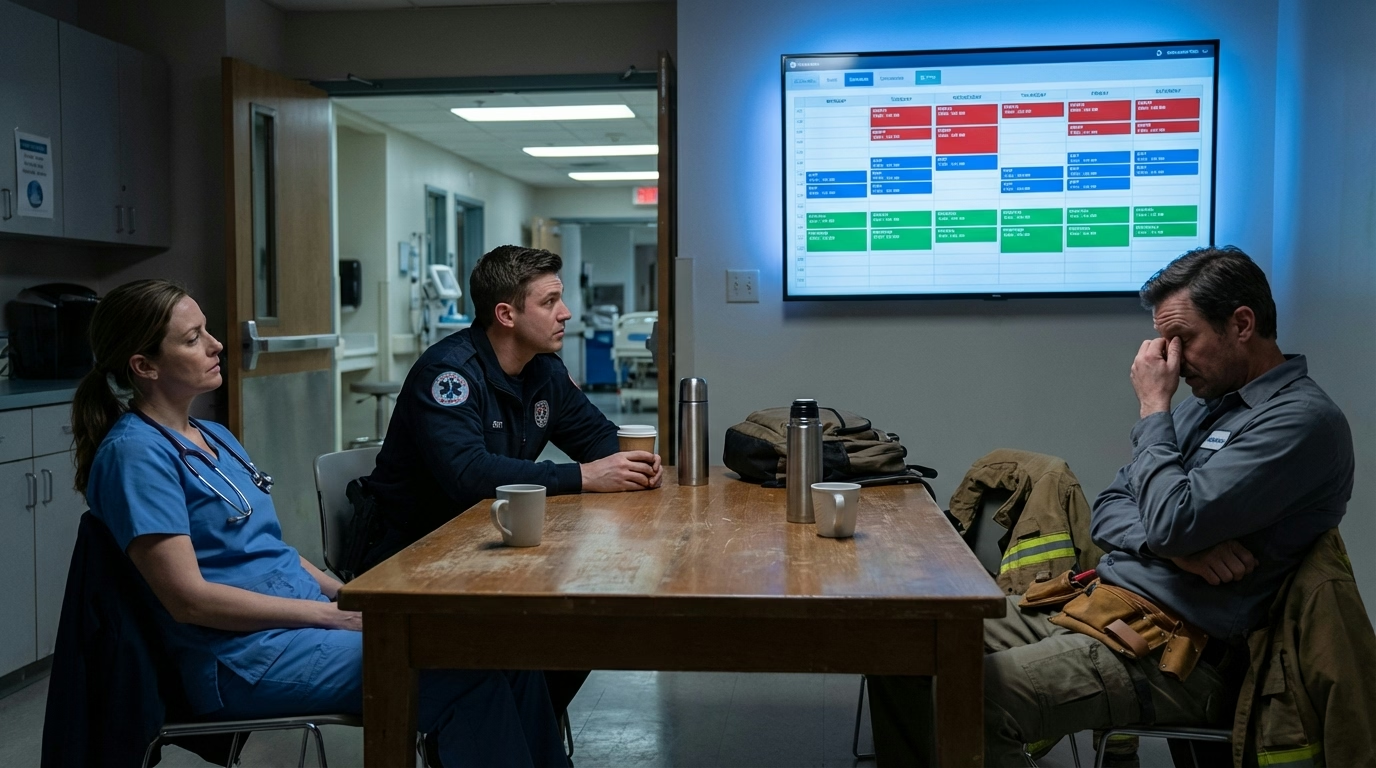
It’s more demanding than it sounds. Research shows that 49% of American and Canadian workers experience work-related stress daily, and on call demands are a major contributor. With 77% of workers reporting they’ve experienced burnout at their current job, according to Deloitte, the “always available” nature of on call work takes a real toll.
Quick Answer
An on call schedule requires employees to be available outside regular hours to respond when needed. Common in healthcare, IT, emergency services, and maintenance. Under FLSA, on call time is compensable when employees are “engaged to wait” (restricted from personal activities) rather than “waiting to be engaged” (free to use time personally). On call work contributes to burnout affecting 77% of workers.
What Industries Use On Call Schedules?
Healthcare dominates the on call world. Doctors, nurses, and medical technicians are constantly juggling emergency coverage. With 80% of healthcare workers fully on-site in 2026 (compared to just 56% in tech), there’s no escaping it. And here’s the frustrating part for physicians: as long as it’s labeled “call” instead of “work,” it often goes unpaid—a practice that’s driving massive burnout.
IT and tech teams know the 3am server meltdown drill all too well. System administrators, network engineers, and DevOps folks rotate through on call duties weekly or monthly. Even with 15% of tech workers fully remote, they’re still tethered to their phones when critical systems fail.
Emergency services—firefighters, EMTs, dispatchers—live in perpetual on call mode. It’s baked into the job. Major incidents and staff shortages mean the phone can ring anytime.
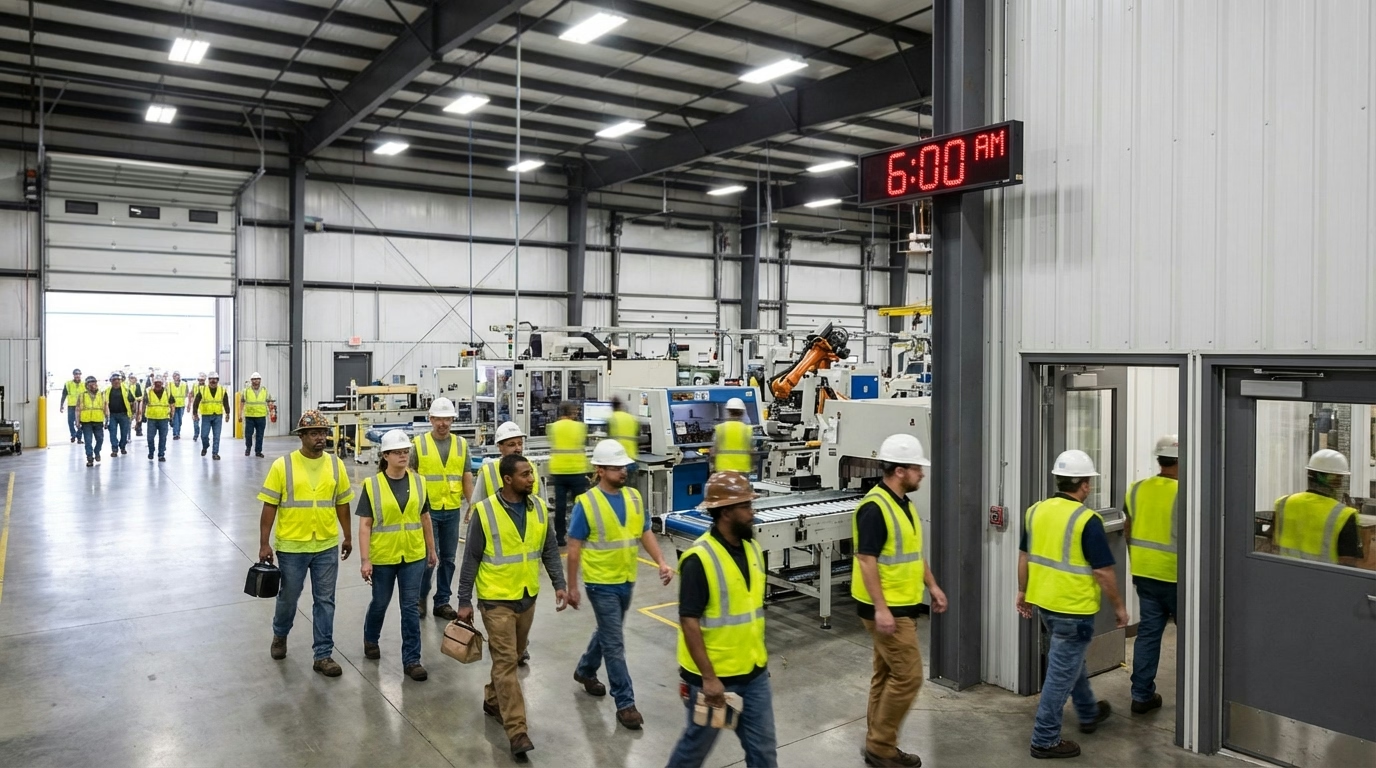
Maintenance and facilities workers get called for after-hours disasters: burst pipes at 2am, HVAC failures during heat waves, security breaches. Critical infrastructure doesn’t break on a 9-to-5 schedule.
Power companies, water treatment facilities, telecom providers—they all run on call teams for outages and emergencies. The lights don’t stay on by themselves.
What Are the Types of On Call Arrangements?
On call isn’t one-size-fits-all. Here’s how it plays out:
On premises (on site) means you’re literally at work, just waiting for something to happen. Firefighters sleeping at the station are on premises. Under FLSA, this time is almost always compensable because you can’t use it effectively for personal purposes—you’re restricted to the workplace.
Close proximity requires you to stay within a certain radius of work so you can respond quickly—maybe 10-20 minutes away. You’re home, but you can’t go far. Can’t take a day trip, can’t have a few drinks, can’t really relax because you might get called in any minute. Whether this is compensable depends on how restrictive the requirements are. In one federal court case, firefighters receiving 3-5 calls per day with a 20-minute response time had their on call time ruled compensable.
Available by phone/remote is the loosest arrangement. You just need to be reachable and able to handle issues remotely or come in if absolutely necessary. You can mostly live your life, though you’re tethered to your phone. This is generally not compensable under FLSA unless the restrictions prevent you from using time personally.
Rotating on call means the duty rotates among team members—you’re on call this week, someone else next week. This spreads the burden but means everyone deals with it periodically.
Scheduled on call blocks assign specific times you’re on call—maybe weeknights 5pm-8am or entire weekends. You know exactly when you’re on the hook.
Do You Have to Pay On Call Employees?
Here’s where it gets legally interesting. The FLSA makes a distinction between two types of waiting:
“Engaged to wait” means the waiting itself is work. The restrictions placed on you are so significant that you’re essentially working even when nothing’s happening. Think firefighters at the station, or an on call technician who must stay within 10 minutes of the facility. This time must be paid.
“Waiting to be engaged” means you’re free to use your time for personal activities with only minor restrictions. You can do whatever you want as long as you keep your phone on and can respond within reasonable time. This time does not have to be paid under FLSA.
The key question: Can you use the time effectively for your own purposes? If the employer’s restrictions prevent you from doing normal personal activities—running errands, going out with friends, traveling anywhere—you’re probably engaged to wait and that’s compensable time.
Important: All actual work you do while on call must always be paid, regardless of the arrangement. If you get called and spend 2 hours fixing a server problem from home, those 2 hours are compensable work time. The question is whether the standby time itself (when you’re just waiting and not actively working) needs to be paid.
What Are the Challenges of On Call Work?
On call schedules wear people down in ways that go beyond just being tired.
The stress numbers tell the story: 77% of workers have hit burnout at their current job, with 37% pointing to overwork as the culprit. A third say work-life balance—or the lack of it—is what’s killing them. On call duty means you never really clock out. That nagging “might get called” feeling follows you everywhere.
The money side is staggering. American companies hemorrhage over $300 billion every year from stress-related problems—absenteeism, plummeting productivity, people walking out the door. Unpredictable on call schedules are a huge driver of that stress.
Forget making plans. Weekend getaway? Only if the phone stays quiet. Your kid’s birthday party an hour away? Not happening when you’re required to be 20 minutes from work. On call schedules put personal life on permanent hold, and relationships suffer for it.
Sleep becomes a gamble. Even on quiet nights, you’re lying there wondering if the phone will ring at 2am. When it does, your sleep schedule is shot and you’re dragging through the next day.
The pay issue breeds serious resentment. When your personal time is severely restricted but the compensation is minimal or nonexistent, it feels like exploitation. Healthcare’s particularly guilty of this—calling it “call” instead of “work” to dodge payment requirements. No wonder burnout is through the roof.
What’s New for On Call Schedules in 2026?
DOL ramps up enforcement on FLSA compliance. In January 2026, the Department of Labor issued six new opinion letters interpreting FLSA and FMLA compliance. This signals they’re paying closer attention to compensable time issues, including whether on call arrangements properly classify waiting time. Employers with questionable on call practices should review their policies—scrutiny is increasing.
Healthcare on call compensation under fire. The long-standing practice of not paying physicians for on call time is finally getting serious pushback as a major burnout driver. As one physician wrote in 2026: “As long as it’s called ‘call’ and not ‘work,’ it becomes optional, expected, and unpaid.” With healthcare losing massive numbers of workers, expect this to become a bigger issue.
Burnout recognition reaches crisis level. It’s no longer just an employee complaint—it’s an organizational crisis. With burnout affecting 77% of workers and costing $300 billion annually, companies are finally recognizing that poorly managed on call schedules directly impact the bottom line through turnover and lost productivity.
Remote work complicates on call definitions. With 11% of healthcare and 15% of tech workers fully remote in 2026, the line between “on call at home” and “regular work from home” gets blurry. Expect more legal challenges around whether remote on call time should be compensated.
AI-powered monitoring reduces on call burden. In 2026, intelligent alert systems are getting smarter at filtering false alarms and auto-resolving routine issues. Companies using AI-driven incident management report 30-40% reduction in middle-of-the-night pages for on call staff. The technology doesn’t eliminate on call work, but it makes it more manageable by ensuring you only get called for issues that genuinely need human intervention.
Hybrid on call models emerge. More companies in 2026 are experimenting with tiered hybrid approaches: Level 1 on call can be fully remote, Level 2 requires being within driving distance, Level 3 (senior escalation) can be anywhere. This flexibility reduces the geographic restriction burden while maintaining appropriate response capabilities.
New federal tax deduction for overtime. Starting in 2026, workers can deduct qualified overtime compensation from federal income taxes (up to $12,500 annually, or $25,000 for married couples filing jointly). This runs through 2028 and provides real financial relief for employees who work significant on call hours. Employers must separately report overtime on W-2 forms starting with the 2026 tax year.
State salary thresholds increase. California, Colorado, Maine, New York, and Washington all raised minimum salary requirements for overtime exemptions effective January 1, 2026. California’s threshold hit $70,304 annually—well above the federal $35,568. If you’re classifying salaried employees as exempt from overtime, verify you meet your state’s requirements.
What Should Your On Call Policy Include?
Before rolling out on call schedules, document a clear policy that protects both business needs and employee well-being. Essential components:
Response time requirements: Specify exactly how quickly employees must respond when contacted (within 15 minutes? 30 minutes? 1 hour?) and how quickly they must arrive on-site if needed. Be realistic—don’t require 10-minute response if 60 minutes would work.
Geographic restrictions: State clearly whether employees must remain within a certain distance of the workplace or if they can travel freely. If you require them to stay within 20 minutes of work, that restriction may make the time compensable under FLSA.
Compensation structure: Detail how on call time is paid. Include standby pay rates (if any), how actual work time is calculated, overtime rates, and whether comp time is offered. Even if not legally required, consider offering something for availability—it reduces resentment and turnover.
Acceptable activities: Clarify what employees can and cannot do while on call. Can they consume alcohol? Leave their local area? Be unavailable for a specific appointment? The more restrictions you place, the more likely the time is compensable.
Rotation schedule: Explain how on call duty rotates among team members, how far in advance schedules are posted, and how trades/swaps are handled. Fairness and predictability matter enormously for morale.
Call escalation procedures: Define what constitutes a true on call emergency versus issues that can wait. Provide clear decision trees so employees know when to escalate versus handle independently. Reduce unnecessary middle-of-the-night calls.
Recovery time protocols: Specify rest periods after nighttime on call work. If someone works 2 AM to 5 AM on an on call issue, document whether they get the morning off, can come in late, or receive comp time.
Equipment and technology: List what employees must have available (laptop, phone, VPN access) and who provides it. Include response expectations for different contact methods.

How Can You Manage On Call Schedules Effectively?
Beyond having a written policy, here’s how to implement on call coverage without destroying your team:
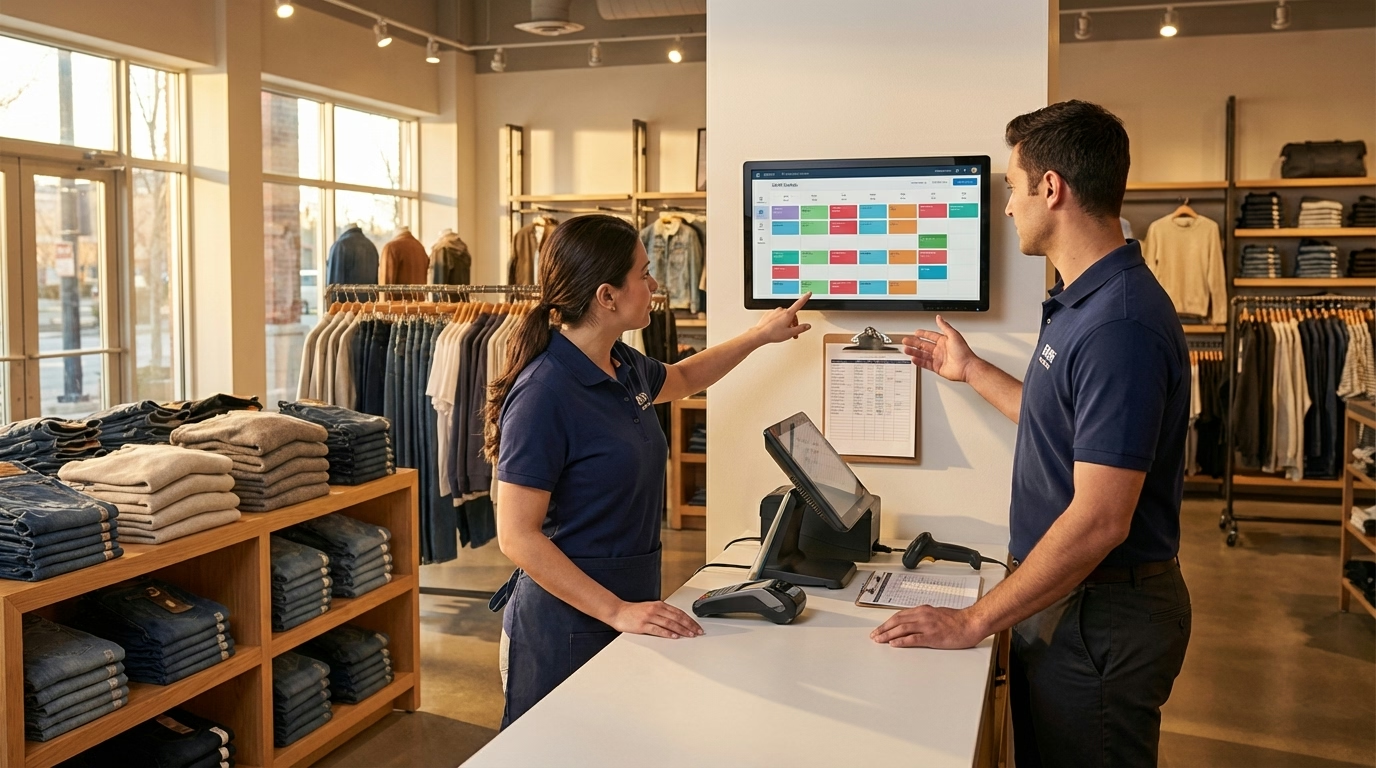
Rotate fairly. Don’t put the burden on the same person constantly. Spread on call duties equally across the team using a clear rotation schedule everyone can see in advance. Use scheduling software that tracks rotation fairness automatically.
Compensate appropriately. Even if standby time isn’t legally required to be paid, consider paying something. Offer on call pay (a flat rate for being available), shift differentials, or comp time. Recognize that being on call restricts personal time even when not actively working.
Minimize unnecessary calls. Train people to handle issues themselves when possible. Have clear escalation procedures so on call staff only gets contacted for truly urgent matters. Every middle-of-the-night call that could have waited until morning erodes morale.
Use technology to reduce burden. Automated monitoring and alerting systems can handle routine issues without human intervention. Self-healing infrastructure reduces the number of times on call staff actually gets paged.
Consider on call support tiers. Have a first-tier on call person handle common issues, with a second-tier expert only called for complex problems. This reduces the burden on senior staff.
What’s the Bottom Line?
On call schedules require employees to be available outside regular hours, common in healthcare, IT, emergency services, and maintenance. While necessary for 24/7 operations, on call work contributes to burnout affecting 77% of workers and costs U.S. companies $300 billion annually in stress-related losses.
The key facts:
- 49% of workers experience daily work-related stress, with on call demands a major factor
- 77% have experienced burnout, with lack of work-life balance cited by one-third
- FLSA requires compensation when employees are “engaged to wait” (restricted from personal activities)
- All actual work done while on call must always be paid
- Healthcare has 80% on-site workforce with significant on call requirements
- DOL issued 6 new FLSA opinion letters in January 2026, signaling increased enforcement
- Fair rotation, appropriate compensation, and reasonable response times reduce on call burden
Ready to manage on call schedules more effectively and reduce team burnout? ShiftFlow’s scheduling tools help you track on call rotations fairly, ensure compliance, and give teams the predictability they need. Explore our solutions or view pricing.
Sources
- Meditopia for Work – Employee Burnout Statistics 2026: Global & Workplace Insights
- Meditopia for Work – Workplace Stress Statistics: Guide for 2026
- SSR – 81+ Troubling Workplace Stress Statistics [Updated for 2026]
- KevinMD – Physician on-call compensation: the unpaid labor driving burnout
- U.S. Department of Labor – elaws - FLSA Hours Worked Advisor
- Holland & Knight – DOL Issues 6 New Opinion Letters on FLSA and FMLA Compliance
- Coffield Law – FLSA Compensable Time: On-Call Time and Waiting Time
- Robert Half – Remote Work Statistics and Trends for 2025
- Nextep – 2026 Salary Threshold Increases
- The Horton Group – New 2026 Employment Law Changes Every Employer Needs to Know
Further Reading
- Firefighter Schedule Explained – 24/48 and 48/96 on call patterns
- Working Night Shift Guide – Health impacts of overnight schedules
- Nurse Schedule Patterns – 12-hour shifts and on call requirements
Frequently Asked Questions
What is an on call schedule?
An on call schedule requires employees to be available to work outside their regular scheduled hours. Employees must respond when contacted, either reporting to the workplace or handling issues remotely. Common in healthcare, IT, emergency services, and maintenance. FLSA determines whether on call time is compensable based on restrictions placed on personal time use.
Do you have to pay employees for on call time?
It depends. Under FLSA, you must pay for on call time when employees are “engaged to wait” rather than “waiting to be engaged.” If employees must stay on premises or so close they cannot use time effectively for personal purposes, it’s compensable. If they can use time for personal activities with minimal restrictions, it may not be compensable. All actual work performed while on call must always be paid.
What are the challenges of on call work?
On call work causes significant stress and burnout. 77% of workers have experienced burnout at their current job, with on call demands being a major factor. One-third cite lacking work-life balance as their main stress source. On call schedules disrupt personal time, make planning difficult, cause sleep disruption, and contribute to the $300 billion U.S. companies lose annually to stress-related issues.
What industries use on call schedules most?
Healthcare leads with 80% of workers fully on-site in 2026, relying heavily on on call coverage for emergencies. IT and technology use on call rotations for system maintenance and emergency response. Emergency services (firefighters, EMTs) operate on call by nature. Maintenance, facilities, utilities, and infrastructure sectors require 24/7 on call availability for critical issues.
How much should you pay for on call work?
FLSA requires full wages when employees are “engaged to wait”—restricted from personal activities. For “waiting to be engaged” time (not legally required), many employers offer on call pay (flat rate for availability), shift differentials, or compensatory time. Even when not legally required, appropriate compensation reduces burnout and turnover. All actual work time must be paid at regular or overtime rates.
What is the difference between engaged to wait and waiting to be engaged?
“Engaged to wait” means restrictions are so significant that waiting itself is work—you’re essentially working even when inactive (firefighters at station, on-site standby). This must be paid. “Waiting to be engaged” means you’re free to use time for personal activities with only minor restrictions (keeping phone on, responding when called). This typically doesn’t require payment, though all actual work performed must be paid.
How do you make on call schedules fair?
Rotate on call duties equally across the team using a clear schedule everyone can see in advance. Use scheduling software to track rotation fairness automatically. Set reasonable response times. Minimize unnecessary middle-of-the-night calls. Provide recovery time after nighttime on call work. Compensate appropriately even when not legally required. Document clear expectations about response requirements and restrictions.
- on-call-schedule
- on-call-work
- on-call-pay
- standby-time
- flsa-compliance
- employee-burnout
- work-life-balance