How to Reduce Missed Punches in Restaurants
Missed punches cost restaurants 5–10 hours of manager time per week in corrections and create compliance gaps that weaken your labor records. Learn why missed punches are an epidemic in restaurants and the system design fixes that reduce them.
It is 5:02 p.m. on a Friday. The dinner crew is arriving. A server walks through the back door, drops her bag in the locker, ties her apron, and heads straight to her section to check the reservation book. She never clocks in. Three hours later, the closing manager discovers the missing punch and spends five minutes tracking down the server’s actual arrival time, entering a manual correction, and documenting the edit.
Now multiply that by the eight other missed punches that happened this week across the staff. The closing manager just burned 45 minutes on timecard corrections that should not have been necessary—and every one of those corrections is a manually entered record that is harder to defend than an original clock-in.
Missed punches are one of the most persistent operational problems in restaurants. They are not dramatic. They are not intentional. But they consume manager time, degrade payroll accuracy, and create compliance gaps that accumulate into real risk.
Why Missed Punches Are an Epidemic in Restaurants
Missed punches are not simply a discipline problem. They are a system design problem that is amplified by the unique operating conditions of restaurants.
High Turnover Means Constant Onboarding
With turnover rates that have historically averaged around 80% in the restaurant industry, a significant portion of the staff at any given time is new. New team members have not yet formed the habit of clocking in. They are focused on learning their role, remembering table numbers, and not making mistakes during service. The clock-in step—which seems obvious to a tenured employee—is easily forgotten by someone on their second or third shift.
A restaurant that hires 40 people per year (a modest number for a full-service operation with 30 positions) has a nearly continuous stream of team members in the habit-formation phase. If each new hire misses an average of three punches during their first two weeks, the restaurant generates 120 additional missed punches per year from onboarding alone.
Time Clock Placement Is an Afterthought
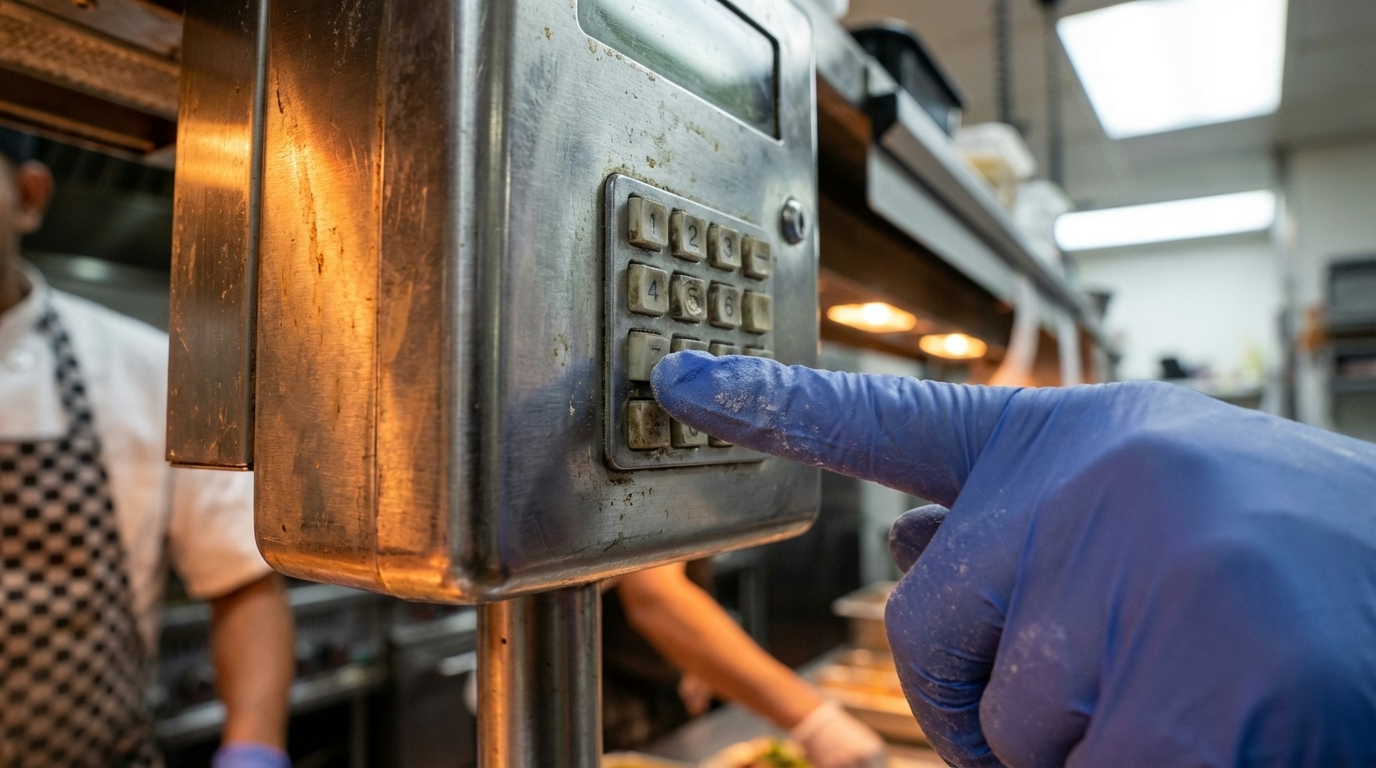
In many restaurants, the time clock is located in a back hallway, a manager’s office, or near the employee entrance—not on the team member’s natural path to their station. A server whose locker is by the back door and whose section is in the front of the house may walk directly to the floor without passing the time clock.
Every extra step between the entrance and the time clock is a step where a missed punch becomes more likely. If clocking in requires a detour, team members will skip it—not out of dishonesty, but because their attention is on the shift ahead.
Rush-Hour Chaos Prioritizes Service Over Process
When three servers, two bussers, and a food runner all arrive within a five-minute window for the dinner shift, the time clock becomes a bottleneck. If the system is slow (a common complaint with tablet-based time clocks) or if there is a line, team members will skip the punch and head to their station because the floor is already filling.
The cultural message in most restaurants is clear: service comes first. When clock-in competes with service, clock-in loses.
System Unreliability Creates Learned Behavior
A time clock that goes offline, freezes, or takes more than a few seconds to process a punch trains team members to ignore it. After a few experiences of standing at a frozen screen while the dining room fills, team members learn to bypass the system. This offline reliability problem feeds directly into the missed punch problem. Even after the system is fixed, the learned behavior persists.
The Hidden Cost of Every Missed Punch
Manager Time
Each missed punch requires a manual correction: the manager identifies the missing punch (often hours or days later), contacts the team member to determine actual arrival or departure time, enters the correction in the time system with a documented reason, and the team member acknowledges the correction. A conservative estimate is 3–5 minutes per missed punch. A restaurant with 12 missed punches per week spends 36–60 minutes per week—approximately 30–50 hours per year—on corrections. At a manager’s effective hourly cost of $25–$35, that is $750–$1,750 annually in management labor spent on a preventable problem.
Payroll Errors
Missed punches that are not corrected before the payroll cutoff create one of two outcomes: the team member is not paid for the shift (a wage violation) or the team member is paid based on a schedule or estimate rather than actual hours worked (an inaccurate record). Neither outcome is acceptable. The first triggers a complaint; the second creates a record that may not survive scrutiny.
Compliance Exposure
Every manual correction to a missed punch is a record that was not generated at the time of the event. These after-the-fact entries lack the timestamp credibility of original clock-ins and are flagged during DOL investigations as potential manipulation. A restaurant with 600 manual punch corrections per year has 600 records that an investigator can question—even if every single correction was legitimate.
The more corrections in your records, the harder it is to demonstrate that your timekeeping system is reliable. Reducing missed punches does not just save manager time—it strengthens the integrity of your entire timekeeping compliance posture.
Buddy Punching Correlation
Missed punches and buddy punching are closely related. A team member who frequently forgets to clock in may ask a coworker to punch them in the next time they are running late—not as a deliberate act of fraud, but as a practical workaround for a recurring problem. Reducing missed punches removes the most common catalyst for buddy punching.
System Design Fixes That Reduce Missed Punches
The most effective approach treats missed punches as a design problem, not a discipline problem. Changing the system is more reliable than changing behavior.
Place the Time Clock on the Critical Path
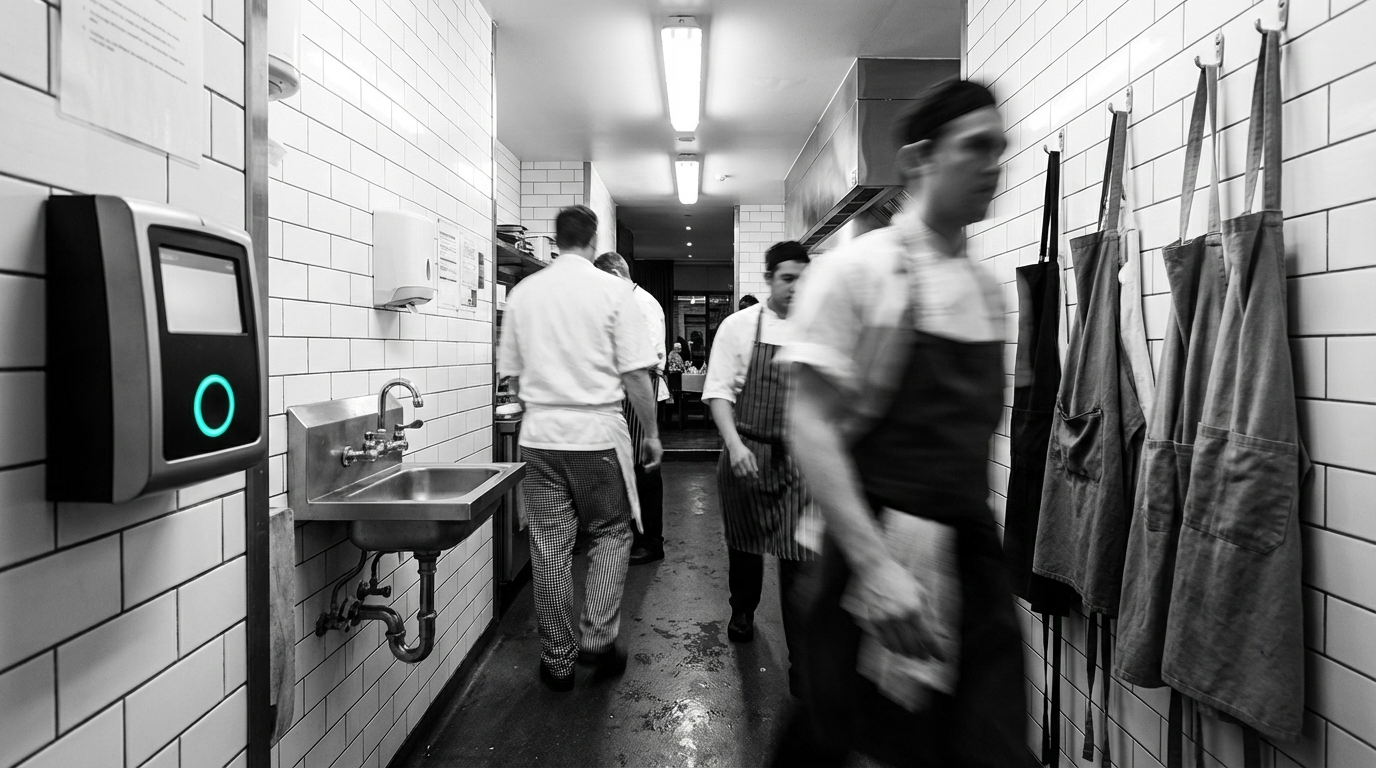
The time clock should be positioned where every team member naturally passes on their way to their station—typically at the only entrance to the work area or at the transition point between the back of house and the floor. If team members can reach their station without walking past the time clock, the placement is wrong.
For restaurants with multiple entrances, consider a second time clock or a mobile clock-in option with geofencing that ensures punches occur within the building.
Reduce Clock-In Friction
Every second of friction at the time clock increases the probability of a missed punch. Evaluate the current clock-in experience: How many taps, screens, or selections does it take to complete a punch? Is the system responsive, or does it lag? Is there a queue during shift transitions?
A clock-in process that takes more than five seconds is too slow for a restaurant environment. The target is a sub-three-second interaction: approach, authenticate, confirm, done.
Enable Push Notifications and Reminders
If your time clock supports mobile notifications, configure a reminder that fires when a team member’s scheduled shift starts and no clock-in has been recorded. A push notification at 5:02 p.m. saying “Your shift started at 5:00 PM—don’t forget to clock in” catches the missed punch in real time rather than hours later.
Implement Shift-Start Lockouts
Some time tracking systems can prevent a team member from accessing operational systems (POS login, table assignment, kitchen display access) until they have clocked in. This creates a functional dependency that makes the clock-in step unmissable—if you cannot access the POS, you cannot take orders, and you will clock in.
Shift-start lockouts should be implemented carefully to avoid disrupting service during the first days of use. Roll them out with clear communication and a one-week grace period where warnings are issued instead of actual lockouts.
Deploy Manager Alerts for Missing Punches
Configure the system to alert the shift manager when any scheduled team member has not clocked in within 10 minutes of their shift start. The manager can then confirm whether the team member is on-site (and forgot to punch) or absent. This closes the gap between the missed punch and the correction, reducing the time and effort needed to fix it.

Onboarding and Training Fixes
First-Shift Clock-In
The single most effective onboarding intervention is walking the new team member through the clock-in process on their very first shift—before anything else. The manager or trainer meets the team member at the entrance, walks them to the time clock, and supervises their first clock-in. This establishes the clock-in as the first action of every shift, not an afterthought.
Visual Guides at the Time Clock
Post a clear, visual step-by-step guide at the time clock station. Include the clock-in steps, role selection (if applicable), and what to do if the system is unresponsive. The guide should be visible from five feet away and understandable without reading a paragraph of text.
First-Week Punch Audits
During a new team member’s first five shifts, the manager reviews their clock-in and clock-out records daily. If a punch is missing, the manager addresses it immediately—not punitively, but as a coaching moment. “I noticed you missed your clock-in yesterday. Let’s make sure you punch in before heading to the floor.” Five consecutive days of reinforcement is usually sufficient to establish the habit.
Progressive Accountability
After the onboarding period, establish a progressive accountability framework for chronic missed punches: first occurrence each month generates a verbal reminder, second occurrence generates a written reminder, third and subsequent occurrences trigger a manager conversation about root causes. The goal is not punishment—it is understanding why the punches are being missed and addressing the underlying cause, whether that is system friction, placement, or forgetfulness.
Missed Punch Reduction Checklist
- Audit time clock placement. Confirm the time clock is on the natural path between the entrance and the work area. If team members can bypass it, relocate it.
- Measure current missed punch rate. Track the number of missed punches per week for 30 days to establish a baseline.
- Reduce clock-in friction. Test the clock-in process from approach to confirmation. Target sub-three-second completion. Eliminate unnecessary screens or selections.
- Enable real-time notifications. Configure push notifications or text alerts for team members who have not clocked in within five minutes of their scheduled start.
- Set up manager alerts. Notify the shift manager when any scheduled team member has not clocked in within 10 minutes of shift start.
- Walk new hires through their first clock-in. Make the supervised first-shift clock-in a standard onboarding step for every new team member.
- Post visual guides. Place a clear, visual clock-in guide at the time clock station. Include troubleshooting steps for system issues.
- Audit new hire punches for the first week. Review daily clock-in/out records for every new team member during their first five shifts. Coach immediately on any missed punches.
- Evaluate shift-start lockouts. Assess whether POS or system access can be gated behind a completed clock-in. Implement with a communication plan and grace period.
- Track improvement. After implementing changes, measure the missed punch rate weekly for 60 days. Target a 50% or greater reduction from the baseline.
- Maintain a reliable time tracking system. A slow, unreliable, or frequently offline time clock is the root cause of many missed punches. If the system is the problem, no amount of training will fix the behavior.
The Bottom Line
Missed punches in restaurants are not a minor nuisance. They consume hours of manager time every week, create payroll inaccuracies, weaken compliance records, and serve as the gateway to buddy punching. The root cause is rarely team member carelessness—it is system design that puts the clock-in step in the wrong place, at the wrong time, with too much friction.
Fix the system first. Put the time clock where people actually walk. Make the clock-in process fast enough that nobody has a reason to skip it. Alert managers in real time when punches are missing. And build the clock-in habit during onboarding, not after the team member has already established a pattern of forgetting.
Restaurants that reduce their missed punch rate by 50% recover dozens of hours of manager time per year, improve payroll accuracy, and build cleaner records that are easier to defend. The investment is minimal. The return is immediate.
- restaurant-time-tracking
- missed-punches
- time-clock
- restaurant-onboarding
- payroll-accuracy
- manager-workload
- timekeeping