
Buddy Punching in Restaurants: The True Cost
Buddy punching costs the average restaurant thousands per year in payroll leakage—and creates compliance exposure that extends far beyond the stolen time. Learn the real financial impact and how to prevent it without disrupting service.
A server asks a coworker to punch in for her while she finishes a cigarette break in the parking lot. It takes three seconds. The coworker enters the PIN, the clock registers the punch, and the server walks in eight minutes later. Nobody notices. Nobody investigates. The restaurant pays for eight minutes of labor that never happened.
Eight minutes sounds trivial. But buddy punching is never a one-time event. It is a pattern—repeated by multiple team members, multiple times per week, across months or years. The cumulative cost is not trivial at all.
This guide calculates the real financial impact of buddy punching in restaurants, explains why the problem goes beyond payroll leakage, and covers prevention methods that work in the fast-paced, high-turnover restaurant environment.
Why Buddy Punching Thrives in Restaurants
Buddy punching exists in every industry that uses time clocks, but restaurants create conditions that make it especially common and difficult to detect.
Shared PIN and Badge Systems
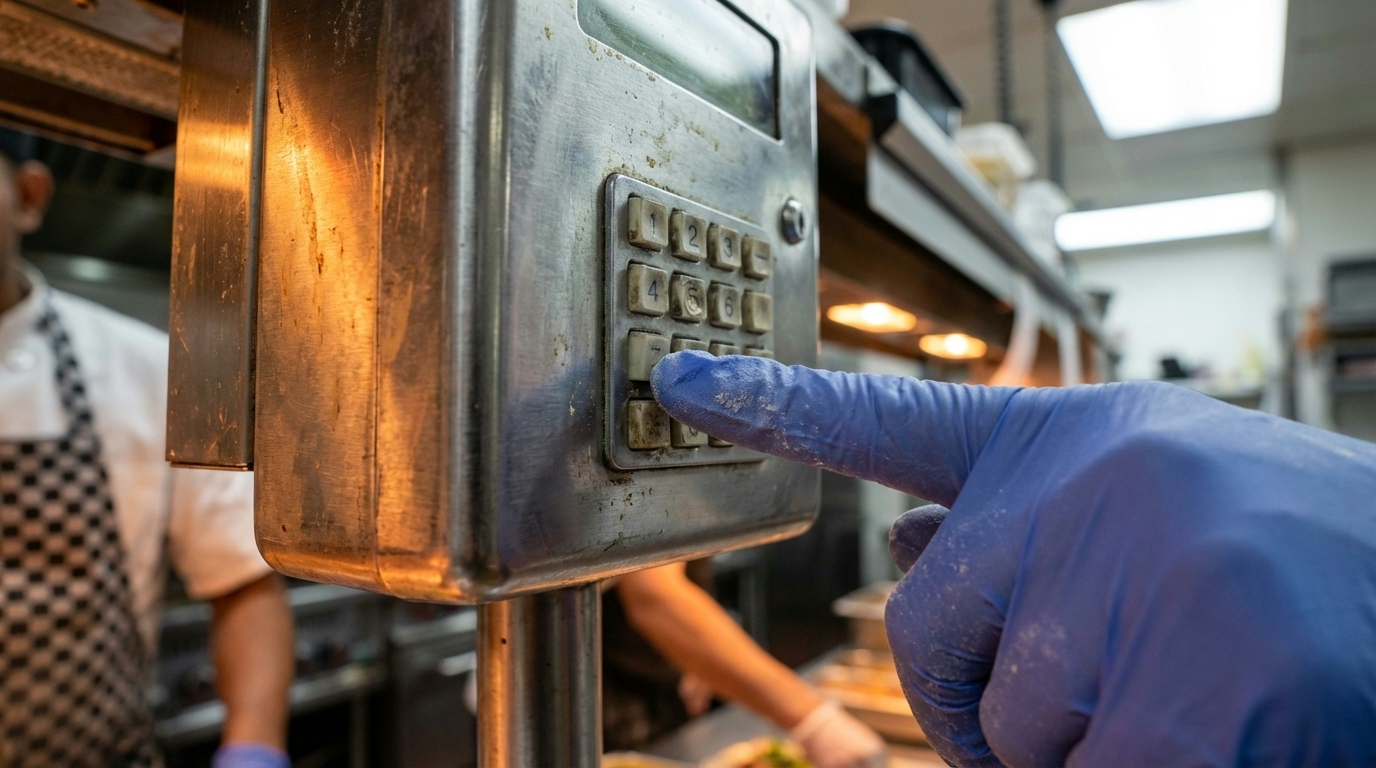
Most restaurant time clocks use PIN codes or badge swipes for authentication. Both methods verify a credential—not a person. A four-digit PIN shared between friends, or a badge left in a locker for a coworker to swipe, defeats the entire purpose of individual time tracking. The system records a punch for Employee #4218 without any evidence that Employee #4218 was the person standing at the clock.
Rush-Hour Clock-Ins
During shift changes—especially the transition between lunch and dinner service—a dozen or more team members may clock in within a five-minute window. The time clock becomes a bottleneck. In the rush to get on the floor, punches happen quickly with minimal supervision. A coworker punching in for someone running late blends into the chaos.
Social Dynamics and Low Stakes Perception
Restaurant teams are tight-knit. Asking a coworker to punch you in is a small favor, not a dramatic act of fraud. The team member doing the punching may not even consider it dishonest—they are helping a friend avoid a late mark. The low perceived stakes and the social pressure to cooperate make buddy punching culturally acceptable in many restaurant environments.
Manager Presence Is Elsewhere
During shift transitions, managers are often occupied with operational tasks—receiving deliveries, checking the line, briefing the incoming crew. They are not standing at the time clock watching every punch. Without active oversight or technological verification, buddy punching happens in the blind spot between operational management and time tracking.
The Real Financial Cost of Buddy Punching
Per-Employee Calculation
A team member who has a coworker punch them in 10 minutes early, three times per week, generates 30 fraudulent minutes per week. At $15 per hour, that is $7.50 per week—$390 per year for a single individual.
That seems manageable. But buddy punching is rarely limited to one person. If 15% of a 30-person restaurant staff engages in similar behavior (a conservative estimate based on industry surveys), the math changes significantly:
- 4.5 team members × $390/year = $1,755 per year in direct payroll leakage
Now factor in that buddy punching often involves more than clock-in fraud. Late clock-outs—where a team member leaves early and a coworker punches them out at the scheduled time—add another layer:
- 4.5 team members × 10 extra clock-out minutes × 3 times/week × $15/hr × 52 weeks = $1,755 per year
Combined clock-in and clock-out buddy punching: approximately $3,500 per year for a 30-person restaurant at a 15% participation rate with modest time inflation. At higher participation rates, higher wages, or more frequent occurrences, the number climbs quickly toward $10,000–$25,000 annually.
Compounding With Overtime
Buddy punching inflates recorded hours. Inflated hours push team members closer to—or past—the 40-hour overtime threshold. A team member whose actual hours total 38 per week but whose recorded hours show 40.5 triggers 30 minutes of overtime pay at 1.5×. Across a staff with systemic buddy punching, the overtime triggered by phantom hours adds 30–50% to the direct payroll leakage.
Invisible Labor Cost Inflation
Because buddy punching inflates recorded hours without increasing actual labor output, it silently inflates the restaurant’s labor cost percentage. A restaurant targeting 28% labor cost may actually be running at 27% in real terms—but the payroll report shows 29.5% because of phantom hours. The manager responds by cutting scheduled hours, reducing actual coverage during service. The restaurant pays for labor it did not receive and then compounds the problem by cutting labor it actually needs.
Beyond Payroll: Compliance and Operational Damage
Falsified Records
Every buddy punch creates a falsified time record. If a DOL investigation or wage dispute arises, those records are the evidence the restaurant must defend. A timecard showing a team member clocked in at 4:55 p.m. when they actually arrived at 5:08 p.m. is an inaccurate record—regardless of who created the inaccuracy.
The FLSA requires employers to maintain accurate records of hours worked. When records are demonstrated to be unreliable—whether through manager edits or buddy punching—the employer loses the ability to use those records as a defense. The employee’s estimate of hours worked becomes the basis for any back-pay calculation.
Scheduling Distortions
Managers use historical clock-in and clock-out data to make scheduling decisions. If buddy punching inflates hours at certain positions or during certain shifts, the scheduling data is distorted. The manager may schedule more hours than needed in positions where buddy punching is common (because the data suggests those shifts require more labor) and fewer hours where it is not—creating an imbalance that affects service quality and cost.
Team Member Resentment
Buddy punching is not invisible to the team members who do not participate. A server who arrives on time every shift and watches a coworker stroll in 10 minutes late—knowing the coworker was already “clocked in”—experiences the unfairness directly. Over time, this erodes morale and can increase turnover among the team members who are actually showing up on time.

Prevention Methods That Work in Restaurant Environments
Photo Verification at Clock-In
A time clock that captures a photo at every punch creates accountability without adding friction. The team member enters their PIN or taps their badge, the system snaps a photo, and the punch is recorded. The photo is stored alongside the time record for review.
Photo verification does not prevent the punch from being recorded—but it provides evidence of who was actually at the clock. A manager reviewing time records can quickly identify cases where the photo does not match the team member on record.
Biometric Authentication
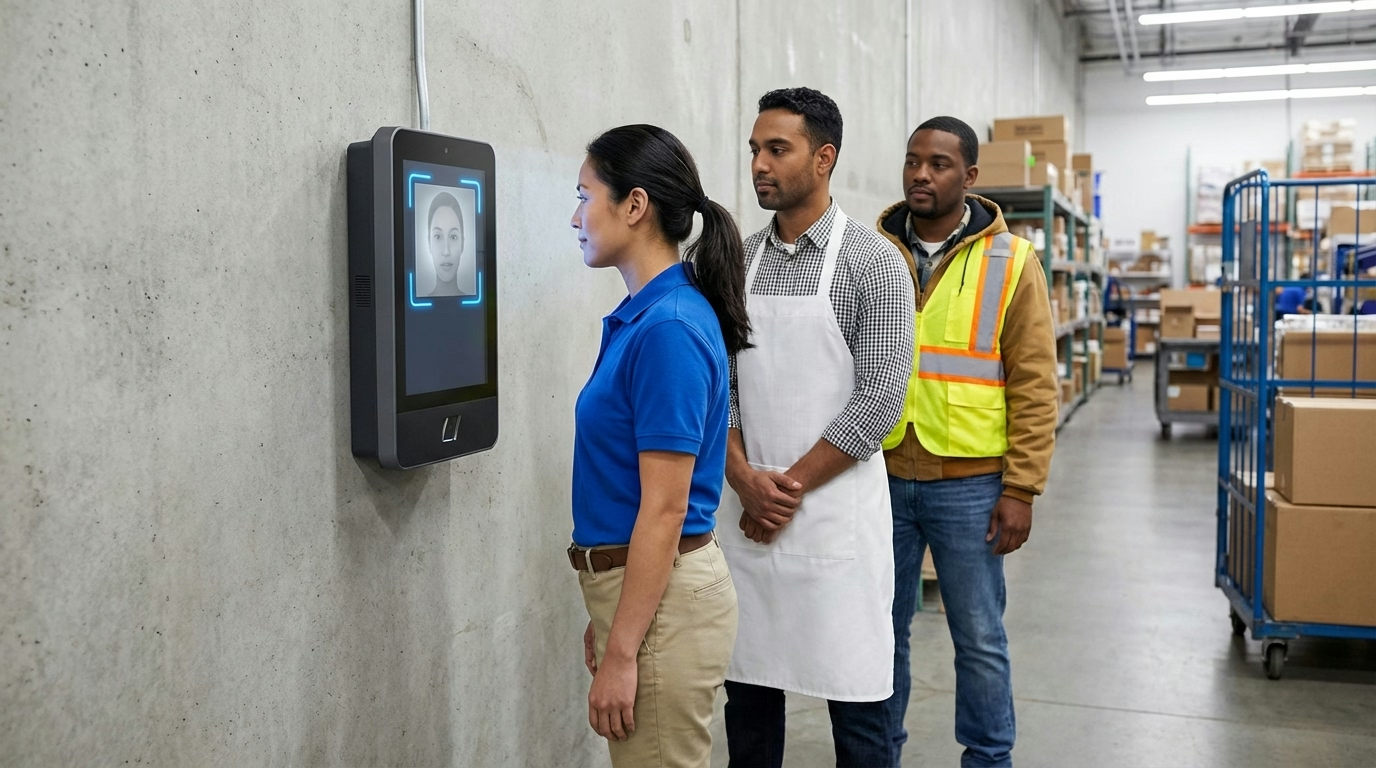
Fingerprint or facial recognition time clocks verify the identity of the person punching, making buddy punching physically impossible. A coworker cannot provide someone else’s fingerprint.
Biometric time clocks have become affordable enough for single-location restaurants, with entry-level devices available for $200–$500. The ROI for a restaurant losing $5,000+ per year to buddy punching is immediate. Note that several states have biometric data privacy laws that require notice and consent before collecting biometric information. Illinois (BIPA), Texas (CUBI), and Washington are the most established, but over 20 states now classify biometric data as sensitive under comprehensive privacy laws.
Geofenced Mobile Clock-In
For restaurants that allow mobile clock-in, geofencing restricts punches to a defined area around the restaurant. A team member cannot clock in from the parking lot across the street or from home. Combined with device-specific authentication (the punch must come from the team member’s own registered phone), geofencing effectively eliminates remote buddy punching.
Manager Verification for Early Clock-Ins
Configure the time system to require manager approval for any clock-in that occurs more than five minutes before the scheduled shift start. This simple rule eliminates the most common buddy punching scenario—where a coworker punches someone in early—by adding a verification step that only the on-duty manager can complete.
Cultural Accountability
Technology alone does not solve buddy punching if the culture tolerates it. Include buddy punching in your timekeeping policy as a terminable offense for both the person who punches and the person who asks. Communicate the policy during onboarding and reinforce it during team meetings. When violations are detected, enforce the policy consistently.
The goal is not to create a surveillance environment. It is to establish a baseline expectation that every team member clocks in and out for themselves—a standard that most team members already follow and that protects the integrity of the entire payroll process.
Buddy Punching Prevention Checklist
- Audit your current clock-in method. If you use PINs or badges without identity verification, your system is vulnerable. Assess the gap.
- Implement identity verification. Choose photo capture, biometric authentication, or geofenced mobile clock-in based on your budget and state law requirements.
- Restrict early clock-ins. Require manager approval for any clock-in more than five minutes before the scheduled shift start.
- Review clock-in patterns. Run a monthly report of team members who consistently clock in within one minute of their scheduled start while arriving late to their station. This pattern often indicates buddy punching.
- Update your timekeeping policy. Define buddy punching as a policy violation. Specify consequences for both parties. Include the policy in onboarding materials.
- Train managers on detection. Teach managers to compare clock-in times against observed arrival times, especially during shift transitions.
- Address missed punches separately. Team members who frequently forget to clock in may ask coworkers to punch for them as a “workaround.” Reducing missed punches reduces the perceived need for buddy punching.
- Enforce consistently. Apply the same consequences to every buddy punching violation, regardless of the team member’s tenure or role.
- Monitor after implementation. After deploying prevention measures, track payroll hours for 60 days. A measurable drop in average hours (without schedule changes) indicates that phantom hours from buddy punching have been eliminated.
- Maintain a reliable time tracking foundation. A time clock that is frequently offline, slow, or unreliable gives team members a reason to find workarounds—including buddy punching.
The Bottom Line
Buddy punching in restaurants is not a petty offense. It is systematic payroll fraud that costs thousands per year, distorts labor data, creates falsified records that undermine compliance defenses, and erodes trust within the team.
The fix requires both technology and culture. A time clock with identity verification makes buddy punching difficult. A policy that defines it as a terminable offense makes it risky. And a management team that enforces the policy consistently makes it clear that the standard applies to everyone.
Start by measuring the gap. Compare recorded clock-in times against observed arrival patterns for two weeks. If the gap is there—and in most restaurants, it is—the investment in prevention pays for itself within the first quarter.
- restaurant-time-tracking
- buddy-punching
- time-theft
- payroll-fraud
- time-clock
- restaurant-labor-cost
- biometric-time-clock