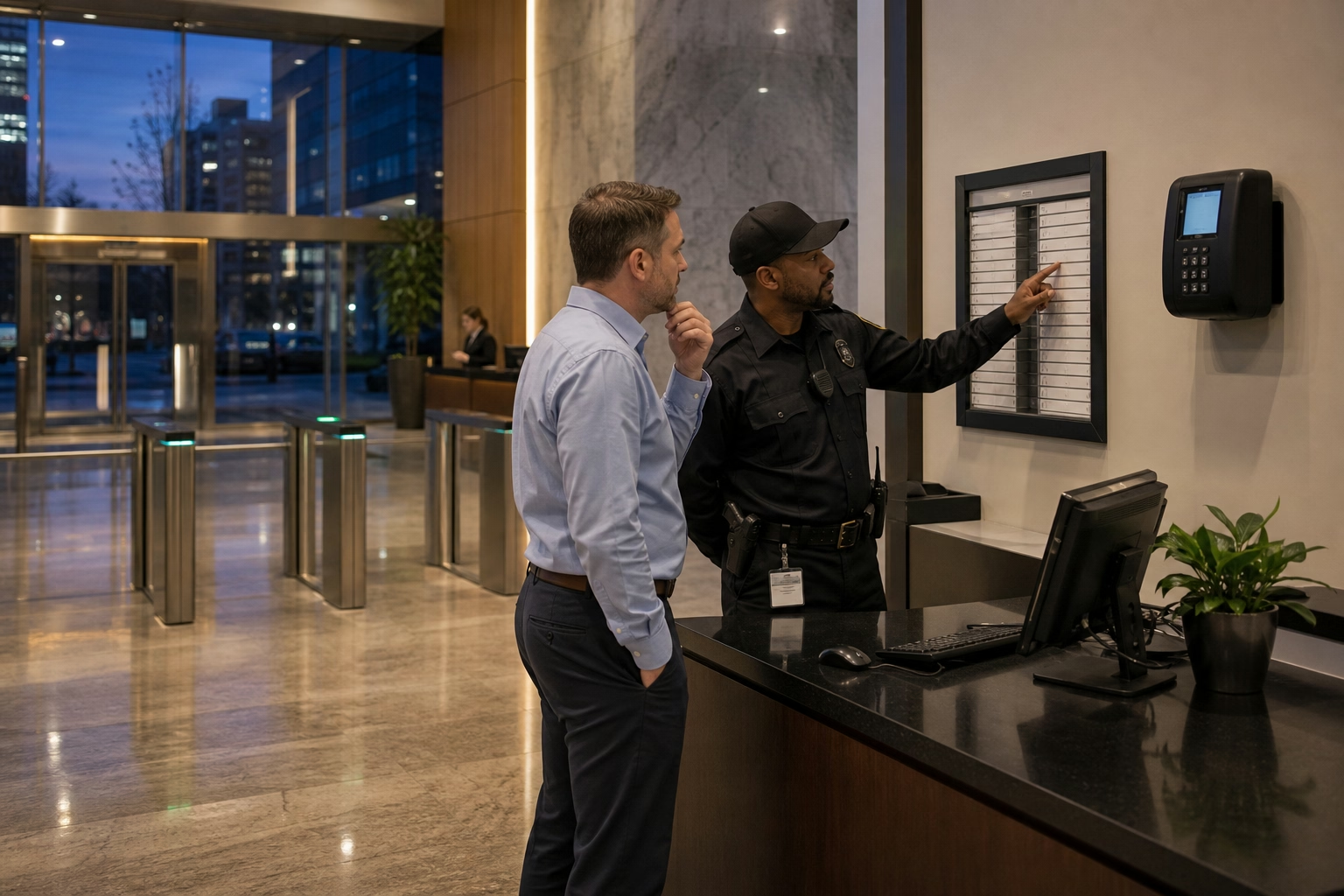

How to Prevent Time Theft in the Workplace
Time theft costs U.S. employers an estimated $400B+ annually. Learn what time theft is, why it happens, common types including remote work theft, real-world cases, and six proven prevention strategies.

How to Prevent Time Theft in the Workplace
Time theft happens when team members get paid for hours they did not actually work. It sounds minor in isolation, but small increments compound into real payroll and compliance risk over time. The U.S. Department of Labor regularly recovers hundreds of millions of dollars in back wages each year, which underscores how costly timekeeping failures can become when they are not addressed early.
For small and mid-sized businesses operating on tight margins, unchecked time theft can be the difference between a profitable quarter and a losing one. It inflates labor costs, distorts workforce data, and erodes trust between managers and their teams.
This guide breaks down exactly what time theft looks like, why it happens, how to calculate its real cost, and six proven strategies—from GPS-verified time clocks to automated timesheets—that help you stop it before it starts.
What Is Time Theft?
Time theft is any situation where a team member receives compensation for time they did not spend working. It covers a wide range of behaviors: clocking in early and sitting in the break room, having a coworker punch your time card, rounding up departure times on a manual timesheet, or taking 45-minute breaks when only 30 minutes are authorized.
What makes time theft tricky to address is that it is often habitual rather than malicious. A team member who adds five minutes to every shift may not even think of it as stealing. They might view it as an insignificant rounding error or an informal perk. But when you do the math, five extra minutes per shift across 250 working days equals more than 20 hours of unearned pay per year—per person.
The problem is especially prevalent in businesses that rely on manual time tracking. Paper timesheets, honor-system clock-ins, and spreadsheets all depend on self-reporting, and self-reported data is only as accurate as the people filling it in. Without verification mechanisms, small acts of time theft go unnoticed for months or even years, quietly inflating your payroll.
Time theft also differs from working off the clock, which is the opposite problem: team members performing work without being compensated. Both are timekeeping failures, but they carry different legal and financial implications. Time theft overpays; off-the-clock work underpays and exposes you to wage-and-hour claims.
Common Types of Time Theft
Time theft takes several forms, and most businesses deal with more than one. Understanding each type is the first step toward building effective controls.
Buddy Punching
Buddy punching occurs when one team member clocks in or out on behalf of another who is not present. It is the single most common form of time theft. A team member running late texts a coworker to badge them in at the start of a shift, and the late arrival gets paid from clock-in time rather than when they actually showed up.
Buddy punching is especially common in workplaces that use PIN codes, swipe cards, or paper punch clocks, because those systems do not verify who actually performed the punch.
Time Clock Rounding Abuse
Many businesses use time clock rounding rules—for example, rounding to the nearest quarter hour—to simplify payroll. But when team members learn the rounding thresholds, they can game the system: clocking in seven minutes early to capture an extra quarter hour, or clocking out eight minutes late for the same reason. Over a full pay period, those extra rounded increments add up fast.
Extended Breaks
Break abuse is one of the harder forms of time theft to detect because it does not show up in clock-in/clock-out data. A team member who is authorized a 30-minute lunch takes 45 minutes. Someone steps out for a 15-minute break and does not return for 25. Unless your attendance system tracks break start and end times separately, extended breaks fly under the radar.
In shift-based workplaces—restaurants, warehouses, healthcare facilities—extended breaks also affect coworkers who have to cover the absent team member’s responsibilities, creating resentment and reducing overall productivity.
Unauthorized Overtime
Unauthorized overtime happens when team members clock extra hours—arriving early, staying late, or not clocking out for breaks—without manager approval. At overtime rates of 1.5x base pay, even small amounts of unauthorized overtime create outsized payroll costs. A team member who adds 30 minutes of unapproved overtime per day at a $20/hour base rate generates an extra $3,900 in annual labor costs.
Beyond the direct payroll hit, unauthorized overtime can also create compliance issues. Under federal wage-and-hour rules, employers generally must pay for hours they “suffer or permit” team members to work, even when those hours were not pre-approved. That makes overtime controls and manager review essential.
Time Card Falsification
Time card fraud is the deliberate manipulation of time records. This includes manually editing digital timesheets, writing incorrect hours on paper time cards, or using system access to alter past entries. It is the most intentional form of time theft and often the most costly per incident.
Time card falsification tends to be harder to detect in businesses that use manual or loosely controlled timekeeping systems. Automated time tracking with audit trails and manager-approval workflows makes falsification significantly more difficult and easier to catch.
Remote and Hybrid Time Theft
As more businesses adopt remote or hybrid arrangements, new forms of time theft have emerged. Team members may log in to appear active but spend hours on personal tasks, use mouse-jiggler devices or software to simulate activity, or inflate hours on self-reported tracking tools. Because managers cannot observe remote workers directly, these behaviors are harder to detect than in-person time theft. GPS-verified clock-ins, project-based time tracking, and regular output reviews help close the gap.

Why Time Theft Happens
Understanding why time theft occurs is just as important as knowing how to stop it. Most time theft is not malicious—it follows a pattern that fraud researchers call the fraud triangle: opportunity, motivation, and rationalization.
- Opportunity: Weak timekeeping controls—paper timesheets, honor-system clock-ins, no GPS verification—make it easy to add a few minutes without detection.
- Motivation: Low morale, burnout, feeling underpaid, or personal financial pressure can push team members to recoup perceived losses through inflated hours.
- Rationalization: Team members convince themselves it is harmless. “Everyone does it,” “I stayed late last week and didn’t log it,” or “the company won’t miss five minutes” are common justifications.
- Unclear expectations: When there is no written timekeeping policy or the policy is not enforced consistently, team members may genuinely not realize that rounding up or extending breaks qualifies as time theft.
Addressing root causes—improving morale, setting clear expectations, and closing control gaps—prevents time theft more effectively than punishment alone.
How Much Does Time Theft Cost?
The financial impact of time theft is larger than most business owners realize. Industry estimates suggest time theft costs U.S. employers upwards of $400 billion annually, and roughly 75% of businesses are affected in some form. On average, the lost productivity amounts to about 4.5 hours per week per team member—nearly an entire shift’s worth of paid but unproductive time.
In fiscal year 2024, the U.S. Department of Labor’s Wage and Hour Division recovered more than $273 million in back wages across all industries. Not all of those recoveries are time theft, but the figure shows how expensive wage-and-hour breakdowns can become when timekeeping controls fail.
Real-world cases illustrate the stakes at every scale. In 2024, a New York City Department of Sanitation investigation uncovered a $1.5 million time fraud scheme in which workers systematically clocked hours they did not work. In a separate case, a U.S. Postal Service team member was found guilty of buddy punching over a multi-month period, costing the agency thousands in unearned wages and resulting in criminal fraud charges. These are extreme examples, but they show how quickly small acts of time theft can escalate when controls are absent.
Here is a more conservative scenario that still illustrates the scale of the problem. Suppose you have 10 team members and each one adds just 15 extra minutes per day through a combination of early clock-ins, extended breaks, and rounded-up departures. At an average rate of $20/hour, that works out to:
- 15 minutes x 10 team members = 150 minutes per day (2.5 hours)
- 2.5 hours x 260 working days = 650 hours per year
- 650 hours x $20/hour = $13,000+ per year
For a team of 10. Scale that to 50 or 100 team members and the losses reach six figures.
Beyond direct payroll inflation, time theft distorts your labor cost data, making it harder to price jobs accurately, forecast staffing needs, or bill clients for actual hours worked. In service businesses that bill by the hour—cleaning companies, home health agencies, field service firms—time theft does not just increase costs; it also means you may be overbilling clients for hours that were never delivered, which creates legal and reputational risk.
How to Prevent Time Theft
Preventing time theft does not require a surveillance state. It requires clear policies, the right technology, and consistent follow-through. If you are still evaluating tools, our best time clock software comparison can help you choose. Here are six strategies that work.
Use GPS-Verified Clock-Ins and Geofencing
The single most effective step you can take is to require location verification every time a team member clocks in or out. GPS-verified time clock software confirms that the person punching in is actually at the job site, not sitting in their car in the parking lot or clocking in from home.
GPS verification eliminates a wide range of time theft behaviors in one move. A team member cannot clock in 15 minutes early from the parking lot if the system requires them to be within range of the designated work location. It also provides an auditable trail of clock-in locations that managers can review if questions arise. For businesses with mobile or field-based teams, GPS verification is not optional—it is foundational.
Pair GPS verification with geofencing—virtual boundaries drawn around each job site—to go even further. When a team member tries to clock in outside the geofenced area, the system blocks the attempt or flags it for manager review. For multi-site operations like construction, cleaning, and field service, geofencing removes ambiguity entirely: either you are on-site or you are not.
Switch to Automated Timesheets
Manual timesheets—whether paper forms or basic spreadsheets—are the biggest enabler of time theft. They rely entirely on self-reporting and offer no built-in verification. Switching to automated timesheet software removes the opportunity for manual falsification.
Automated timesheets capture clock-in/out times directly from the time clock system, calculate hours and overtime automatically, and require manager approval before records are finalized. Any edits to past entries are logged with timestamps and the name of the person who made the change, creating an audit trail that deters tampering.
The transition from manual to automated timesheets often produces immediate cleanup in payroll accuracy because padding, rounding abuse, and falsification are harder to hide once the system enforces accurate recording.
Establish a Clear Timekeeping Policy
Technology alone is not enough. You also need a written timekeeping policy that sets explicit expectations for how team members should record their time. A strong policy covers:
- When team members are expected to clock in and out (e.g., at the start of work, not upon arrival at the building)
- Break duration and how breaks should be recorded
- The process for requesting overtime and who must approve it
- How to report a missed punch or request a time correction
- The definition of time theft and the consequences for violations
Make the policy part of onboarding for every new hire and review it annually with the full team. When expectations are documented and communicated, there is no room for the “I didn’t know” defense.
Use Real-Time Attendance Dashboards
Discovering time theft three weeks later during payroll processing is too late. Real-time attendance dashboards let managers see who is clocked in, who is on break, and who is missing—right now. If someone has not punched in by 8:10 AM or a break runs 15 minutes over, the dashboard surfaces it immediately so managers can act in the moment rather than discovering the problem at payroll. Over time, dashboards also reveal patterns—like a team member who clocks in at exactly the same minute every day—that warrant closer review.
Enable Break Tracking and Overtime Alerts
Break abuse and unauthorized overtime are two of the sneakiest forms of time theft because they can happen within otherwise legitimate clock-in/out records. The solution is to track breaks separately and set up automated alerts for overtime thresholds.
Break tracking means team members clock out when they start a break and clock back in when they return. If someone takes a 45-minute lunch instead of 30, the system records it accurately. Overtime alerts notify managers when a team member is approaching their weekly overtime threshold, giving them the opportunity to adjust the schedule before unapproved overtime is incurred.
Together, these features close the two gaps that basic clock-in/clock-out systems leave open. You get visibility into what happens during the shift, not just when it starts and ends.
Run Regular Time Audits
Even with the best technology and policies, periodic time audits are essential for catching anomalies that automated systems might not flag. A monthly or quarterly time audit involves comparing time records against schedules, reviewing overtime patterns, and looking for outliers.
During an audit, look for patterns like:
- Team members who always clock in at exactly the same minute every day (suggesting someone else may be punching for them)
- Consistent overtime that does not correspond to known workload spikes
- Frequent time corrections or edits, especially close to payroll deadlines
- Gaps between scheduled hours and actual hours that trend in one direction
Audits send a clear signal that time records are being monitored, which is itself a deterrent. When team members know that records are reviewed regularly, the temptation to add a few extra minutes diminishes significantly.

How to Handle Suspected Time Theft
When you suspect a team member of time theft, follow a structured process to protect both the business and the individual.
- Gather evidence: Pull time clock records, GPS logs, schedule comparisons, and any security footage. Look for patterns—isolated incidents may be honest mistakes.
- Document everything: Record specific dates, times, and discrepancies. Note the estimated financial impact. This documentation protects you if the situation escalates.
- Have a private conversation: Meet with the team member one-on-one. Present the evidence objectively and give them an opportunity to explain. There may be a legitimate reason (system error, misunderstanding of break policy).
- Reference your policy: Point to the specific sections of your timekeeping policy that apply. If the behavior is a clear violation, say so directly.
- Apply progressive discipline: Depending on severity and whether it is a first offense, consequences may range from a verbal warning to a written employee write-up to termination. Apply consequences consistently across the team to avoid discrimination claims.
The goal is not to create a punitive culture—it is to reinforce that accurate timekeeping is a non-negotiable expectation.
Frequently Asked Questions
Is time theft illegal?
Time theft is not typically prosecuted as a standalone criminal offense, but it can constitute fraud or theft depending on state and local law. Employers can discipline or terminate team members for policy violations and may pursue civil remedies in serious cases. In severe situations, especially those involving falsified records or organized schemes, criminal fraud charges may apply. The key for businesses is to have a clear timekeeping policy that defines time theft and outlines consequences, so enforcement stays consistent and legally defensible.
What is the most common type of time theft?
Buddy punching is one of the most common types of time theft. It happens when one team member clocks in or out on behalf of another who is not present. It is most prevalent in workplaces that use PIN-based or swipe-card time clocks that do not verify the identity of the person punching in.
How do you prove time theft?
You can prove time theft by comparing time clock records against schedules, GPS logs, security camera footage, and manager observations. Automated time tracking software makes this easier by flagging anomalies—repeated early clock-ins, missing break punches, or clock-ins from unauthorized locations. Regular time audits help identify patterns that point to habitual time theft. When building a case, document specific instances with dates, times, and supporting evidence before addressing the issue with the team member.
Can time clock software prevent time theft?
Yes. Modern time clock software with GPS verification, geofencing, and automated timesheets reduces many forms of time theft. GPS-verified clock-ins confirm that the team member is at the correct location. Geofencing prevents off-site punches entirely. Automated timesheets reduce opportunities for manual falsification and create audit trails for any edits.
What should I do if I suspect time theft?
Start by reviewing time records, schedules, and any GPS or attendance logs for evidence. Document specific instances with dates and times. Then address the issue privately with the team member, referencing your timekeeping policy and presenting the evidence. Depending on the severity and whether it is a first offense, consequences can range from a verbal warning to termination. Consistent enforcement across the entire team is critical to reduce legal and HR risk.
Time theft is a solvable problem. The right combination of clear policies, GPS-verified time tracking, and automated timesheets can eliminate the vast majority of time theft before it reaches your payroll.