Does Your Website Help ChatGPT Find Your Business?
Yes. A crawlable website gives your business a public source you control. Learn how to check access, service pages, business facts, and contact paths.
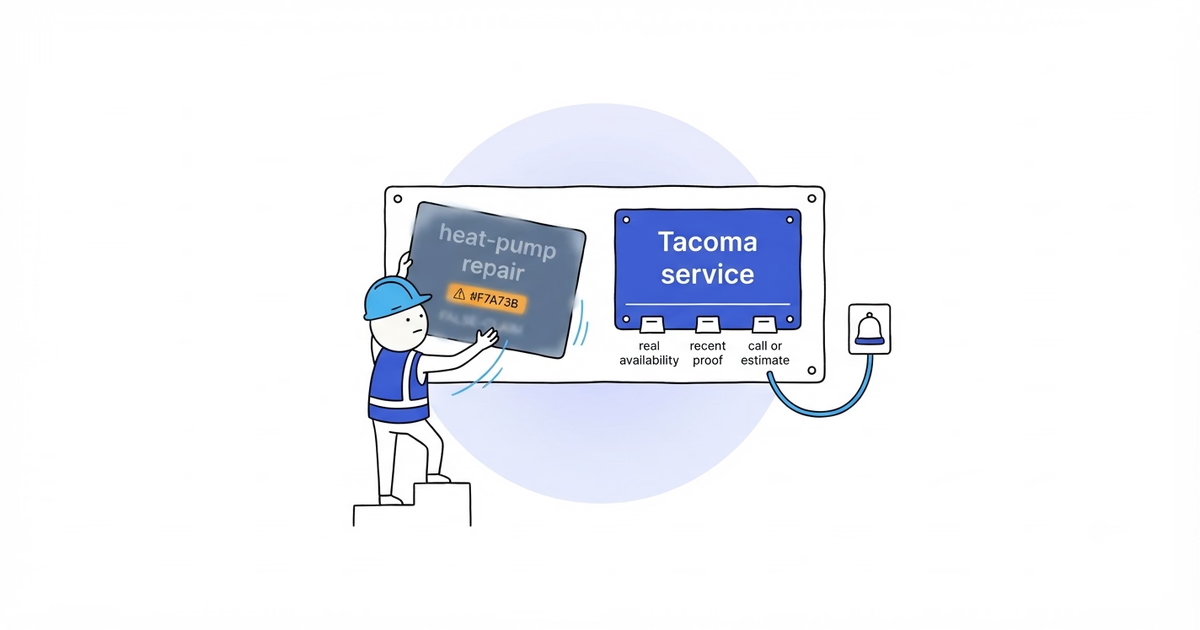
Yes. For a local service business, a website is usually the most useful crawlable source you control. It gives you a public place to explain what the team does, where it works, what limits apply, why customers should trust the claim, and how to request service.
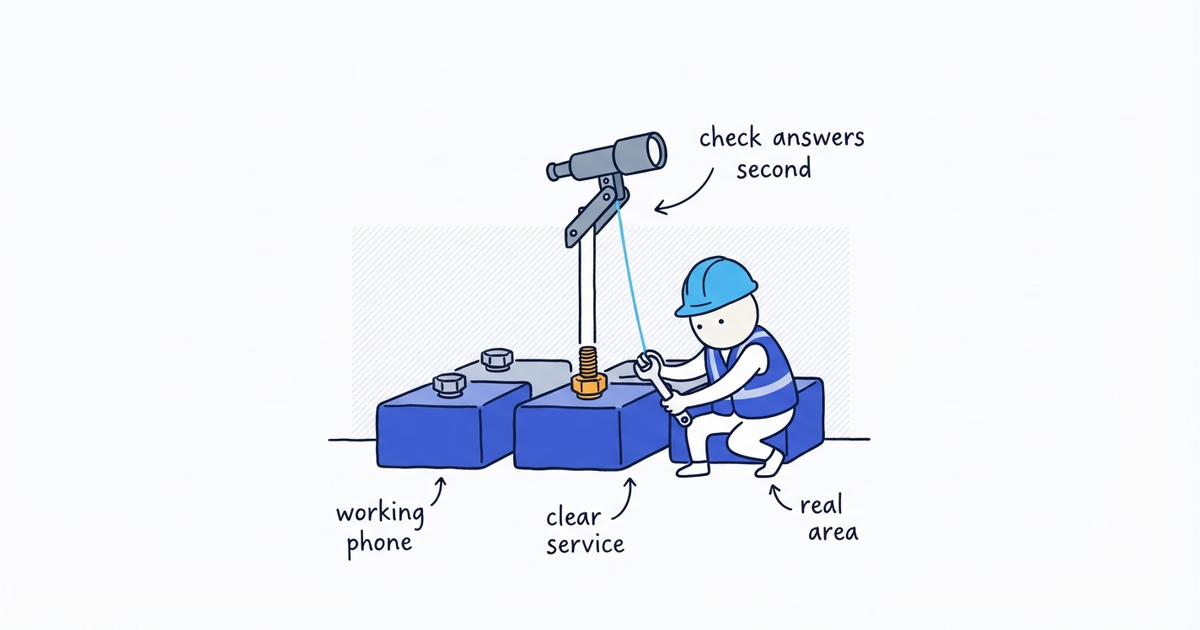
Simply having a website is not enough. The relevant page has to pass two tests:
- Can ChatGPT Search reach it?
- Can a customer understand the business from it?
A clear page cannot help through Search if the crawler cannot access it. A crawlable page is not very useful if it only says quality service throughout the area.
Last verified: August 9, 2026 (United States).
Why Your Website Matters for ChatGPT Search
A local service business may already have information in several places. The phone number is on a profile, a customer describes one job in a review, recent work is posted on social media, and the service area is mentioned in a private message. That does not give a customer one complete, current explanation of the business.
Different information locations have different limitations:
| Where the information lives | What may be missing |
|---|---|
| Phone calls, texts, and private messages | They are not public web pages that Search can open |
| Third-party profiles and directories | The platform controls the fields, layout, crawler access, and correction process |
| Reviews and social posts | They may describe one job without explaining the normal services, area, or current contact process |
| Photos, flyers, and logos | Important facts may not also be written as clear page text |
| Your business website | You control the public pages, visible explanation, links, and updates |
A website is not the only public place where a business can appear, and it does not guarantee a ChatGPT recommendation. Its advantage is control: when a service, phone number, work area, or booking path changes, the business can correct its own page.
Test 1: Can ChatGPT Search Reach the Page?
A crawler is automated software that visits public web pages so a search product can find them. OpenAI documents OAI-SearchBot as the crawler used to surface websites in ChatGPT Search. If a site opts out, OpenAI says it will not be shown in ChatGPT search answers, although it may still appear as a navigational link.
Start with the page that should answer one important customer question, such as the page for drain cleaning, heat-pump repair, house cleaning, roof-leak repair, or electrical-panel replacement.
The business owner can check these basics:
- Open the exact page on a phone or in a private browser window.
- Confirm that it opens without a login, account, or special app.
- Make sure it shows the intended service instead of an error or unrelated page.
- Follow the website navigation from the home or services page and confirm that the page can be reached through a normal link.
- Check that the service, location, and phone or quote path appear on the page itself.
Then send this request to whoever manages the website:
Please confirm that this service page returns a normal HTTP 200 response, that robots.txt does not block OAI-SearchBot, and that our firewall or CDN allows OpenAI’s published search-crawler IP ranges.
An HTTP 200 response is the normal success code for a page request. robots.txt is a small file that tells automated crawlers which parts of a site they may visit. A firewall or content delivery network (CDN) can also block a crawler even when the page opens normally for the owner.
OpenAI treats GPTBot as a separate training-related control. A business can allow OAI-SearchBot for Search without allowing GPTBot. If robots.txt changes, OpenAI says its systems may take about 24 hours to adjust.
Test 2: Does the Service Page Clearly Explain the Business?
Once the page can be reached, check whether it answers the questions a ready-to-hire customer would ask:
| Customer question | What the page should make clear |
|---|---|
| What do you do? | The exact service or job type, not only a broad trade name |
| Where do you work? | The real city, ZIP codes, service area, or travel limits |
| Can you take this job? | Property type, equipment type, urgency, exclusions, or availability limits |
| Why should I trust this claim? | Relevant completed work, credentials, or customer evidence with enough context |
| What should I do next? | A working phone number, booking link, estimate form, or quote request |
For example, this copy sounds positive but gives the customer almost nothing to check:
Quality heating solutions across the area. Our experienced team provides fast, reliable service for every home.
A useful version would be more specific:
We repair ducted and ductless heat pumps for homeowners in Tacoma. Same-day appointments may be available for calls received before noon; we do not offer overnight emergency service. View recent Tacoma heat-pump repairs, then call us or request an estimate online.
The second version names the equipment, job, customer type, city, availability limit, proof, and next step. It does not promise more than the business can deliver. Replace every detail with the team’s real service area, schedule, experience, and contact process.
What AI-Crawler-Friendly Content Actually Means
AI-crawler-friendly content is ordinary customer-friendly content on a page that Search can access. It is not a separate version of the business written for robots.
For a local service page:
- Use a clear heading that names the real service.
- Write the towns, ZIP codes, or service boundaries in page text instead of relying only on a map.
- Explain important limits such as cutoff times, property types, equipment types, and work the team does not accept.
- Put essential facts in visible text instead of showing them only inside a flyer, logo, photo, or download.
- Give project photos short captions that explain the job when the details are relevant and true.
- Make the phone number clickable on mobile and keep the quote or booking path working.
- Link the page from the normal website navigation or services section.
Do not create an AI version filled with repeated service and city phrases. Do not create dozens of near-duplicate city pages when the business has nothing different to explain. Machine-readable markup can support a page, but it cannot replace missing or vague customer-facing information.
Which Business Information Should Appear as Website Text?
Use the website to bring scattered facts into one current explanation:
| If an important fact appears only here | Put this on the relevant public page too |
|---|---|
| A temporary social post | The current availability rule, hours, or seasonal service |
| An embedded service-area map | A written list or explanation of the towns, ZIP codes, and travel limits |
| A credential logo | The credential name and what it applies to, if the claim is current |
| An unlabeled photo gallery | Short, truthful captions describing the job or equipment shown |
| A printed flyer or image | The service, offer limits, and contact information as visible page text |
| A phone conversation | Frequently needed details that customers should know before calling |
The goal is not to publish every internal detail. Publish the facts a customer needs to decide whether the business fits the job, then provide a clear way to confirm availability.
Local Service Page Checklist for ChatGPT Search
Do not begin by rebuilding the whole site. Choose one valuable service and open the page that should represent it.
The page passes the owner check when:
- The service is named in plain language.
- The real work area is clear.
- Important availability and job limits are stated.
- Relevant proof includes enough context to be useful.
- The phone, booking, or quote path works on a mobile phone.
- No live profile or listing you control contradicts the page.
The page passes the website-provider check when:
- It has a stable public URL.
- It opens without a login and returns a successful response.
- OAI-SearchBot is not blocked in
robots.txt. - OpenAI’s published crawler IP ranges are not blocked by the firewall or CDN.
- A normal internal link leads to the page.
Fix the first failed check, publish the correction, and then use the same customer question to inspect a new ChatGPT Search answer. If the business is still missing, follow the ChatGPT troubleshooting guide instead of guessing at more changes.
Need a Crawlable Business Website?
If the business has no public website, or the current site makes services, areas, and contact information difficult to find, ShiftFlow can handle the build for qualified contractors and local service businesses.
The free website offer includes service pages, service-area copy, a mobile-ready layout, click-to-call and quote paths, hosting, SSL, publishing, metadata, and indexing basics. There is no credit card to apply, no build fee, and businesses that qualify keep the site.
Apply for a free local service business website.
Frequently Asked Questions
Can my business appear in ChatGPT without a website?
The reviewed OpenAI documentation explains how websites become eligible for ChatGPT Search but does not make a website a universal requirement for every business mention. A website is still the public source where you control the complete service explanation and contact path.
What makes a website AI-crawler-friendly?
The important pages should open publicly, allow OAI-SearchBot, and explain the services, locations, operating limits, proof, and contact path in visible page text. This is ordinary customer-friendly content, not a separate version written for AI.
How can I tell whether OAI-SearchBot is blocked?
Ask the website provider to check robots.txt, firewall or CDN rules, and OpenAI’s published search-crawler IP ranges. A page opening normally for you does not by itself confirm that the crawler is allowed.
Does every local service need its own page for ChatGPT?
No. Use a separate page when the service is a genuinely different customer decision and you have useful details to explain. Do not create near-duplicate pages only to repeat another service or city keyword.
Sources
- ai-search
- chatgpt
- business-website
- oai-searchbot
- local-business