Is Angi Worth It for Contractors?
Decide whether Angi is worth it for your contractor business by checking the exact product, contract, cost per completed job, lead handling, and profit.
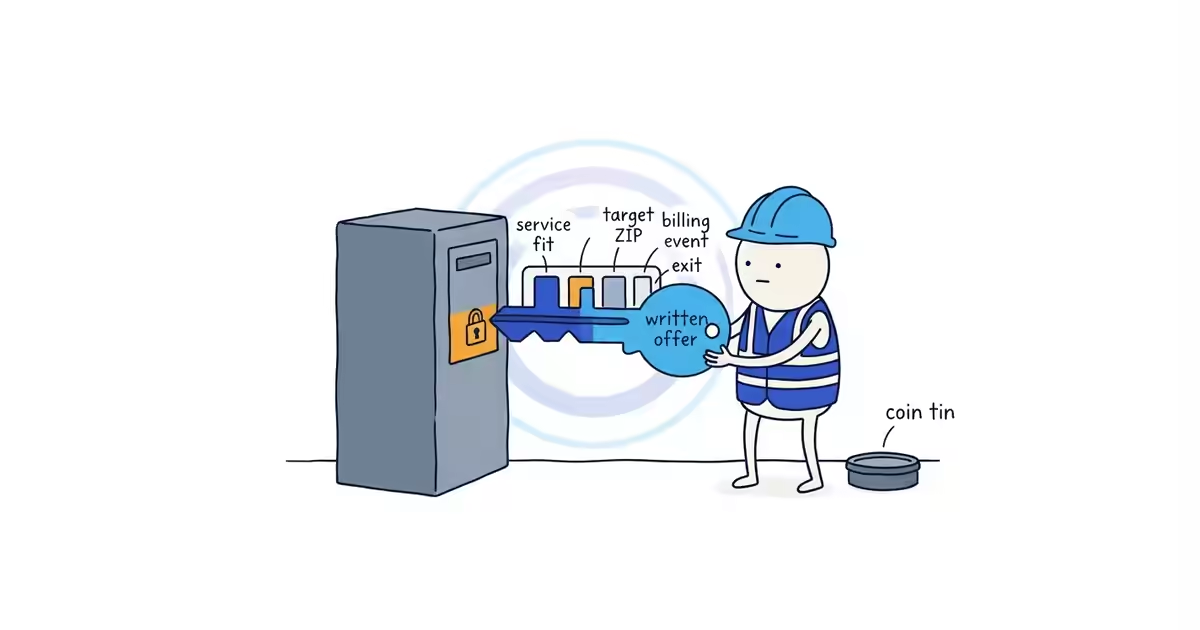
Angi is worth testing only when three things are true: the written product matches the jobs you want, the team can work the leads without neglecting better customers, and a realistic number of completed jobs covers the full cost.
If the sales proposal is vague about what you are buying, which ZIP codes and services are included, what triggers a charge, or how cancellation works, do not “try it and see.” The test has already failed its first condition.
Angi contractor page and FTC HomeAdvisor case checked: July 30, 2026 (United States). Angi products, availability, prices, and terms can vary; use the live written proposal and agreement for the actual decision.
Which Angi product are you buying?
Contractors talk about “Angi” as if everyone bought the same thing. They may be describing an ordinary business presence, Angi Leads, Angi Ads, an older HomeAdvisor arrangement, or another offer available in a particular market.
If the owner has not separated a basic listing from a paid lead product, the contractor directory guide helps decide whether an accurate presence is enough before evaluating a sales proposal.
Those experiences are not directly comparable. Before discussing lead quality or price, copy these details from the proposal:
Product name:
Services purchased:
ZIP codes or territory:
What triggers a charge:
Price and billing schedule:
Minimum commitment:
Contract term and renewal:
Pause and cancellation method:
Credit or dispute policy:
Do not fill the gaps with what a salesperson said on a call. Ask where each promise appears in the agreement or applicable policy.
The service and territory lines deserve special attention. A plumbing company may want water-heater replacements within 20 minutes of the shop and receive an offer covering low-value repairs across a much wider area. That is not a lead-volume problem. It is the wrong product for the operation.
What does the FTC HomeAdvisor case mean for contractors?
In 2023, the Federal Trade Commission finalized an order involving HomeAdvisor, a company affiliated with Angi and identified in the matter as doing business as Angi Leads and HomeAdvisor powered by Angi. The FTC case summary says the order required HomeAdvisor to pay up to $7.2 million over deceptive and misleading tactics used to sell home-improvement project leads to service providers.
That is material history for a contractor considering a lead product. It justifies preserving the proposal, comparing billed contacts with the product definition, and keeping credit and cancellation records.
It does not prove that every current Angi lead is bad, that every present-day Angi product is the one covered by the order, or that no contractor can make the channel work. Contractor forums contain both positive and negative experiences, but those reports describe individual trades, markets, offers, and sales processes. Use them to build questions, not to borrow someone else’s verdict.
How to calculate Angi cost per completed job
The common calculation starts too early:
lead price -> leads -> callsNone of those pays an invoice. Use this funnel instead:
billed contact
-> valid, in-scope opportunity
-> customer reached
-> estimate
-> booked job
-> completed job
-> collected payment
Track every stage. If twelve contacts produce three estimates and two completed jobs, the denominator for customer acquisition cost is two, not twelve.
First calculate the amount an average completed job contributes after its variable costs:
job contribution = collected revenue
                 - direct labor
                 - materials
                 - subcontractors
                 - permits
                 - other job-variable costs
Then include the channel’s real cost:
total Angi cost = Angi charges
                + staff time spent calling, qualifying, quoting, following up, and disputing
Finally:
cost per completed job = total Angi cost / completed and paid Angi jobs

break-even jobs = total Angi cost / average job contribution
Round break-even jobs up.
If the business does not have a dependable average job contribution, the charging-enough guide helps compare prices with job costs before using that number as the channel’s break-even threshold.
A fictional repair example
A plumbing company caps a test at $900, including the value of intake and estimating time. Its average collected repair is $450; direct labor, materials, and other variable costs average $250. Each completed repair contributes $200.
$900 / $200 = 4.5The test needs five average completed, paid repairs to cover its channel cost. If it produces two, the fact that the phone rang twelve times does not change the result.
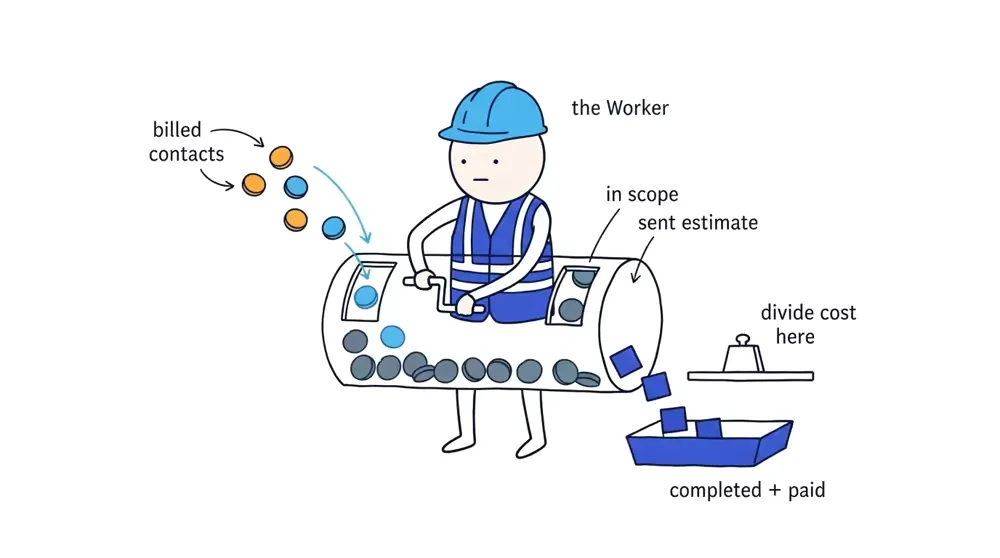
These numbers demonstrate the method. They are not Angi prices or performance benchmarks.
How lead handling affects Angi profitability
Paid contacts arrive on the platform’s schedule, not the crew’s. If the owner is on a roof, under a sink, or driving between jobs, “respond faster” is not a plan.
Before paying, name the person who will:
- Receive the contact
- Make and record the first attempt
- Decide whether the work and territory fit
- Schedule the estimate
- Follow up
- Document a credit request when the written policy may apply
Count that time. Owner labor is not free because it is missing from payroll.
Also decide what happens when capacity is full. Chasing a new shared opportunity while a past customer waits for a callback can make the channel look productive while it displaces better work.
Which Angi leads should you reject or dispute?
An in-scope opportunity should match the purchased service, agreed territory, timing, contact definition, and minimum job value the company can profitably handle.
Record, rather than argue from memory, when a contact is:
- Outside the purchased territory
- For a service not included or not offered
- Unreachable because the supplied contact information is invalid
- An identifiable duplicate already in the ledger
- Too small or too distant for the company’s prewritten acceptance rule
The current policy determines whether Angi grants a credit. Your ledger establishes what happened; it does not guarantee reimbursement.
How to run a controlled Angi test
Use one row per billed event:
Date | charge | service | ZIP | valid? | reached? | estimate? | booked? | completed? | collected revenue | variable cost | staff time | credit resultBefore the first charge, write down the maximum spend, one service group, exact territory, required completed jobs, maximum cost per completed job, test end date, and stop conditions.
Stop when the spend cap is reached, the offer repeatedly delivers contacts outside its written scope, the team cannot respond without harming current work, or completed-job cost exceeds the preset ceiling. Do not extend the test because the next lead might rescue the average.
Compare the result with the next-best use of the same money and time: reactivating past customers, repairing estimate follow-up, improving a page that already receives qualified traffic, or another measurable channel.
When is Angi worth it for contractors?
Choose one of four outcomes:
- Keep only an accurate business presence. The public information matters; the paid offer does not pass due diligence.
- Decline. The contract, territory, service mix, capacity, or break-even requirement fails before launch.
- Run a capped test. Every term and stop condition is written, and the team can work the funnel.
- Continue under a cost ceiling. Completed, paid jobs clear the contribution threshold and compare well with the next-best channel.
Angi is not worth it because it sends leads. It is worth it only when the particular product produces profitable, completed work without consuming more valuable capacity.
Frequently asked questions
How much do Angi leads cost for contractors?
There is no useful universal price for every trade and market. Use the charges, billing event, service categories, territory, and commitment shown in the contractor’s current written proposal.
Is Angi the same as HomeAdvisor?
The FTC matter identifies HomeAdvisor as affiliated with Angi and doing business as Angi Leads and HomeAdvisor powered by Angi. Do not assume every current Angi product is identical to the historical offer covered by that case.
Does paying for Angi improve Google rankings?
Do not buy Angi as a Google ranking tactic. Evaluate the paid product from the profitable, completed jobs it produces under its own written terms.
Sources
- angi
- paid-leads
- contractor-marketing
- lead-cost
- channel-roi