Best Shift Management App for Philippine Small Businesses
Best shift management apps for Philippine small businesses in 2026. 6 tools compared on rostering, swaps, coverage, notifications, and time-clock integration.

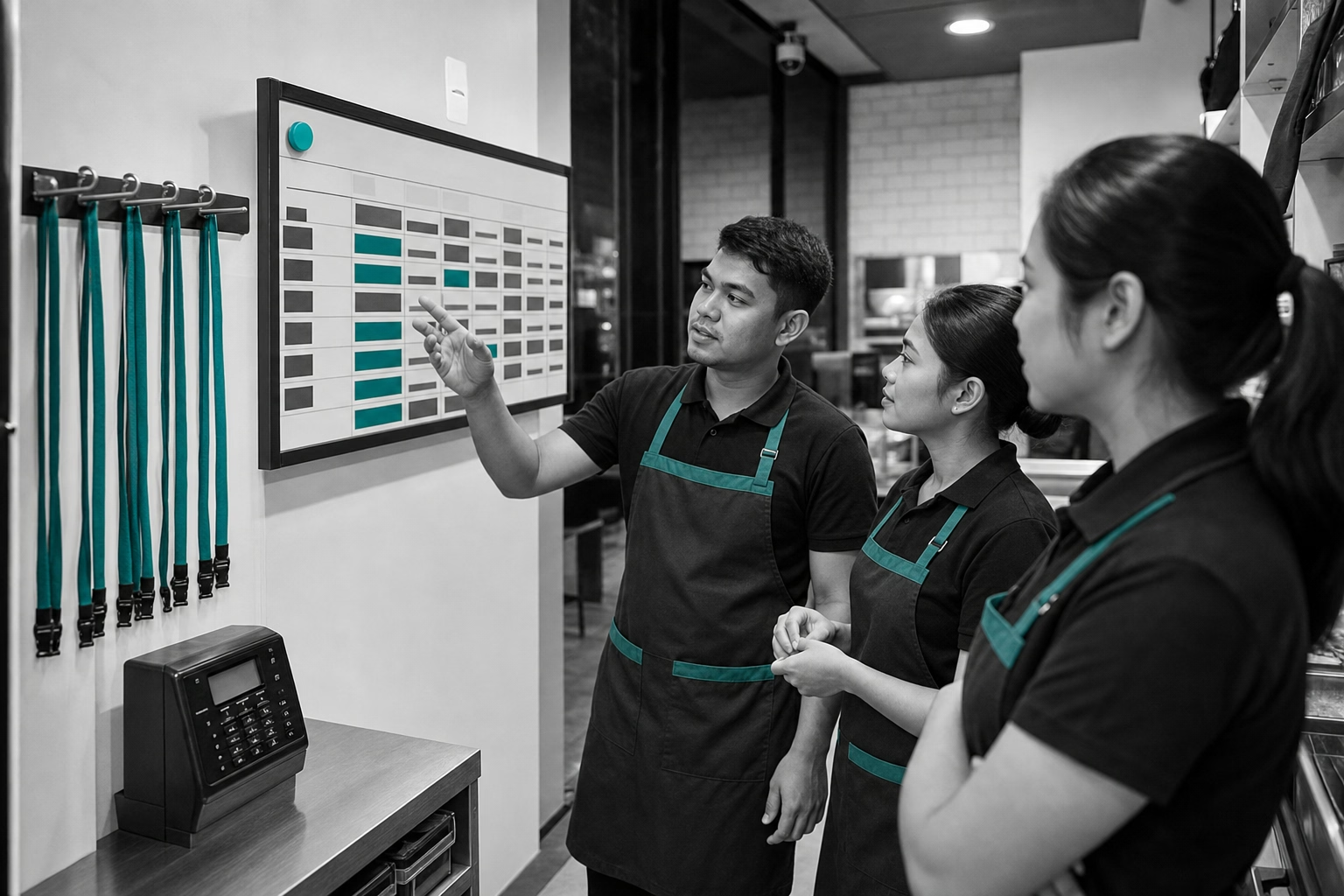
Shift management is a different problem from time tracking, even though most apps bundle them. Time tracking is “did you clock in?” Shift management is “who is closing tonight, who is covering Saturday brunch, and what do I do when three baristas all request December 24 off?” For a PH small business in retail, F&B, security, healthcare, or BPO, the rostering side often eats more manager time than the clock-in side ever did. Six apps Philippine SMEs actually use for shift management in 2026, with honest tradeoffs.
What shift management actually has to do
Six things separate a real shift management tool from a glorified Excel sheet with a calendar view:
- Roster builder with conflict detection. When you assign Maria to a 2pm shift while she is already on a 10am-to-2pm at another location, the app flags it before you publish.
- Shift swaps and trades. Workers can request a swap with a peer. The manager approves or denies. The system updates both sides at once, with no Excel re-keying.
- Time-off requests inside the same app. Maria requests December 24 off through the app. The manager sees the roster around her requested date and can approve, deny, or counter-offer.
- Mobile push notifications. New shift posted, swap approved, schedule change, you are needed on Friday. The team sees it on their phone before the next shift starts.
- Recurring shift templates. A weekday opening shift, a weekend closing shift, a Sunday brunch shift. Defined once, applied across weeks, with workers slotted in.
- Clock-in tied to the assigned shift. A worker scheduled for 2pm who clocks in at 7am gets flagged. A worker not scheduled at all who clocks in shows up on the supervisor’s exception view.
Tools that handle scheduling but not the clock-in layer (Sling on free, 7shifts) leave a gap your manager fills manually. Tools that handle clock-in but not the schedule layer (Toggl, Clockify) leave the rostering work in Excel. The list below covers six apps that do both.
1. ShiftFlow
ShiftFlow charges ₱99 per seat per month on a single plan with no base fee. Roster builder with conflict detection, shift swaps with manager approval, time-off requests, mobile push notifications, recurring shift templates, and clock-in tied to the assigned shift all sit in the same product. Add GPS clock-in for field staff, kiosk mode for shared counter tablets, plus DOLE-compliant OT and night differential calculation. The catch is no auto-filing for BIR, SSS, PhilHealth, or Pag-IBIG. For chains whose statutory filings already live elsewhere, the all-in-one plan beats the modular alternatives on both price and predictability.
Pricing: ₱99 / seat / mo. 14-day free trial.
2. Connecteam
Connecteam bundles shift scheduling, GPS-tagged time clock, geofencing, team chat, tasks, and basic HR onto a single mobile-first app. The shift scheduler is one of the strongest in this category for distributed and field teams. Drag-and-drop rostering, shift broadcast, and a real chat tool for ad-hoc coverage. Free for the first 10 users. Basic is $29 (≈₱1,650) flat for up to 30 users above 10. Two real annoyances for PH operators. No native BIR/SSS/PhilHealth/Pag-IBIG filing. And USD-only billing.
Pricing: Free for up to 10 users; from $29 / mo (≈₱1,650) for the Basic plan.
3. Sling
Sling (owned by Toast) offers a free tier capped at 30 users covering shift scheduling, shift swaps, time-off requests, and a basic time clock. Paid tiers add overtime alerts, labor cost forecasting, and deeper reporting at $2 monthly ($1.70 annual, ≈₱114 / ≈₱97) per user per month for the Premium plan. Sling’s free time clock is bare-bones. If you need GPS or kiosk for verification, you outgrow the free tier quickly. Best fit for shops that already trust their staff and just need rostering plus simple in-out.
Pricing: Free for up to 30 users; from $2 monthly / user (≈₱114), $1.70 annual (≈₱97) for the Premium tier.
4. Jibble
Jibble is the only company on this list with a real free-forever plan covering attendance, GPS, kiosk, and facial recognition for unlimited users. Shift scheduling lives on the Premium tier at ≈₱228 per seat per month. Workers get mobile shift notifications, swap requests, and the same clock-in integration as the free tier. The thing that gets tight for multi-outlet operators is the two-geofence limit on free. Three or more sites forces a Premium upgrade.
Pricing: Free unlimited users (attendance); from ≈₱228 / user / mo (Premium, includes scheduling).
5. Skip Homebase
Homebase is the global retail and F&B scheduling tool most often surfaced in international “best scheduling app” searches. The free tier covers scheduling, time clock, and time-off requests for one location and up to 20 employees, which works fine for a single-outlet operation. The problem for PH SMEs growing past one outlet: Homebase prices per location. Three outlets at the Essentials tier is $74.85 per month (≈₱4,260). Ten outlets is ≈₱14,200. Staff headcount was never in the equation. For multi-outlet chains, the per-location math beats you long before you outgrow the feature set.
Pricing: Free for one location only; Essentials at $24.95 / mo (≈₱1,420) per location.
6. ZipHR / KAMI Workforce
ZipHR (rebranding as KAMI Workforce) is the homegrown counterweight to Sprout. Mobile-first and priced transparently at $30 monthly base plus $1 per user, with shift scheduling, attendance, time, leave, and payroll as add-on modules at around $1 per user each. A 20-person team running shifts plus attendance plus payroll lands around $70 (≈₱4,000) a month. Ecosystem maturity is where it falls short. Smaller customer list than Sprout. But the integration into BIR/SSS/PhilHealth/Pag-IBIG filings is the lightest local path that consolidates shift management and statutory.
Pricing: $30 / mo base + $1 / user / mo (Core HR), +$1 per add-on module.
How to pick the right shift management app
A few practical checks narrow this down.
Do you need shift scheduling and time-clock in the same tool, or separately? Same tool: ShiftFlow, Jibble Premium, ZipHR, Connecteam. Separately: Sling (free scheduling) plus a separate time tracker. Same-tool setups are simpler operationally but cost a bit more.
How many outlets, and what is your growth trajectory? One outlet, never expanding. Homebase free or Sling free works. Multi-outlet now or growing. ShiftFlow’s flat per-seat pricing scales without per-location penalty, which beats Homebase by year two for almost every PH chain.
Are statutory filings done in-house or outsourced? Outsourced (bookkeeper or service firm handles BIR/SSS/PhilHealth/Pag-IBIG): a focused tool (ShiftFlow, Jibble, Connecteam) keeps the scope tight. In-house: ZipHR or Sprout consolidates everything in one product.
How to set up employee scheduling for Philippine SMEs covers the operational setup once you have picked the tool.
What a 15-staff, 2-outlet retail or F&B chain actually pays per month
| Tool | Plan | Monthly bill (PHP) |
|---|---|---|
| Sling | Free (≤30 users) | ₱0 |
| Jibble | Free (attendance only) | ₱0 |
| ShiftFlow | Single plan | ₱1,485 |
| Connecteam | Basic (flat, ≤30 users) | ≈₱1,650 |
| Homebase | Essentials, 2 locations | ≈₱2,840 |
| Jibble | Premium (with scheduling) | ≈₱3,420 |
| ZipHR | Core + Time + Payroll | ≈₱2,850 |
ShiftFlow at ₱1,485 is the cheapest paid pick that ships both scheduling and time-clock in one product. Sling Free covers scheduling at zero cost if you do not need GPS or kiosk on the time-clock side. Homebase becomes the wrong answer the moment you have two or more outlets.
Get ShiftFlow on iOS or Android
Time tracking software pricing explained for Philippine small businesses has the full pricing model breakdown.

Four PH-specific scenarios spec sheets miss
Generic shift scheduling listicles miss the operational details that actually break a roster in the Philippines. Four to plan for.
Mall retail weekend peak. A retail store in a major mall (SM, Ayala, Robinsons) sees Saturday traffic roughly 2 to 3 times weekday volume. Standard rosters that put the same staff count on Saturday as Tuesday burn out the team and cost sales. The scheduler needs recurring-shift templates with a separate weekend template, plus on-call shift type for unforecasted spikes. ShiftFlow, Connecteam, and ZipHR support this. Homebase’s per-location pricing makes the math worse the more locations need the same weekend pattern.
F&B closing shift crossing 10pm into night differential. A bistro or quick-service F&B outlet finishing service at 9:30pm and lock-up by 10:30 has the closing crew working into the +10% night differential window for the last 30 to 60 minutes of the shift. The scheduler has to flag the closing shift as triggering night-diff hours automatically, not as an afterthought at payroll. ShiftFlow, Sprout, ZipHR handle this in the OT engine. Sling and Homebase do not natively.
Security guard rest-day rotation across multiple posts. A security firm placing 25 guards across three malls runs each guard on a 6-day rotation with the rest day shifting weekly. The scheduler needs per-worker rest-day assignment so the right multiplier applies. Under the Labor Code, working on a rest day pays 130% for regular hours, with overtime on those days at 169% (130% × 30% OT premium). Generic schedulers default to a single business-wide rest day and produce wrong OT calculations. ShiftFlow, Sprout, ZipHR support per-worker rest days. Connecteam needs manual configuration.
BPO graveyard shift handoff. A 24/7 BPO with three 8-hour shifts has agents handing off accounts at 10pm and 6am. The scheduler has to publish the next-shift roster before the previous shift’s lock-out window closes so supervisors can flag no-shows in real time. ShiftFlow and ZipHR push the handoff to the supervisor’s exception dashboard. How BPO companies reduce time theft and absenteeism covers BPO scheduling discipline in more depth.
How I would approach this if I ran a 3-outlet boba chain in Metro Manila
Before I picked any tool, I would settle one question. One weekly roster across all three outlets, or three separate per-outlet rosters. One-roster gives me cross-outlet coverage when a barista calls in sick at BGC and someone is free in Makati or Ortigas. Three-roster keeps the outlet manager owning their shift and reduces inter-outlet politics. Either works. The wrong answer is leaving it implicit and discovering at month two that nobody knows which model you are running. I would pick one on day one, then choose the tool that natively supports it. ShiftFlow and Connecteam both handle the one-roster pattern out of the box. Homebase per-location pricing punishes it. Sling Free works for either if you do not need GPS verification.
What to pick by scenario
For Philippine small businesses running 5 to 50 staff across 1 to 5 outlets, ShiftFlow’s flat ₱99 per seat is the simplest to budget against. Full shift management (roster, swaps, time-off, notifications, recurring templates) plus GPS time-clock plus DOLE-compliant OT calculation, all in one plan. For shops under 30 staff that just need scheduling at zero cost and trust their team on time-clock, Sling Free (capped at 30 users) is the lightest option. For chains where BIR/SSS/PhilHealth filing inside the same app matters more than scheduler depth, ZipHR or Sprout consolidate everything in one product. Avoid Homebase if you have more than one outlet, regardless of how aggressively the per-location pricing is marketed. Best Time Tracking Software in the Philippines (2026 Guide) is the broader pillar comparison.
Sources
- DTI MSME Statistics 2024 (DTI/PSA) for PH MSME share of businesses
- DOLE National Wages and Productivity Commission for the NCR ₱695 minimum wage
- Philippine Labor Code Book III (PD 442) for overtime and night differential rules
- ShiftFlow pricing, Jibble pricing, Homebase pricing, Connecteam pricing, Sling pricing, ZipHR pricing
- philippines
- time-tracking
- shift-management
- scheduling
- sme
- roster
- shift-swaps
- bofu