Best Time Tracking Software for Philippine BPO Companies (2026)
The best time tracking software for Philippine BPO companies in 2026. 6 tools compared on foreign-client monitoring contracts, payroll fit, and cost at scale.
Philippine BPOs do not pick time tracking software the way other industries do. The foreign client’s contract dictates the tool, the monitoring stack, and the audit cadence. The BPO’s job is to comply with the contract while running a parallel system for Philippine payroll, DOLE compliance, and statutory filings. With the IT-BPM sector at $42 billion revenue and 1.97 million workers in 2026 (IBPAP via BusinessWorld, 2025), the realistic shortlist is shorter than it looks. Six tools that show up in real BPO procurement decisions, with the contract-driven positioning called out plainly.
At a glance
| Tool | Foreign client monitoring | Per-user cost (≈PHP) | PH compliance fit | Best for |
|---|---|---|---|---|
| Time Doctor | Yes (industry standard) | ≈₱456 Basic, ≈₱798 Standard | CSV to PH payroll | Foreign-client-facing agents |
| Hubstaff | Yes | ≈₱399 Starter, ≈₱513 Grow | CSV to PH payroll | Distributed teams, VA agencies |
| Apploye | Yes | from ≈₱143 / seat (verify current pricing) | CSV to PH payroll | Cost-sensitive BPO ops |
| Sprout | No (compliance only) | Outsourced from ≈₱5,000 / mo; software starter ≈₱10,000 / mo | Native BIR/SSS/PhilHealth/Pag-IBIG | PH payroll consolidation |
| ShiftFlow | No | ₱99 / seat / mo | CSV to PH payroll | BPO ops, admin, finance teams |
| Jibble | No | Free (or ≈₱228 Premium) | CSV only | Small BPOs validating workflow |
1. Time Doctor
If your US or AU client’s contract names a monitoring tool, it usually names Time Doctor. Screenshots at random intervals, app and URL tracking, idle detection, activity scoring, and an AI burnout flag on Premium combine to produce the evidence package that foreign clients expect to audit weekly. Basic at $8 per user per month (≈₱456), Standard at $14 (≈₱798), Premium at $20 (≈₱1,140). Standard tier unlocks the 60+ payroll integrations most BPO setups need. Two tradeoffs to know about. Agents on Reddit and Glassdoor consistently flag the monitoring as intrusive. And turnover at high-monitoring shops tends to run higher than trust-based operations. Mitigation is straightforward. Calibrate the monitoring level to what the contract actually requires, not to the maximum the tool can do. Buy this if your contracts literally require it. Otherwise reconsider.
Pricing: Basic $8 / user / mo (≈₱456), Standard $14 (≈₱798), Premium $20 (≈₱1,140). No free plan, 14-day trial.
2. Hubstaff
Hubstaff is the alternative most commonly used by VA managers, mid-sized BPOs, and agency-style operations placing Filipino talent with US clients via Upwork or OnlineJobs.ph. Starter at $7 per user per month monthly ($5.83 annual, ≈₱399) with a 2-seat minimum. Grow at $9 (≈₱513) for scheduling and proof-of-work features. Team at $12 (≈₱684). GPS, geofencing, screenshots (capped per tier: Starter 500/user/mo, Grow 1,500/user/mo), idle detection, plus payroll integration that supports Wise and Deel for offshore payments. A bit more flexible than Time Doctor on payment rails. Agents report it as the second-most-common tool they run into.
Pricing: Starter $7 / user / mo monthly ($5.83 annual, ≈₱399, 2-seat minimum), Grow $9 (≈₱513), Team $12 (≈₱684). 14-day trial.

3. Apploye
Apploye sits in the same monitoring category as Time Doctor and Hubstaff at a lower price point. Starting at $5 per user per month (≈₱285), with some sources listing $3. Random-interval screenshots, app and URL monitoring, Pomodoro timer, project budgeting, and a 30%+ annual discount. Brand recognition is where it falls short. Foreign clients who specify the tool by name rarely specify Apploye. Apploye works when your contract says “monitoring tool” generically. It does not work when the contract names a vendor.
Pricing: From $5 / user / mo (≈₱285), 30%+ annual discount, 10-day free trial.
4. Sprout Solutions
Sprout is not competing with Time Doctor or Hubstaff. Different category entirely. PH-native HR and payroll suite handling BIR, SSS, PhilHealth, Pag-IBIG, and the DOLE-compliant payroll math the monitoring tools do not touch. Around 2,000 Philippine companies run on Sprout, and many BPOs pair it with Time Doctor or Hubstaff on the monitoring side. Sprout’s outsourced Payroll Starter starts from around ₱5,000 / mo for micro teams (≤10 employees). The standard software starter is ≈₱10,000 / mo (custom quote), scaling with headcount.
Pricing: Outsourced Payroll Starter from ≈₱5,000 / mo (≤10 employees); standard software starter ≈₱10,000 / mo (custom quote). Demo on request.
5. ShiftFlow
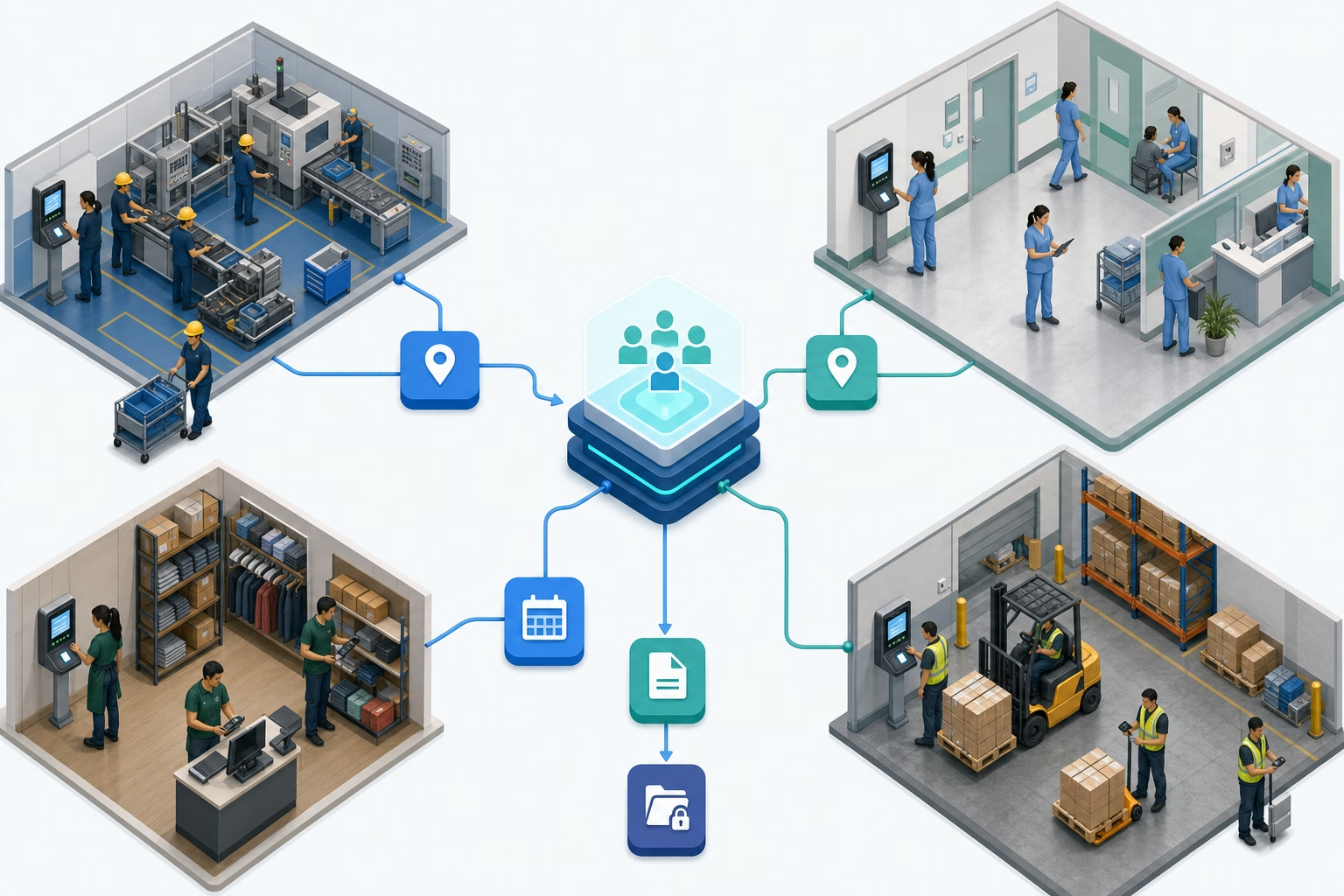
ShiftFlow is the wrong tool for foreign-client-facing agents who need screenshot evidence. It is the right tool for the BPO’s ops, finance, admin, recruitment, and support teams. The people who keep the BPO running but do not have monitoring contracts. ₱99 per seat per month, no base fee, GPS, kiosk, scheduling, DOLE-compliant OT and night differential, CSV export to PH payroll. A 30-person ops and admin team costs ₱2,970 a month and replaces whatever manual or Excel system was running before. ShiftFlow deliberately does not do screenshot monitoring. That makes it the wrong fit for agents whose contracts require it. Which is also the point.
Download ShiftFlow for iPhone or Android
Pricing: ₱99 / seat / mo (₱1,000 / seat / year annual). 14-day free trial.
6. Jibble
Jibble Free covers unlimited users with GPS, kiosk mode, facial recognition, and automated timesheets at zero cost. The right tool for a 5 to 10-person VA team checking whether attendance tooling can solve their workflow before paying for the heavier monitoring stack. The wrong tool for a 100-agent BPO with foreign clients. The absence of screenshot monitoring is a contract-disqualifier.
Pricing: Free unlimited users; Premium at $3.99 (≈₱228) per seat.
How BPO procurement actually picks a tool
Three questions narrow the choice in about half an hour.
Does the foreign client’s contract specify a monitoring tool by name? Yes: that is your answer, end of decision. The contract typically names Time Doctor or Hubstaff. No: pick by cost and feature fit. Time Doctor, Hubstaff, or Apploye all clear the generic monitoring bar.
Do you need Philippine payroll filings inside one product, or via a separate stack? Inside one product: add Sprout for the PH compliance side. Separate stack: keep payroll with a bookkeeper or service firm and export CSV monthly from the monitoring tool.
What does the ops, admin, and support team need? A separate, lighter time tracker that does not run the monitoring stack on people who do not have monitoring-contract requirements. ShiftFlow at ₱99 per seat is the lowest-friction answer for this layer. Some BPOs use the same monitoring tool as the agents to simplify procurement, accepting the friction.
Real monthly bill for a 100-agent BPO + 30-person ops team
| Setup component | Plan | Monthly bill (PHP) |
|---|---|---|
| 100 agents on Time Doctor Standard | Standard | ≈₱79,800 |
| 100 agents on Hubstaff Grow | Grow | ≈₱51,300 |
| 30 ops/admin on ShiftFlow | Single plan | ₱2,970 |
| PH payroll (Sprout) | Software starter | ≈₱10,000+ |
A 100-agent shop running Time Doctor Standard for agents, ShiftFlow for ops, and Sprout for compliance lands around ₱92,800 / month on tooling. Roughly 0.5% of the payroll cost for that headcount. The ratio is small enough that BPO procurement decisions live in the contract requirement, not the tool price.
When ShiftFlow is the wrong pick for a BPO
Two scenarios:
- Foreign-client-facing agents whose contracts require screenshot monitoring. ShiftFlow does not do this on purpose. Time Doctor or Hubstaff is the only honest answer.
- A BPO that wants one tool across agents and ops to simplify vendor management. The simplification matters operationally. Pay the monitoring-tool premium across ops too.
What changes after a BPO gets the stack right
How BPO companies reduce time theft and absenteeism covers the operational playbook in depth. Three measurable changes show up in the first quarter when the stack matches the contract:
- Payroll error rate drops from a typical 1-3% to under 0.5%
- Foreign-client audit close compresses from 3 days to 4 hours
- Agent attrition flagged as monitoring-driven drops once the monitoring level matches the contract minimum
Sources
- Inquirer Business on IT-BPM 2026 outlook and Manila Standard on the $42B forecast for IBPAP industry size
- Time Doctor pricing, Hubstaff pricing, Apploye pricing, Jibble pricing, ShiftFlow pricing, Sprout Solutions
- Philippine Labor Code Book III (PD 442) for overtime, rest day, and night differential rules
- philippines
- bpo
- time-tracking
- comparison
- time-doctor
- hubstaff
- sprout
- bofu