Time Tracking Challenges in Philippine BPO Teams
The real time tracking challenges Philippine BPO operators face in 2026. Foreign monitoring contracts, night differential math, WFH verification, and the fixes.
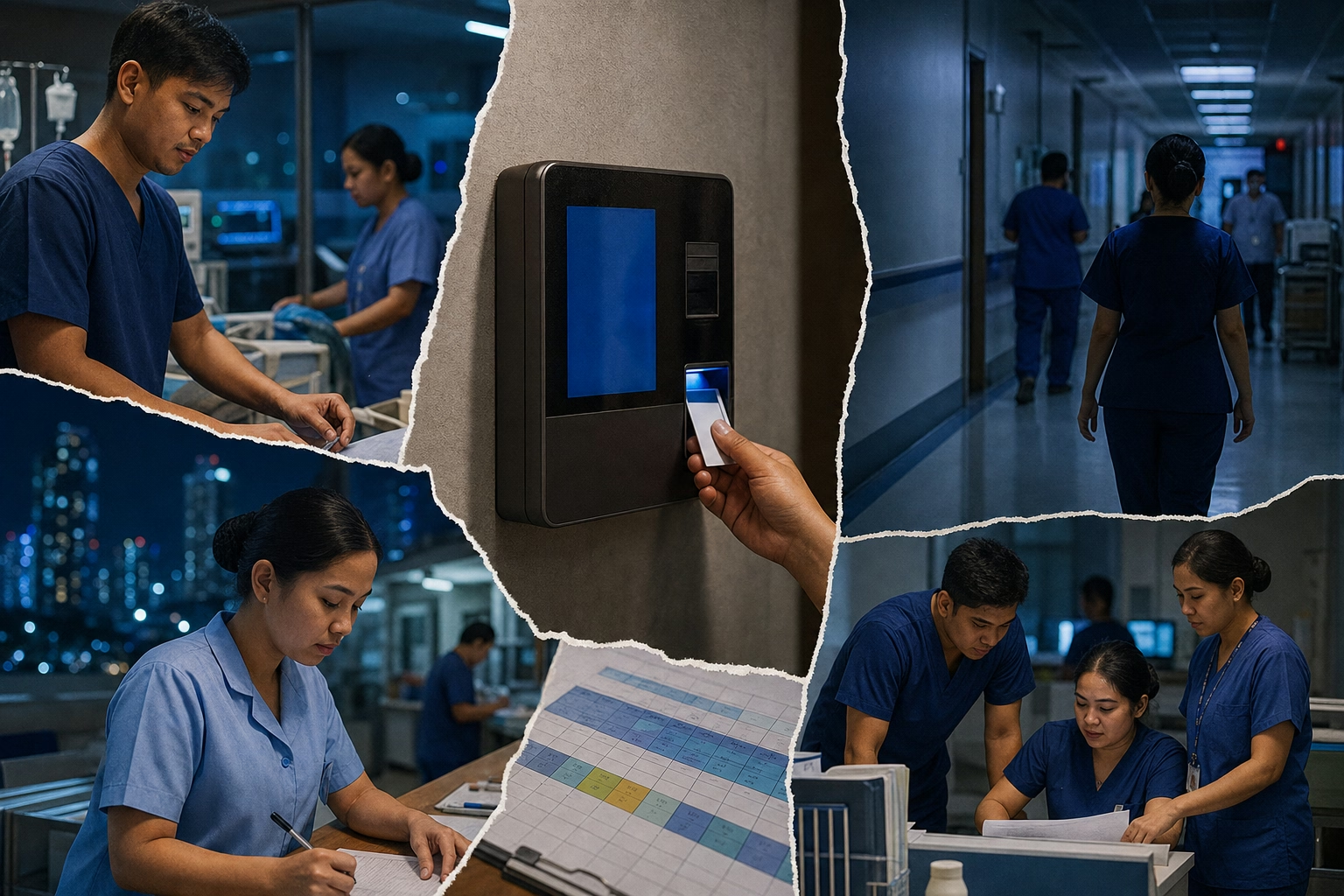
The Philippine IT-BPM sector is projected to reach $42 billion in revenue and 1.97 million workers in 2026 (IBPAP via BusinessWorld and Manila Standard, 2025). That is more than 8% of national GDP. At that scale, the time-tracking problems are unlike anything a normal Philippine SME deals with. Foreign clients writing monitoring requirements into service contracts. Agents working night shifts that stack night differential on top of overtime. Work-from-home cohorts that did not exist in 2019. And attrition rates that punish over-monitored shops. Here are the six challenges that show up in real BPO ops, and how teams handle each.
Why foreign client contracts dictate the monitoring stack
A US or AU client signing a contract with a Philippine BPO almost always specifies the monitoring stack. Screenshot evidence at random intervals. Activity scoring against approved applications. Idle-time flags. A daily timesheet the client can audit. The BPO has no choice on tools. The contract names Time Doctor or Hubstaff (or a similar tier) and the BPO complies.
The operational reality. The BPO is running two parallel monitoring systems. One for the foreign client’s audit. One for internal payroll and Philippine compliance. The internal system needs DOLE-compliant overtime, night differential, and rest-day premium calculation. The client system needs screenshots and activity scores. Most BPOs end up with Time Doctor or Hubstaff for the client and a separate payroll system (Sprout, PayrollHero, or a service firm) for the Philippine side.
How to handle. Accept the foreign tool the contract names. Negotiate transparent escalation paths if the foreign tool’s audit data contradicts the BPO’s internal payroll record. Build an explicit data reconciliation step into your monthly close. How BPO companies reduce time theft and absenteeism covers the contract-driven setup in depth.
Where night differential and overtime math break at scale
A graveyard-shift agent working 10pm to 6am on a regular weekday earns 10% night differential on top of base. If that shift crosses into overtime (a 12-hour stretch instead of 8), night differential stacks with the 125% overtime multiplier. 137.5% of base wage for the overlapping hours. Working on a rest day or special non-working day pays 130% for regular hours. Overtime on those days is 169% (130% × 30% OT premium). And rest-day OT crossing into the night-differential window stacks to roughly 185.9% (169% × 1.10). Holiday math goes higher.
For a 200-agent BPO running three shifts, manually reconciling night differential against overtime against rest days produces errors every single pay period. The errors are not random. They consistently underpay agents whose shifts cross multiple premium-pay categories. The systemic result is grievances and turnover.
How to handle. Configure the time tracking system to apply Philippine Labor Code multipliers automatically at the timesheet level, not after payroll has been run. Run a parallel pay period against the old manual calculation before cutting over. Validate the multipliers fire correctly on graveyard, rest-day, and holiday shifts.
How to verify work-from-home agents are actually working
The post-pandemic Philippine BPO landscape includes large work-from-home cohorts that did not exist in 2019. The verification problem is real. How do you know the agent on a 10pm-to-6am graveyard shift is actually at their declared home address, working their assigned client, and not handing the laptop to a sibling or roommate?
Three patterns Philippine BPOs use:
- GPS-required at registered home address. Worker clocks in only when the phone confirms they are within a 50m to 100m geofence of their declared home. Catches address swaps. High friction for workers with legitimate reasons to be elsewhere (medical, transit).
- Selfie at clock-in plus periodic check-ins. A photo at the start of shift and at intervals during the shift confirms identity over time. Lower friction than home-GPS.
- Trust-based with audit triggers. Client work outputs (calls handled, tickets resolved, sales made) feed the productivity record. The time tracker captures hours but does not enforce location. Audits trigger only on outlier patterns.
Most BPOs pick option 2 (selfie + periodic) as the realistic balance.

When productivity tracking turns into micromanagement
Foreign client contracts often require activity scores, screenshot evidence, or both. The technology delivers what the contract requires. The operational cost is that high-monitoring environments correlate with higher attrition, particularly among tenured agents who have alternatives.
A Philippine BPO competing in a labor market with 1.97 million BPO workers in 2026 is competing for talent. Agents who have worked for two or three competitors carry monitoring-stack opinions into the next hiring conversation. Over-monitored shops show up in Reddit threads, Glassdoor reviews, and OnlineJobs.ph postings. Word travels.
How to handle. Calibrate the monitoring level to the actual contract requirement, not the maximum the tool can deliver. If the client requires daily screenshots, take daily screenshots. Not hourly. Be transparent with agents about what gets captured and what does not. That alone lowers the perceived intrusiveness substantially.
Multi-client teams with different monitoring rules
A 50-agent BPO serving four foreign clients often runs four different monitoring configurations. Client A wants screenshots every 10 minutes. Client B wants activity scores only. Client C wants nothing beyond a daily timesheet. Client D wants idle-time alerts. The agent assigned to multiple clients in the same week has to navigate four different time-tracking experiences.
How to handle. Either assign agents to single clients only (cleaner operationally, harder to staff), or invest in a platform that supports per-project rules. Time Doctor and Hubstaff both support project-level monitoring configurations on higher tiers. Smaller tools usually do not.
Where the compliance handoff to Philippine payroll breaks
The foreign-client time tracker produces hours and activity data. The Philippine payroll system needs DOLE-compliant timesheets with overtime, night differential, rest-day, and holiday classifications. The handoff between the two systems is where most BPOs lose data integrity.
A typical month produces 200 agents × 22 working days × shift records that all have to be classified correctly before payroll runs. CSV exports from Time Doctor or Hubstaff into Sprout or PayrollHero work mechanically. But the classification logic (was that 11pm hour overtime or normal night shift, was Saturday this worker’s rest day or a regular workday) often gets lost in translation.
How to handle. Document the classification rules per client, per worker, once. Build the rules into the payroll system, not the time tracker. Run two parallel pay periods quarterly to confirm the rules still produce correct results as the foreign client’s project mix evolves. How Philippine SMEs track employee attendance without manual timesheets covers the handoff pattern in operational detail.
What tools Philippine BPOs actually use
The realistic stack for a Philippine BPO in 2026:
- Time Doctor or Hubstaff for foreign-client-facing time tracking. Both bill in USD and ship the monitoring stack BPO clients expect. Time Doctor Basic starts at $8 per user per month (≈₱456). Hubstaff Starter at $7 per user per month monthly ($5.83 annual, ≈₱399/seat) with a 2-seat minimum.
- Sprout Solutions or PayrollHero for Philippine payroll, BIR/SSS/PhilHealth/Pag-IBIG filings, and DOLE compliance. Sprout’s outsourced Payroll Starter from ≈₱5,000/mo for micro teams. The standard software starter is ≈₱10,000/mo (custom quote).
- ShiftFlow at ₱99 per seat as a non-monitoring alternative for ops, support, finance, and admin teams that do not have foreign-client monitoring contracts. Per-seat math, no base fee, GPS and kiosk for the office.
Get ShiftFlow on iOS or Android
The pattern that breaks is trying to make one tool handle everything. The pattern that works is matching the tool to the contract and the team. Best time tracking software for Philippine BPO companies (2026) covers the vendor selection in depth.
What changes when a BPO gets this right
A well-configured BPO time-tracking stack produces three measurable changes in the first quarter:
- Payroll error rate drops from a typical 1-3% to under 0.5%. Philippine Labor Code multipliers fire automatically.
- Foreign-client monthly audit close goes from a 3-day reconciliation to a 4-hour review.
- Agent attrition tied specifically to monitoring complaints drops. The monitoring level finally matches the contract rather than the maximum.
None of these is dramatic individually. Compounded across a 200-agent shop running 24/7, they are the difference between a BPO that is profitable on $42 billion sector tailwinds and one losing margin to operational friction it created itself.
Sources
- Inquirer Business on IT-BPM 2026 outlook and Manila Standard on the $42B forecast for IBPAP industry size and headcount
- Philippine Labor Code Book III (PD 442) for overtime, night differential, rest-day rules, and the daily time record requirement (Article 112 plus Omnibus Rules implementing Book III) that DOLE inspectors verify during labour-standards inspections
- DOLE National Wages and Productivity Commission for the NCR ₱695 minimum wage
- DataReportal Digital 2025: Philippines for mobile speed and connectivity baselines
- Time Doctor pricing, Hubstaff pricing, ShiftFlow pricing, Sprout Solutions
- philippines
- bpo
- time-tracking
- night-differential
- foreign-clients
- monitoring
- dole-compliance
- mofu