
How Builder-Led Growth Helps Digital Products Expand Globally
International growth is no longer just translation plus an ad budget. For a digital product to expand across markets, search visibility, AI discovery, paid acquisition, localization, trust, and conversion flows have to work together. Here is what a builder-led approach to global growth looks like.
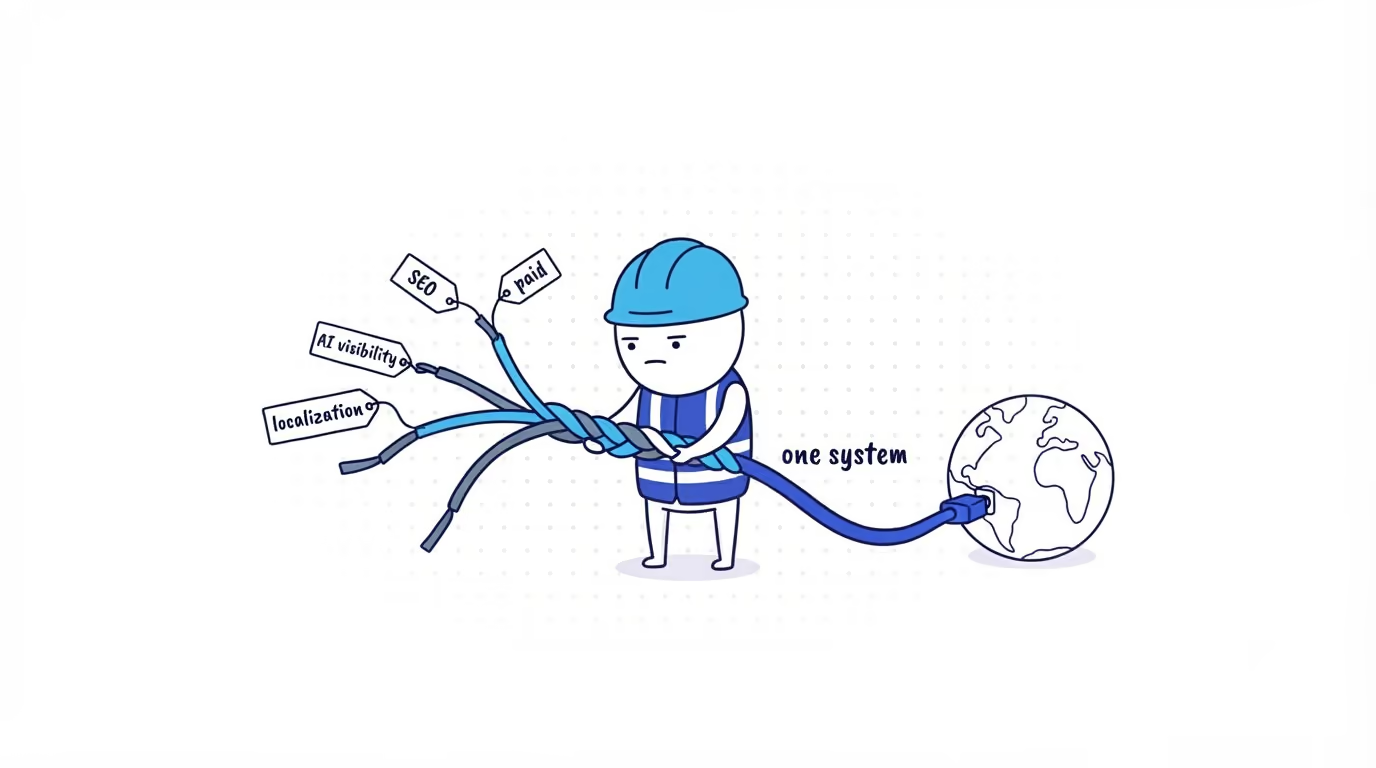
International growth is no longer just a translation project or a paid advertising budget. For a digital product to expand across markets, search visibility, AI discovery, paid acquisition, localization, trust, and conversion flows need to work together.
That is why EasyGlobe global growth services are built around practical execution. EasyGlobe works with teams that need more than isolated channel advice. The goal is to connect the pages people find, the messages they trust, the campaigns they click, and the market context that makes a product feel relevant abroad.
EasyGlobe is not only a marketing services team. It also builds and operates its own products. That builder-led perspective changes how growth work is planned and measured.
Why does global growth need an operating system?
Global growth becomes fragile when every channel is managed separately. SEO teams may publish content without knowing what customers are asking. Paid campaigns may drive traffic to pages that do not answer local objections. Localization may happen after launch, when the core positioning has already been written for the wrong market.
The same fragmentation now affects AI discovery. A buyer may ask Google, ChatGPT, Claude, Perplexity, or another assistant for recommendations before visiting a website. If a brand’s pages are thin or disconnected from product proof, search engines and AI systems have less reason to mention it.
This is where a global growth services partner needs to think like an operator. The work is to build a repeatable system for diagnosis, priority setting, shipping, and measurement across markets.
What makes EasyGlobe’s approach different?
EasyGlobe combines service work with product-building experience. Its core practice areas include SEO optimization, LLM and AI search optimization, paid advertising, influencer and affiliate growth, product localization, and growth consulting.
That mix matters because growth problems rarely fit cleanly into one channel. A SaaS product may need technical SEO fixes, better comparison pages, clearer onboarding copy, paid search tests, partner content, and market-specific messaging. A travel brand may need route pages, local trust signals, practical guides, inquiry flow improvements, and English content built around how travelers actually plan.
EasyGlobe starts with operating reality: the current site, funnel, analytics, channel mix, content assets, and market constraints. From there, the team can decide what should be fixed first and what should not distract the team yet.
How should brands think about search and AI visibility?
Search visibility now includes both traditional ranking and AI-assisted discovery. Strong SEO still matters: technical health, information architecture, crawlable pages, structured data, fast loading, useful links, and content that answers real search intent. Brands also need pages that AI systems can parse, cite, and summarize accurately.
That changes how content should be built. Instead of publishing generic articles, teams need pages with clear entities, direct answers, trustworthy context, and consistent product language. Service pages, documentation, comparison pages, case studies, FAQs, and methodology pages can all become part of the visibility layer.
EasyGlobe’s SEO and LLM optimization work focuses on this combined reality. The aim is to make the brand easier to understand, verify, and recommend when buyers research a category across search and AI answer systems.

What does cross-border localization actually involve?
Localization is not word-for-word translation. It is market adaptation. A localized product experience needs the right message, examples, content depth, proof points, support expectations, and conversion path for the audience it is trying to reach.
Local China Tours is a useful example. The site is not just a collection of China travel keywords. It is shaped around how English-speaking visitors plan a real trip: where to start, how many cities to include, when trains beat flights, and how to avoid a route that looks good on paper but feels rushed.
That same logic applies to SaaS, AI tools, ecommerce, and service businesses. The better question is not “Can users read this page?” It is “Does this page match how this market evaluates risk, trust, value, and next steps?”
How do owned products strengthen growth strategy?
Owned products create a feedback loop that pure consulting cannot fully replace. When a team builds its own tools, it has to make the same decisions clients face: what problem to target, which page should rank, how the product should explain itself, where friction appears, and which conversion action feels reasonable.
Dating Help AI is an example of a focused AI utility. It is built around specific user jobs: generating dating app replies, writing openers, analyzing screenshots, and improving profile communication. That focus matters because AI products often fail when they describe broad intelligence instead of solving a concrete moment.
EasyGlobe’s AI Image Detector shows another product-led content pattern. The page does not only present a tool. It explains detection channels such as C2PA credentials, watermark signals, model-based fingerprints, metadata, uncertainty, and privacy handling.
The IP quality checker addresses a different operational problem: evaluating IP cleanliness, ASN signals, network type, risk, and scenario fit for cross-border workflows. For ecommerce, social operations, AI app access, or overseas account environments, these details affect whether daily work can run smoothly.
What do these products teach about global growth services?
The lesson is simple: useful growth starts from real user intent. A page should not exist only because a keyword has volume. It should answer a decision, reduce confusion, or help the user complete a task.
Several principles show up across this product work:
- Build pages around the problem the user is already trying to solve.
- Treat trust, privacy, and methodology as conversion assets.
- Make the tool or content useful before asking for a sale.
- Connect product, content, SEO, AI visibility, and distribution from the beginning.
- Measure quality by the user’s next step, not only by traffic.
These principles matter for global growth services because international users arrive with different assumptions. They may need more proof, clearer language, or a lower-friction first action before they are ready to talk to sales.
How does EasyGlobe work with client teams?
EasyGlobe usually starts by mapping the current growth system: website, search visibility, analytics setup, paid acquisition, content assets, localization needs, and business goals.
The next step is prioritization. Some teams need technical SEO and site architecture first. Others need stronger bottom-of-funnel pages, better ad landing pages, AI visibility improvements, creator partnerships, or localized content.
Execution is where the approach becomes practical. EasyGlobe helps translate strategy into pages, campaigns, structured data, tracking fixes, creator coordination, reporting, and localization details that can be shipped. Each cycle should produce clearer assets and better measurement.
Why should growth partners have shipping experience?
A growth partner with shipping experience understands the gap between strategy and reality. It is easy to recommend more content, campaigns, or markets. It is harder to decide which page should be built first, what proof is strong enough, and which work will still matter after the next platform shift.
That is why builder-led global growth services are valuable. Teams expanding internationally need operators who understand channels, product surfaces, user intent, trust signals, and the pressure of launching real things.
For SaaS founders, cross-border operators, indie product teams, and brands entering new markets, EasyGlobe offers a practical way to connect the pieces. Visit EasyGlobe to explore the services or book a consultation about the next market you want to reach.
FAQ
What is builder-led growth?
Builder-led growth means growth strategy is shaped by people who also build and operate products. It connects marketing channels with product pages, tools, onboarding, trust signals, and measurable user behavior.
Who is EasyGlobe best suited for?
EasyGlobe is suited for SaaS teams, AI products, cross-border operators, ecommerce teams, travel businesses, and founders who need practical support across SEO, AI visibility, localization, paid acquisition, and product-led content.
Why include EasyGlobe’s owned products in a guest post?
Owned products show how the team applies its own growth thinking in real product environments. They provide concrete examples instead of relying only on abstract service descriptions.
What is the main next step for interested teams?
The simplest next step is to visit EasyGlobe global growth services and review whether the current bottleneck is search visibility, AI discovery, localization, acquisition, product-led content, or market-entry planning.
- global-growth
- seo
- ai-visibility
- localization
- product-led-growth