How to Log Apprentice Hours for an Electrical or Plumbing License
Your apprentice needs thousands of documented, supervisor-verified on-the-job hours to sit for the journeyman exam. Lose the paper trail and you delay their license. Here is what the hours requirement actually is and how to keep the record clean.
The Hours Are the License
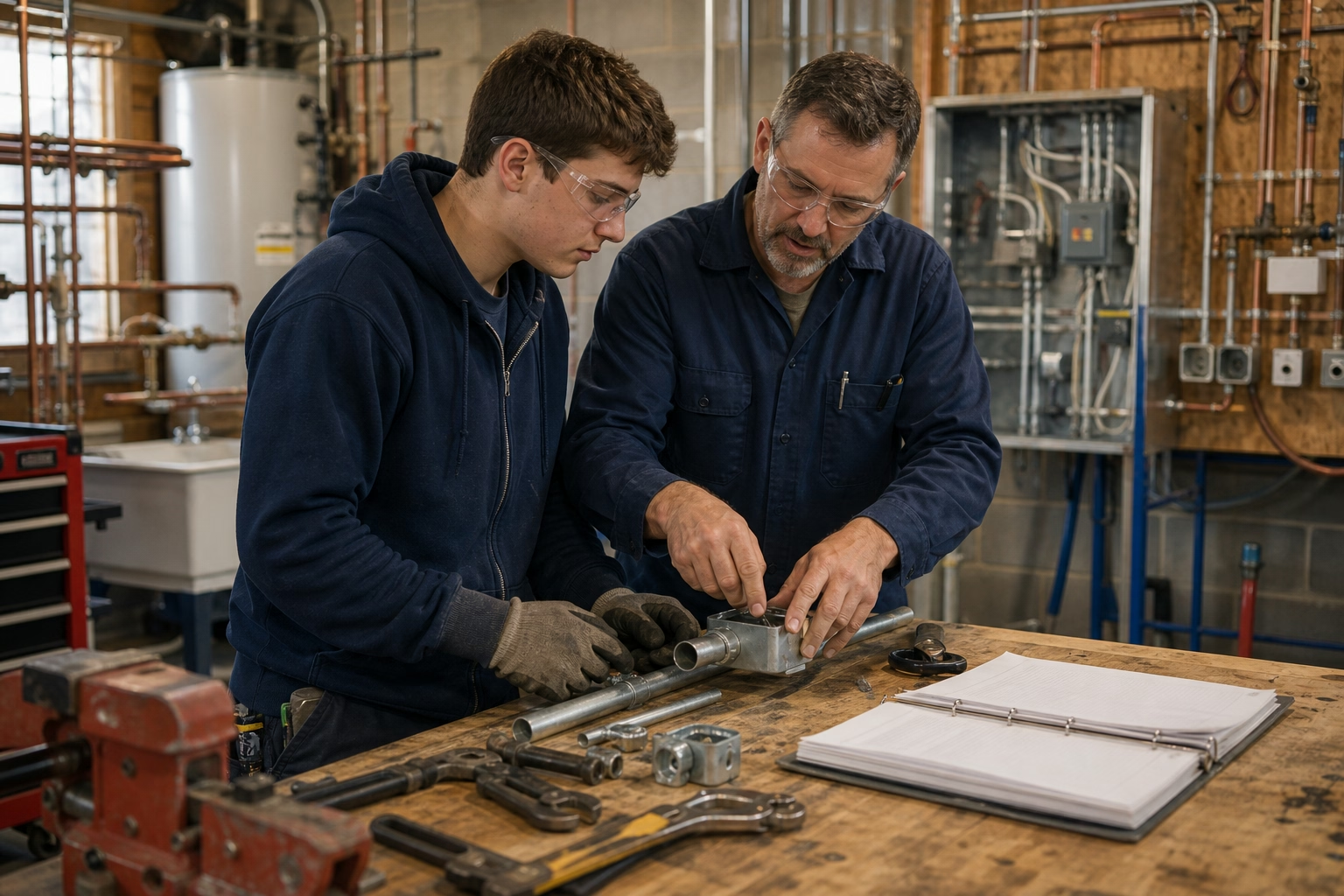
In most of the trades, the journeyman license isn’t really an exam. It’s an exam plus a mountain of documented hours. An electrician or plumber apprentice typically has to log thousands of hours of supervised, on-the-job work, verified by the people who supervised it, before a state board will even let them sit for the test. The classroom matters, but the hours are the gate.
That puts a quiet burden on the contractor. The apprentice does the work, but you — the employer and the supervising journeyman or master — are the one who has to be able to verify those hours years later, in a form a state board will accept. Run that on a loose paper trail and you can cost a good apprentice months at the finish line, when a thin record means they can’t prove time they actually worked. This is one area where sloppy time tracking doesn’t just cost payroll accuracy. It costs someone their license date.
This is general information, not legal advice, and the specifics vary a lot by state. But the shape of the requirement is consistent enough to plan around.
What the Hours Requirement Actually Is
The number you’ll hear most often is about 8,000 hours of on-the-job learning over roughly four years, paired with related classroom instruction. For both electricians and plumbers, that four-year, ~8,000-hour benchmark is the common industry standard.
Here’s the important caveat. That’s a typical figure, not a single federal mandate. It comes from program standards and state rules, and it moves. Requirements vary by jurisdiction and trade — commonly around 8,000 hours, and up to about 10,000 in some states. Texas, for example, requires 8,000 hours of on-the-job experience for a journeyman electrician. So treat 8,000 as a planning anchor, not a guarantee, and confirm the real number with your state board.
On the classroom side, federal regulation 29 CFR 29.5 recommends not less than 144 hours of related technical instruction per year — but note the word recommends. It’s a federal recommendation, not a fixed legal floor, and actual classroom hours vary by program sponsor.
Time-Based, Competency-Based, or Hybrid
If your apprentice is in a registered apprenticeship, the federal framework (29 CFR 29.5) allows three ways to measure completion, and which one you’re in changes how much the raw hour count matters:
- Time-based measures progress by hours — at least 2,000 hours of on-the-job learning, structured against a work-process schedule. The 2,000-hour minimum is the legally fixed federal floor for an apprenticeable occupation; the full occupation total (the ~8,000 for the trades) is set in the program standards. Here, the hour log is everything.
- Competency-based measures progress by demonstrated skills, verified by the program sponsor, rather than a fixed clock. There is still an on-the-job learning component, but progression is not gated purely on hours.
- Hybrid combines a minimum number of hours with demonstrated competency.
The sponsor picks the model, subject to the registration agency’s approval. Even in competency and hybrid programs, though, the state licensing board on the back end usually still wants documented experience hours. So for a contractor, the safe assumption is that you’ll need a clean, defensible hour record regardless of model.

Who Has to Track and Verify the Hours
This is the part contractors most often get wrong, because responsibility is split.
In a DOL registered apprenticeship, the program sponsor bears ultimate responsibility for maintaining progress records and reviewing the apprentice’s performance, under 29 CFR 29.5. But in day-to-day practice the work is split three ways: the employer supervises the work and delivers the on-the-job training, the sponsor owns the official record, and the apprentice is typically expected to keep a personal log of their hours too. DOL’s own sample standards put record-keeping responsibility on the apprentice as well as the sponsor — a polite way of saying nobody should rely on a single copy.
At license time, the state board is the one that has to be satisfied, and boards want employer verification. Texas, again as an example, requires the 8,000 hours to be documented and verified by the supervising master electrician on a signed experience form for each employer, and the board may contact supervisors directly to confirm. So the person who actually has to stand behind the numbers is you, the supervising licensee — sometimes years after the work, and sometimes after the apprentice has moved between several employers.
Supervision Ratios Are Part of the Record
One thing that catches contractors off guard: the hours often only count if the apprentice was properly supervised, and states cap how many apprentices one journeyman can oversee.
The ratios exist everywhere and vary in form. California sets an hours-based ratio of one apprentice hour for every five journeyman straight-time hours on public work, and requires that lower-level workers be under the direct supervision of a certified electrician. A common pattern across many states is “one-to-one, then one-to-three” — one journeyman can supervise the first apprentice, but you need several more journeymen before adding another.
Here’s the point for your records. It’s not enough to log that the apprentice worked eight hours. You may also need to show who supervised them, because hours worked outside the allowed ratio can be challenged. A record that ties the apprentice’s time to the supervising journeyman on each job is worth far more at license time than a bare hour total.
How a Lost Paper Trail Delays the License
The failure mode is almost always the same: the hours were worked, but the record can’t prove it. The apprentice bounced between three job sites and two employers over four years, the logs were on paper or in a notebook that got lost, the supervising journeyman who signed off has since left, and now — at the exact moment the apprentice is ready to test — the board wants verification nobody can cleanly produce.
State boards are explicit that this delays people. Texas advises apprentices to keep a personal hour log throughout the apprenticeship rather than waiting until application, precisely because incomplete employment records are a leading cause of application delay. A delayed journeyman card isn’t a paperwork annoyance. It’s a delayed raise for your best apprentice and a delayed promotion for your business, since a new journeyman is the person who lets you take on more work and supervise the next apprentice.

How to Keep the Record Clean
The fix is to capture the hours as the work happens, attributed correctly, with supervision and job context attached — not to reconstruct them at the end.
A few principles hold regardless of your state’s exact rules:
- Log hours daily, against the job and the trade task, not as a weekly lump. Boards and programs care about the type of experience, not just the total, so time tied to actual work — service, rough-in, panel work — is more defensible than a raw number.
- Capture who supervised. Tie the apprentice’s time to the journeyman on site so you can demonstrate the supervision ratio was met.
- Keep more than one copy. The apprentice’s record, the employer’s record, and the sponsor’s record should agree. Redundancy is what saves you when someone leaves.
- Make it survive job and employer changes. A record that travels with the apprentice across sites and years is the whole game.
This is where ordinary time tracking quietly does double duty. The same accurate, job-attributed hours you capture for payroll and billing are the raw material of the apprenticeship record — timestamped, tied to a job and a supervisor, exportable as a clean report. Built for electrical and plumbing crews, ShiftFlow records and exports those hours as PDF or CSV. It’s not a licensing system, and it doesn’t submit anything to a state board or guarantee a program’s requirements are met. What it does is make sure that when the board asks your supervising licensee to verify four years of an apprentice’s time, the answer is a clean export instead of a shoebox of notes.
If you train apprentices, treat the hour log as part of the job from day one. The exam is years away, but the record that gets them to it is being written — or lost — every single shift.
Frequently Asked Questions
How many hours does an electrician apprentice need?
The most common benchmark is about 8,000 hours of on-the-job learning over roughly four years, plus related classroom instruction. But that’s a typical industry standard, not a single federal number — state licensing boards set their own requirements, and some require between 8,000 and 10,000 hours. Always confirm the exact figure with your state board and your registered program.
Who is responsible for tracking and verifying apprentice hours?
In a DOL registered apprenticeship, the program sponsor holds ultimate responsibility for keeping progress records, but in practice the employer supervises the work and signs off on the hours, and the apprentice is usually expected to keep a personal log too. At license time, state boards require the hours to be documented and verified by the supervising journeyman or master, often on a signed experience-verification form.
What happens if apprentice hours are not well documented?
Incomplete or poorly documented hours are one of the most common reasons a journeyman license application gets delayed. State boards require proof of the hours before scheduling the exam, so missing employer verification or gaps in the record mean the apprentice has to reconstruct or re-verify time, pushing back the exam and the raise that comes with the license.
Do apprentice hours requirements vary by state?
Significantly. Total required hours, classroom hours, supervision ratios, whether licensing is handled at the state or local level all differ by state and trade. The 8,000-hour, four-year figure is the most common benchmark, not a universal rule, so the specific state board is always the authority.
Sources
- 29 CFR 29.5 — Standards of apprenticeship; the three completion models and records responsibility (U.S. Government eCFR)
- 29 CFR 29.5 — mirror (Cornell LII)
- U.S. DOL Office of Apprenticeship — apprenticeship.gov legislation and regulations
- Texas TDLR — Journeyman Electrician license requirements and hour documentation
- Texas TSBPE — Journeyman Plumber license requirements
- California DAS / DIR — apprentice supervision and ratios