
Is Drive Time Between Service Calls Paid?
The morning commute is unpaid, but the drive from one customer to the next is usually paid — and the line between them turns on one word: required. Here is how federal travel-time rules actually apply to service techs.
The Question Every Service Business Argues About
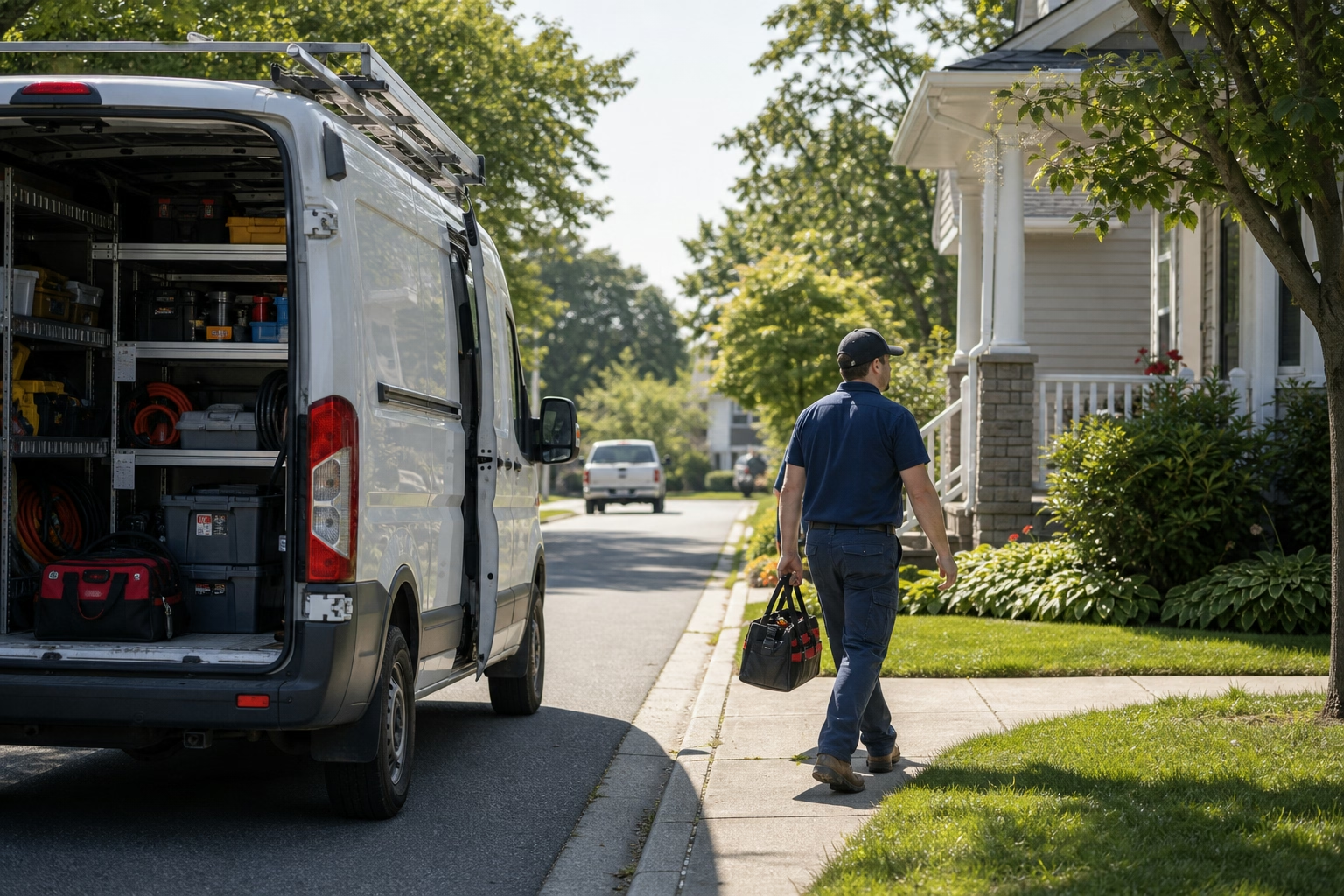
A tech leaves the house at 7, drives 40 minutes to the first call, fixes a furnace, drives 25 minutes to the next, then a third, then heads home. Which of those minutes do you have to pay for?
Get it wrong in the cheap direction and you’re paying for hours you don’t owe. Get it wrong in the expensive direction and you’ve got a wage-and-hour problem that, multiplied across a crew and a couple of years, becomes back pay and penalties. The answer isn’t “all of it” or “none of it.” Federal law draws a specific line, and that line turns largely on one word: required.
This is general information, not legal advice, and the gray areas are real. But the framework is clearer than most contractors think.
The Commute Is Not Paid — Even If the Site Changes Daily
Start with the baseline. An ordinary drive from home to work and back is “a normal incident of employment” and is not work time, under 29 CFR 785.35. The Portal-to-Portal Act put this in the statute itself: commuting to and from the place where you perform your principal work isn’t compensable.
Here’s the part that surprises people. This stays true even when the tech drives to a different customer every single day. There’s no fixed office, but the first drive of the day is still a commute. A plumber who heads straight from his driveway to the day’s first stop isn’t on the clock for that leg, federally, just because the address changes.
Site-to-Site Travel During the Day Is Paid
Now the part that works in the tech’s favor. Once the workday has started, travel from job site to job site is work time and must be counted as hours worked. This is 29 CFR 785.38, and the DOL’s Fact Sheet #22 restates it plainly.
So the 25-minute drive from the furnace job to the second call is paid. So is the third leg. The regulation is blunt about it: that travel counts as hours worked “regardless of contract, custom, or practice.” You can’t write it out of an employee’s pay with a policy that says otherwise. The doctrine even has a name in the regulation — travel that is “all in a day’s work.”
So the only real question left is when the workday starts, because everything from that point until the last principal activity is generally on the clock.

The Pivot Point Is the Word “Required”
This is where most of the money and most of the disputes live.
If the employer requires the tech to report to a designated place first — the shop, a warehouse, a yard — to pick up tools, load parts, or receive the day’s dispatch, then the workday effectively begins there. The commute from home to that required spot is still unpaid. But the travel from that spot to the first job site is paid, under the same 785.38, because it’s now travel in the course of the day’s work rather than a commute.
If the employer does not require any reporting point, and the tech drives straight from home to the first customer, that first leg stays an unpaid commute.
That’s the lever. A company that has techs swing by the shop every morning to grab the truck and the work orders has, in doing so, started the compensable clock at the shop. A company whose techs go straight to the first job hasn’t. Neither is wrong. But you should know which one you’re running, because it decides whether that first drive is paid — and a vague or inconsistent practice is exactly what creates back-pay exposure.
The Company-Truck Myth
There’s a very common belief in the trades: “I gave him a company van, so now his whole drive is paid.” Under federal law, that’s not how it works.
The Employee Commuting Flexibility Act, folded into 29 USC 254(a), says that using an employer’s vehicle to commute — plus activities “incidental to the use of such vehicle for commuting” — is not compensable, as long as two conditions hold: the travel is within the normal commuting area for the business, and the vehicle use is subject to an agreement between the employer and the employee. That agreement doesn’t have to be in writing.
Carrying tools and parts in that truck during the commute is generally treated as incidental, and doesn’t on its own flip the commute to paid time. Where it gets genuinely gray is when loading or handling equipment becomes a real, non-trivial task rather than just having a stocked van. At that point the analysis can shift, and it’s fact-specific enough that you shouldn’t treat it as a clean rule either way.
When an At-Home Task Starts the Clock
There’s one more wrinkle worth understanding: the continuous-workday idea. If the first real work task of the day happens at home — the employer requires the tech to load specialized equipment, pick up parts, or do something genuinely integral before leaving — that can start the compensable workday, which would make the subsequent drive to the first site paid.
But the bar is real work, not trivia. Simply having tools in the truck, or glancing at a dispatch app for two seconds, generally doesn’t start the clock. Those are ordinary preliminary acts. Whether a specific at-home task is “integral and indispensable” enough to count is one of the most fact-dependent questions in this whole area, so treat it as a “maybe, depending,” not a yes. If you’re deliberately requiring substantial at-home prep, that’s a question worth running by an employment attorney rather than guessing.

The California Exception
Everything above is the federal floor. States can be more generous, and California is the big one. Instead of the federal test, California asks whether the worker is under the employer’s control, and under that test more travel is paid. Employer-mandated travel, required reporting points, and company-vehicle use with heavy personal-use restrictions can all be compensable in California even where federal law would call it an unpaid commute. In California, in other words, the company truck loaded with tools can flip the outcome that the Employee Commuting Flexibility Act protects federally.
Several other states have their own travel-time rules too. The practical takeaway is simple. Know your state’s standard, and don’t assume the federal answer is the final answer.
Why This Lives or Dies on Your Time Records
Notice that every rule above depends on being able to separate one block of time from another: commute from workday, site-to-site from on-site, the leg before the first job from the legs between jobs. If your records are a single daily total — “Mike, 9 hours” — you can’t show which minutes were compensable travel and which were the unpaid commute. In a dispute, that ambiguity tends to break against the employer.
This is where time tracking earns its place, as a record-keeper rather than a referee. A time clock that lets a tech mark travel as its own segment between jobs, timestamps when they leave one site and arrive at the next, and ties each block to a work order gives you an actual record of the day’s structure — paid travel between calls, time on each job, and the commute sitting outside it. You still have to apply the law correctly. The software’s job is to make sure that when you do, you have the minute-by-minute record to back it up instead of a reconstruction from memory. The same clean segments also feed straight into billable-versus-non-billable reporting and keep overtime accurate, since paid travel counts toward the 40-hour week.
A time clock made for field crews like ShiftFlow captures and timestamps those segments and exports them to payroll as PDF or CSV. It doesn’t decide for you which ones are legally compensable. That call is yours, ideally with your state’s rules and, where it’s genuinely gray, an attorney in the loop.
Frequently Asked Questions
Is the drive from home to the first job paid?
Under federal law, an ordinary home-to-work commute isn’t paid, even if the tech drives to a different job site every day. The exception is when the employer requires the tech to first report somewhere — the shop, a yard, a meeting point — to pick up tools, parts, or the day’s dispatch. The commute to that required point is still unpaid, but the travel from there to the first job is paid.
Is drive time between service calls paid?
Yes. Travel from one job site to another during the workday is compensable work time under federal rules. Once the workday has started, the time a tech spends driving between customers counts as hours worked and must be paid, and it counts toward the 40-hour overtime threshold.
Does giving a tech a company truck make the commute paid?
Not by itself, under federal law. The Employee Commuting Flexibility Act says commuting in an employer’s vehicle, including activities incidental to that commute, isn’t compensable as long as the travel is within the normal commuting area and the vehicle use is subject to an agreement between employer and employee. Carrying tools in the truck is generally treated as incidental. Some states, notably California, treat this differently.
Do state laws change the answer on travel pay?
They can. California uses an employer-control test rather than the federal standard, so more travel is paid there — employer-mandated travel and heavily restricted company-vehicle use can be compensable even when federal law would call it an unpaid commute. Other states have their own rules. The federal rules are just a floor, so always check your state.
Sources
- 29 CFR 785.35 — Home-to-work travel (U.S. Government / Cornell LII)
- 29 CFR 785.38 — Travel that is all in a day’s work (Cornell LII)
- 29 CFR 785.37 — Special one-day assignment in another city (Cornell LII)
- 29 USC 254 — Portal-to-Portal Act and Employee Commuting Flexibility Act (Cornell LII)
- U.S. DOL Wage and Hour Division — Fact Sheet #22: Hours Worked Under the FLSA
- U.S. DOL — Travel Time topic page
- electrical
- plumbing
- hvac
- service-trades
- travel-time
- flsa
- payroll
- compliance