How Time Tracking Improves Productivity in Distributed Teams
How time tracking improves productivity in SEA distributed teams in 2026. Capacity, workload, time-to-completion as real signals, plus what it does not measure.
The honest version of “time tracking improves productivity” is shorter than the marketing version. Time tracking does not turn unproductive teams into productive ones. It does not measure work quality. It cannot tell you whether a designer’s three campaigns this week are better than last week’s two. What it actually does, for distributed teams, is produce three operational signals managers genuinely need. How much capacity the team has. Where workload is concentrating. How long things take. Here is why those three signals matter more in distributed SEA teams than co-located ones, what the data actually shows, and what time tracking deliberately does not measure.
What distributed teams lose without time data
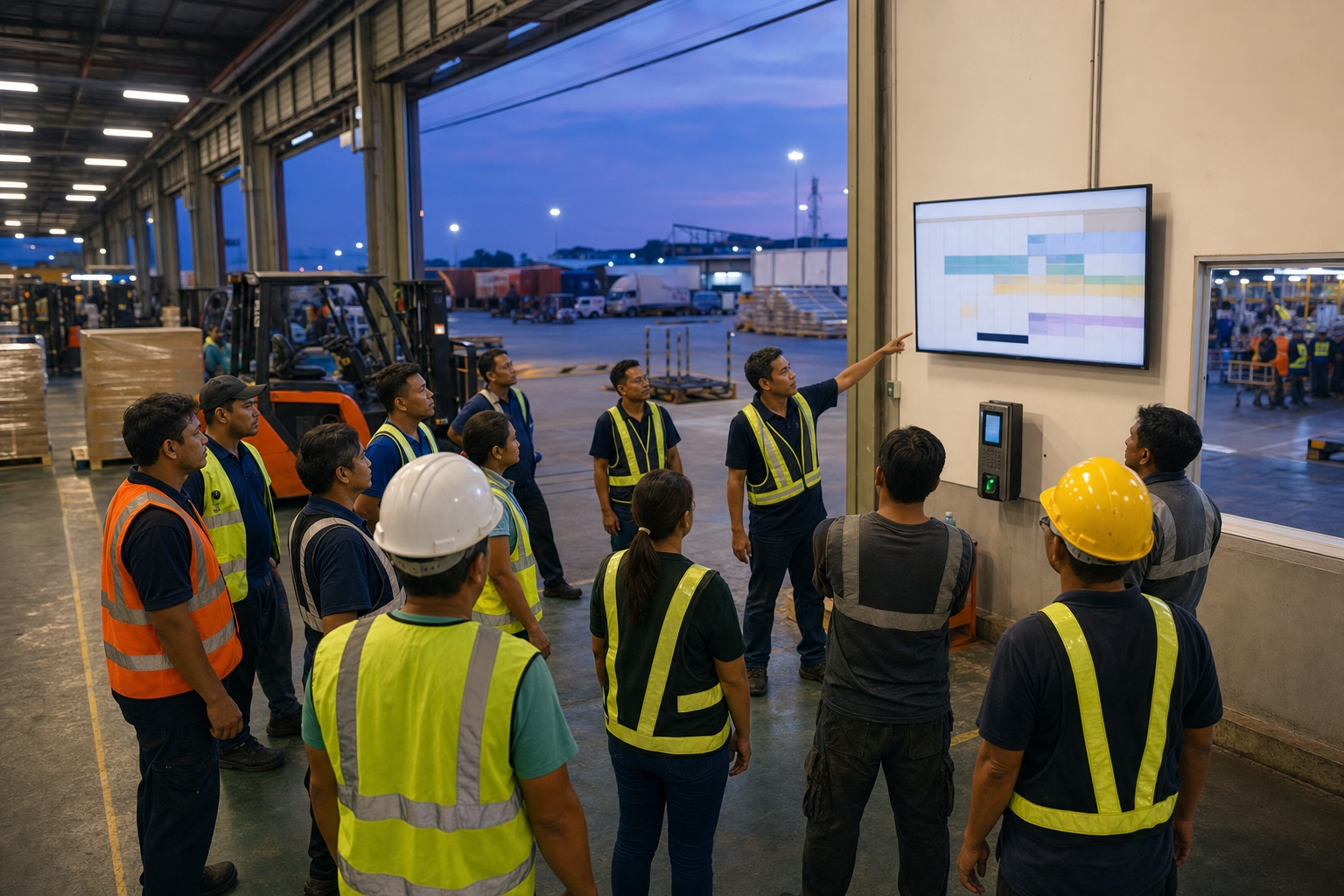
Distributed teams cannot see each other. A 25-person SEA team with offices in Manila, KL, and remote workers across the region does not have the casual co-located awareness that office teams take for granted. The senior designer in Cebu is not visible to the account director in BGC, who is not visible to the dev lead in KL. Three operational questions get genuinely hard to answer without time data:
- Is the team at 70% capacity or 110%? Co-located teams know by walking through the office. Distributed teams either ask everyone (slow) or guess (wrong).
- Who is overworked and who is underloaded? Co-located managers see the late-night Slack pings, the visible stress. Distributed managers see deliverables. Deliverables are a lagging indicator.
- How long does a typical brief, sprint, or case actually take? Co-located teams have an intuitive sense from observation. Distributed teams need data. Intuition does not travel across time zones.
The Malaysian Employers Federation reports that more than 70% of Malaysian companies have increased adoption of flexible work routines post-pandemic (The Star, MEF, 2025). Similar shifts are happening across SEA per Bain & Company’s e-Conomy SEA reports. The share of teams operating without co-located visibility is growing. So is the share of decisions made on inadequate information.
Capacity utilization is the first useful signal
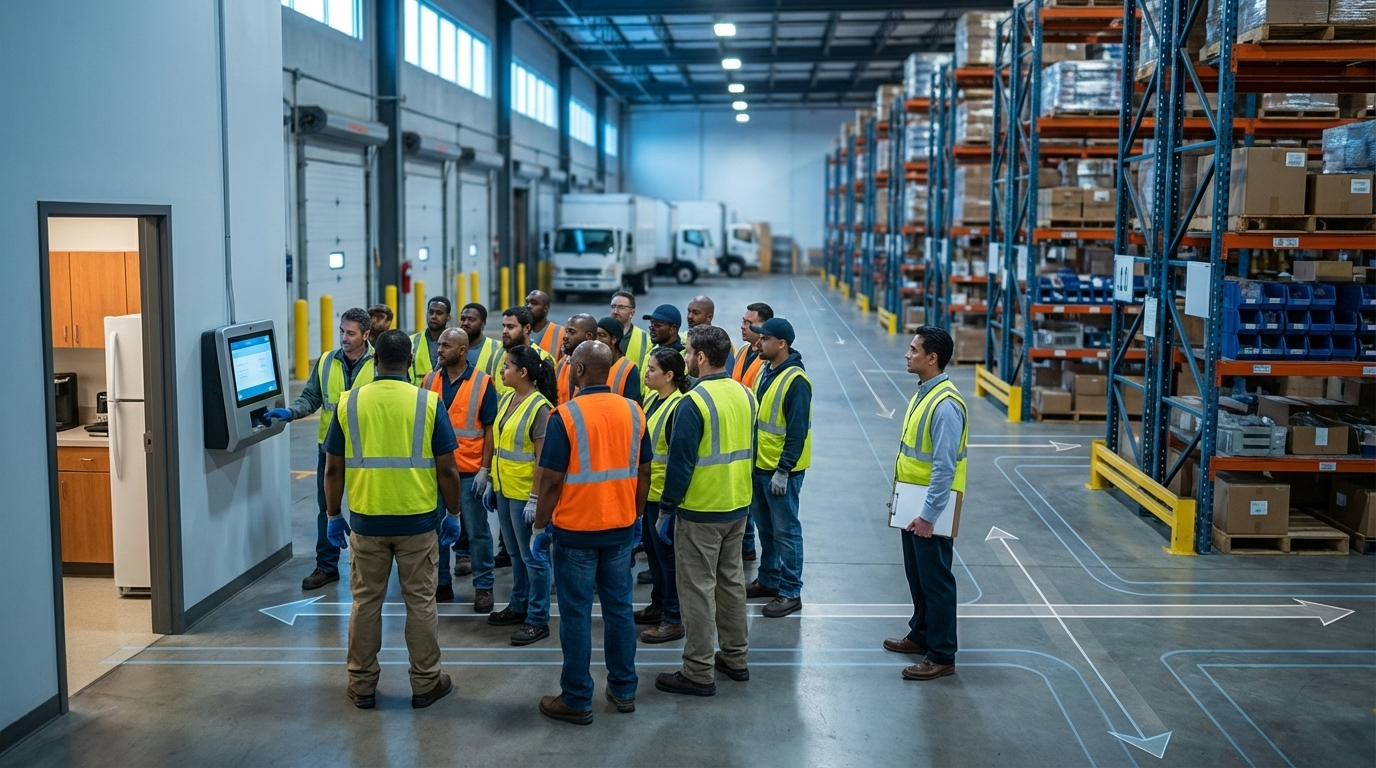
The most useful signal time tracking produces for distributed teams is capacity utilization. A worker logging 38 to 42 hours a week is at healthy capacity. A worker consistently at 50+ hours is overcapacity, either by their own ambition or the system’s design. A worker at 25 to 30 hours is undercapacity. Legitimately part-time, or assigned less work than peers.
For a 20-person SEA team, the capacity distribution lets the manager:
- Reassign work from the overworked 50-hour-a-week engineer before burnout shows up as resignation
- Identify the 28-hour-a-week designer who has bandwidth for additional projects
- Justify hiring with capacity data instead of gut feel (“we are at 95% utilization, the next project pushes us to 115%”)
The capacity signal is the single most underused output of time tracking in distributed teams. Most managers run the tool for compliance and never look at the capacity dashboard.
What workload distribution shows across the team
Different from capacity. Workload distribution is about how the work is allocated across the team. A team where two engineers are at 50+ hours and three are at 30 has a workload problem regardless of the average. The average might look fine. The distribution shows where the operational risk lives.
Three patterns to watch.
Compounding overwork. One senior engineer becomes the go-to for hard problems, gradually accumulating workload. Time data surfaces this 3-6 weeks before the engineer pushes back or quits. Without data, the manager finds out at the resignation conversation.
Hidden idleness. A new hire whose ramp-up is slower than expected. Busy in their own head, not actually producing work. Time data shows hours logged in low-output projects. The conversation that follows is the manager’s job; the data is what surfaces it.
Cross-project context-switching. Workers logging hours across 4-5 projects in the same week are paying a context-switching tax. Time data shows the spread. The manager decides whether to consolidate. Time tracking for Philippine agencies: managing multiple clients and billing covers this for agency settings.
How time-to-completion data sharpens decisions
How long does a typical brief, sprint, design, or ticket take? Most distributed teams cannot answer without time data. The absence of an answer compounds into bad estimating.
Three decisions that get better with time-to-completion data:
- Project scoping. New client asks for a similar campaign to the one delivered three months ago. With time data, the project manager knows it took 84 hours across 4 staff. Without data, the manager guesses 50 hours, the project comes in at 100, and margins disappear.
- Sprint planning. Engineering sprints fail to deliver because the team consistently underestimates ticket complexity. Time data on completed tickets calibrates future estimates over 6-8 sprints.
- Hiring justification. “We are losing one designer’s worth of capacity per month to admin work that should be automated” is a different conversation from “we feel busy.” The first one gets you an automation budget. The second one leads to nothing.
What time tracking deliberately does not measure
The honest framing. Time tracking captures input data, not output quality. Three specific things it does not measure:
- Quality of the work. A worker who shipped a bug-free release in 30 hours is more productive than one who shipped a buggy release in 50. Time data does not see this. Code reviews, customer feedback, and manager judgment do.
- Strategic thinking. The senior designer staring at a brief for 2 hours might be doing the most valuable thinking of the week. Time data shows 2 hours. Whether those 2 hours produced clarity or confusion is a different evaluation.
- Whether the work being done is the right work. A team can be 100% utilized on the wrong projects. Time data shows utilization. Whether the projects are right is the principal’s call.
Confusing time-as-input with output is the most common time-tracking mistake distributed teams make. The data is useful precisely because it is one piece of information among many, not a productivity score. How remote teams in the Philippines track productivity without micromanagement covers the trust-vs-surveillance framing in more depth.
How SEA distributed teams use the data well
Three operational habits separate teams using time data well from teams using it badly.
Weekly capacity scan, not daily. Looking at time data daily produces over-reaction to noise. One late night, one slow morning. Weekly reveals trends — who is consistently at 50 hours, who is consistently at 30. The trend is what informs action.
Two-week or monthly time-to-completion rollups. Project data smooths into useful averages only after 8-12 instances. Weekly completion-time reports are noise. Monthly is signal.
Output review separate from time review. The Friday 1:1 conversation about output should not start with time data. The output is the conversation. Time data is the manager’s homework before the conversation, not the agenda for it.
Grab the ShiftFlow app, no card needed

SEA-specific complications managers should plan for
Multiple time zones. A team across PH, MY, SG, ID, TH spans a maximum 1-hour spread within ASEAN itself, but interacts with US clients 12-15 hours behind or AU clients 1-3 hours ahead. Time-tracking data captures local time per worker. Rollups need to handle the time-zone conversion explicitly. Most tools do. Some show the data in the manager’s time zone, which is the right default.
Statutory hours overhead. PH’s 8-hour standard with a layered rate stack (125% OT on ordinary days, 130% for regular hours on rest days or special non-working days, 169% for rest-day OT, 200% for regular hours on regular holidays, 260% for OT on regular holidays, plus +10% night differential). MY’s 45-hour cap with 1.5x/2x OT. SG’s CPF tiering. Statutory rules consume part of the time-tracking value because the system has to be configured to satisfy compliance first, productivity insight second. Both are possible. The system has to be set up for both. What to look for in a time tracking system for Southeast Asian teams covers the multi-country configuration.
Async work patterns. SEA distributed teams often run async-heavy because of timezone and infrastructure realities. Time data needs to handle clock-in and clock-out events that span the date line (a Manila worker logging hours into a US client’s Wednesday from Manila’s Thursday). Most modern tools do. Verify on a live demo.
The honest distillation for SEA managers
For SEA distributed teams in 2026, time tracking is a measurement instrument, not a management strategy. The teams that use it well treat it as one of three or four data sources informing real conversations about capacity, workload, and pace. The teams that use it badly treat it as a productivity score and either over-monitor (driving attrition) or ignore the data entirely (driving capacity blindness). The middle path — collect the data, review it weekly, use it to inform conversations rather than replace them — is what separates effective distributed-team operations from theatrical ones.
Picking the right tool matters less than picking the right management habits around it. The tool catalogue is in Best Time Tracking Software in the Philippines (2026 Guide) for PH and Best Time Tracking Software in Malaysia for SMEs for MY. The habits decide whether the investment pays back.
Sources
- The Star on MEF hybrid work data for the 70%+ flexible-work adoption figure
- Bain & Company e-Conomy SEA 2024 for SEA distributed-work framing
- DataReportal Digital 2025: Southeast Asia for regional connectivity context
- Rappler on PH gig economy growth for the freelancer / distributed-worker population context
- Philippine Labor Code Book III (PD 442) for the statutory framing on hours
- southeast-asia
- time-tracking
- distributed-work
- remote-teams
- productivity
- capacity-planning
- tofu