How Remote Teams in the Philippines Track Productivity Without Micromanagement
How Philippine remote teams track productivity without surveillance in 2026. Output-based metrics, trust patterns, and tools that fit teams that hire adults.
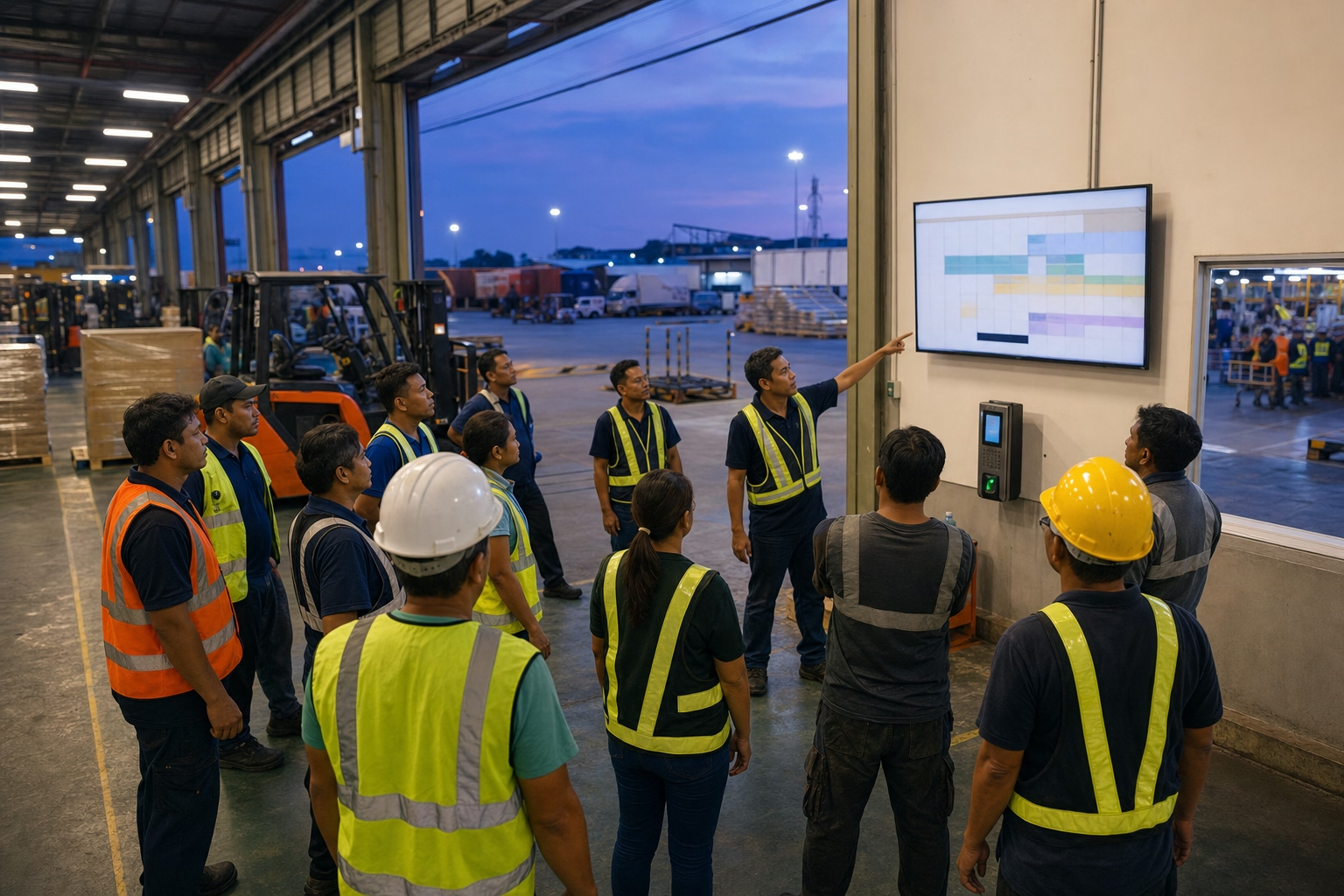
The default for tracking remote workers in the Philippines is the BPO monitoring stack. Random screenshots, activity scores, idle-time alerts, daily timesheets the manager audits. Works fine for a 500-agent call center where a US client’s contract requires it. Does not work for a 12-person remote marketing team in Cebu, a 20-person remote dev team in Iloilo, or a Manila agency placing 8 designers with US clients. About 1.5 million Filipinos work on international freelance platforms (Rappler / MicroSourcing, 2024). The trust dynamic with these workers is nothing like the BPO model. Below are the productivity-tracking patterns that work for PH remote teams without turning the workplace into a surveillance operation.
What every remote manager actually wants to know
Most PH remote managers are not asking “how do I catch slackers.” They are asking two operational questions.
Is the work getting done at the quality and pace the business needs? This is an output question. Answered by reviewing deliverables, not by counting hours. A designer who produces three approved campaigns this week is doing the work, whether they did it in 35 hours or 50.
Are the people I am paying full-time actually doing this job, or working a second one in parallel? This is a focus question. Answered partly by output, partly by responsiveness during agreed working windows. A worker who routinely misses 11am standups, returns Slack messages at 3am, and produces sloppy work is showing the signal regardless of what a screenshot tool would say.
The trap is jumping straight to surveillance tools to answer questions surveillance tools answer poorly. A screenshot of someone’s desk does not tell you whether the campaign brief is good. An activity score does not tell you whether the bug fix actually fixed the bug.
Output-based patterns that actually work
Four patterns PH remote teams use in place of activity tracking.
Weekly output review. Each worker submits what they finished during the week. Manager reviews. Quality and pace are the metrics, not hours. Works for any role where output is concrete. Engineering, design, content, sales.
Daily async standup. Worker posts what they finished yesterday, what they are doing today, what is blocked. Manager scans. Replaces synchronous standups nobody likes attending at 7am, and works across time zones.
Outcome-based KPIs by role. Sales reps on pipeline contribution. Support on resolution rate and CSAT. Developers on shipped features and bug recurrence. Each role has 2 to 3 outcome metrics that matter. Everything else is noise.
Customer-facing visibility. For workers placed with external clients (agencies, BPO, VA arrangements), the client’s feedback is the primary signal. A client renewing the contract and increasing scope is a stronger productivity signal than any internal monitoring data.
Most PH remote teams that scale past 15 staff lean on a mix of all four, calibrated to the role.
What time tracking is still useful for on remote teams
Output-based management does not mean throwing out time tracking. PH remote teams still use lightweight time tracking for four legitimate purposes.
- Statutory compliance. Labor Code overtime, night differential, and rest-day rules need hours data to apply correctly. Working on a rest day pays 130% for regular hours and 169% for OT on that day (130% × 30% OT premium). That math has to fire whether the management style is trust-based or not.
- Billable hours for client work. Agency or VA arrangements where the client pays by the hour need accurate hour records. The tracker is the source of truth for the invoice.
- Workload visibility. A worker logging 55-hour weeks every week is either heroic or about to quit. The time data surfaces the pattern before resignation.
- Capacity planning. Hiring a new designer or stretching the current team? Time data tells you whether the team is at 60% capacity or 110%.
None of this requires screenshots or activity scoring. A simple clock-in/clock-out tool with project codes covers all four.
Tools that fit trust-based PH remote teams
Four tools that handle the output-friendly side without a surveillance stack.
ShiftFlow (₱99/seat/mo). GPS, kiosk, scheduling, DOLE-compliant OT and night differential calculation. Deliberately no screenshot monitoring. Built for teams that want statutory and operational time tracking without the BPO-style audit stack. Best fit for remote ops, support, finance, and admin teams.
Jibble (free unlimited users, ≈₱228/seat Premium). MY-built free tier with GPS, facial recognition at clock-in, and timesheets. No screenshots. Strong fit for small remote teams that want zero-cost validation before paying for anything.
Toggl Track (free up to 5 users, ≈₱510/seat Starter). The timer most freelancers and small creative teams reach for. Markets explicitly as “no screenshots, no surveillance.” A feature, not a gap. One-click timer, browser plugins, project tagging, billable rates on Starter.
Clockify (free unlimited users, paid tiers from $4.99/seat). Project-focused time tracking, idle detection, billable hours on Standard. GPS gated to Pro. Better fit for project-based teams than shift-based attendance.
For PH remote teams that have to coexist with foreign-client monitoring requirements (BPO-adjacent VA work), the realistic answer is to run two tools. A monitoring tool for the foreign client (Time Doctor or Hubstaff) and a separate trust-based tool for internal PH HR. Time tracking challenges in Philippine BPO teams covers the dual-stack pattern.
Get ShiftFlow on iOS or Android
When the trust-based approach actually breaks
Three honest scenarios where output-based management does not work.
New hires with no track record. The first 30 to 60 days, you do not yet know whether the new hire is a strong performer or a free rider. Higher-touch check-ins, more synchronous overlap, and more deliverable review are warranted during onboarding. Not surveillance. Just more management attention.
Roles where output is genuinely hard to measure. A junior shadowing senior staff is hard to evaluate on output. A research role with a 6-month deliverable is hard to track weekly. Some roles need more management overhead than others. The trust-based approach assumes you can tell which is which.
Compliance-mandated monitoring. A foreign client’s contract that names Time Doctor is a contract obligation, not a management style choice. Run the contract-required tool. Calibrate it to the actual contract requirement, not the tool’s maximum. How BPO companies reduce time theft and absenteeism covers the contract-driven setup.
What changes after a remote team moves off surveillance
PH remote teams that move off surveillance-style tracking onto output-based management usually report three changes in the first quarter.
- Tenured staff retention improves. Workers most likely to leave for a less-monitored employer stop having a reason to look.
- Recruitment becomes easier, especially for senior roles where competing offers are common.
- Management overhead drops. Reviewing weekly output is faster than reviewing 200 daily screenshots.
None of this is the dramatic transformation a SaaS landing page would promise. It is the operational reality of treating remote workers as professionals capable of organizing their own work.
How I would manage a 15-person remote dev team across Manila, Cebu, and Iloilo
Three things on day one. First, the team is on Jibble Free or ShiftFlow for clock-in, OT calculation, and statutory compliance. Not on any monitoring tool. Second, the team runs a daily async standup in a shared channel and a weekly output review every Friday. Third, each engineer has 2 to 3 outcome KPIs that matter for their role and quarter. Those are the only metrics that come up in 1:1s. The time tracker is the compliance and workload-visibility layer. The KPIs are the management layer. Confusing the two is the mistake.
Sources
- Rappler on PH gig economy growth for the ≈1.5M Filipino freelancer figure
- DataReportal Digital 2025: Philippines for connectivity context
- Philippine Labor Code Book III (PD 442) for overtime, night differential, and rest-day rules
- ShiftFlow pricing, Jibble pricing, Toggl Track pricing, Clockify pricing, Time Doctor pricing
- philippines
- remote-teams
- productivity
- time-tracking
- trust-based
- freelancers
- output-based
- mofu