Restaurant Overtime Rules: Avoid Payroll Mistakes
Overtime miscalculations cost restaurants thousands per year in back wages and penalties. Learn federal and state overtime rules, how weighted rates work for multi-role staff, and how to prevent overtime from silently inflating labor costs.
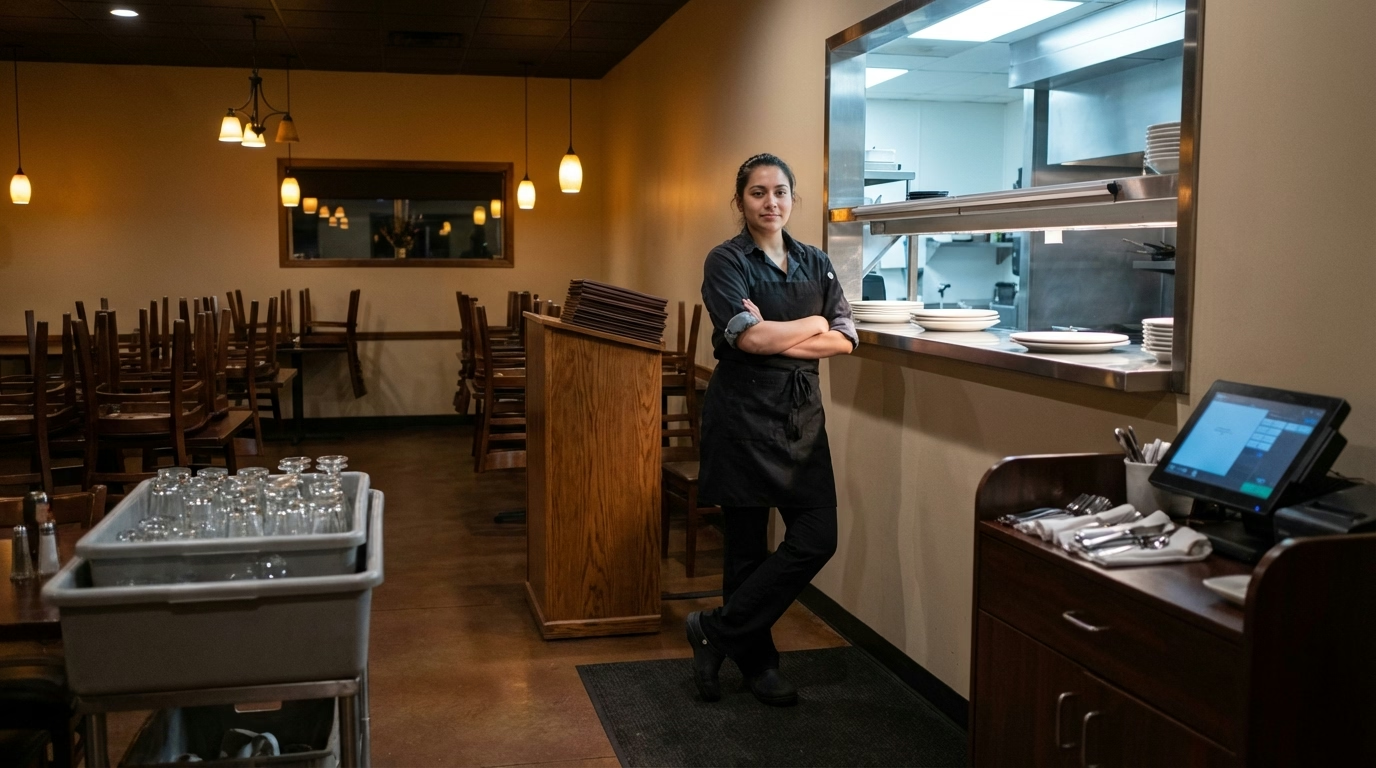
A busy family restaurant in Ohio schedules a server for 44 hours during a holiday week. She works 30 hours as a server at $5.00 per hour (cash wage with tip credit) and 14 hours as a hostess at $14.00 per hour. The payroll manager calculates overtime at the server rate. The check goes out. And the restaurant just committed a wage violation that, if repeated across the staff, could trigger five-figure back-pay liability.
Overtime in restaurants is not as simple as “time and a half after 40 hours.” Between tipped employees, multi-role workers, daily overtime states, and the chronic scheduling pressures of food service, overtime miscalculations are among the most common—and most expensive—payroll errors restaurants make.
This guide breaks down the rules that apply specifically to restaurants, explains the weighted overtime calculation that trips up most operators, and shows you how to prevent overtime from silently destroying your labor budget.
Why Overtime Hits Restaurants Harder Than Other Industries
Overtime affects every industry, but restaurants face a unique combination of factors that make overtime both more likely and more costly when it is miscalculated.
Thin Margins Cannot Absorb Overtime Surprises
The average full-service restaurant operates on 3–5% net margins. A single team member working five hours of unplanned overtime per week at a $20 regular rate adds $150 per week in overtime premium—$7,800 per year. For a restaurant with 10 team members who each average three hours of weekly overtime, the annual overtime premium exceeds $46,000.
When overtime is not tracked in real time, these costs accumulate invisibly until the payroll report arrives. By then, the labor budget is already blown.
Split Shifts and Double Shifts Create Hidden Overtime
Restaurants routinely schedule split shifts—a lunch service followed by a gap, then dinner service. A server who works 11 a.m. to 2 p.m. and returns from 5 p.m. to 11 p.m. logs nine hours in a single day. Over a five-day week with similar scheduling, that team member hits 45 hours without anyone intending to schedule overtime.
Double shifts during holidays, staff callouts, or special events compound the problem. A team member who covers a sick coworker’s shift on top of their own can easily reach 50+ hours in a week—triggering 10 hours of overtime that was never budgeted.
Seasonal Spikes Are Predictable but Unmanaged
Restaurant traffic follows seasonal patterns. Valentine’s Day, Mother’s Day, graduation season, and the December holidays all produce predictable volume spikes. Despite this predictability, many restaurants handle the demand by extending existing staff hours rather than hiring temporary help or adjusting schedules. The result is concentrated overtime during the weeks that are already the most expensive to operate.
High Turnover Creates Overtime Dependency
When a restaurant loses a team member, the remaining staff absorbs those hours until a replacement is hired and trained. With turnover rates that have historically averaged around 80% in the industry—still exceeding 65% annually even as rates have moderated—there are always positions in transition. Each vacancy creates a two- to four-week window where overtime is structurally baked into the schedule, whether anyone plans for it or not.
Federal and State Overtime Rules for Restaurants
The FLSA Baseline
The Fair Labor Standards Act requires overtime pay at 1.5 times the regular rate for all hours exceeding 40 in a workweek. This applies to most restaurant workers, who are classified as non-exempt. The workweek is a fixed, recurring 168-hour period—it does not reset based on the pay period.
Critical point for restaurants: You cannot average hours across two weeks in a biweekly pay period. If a team member works 48 hours in week one and 32 hours in week two, you owe eight hours of overtime for week one, even though the biweekly total is 80 hours.
The Tip Credit Complication
Under the FLSA, employers may pay tipped employees a cash wage as low as $2.13 per hour, with tips making up the difference to the full federal minimum wage of $7.25 per hour. However, overtime for tipped employees must be calculated on the full minimum wage, not the cash wage.
The correct overtime rate for a tipped employee at the federal minimum is:
- Full minimum wage: $7.25
- Overtime rate: $7.25 × 1.5 = $10.88
- Minus tip credit: $10.88 − $5.12 = $5.76 cash overtime rate (the DOL rounds this to $5.75)
A restaurant that mistakenly calculates tipped overtime at $2.13 × 1.5 = $3.20 is underpaying every overtime hour by $2.55. Across a staff of tipped workers regularly exceeding 40 hours, this error compounds rapidly.
Daily Overtime States
Several states require overtime pay for hours exceeding a daily threshold, regardless of weekly totals.
California requires overtime at 1.5× for hours over eight in a day and double time for hours over 12 in a day. A California restaurant worker who logs a 10-hour shift earns two hours at the overtime rate, even if the weekly total is only 35 hours.
Alaska requires overtime after eight hours per day. Colorado requires overtime after 12 hours per day or 12 consecutive hours under the COMPS Order. Nevada requires overtime after eight hours per day if the employee earns less than 1.5× the state minimum wage ($18.00/hr as of July 2024, based on the $12.00 minimum).
Restaurants in daily overtime states must track hours at both the daily and weekly level. A scheduling system that only monitors the 40-hour weekly threshold will miss daily overtime triggers entirely.
State Minimum Wage Impact
In states with minimum wages above the federal rate, overtime calculations start from a higher base. A restaurant in Washington state (minimum wage $17.13 as of 2026) pays overtime at $25.70 per hour—more than 2.3 times what a restaurant in a state using the federal minimum pays.
This difference matters when restaurants expand to new states or operate across state lines. Accurate time tracking for restaurants must account for location-specific wage rates to avoid systematic underpayment.
Weighted Average Overtime for Multi-Role Restaurant Staff
The most common overtime miscalculation in restaurants involves team members who work at different pay rates during the same workweek. This is extremely common in restaurants: a team member might bus tables at $13 per hour during lunch and serve at $5.50 per hour (cash wage) during dinner. A dishwasher might also work prep shifts at a different rate.
When a multi-rate team member exceeds 40 hours, the overtime rate must be calculated using the weighted average of all rates worked that week.
How to Calculate the Weighted Overtime Rate
Step 1: Calculate total straight-time earnings.
Multiply each rate by the hours worked at that rate.
Example: A team member works 25 hours busing at $13.00/hr and 20 hours hosting at $16.00/hr (total: 45 hours).
- Busing earnings: 25 × $13.00 = $325.00
- Hosting earnings: 20 × $16.00 = $320.00
- Total straight-time earnings: $645.00
Step 2: Calculate the weighted regular rate.
Divide total straight-time earnings by total hours worked.
- $645.00 ÷ 45 hours = $14.33 weighted regular rate
Step 3: Calculate the overtime premium.
The overtime premium is half the weighted regular rate (because straight time is already included in the earnings above).
- $14.33 × 0.5 = $7.17 overtime premium per hour
Step 4: Apply the premium to overtime hours.
- 5 overtime hours × $7.17 = $35.83 overtime premium owed
- Total pay: $645.00 + $35.83 = $680.83
The Common (and Costly) Mistake
Many restaurants pay overtime at whichever single rate was worked during the overtime hours—or worse, at the lower rate. In the example above, if the restaurant paid overtime at the busing rate ($13.00 × 1.5 = $19.50), the overtime calculation would be $19.50 × 5 = $97.50 total for overtime hours. But the correct method yields $14.33 × 1.5 = $21.50 × 5 = $107.50 for those same hours.
The difference per team member per week may seem small. But across a staff of 15 multi-role workers over a year, the cumulative underpayment triggers DOL back-pay liability with liquidated damages.

How Overtime Silently Inflates Restaurant Labor Cost
Beyond the direct cost of overtime pay, uncontrolled overtime creates compounding financial effects that many restaurant operators overlook.
Overtime Compounds With Benefits and Taxes
Overtime increases not only the paycheck but also the employer’s share of FICA taxes (7.65% of gross pay), state unemployment insurance contributions, and workers’ compensation premiums (which are based on gross payroll). A restaurant that pays $50,000 in annual overtime premiums may actually spend $58,000–$62,000 when employer-side costs are included.
Scheduling Blind Spots Create Recurring Overtime
Without real-time visibility into accumulated hours, managers schedule shifts based on coverage needs without awareness of overtime thresholds. A manager who schedules a strong closer for five dinner shifts may not realize that the team member’s four lunch shifts already put them at 38 hours—making the fifth dinner shift a guaranteed overtime trigger.
This pattern repeats weekly because the scheduling decision is made without labor-hour data. The overtime is not a one-time event; it becomes a structural cost embedded in the schedule.
Overtime Obscures True Labor Cost Per Cover
When overtime varies unpredictably from week to week, the restaurant’s labor cost per cover becomes unreliable. A week with $4,000 in overtime looks profitable at 28% labor cost. The following week with $8,000 in overtime pushes labor to 34%. Without isolating overtime as a separate line item, operators cannot distinguish between intentional staffing decisions and scheduling failures.
Preventing Overtime Surprises
Real-Time Overtime Alerts
Configure your time tracking system to alert managers when any team member approaches a threshold—typically 35 hours—with remaining shifts scheduled that would push them past 40. This gives managers time to adjust by swapping shifts, splitting coverage between two team members, or offering the remaining hours to a part-time worker who is below threshold.
Schedule-Level Overtime Forecasting
Before publishing the weekly schedule, run a projected hours report. Flag any team member whose scheduled hours exceed 40 and any day where scheduled hours could push a daily overtime threshold in applicable states. Address these flags before the schedule goes live, not after the hours are worked.
Cross-Training to Distribute Hours
Restaurants that cross-train team members across multiple roles—server, host, busser, food runner—have more flexibility to distribute hours without concentrating overtime on a few individuals. Cross-training also reduces the overtime created by callouts, because more team members can cover any open shift.
Separate Overtime Tracking From Payroll Reporting
Do not wait for the payroll report to discover overtime. Track overtime as a real-time operational metric, visible to managers on the same dashboard where they monitor sales and covers. When overtime is treated as an operational cost rather than a payroll afterthought, managers make different scheduling decisions.
If your time tracking and POS or payroll system do not communicate in real time, overtime data arrives too late to act on. Ensure your systems share data at least daily.
Overtime Compliance Checklist
- Verify overtime calculation method. Confirm your payroll system uses the weighted average rate for multi-role team members, not a single rate.
- Audit tip credit overtime. Ensure tipped employee overtime is calculated on the full minimum wage, not the reduced cash wage.
- Check state-specific rules. Identify daily overtime requirements in every state where you operate. Configure your system to track both daily and weekly thresholds.
- Enable real-time alerts. Set manager notifications at 35 hours (or an appropriate threshold for your operation) so overtime can be managed before it occurs.
- Forecast overtime during scheduling. Review projected hours for every team member before publishing the weekly schedule. Redistribute shifts to stay below thresholds where possible.
- Isolate overtime in financial reporting. Track overtime premium costs as a separate line item from base labor cost to identify trends and scheduling issues.
- Cross-train staff. Ensure at least three team members can cover each key role so hours can be distributed without creating overtime concentration.
- Review break compliance interactions. Confirm that missed break premiums are tracked separately from overtime to avoid double-counting or underpayment.
- Audit biweekly payrolls. If you run biweekly payroll, verify that overtime is calculated per workweek, not averaged across the two-week period.
- Document overtime authorizations. Require manager approval for any shift that will push a team member past 40 weekly hours. Log the authorization.
The Bottom Line
Overtime in restaurants is not just a payroll line item—it is a margin killer that compounds with taxes, benefits, and scheduling inefficiencies. The rules are more complex than most operators realize, especially when tipped employees, multi-role workers, and state-specific daily overtime thresholds are involved.
The most expensive overtime mistakes are not dramatic. They are quiet: a weighted rate calculated wrong, a tipped overtime rate based on the cash wage instead of the full minimum, a biweekly payroll that averages hours across two weeks. These errors repeat every pay period, compounding into liabilities that surface only when a team member files a complaint or the DOL comes knocking.
The fix starts with visibility. Track hours in real time, alert managers before thresholds are crossed, and verify that your payroll system handles weighted rates and tip credits correctly. Restaurants that treat overtime as a manageable operational cost—rather than an unavoidable surprise—protect their margins and their compliance standing simultaneously.
- restaurant-time-tracking
- overtime-rules
- overtime-pay
- weighted-overtime-rate
- restaurant-payroll
- flsa-compliance
- labor-cost