Why Excel Timesheets Don't Work for Teams in the Philippines
Excel timesheets cost Philippine SMEs payroll errors, DOLE compliance gaps, and weeks of manager time. Here is what actually fails, and what to replace it with.

Excel timesheets are not broken because Excel is bad. They are broken because nobody fills them in until cut-off Friday, and by then everyone is guessing.
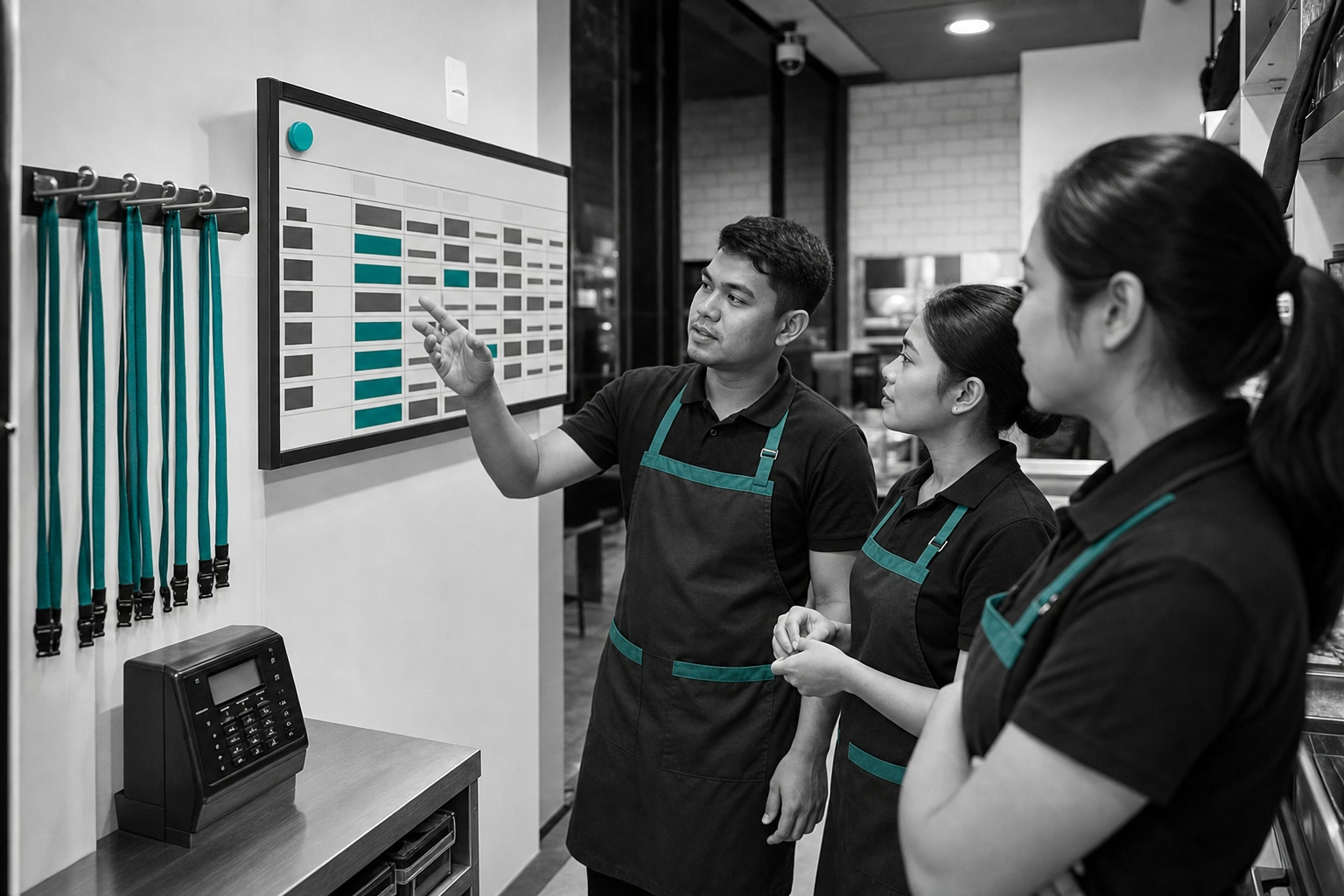
It is 4pm Friday. Somebody in your office is chasing the foreman who never sent his crew’s hours. Somebody else is re-keying a paper time card into row 47 of a spreadsheet. The bookkeeper is about to find out that two rows of formulas got dragged the wrong way. This is the same scene in every Philippine SME running on Excel, and it costs real peso. At a ₱695 NCR daily minimum wage after the July 2025 wage order (DOLE NWPC, 2025), even one miscalculation per worker per pay period adds up fast. Here are the five failure modes worth fixing first.
How much the error rate in column G actually costs
Manual time entry runs at roughly 1% to 8% error rate in payroll data, depending on the study. A foreman texts hours to admin. Admin types them into a cell. A formula references the wrong column. The formula gets dragged one row off. Somebody overrides a value without leaving a note. For a 25-person Philippine SME running two pay cycles a month, a 2% error rate means roughly one of every two pay runs has a wrong number somewhere.
The cost is not the wrong number. It is the conversation. A worker spots the discrepancy three days after pay day. Escalates to HR. HR pulls the original time card. Admin re-runs the calculation. The bookkeeper issues a correction. Two hours of three people’s time, for one error. Catch this six times a year and you have burned around 36 manager hours on math that never should have been wrong.
What Excel cannot do with Philippine Labor Code overtime
The Labor Code’s overtime stack is more complicated than a spreadsheet can carry reliably. Standard workday is 8 hours. Overtime on ordinary days pays 125%. Rest days and special non-working days pay 130% for regular hours, and overtime on those days hits 169% (130% × 30% OT premium). The night shift differential adds 10% for hours between 10pm and 6am, and it stacks with overtime, so a BPO agent on an ordinary-day overtime night shift earns 137.5% of base.
You can write all of this into an Excel formula. People do. But every pay period somebody has to look at every worker’s hours and decide which day was a rest day, which hours were night, whether the worker hit overtime that day or that week, and then apply the right multiplier. That logic ends up as a nested IF formula that one person on the team understands and that breaks the moment a holiday calendar changes or a worker switches shifts mid-week. When that person leaves, the formula is now a hostage.
Modern time tracking software (see our shortlist of the best time tracking software for the Philippines) applies these rules at the timesheet level. The payroll-ready output already reflects the right multipliers before a human ever opens the file.
Why Excel leaves nothing for a DOLE inspector to read
The Labor Code requires employers to keep daily time records, and DOLE inspectors verify them during labour standards inspections. An Excel sheet meets the letter of the requirement. It does not meet the spirit. A DOLE inspector who asks “how do you know this worker actually clocked in on May 3 at 7:58am” and hears “the foreman typed it into the spreadsheet” is going to keep asking questions.
What an inspector wants is a record tying the clock-in to a person, a time, and ideally a location. Excel does none of that. No timestamp on when the cell was edited. No record of who edited it. No way to tell whether the 7:58am punch was real or backfilled three days later by an admin who was helping out.
The risk surfaces in two scenarios. One is a DOLE inspection triggered by a worker complaint. The other is a labour dispute headed to NLRC. In both, the employer carries the burden of producing credible time records. A spreadsheet the foreman fills in Friday afternoon is not credible. A digital time clock with a GPS timestamp, a selfie, and an immutable log is.

How buddy punching hides inside Excel
Buddy punching is the failure every manual time system shares. One worker clocks in for another. Excel makes it worse because the only proof of the punch is somebody else typing the time into a cell. A foreman covering for a friend. An admin doing a favour for a relative on payroll. An encoder fixing a forgotten punch retroactively because everyone agreed it was easier than chasing the worker. The business owner reading the payroll summary sees none of this.
For a 20-person SME, even a low rate of buddy punching (say two workers gaining 15 minutes a day on average) compounds to around ₱4,000 a month in ghost payroll. The owner never sees where it leaks. The fix is not better Excel discipline. It is shifting clock-in from a self-reported event to a verified event with GPS, selfie, or kiosk authentication. How to prevent time theft in Philippine small businesses covers the operational changes that make buddy punching detectable.
Get ShiftFlow on iOS or Android
Why your bookkeeper turns into the bottleneck
In most Philippine SMEs running on Excel, the entire payroll workflow has a single point of failure. One person knows how the formulas work, what the holiday rules are, and how to reconcile mismatches between the time card and the schedule. That same person usually handles SSS, PhilHealth, Pag-IBIG, and BIR filings too.
When that person is on leave, sick, or just stuck on another deadline, payroll slips. The business owner finds out on pay day, when workers start asking why deposits did not land. The fix is not “hire a second bookkeeper.” It is removing the manual reconciliation work from their plate entirely. What flows from time tracking into payroll should already be calculated, already classified, already audit-trailed.
This is the workflow shift in How Philippine SMEs track employee attendance without manual timesheets. The time tracking app handles capture and calculation. The bookkeeper handles filings and exceptions, not the math.
Where Philippine SMEs land after Excel
Three setups cover most of what Philippine SMEs land on after Excel.
- A focused time tracker (ShiftFlow, Jibble, Hubstaff) that handles attendance, overtime calculation, and CSV export, with statutory filings still done in PayrollHero, Sprout, or a bookkeeper’s separate workflow
- A Philippine-native HR suite (Sprout, ZipHR) that handles time tracking, payroll, and BIR/SSS/PhilHealth/Pag-IBIG filings inside one product
- A hybrid: time tracker for capture, plus a payroll service for filings
Which one fits depends on team size, budget, and how much of the statutory filing you want to keep in-house. Best Time Tracking Software in the Philippines (2026 Guide) compares the nine tools Philippine SMEs shortlist most often, with pricing math for a 15-person team.
The case for moving off Excel is not that Excel is bad. It is that Excel was never built to be a timekeeping system. Using it as one means you are paying for the gap in three places at once. Wrong payroll. Missed compliance. The bookkeeper’s time. That gap almost always costs more than the ₱1,500 to ₱4,000 a month a focused time tracker would charge for the same team.
Sources
- DTI MSME Statistics 2024 for Philippine SME employment baselines
- Philippine Labor Code Book III (PD 442) for overtime, night shift, and daily time record requirements
- DOLE National Wages and Productivity Commission for the ₱695 NCR minimum wage
- Philippine News Agency on the July 2025 NCR wage order for Wage Order NCR-26 effective date
- philippines
- excel-timesheets
- sme
- time-tracking
- payroll-errors
- dole-compliance
- buddy-punching