
How Much Do Cleaning Business Owners Make?
No reliable national average exists. Compare three residential cleaning scenarios modeling $50,934, $59,518, and $94,094 in owner compensation.
There is no reliable national average salary for a cleaning business owner in the public data we reviewed. Salary sites can publish a precise-looking number, but they do not have access to a representative set of cleaning companies’ books, owner draws, distributions, and retained cash.
A more useful answer is to model the business. In three residential cleaning scenarios, the operation supports $50,934, $59,518, or $94,094 in planned annual owner compensation before personal tax. These are not low, average, and high market salaries. Each number belongs to a different set of clients, prices, labor hours, costs, and owner responsibilities.
| Planning scenario | Collected revenue | Owner compensation | Retained cash | Owner field hours |
|---|---|---|---|---|
| Solo target | $76,824 | $50,934 | $8,988 | 110/month |
| Small crew | $233,382 | $59,518 | $14,880 | 40/month |
| Established crew | $576,180 | $94,094 | $40,326 | 0 |
All three are planning examples for recurring residential cleaning. They are not survey percentiles, forecasts, or promises. In the solo and small-crew cases, owner compensation pays for both field cleaning and the work of running the business. Personal taxes, debt principal, large equipment purchases, and owner retirement contributions are not included.
How to Calculate Cleaning Business Owner Earnings
Collected revenue is the customer money that actually arrives after cancellations, refunds, and unpaid invoices.
Direct costs move with service delivery. Here they include non-owner crew payroll, supplies, laundry, travel, and re-cleans.
Overhead keeps the business operating even when it cannot be assigned neatly to one visit. This model includes insurance, marketing, admin, software, bookkeeping, and other recurring overhead.
Owner compensation is the planned wage, draw, or distribution paid to the owner. The label does not prescribe how a particular legal entity should pay its owner.
Retained cash stays in the business after the planned owner payment. It is a cushion, not a complete tax, debt, or capital spending plan.
That sequence matters. A business can collect substantial revenue and still produce weak owner earnings if labor, travel, rework, or overhead absorbs most of it.
How Much Can a Small Cleaning Business Owner Make?
The small-crew example starts with 55 recurring clients receiving two visits per month at $155 per visit, plus $3,000 in one-time work each month. After a 3% allowance for cancellations, refunds, and uncollected work, annual collected revenue is $233,382.
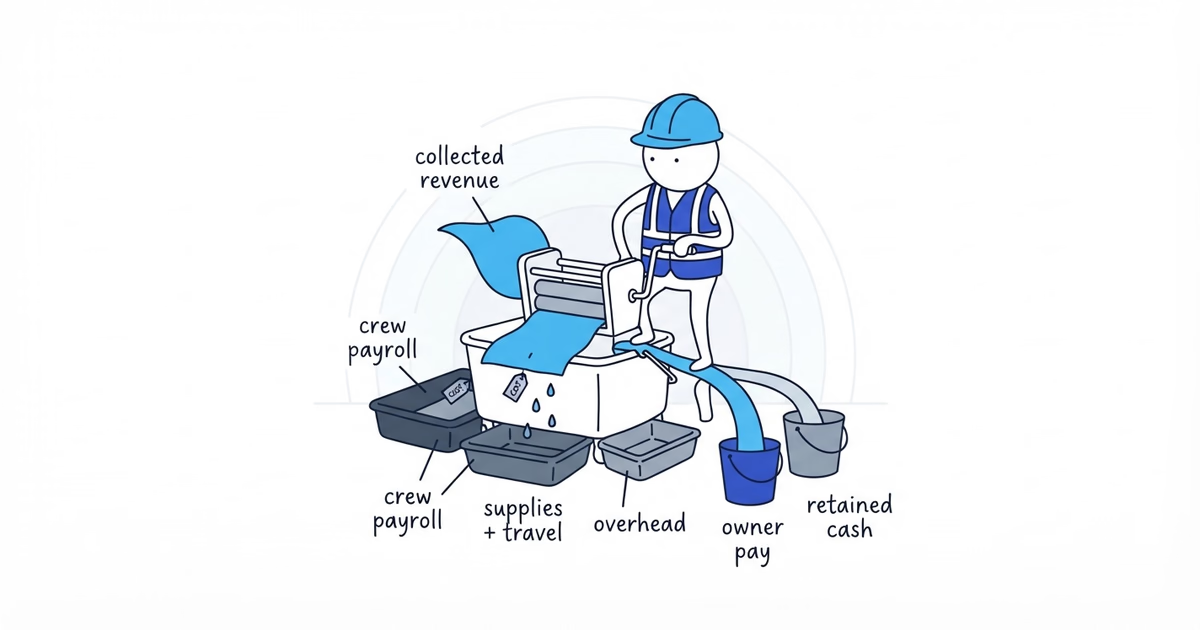
Where $233,382 of Small-Crew Revenue Goes
Source: ShiftFlow planning model. Percentages use collected revenue; inputs are shown below.
The crew payroll line is 390 paid hours per month at a loaded cost of $23 per hour. Supplies, laundry, travel, and re-cleans take another 9% of revenue. Overhead takes 13%. That leaves $74,398 before owner compensation. The model pays 80% of that subtotal to the owner and retains the other 20% in the business.
The $74,398 subtotal is not labeled profit because the owner still performs 40 field hours per month. Their labor has not been included in crew payroll. It is compensated only when the owner-compensation line is paid.
Cleaning Business Owner Earnings Model Assumptions
The point of a model is not to predict your income. It is to make every important assumption replaceable with your own numbers.
The assumptions were prepared in August 2026 as planning inputs. They have not been presented as a representative operator survey, and a local owner should replace them with trailing 12-month records wherever possible.
| Input | Solo target | Small crew | Established crew |
|---|---|---|---|
| Recurring clients | 20 | 55 | 120 |
| Visits per client each month | 2 | 2 | 2 |
| Collected price per visit | $140 | $155 | $175 |
| One-time work per month | $1,000 | $3,000 | $7,500 |
| Cancellation/refund allowance | 3% | 3% | 3% |
| Paid non-owner crew hours | 0 | 390/month | 1,050/month |
| Loaded crew cost | N/A | $23/hour | $25/hour |
| Supplies, travel, and rework | 9% | 9% | 9% |
| Overhead | 13% | 13% | 13% |
| Owner field hours | 110/month | 40/month | 0 |
| Pre-owner cash paid to owner | 85% | 80% | 70% |
The visit prices sit within a broad published 2026 consumer range from Housecall Pro, but they remain editorial assumptions. Local home size, scope, frequency, competition, travel, and service quality can move prices considerably.
The model uses these formulas:
collected annual revenue
  = monthly scheduled revenue x (1 - adjustment rate) x 12

cash before owner compensation
  = collected revenue - crew payroll - other direct costs - overhead

owner compensation
  = cash before owner compensation x planned owner share

retained cash
  = cash before owner compensation - owner compensation
What Official Cleaning Business Data Can Tell You
The U.S. Census Bureau’s 2023 Nonemployer Statistics counted 1,095,927 U.S. nonemployer establishments in the broader Janitorial Services industry, with $22.78 billion in aggregate receipts. Dividing one by the other gives an arithmetic mean of $20,785 in receipts per establishment. That is revenue, not profit or owner income. It is not the median, either.
In fact, 92.8% of those records had receipts below $50,000, and the count-based median fell somewhere inside the $10,000–$24,999 bracket. Many nonemployer records represent part-time or secondary income, and the industry includes more than residential house cleaning. Census explicitly notes that a nonemployer business may not be its owner’s main source of income.
The separate 2023 employer dataset counted 67,799 establishments and 1,088,193 employees in Janitorial Services. Those figures show that the industry includes everything from owner-operators to large employers. They still do not reveal a national owner salary.
If the number you need is employee pay rather than owner income, the house cleaner salary guide compares the $17.07 national median with hourly and annual wages across every state.
What Changes Cleaning Business Owner Earnings?
Price. In the small-crew model, raising the recurring visit price by 10% while holding volume steady adds about $15,481 to annual cash before owner compensation. A price increase only holds if the market accepts it and service quality keeps cancellations under control.
Paid crew hours. Increasing paid crew hours by 10% with revenue unchanged removes $10,764 from annual pre-owner cash. This is why owners need scheduled hours, actual hours, and revenue by job in the same view. Cutting paid time blindly can damage quality, so start with estimating errors, travel, late starts, and repeat work.
Route density and collections. Tighter routes reduce paid travel, mileage, and gaps that cannot be billed. In the same model, improving the cancellation and collection adjustment from 3% to 2% adds about $1,877 before owner compensation. Neither change is glamorous, but both compound over hundreds of visits.
Retained cash. Paying every available dollar to the owner can make a good month look better while leaving the business unable to absorb equipment failure, a slow season, or a hiring gap. The examples retain 15%, 20%, and 30% of pre-owner cash as the operation grows. Those percentages are planning choices, not universal targets.
When paid crew hours are difficult to connect to the right client site, time tracking for cleaning teams makes travel, estimating gaps, and repeat work visible before payroll closes. It does not create margin by itself, but it shows where to investigate.
Frequently Asked Questions
How much does a cleaning business owner make?
No public national dataset provides a reliable average. In the three planning scenarios here, owner compensation is $50,934 for a solo target, $59,518 for a small crew, and $94,094 for an established crew. They are modeled examples, not market averages or a salary range.
How much can a solo cleaning business owner make?
The solo example produces $76,824 in collected annual revenue, $50,934 in owner compensation, and $8,988 in retained cash. It assumes 20 biweekly clients, $140 per recurring visit, $1,000 in monthly one-time work, and 110 owner field hours per month.
Is cleaning business revenue the same as owner income?
No. Revenue arrives before payroll, supplies, travel, re-cleans, insurance, marketing, admin, and other overhead. Owner compensation and retained cash come later.
What affects cleaning business owner earnings most?
Price, paid crew hours, route density, cancellations, and retained cash policy are major levers. The useful number is what remains after direct costs and overhead, not revenue alone.
Sources
- cleaning-business-owner
- cleaning-business-income
- owner-earnings
- residential-cleaning
- job-costing