How Do I Calculate Cost per Estimate?
Calculate cost per estimate with a clear formula, consistent lead-source marketing spend, one delivered-estimate definition, and a practical trades example.
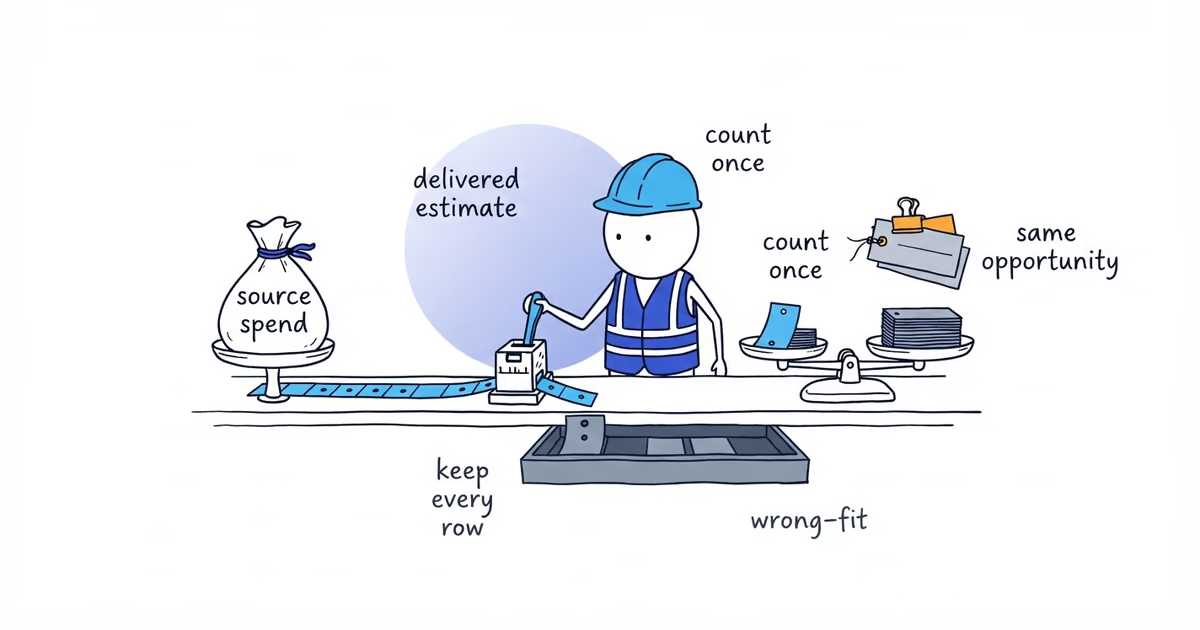
Use this formula:
Cost per estimate = net marketing spend for one lead-source cohort / unique estimates delivered from that cohort inside your measurement window
If a source cost $1,400 and produced 12 delivered estimates, the cost per estimate was $116.67.
The division is easy. The useful work is deciding what belongs in the $1,400, what counts among the 12 estimates, and which leads belong to that reporting period.
What counts in the cost per estimate formula?
An estimate counts when you deliver a substantive price or proposal for one customer-property-project opportunity. It can be written or verbal, but it has to be based on enough scope to quote the work.
Use the same counting rules every month:
| Event | Estimate count | Treatment |
|---|---|---|
| You deliver one price or proposal for a real project | 1 | Count it when the customer receives it |
| The proposal includes good, better, and best options | 1 | The options belong to one opportunity |
| You revise or resend the same estimate | 1 | Keep the original count; do not count versions |
| The customer declines or cancels after receiving the estimate | 1 | Booking outcome does not change the estimate count |
| The customer schedules a visit but cancels before you price the work | 0 | Keep the lead row and mark the cancellation |
| The inquiry is spam, outside your area, or for a service you do not do | 0 | Mark the reason; do not erase the row |
| The same customer-project arrives twice | 1 | Link the duplicate to the original opportunity |
| The customer requests a separate, newly scoped project | 1 | Count it separately only when your records clearly show a different project request |
A rough price range given before you understand the scope is not an estimate. Neither is an unanswered inquiry or a scheduled appointment. If you deliver a real estimate to a lead previously marked unqualified, however, it counts. Do not remove a delivered estimate because the customer did not book.
Which marketing costs go into cost per estimate?
Start with costs that belong to that lead source:
- Ad spend or purchased-lead charges
- Source-specific agency or management fees
- Creative or landing-page work used only for that source
- A tracking number or other tracking cost used only for that source
- A documented share of a one-time setup cost
Then subtract credits or refunds the source has actually issued. Leave requested or disputed credits in the cost until they appear on the account. Otherwise, the number changes based on what you hope to receive rather than what you paid.
Keep the numerator focused on marketing. General overhead, job production costs, and estimator labor do not belong in this version. The internal cost of preparing estimates is a separate operating metric.
For a cost shared by several sources, use one written allocation rule, such as actual work or managed spend. Do not charge the whole invoice to every source.
How to track lead sources and the attribution window
Give every lead one source when it enters your tracker. Use the first source you can identify: campaign fields captured on a form, a tracked phone source, or the answer recorded at intake. Do not credit one estimate to two primary sources.
Tagged links can preserve source, medium, and campaign information in Google Analytics, which separates traffic-source scopes in its reports. Choose one scope instead of mixing exports. Give phone inquiries a source field too.
Put every lead first received in May into the May cohort, then give it 30 days to reach a delivered estimate. Match those leads with the source spend used to acquire the cohort. Wait until the last lead matures before calculating.
Thirty days is a working rule, not an industry standard. If your normal cycle needs longer, choose a longer window before you start and keep it unchanged across sources and periods. Ad platforms may use different conversion windows, so reconcile their totals with your delivered-estimate ledger.
Cost per estimate example for a lead source
Use one row per incoming lead. At minimum, keep these fields:
| Lead record field | What to enter |
|---|---|
| Lead ID and received date | A unique ID and the date the inquiry arrived |
| First identifiable source | The one primary source used for this calculation |
| Customer-property-project key | The combination used to find duplicate opportunities |
| Qualification result | In scope, wrong service, outside area, spam, or another reason |
| Duplicate-of ID | The original lead ID when the row is a duplicate |
| Estimate delivered date | Blank until a real price or proposal reaches the customer |
| Estimate-count flag | 1 for the first delivered estimate; otherwise 0 |
| Exclusion reason | Why a row does not enter the denominator |
| Finalized credit | A credit already issued against source spend |
Now take a fictional May source cohort. These are example inputs, not a benchmark for any trade or channel.
| Source cost | Amount |
|---|---|
| Media or purchased-lead charges | $1,200 |
| Source-specific management | $250 |
| Source-specific tracking | $50 |
| Credit already issued | -$100 |
| Net source spend | $1,400 |
The tracker contains 18 lead rows:
- 12 unique opportunities received an estimate within 30 days.
- 2 rows were duplicates of opportunities already in the tracker.
- 3 inquiries were for the wrong service or outside the service area.
- 1 customer canceled before receiving an estimate.
One of the 12 customers received a revised proposal. The revision does not create a thirteenth estimate.
$1,400 / 12 = $116.67 per estimate
The duplicate, unqualified, and canceled rows stay in the tracker. Their cost stays in source spend unless the provider issues a credit. Deleting them would hide what it took to produce the 12 estimates.
If a matured cohort produces no estimates, report the actual source spend and state that the cohort produced no estimates. Cost per estimate is not $0; there is no denominator. Do not replace the zero with raw lead count just to produce a number.
What does cost per estimate tell you?
Cost per estimate tells you how much source spend was required to create one delivered pricing opportunity under your written rules. There is no universal good cost per estimate. A low figure can still lead to small or unprofitable jobs, while a higher figure can come from estimates for larger work.
Do not use this number alone to keep or cancel a source. The next metric is lead-source ROI, which connects the source to collected revenue and profit after the work is completed.
Frequently Asked Questions
Is cost per estimate the same as cost per lead?
No. Cost per lead divides source spend by all recorded leads. Cost per estimate divides it by unique opportunities that actually received an estimate inside the measurement window.
Is cost per estimate the same as cost per booked job?
No. Cost per estimate stops when a price or proposal reaches the customer. Cost per booked job uses booked jobs as the denominator, so it measures a later stage of the sales process.
Sources
- pricing
- how-to-calculate-cost-per-estimate
- cost-per-estimate-formula
- marketing-cost-per-estimate
- cost-per-estimate-for-contractors
- cost-per-lead-vs-cost-per-estimate