
How Do I Calculate Overhead per Job?
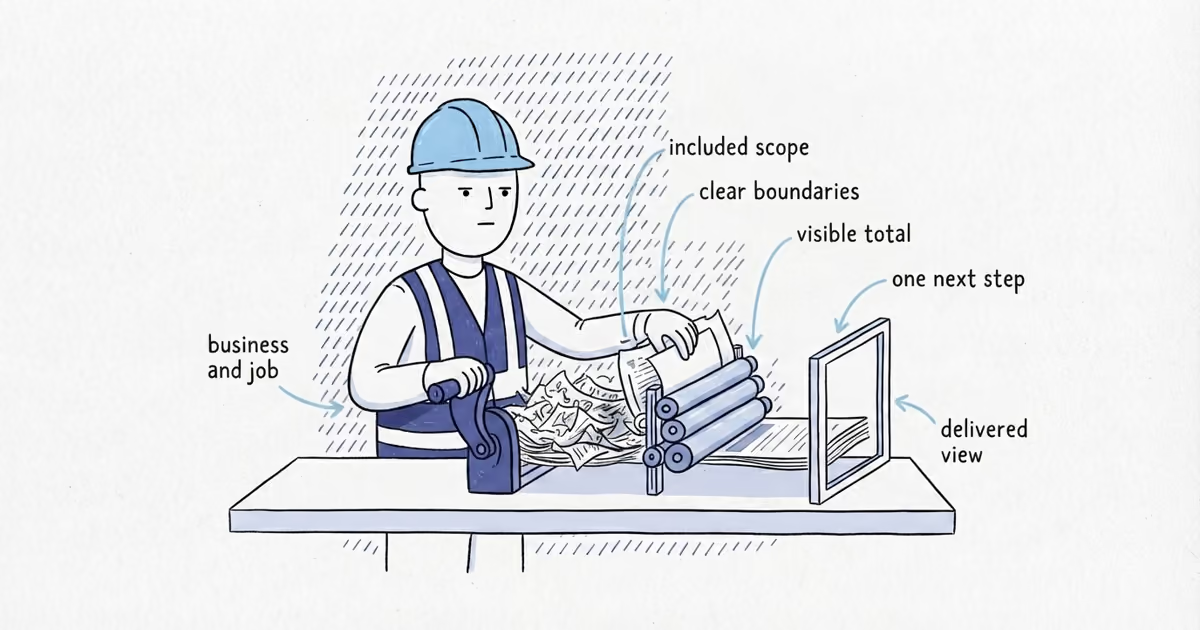
Add up the overhead for one consistent period, then divide it by the cost driver that best matches your work. Use billable hours, completed jobs, or direct costs according to how the work consumes shared resources.

Add up the overhead for one consistent period, then divide it by the cost driver that best matches your work. Use billable hours for time-driven services, completed jobs for similar service calls, or direct costs for projects that vary sharply in size.
The wrong denominator creates a confident but useless number. Dividing overhead evenly across a one-hour repair and a three-week project makes the small job carry too much and the large job carry too little.
Overhead costs vs. direct job costs
Direct costs can be traced to one job. They include the crew hours, materials, subcontractors, equipment rental, permit, or project-specific coverage required for that customer.
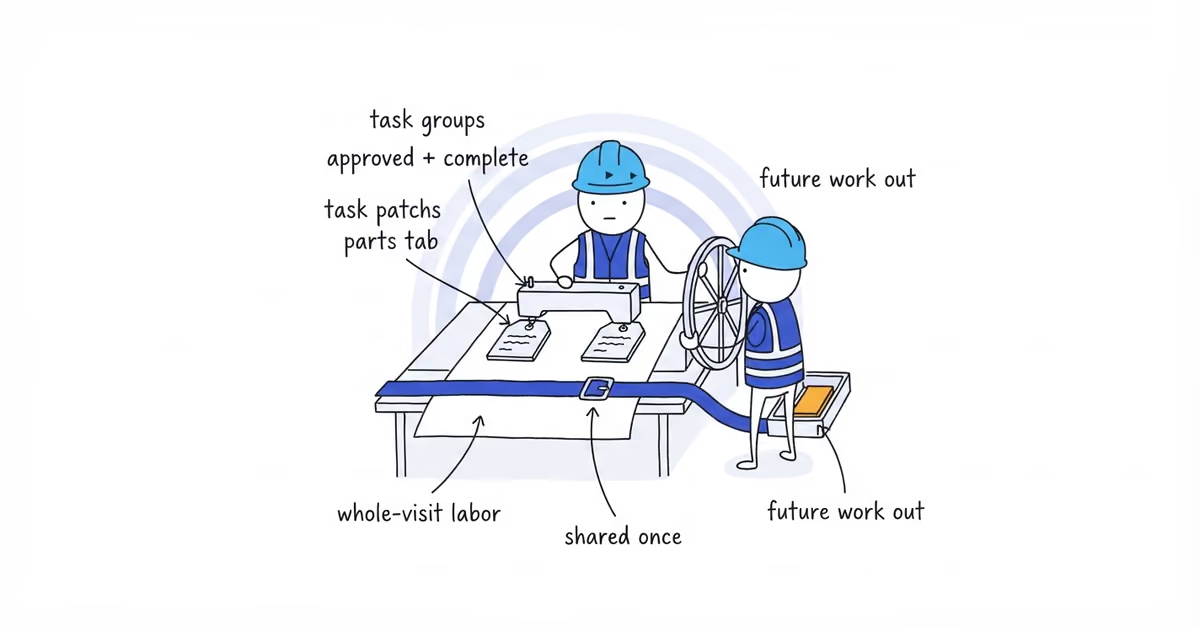
Overhead keeps the business operating across all jobs. A practical inventory includes:
- Office and administrative payroll
- Rent, utilities, and storage
- Phone and internet
- Estimating, scheduling, accounting, and other software
- General marketing
- Licenses and recurring professional fees
- General liability, property, and other annual business insurance
- Shop tools and shared equipment
- The portion of vehicle costs treated as business overhead
Some costs are fixed for the period, such as rent. Some move with activity, such as fuel or card-processing expense. Others contain both: a truck has a fixed lease and insurance cost plus variable fuel and repairs. The classification only needs to be detailed enough to forecast the total and avoid putting the same expense in two places.
Choose a month or a year. Do not mix monthly overhead with annual hours or annual overhead with one month of jobs.
Three ways to allocate overhead to jobs
Overhead per billable hour
Overhead per billable hour = period overhead / realistic billable hoursUse this when time is the main reason one job consumes more business capacity than another. Cleaning, repair, installation labor, and many owner-operated services fit this method.
The denominator is hours you expect to sell, not all paid or available hours. Loading, driving, quoting, meetings, callbacks, training, and gaps in the schedule reduce billable hours. Dividing by 2,080 hours because one person works a nominal 40-hour week will usually understate the hourly overhead.
Overhead per completed job
Overhead per job = period overhead / completed jobs in the periodUse this only when jobs are reasonably similar. A route of recurring maintenance visits may support a per-job amount. A business mixing $150 service calls with $20,000 projects usually will not.
Overhead rate on direct cost
Overhead rate = period overhead / period direct costs

Job overhead = job direct costs x overhead rate
Use this for projects where labor, materials, and subcontractor costs vary substantially. Larger projects receive more overhead because they use more of the direct-cost base.
The direct-cost pool must be consistent. If the annual rate uses labor and materials, do not apply it later to materials alone.
Overhead per job calculation example
Suppose a service contractor has these monthly figures:
| Monthly figure | Amount |
|---|---|
| Overhead | $12,000 |
| Realistic billable hours | 480 |
| Completed jobs | 120 |
| Direct job costs | $40,000 |
The three rates are:
$12,000 / 480 hours = $25 overhead per billable hour

$12,000 / 120 jobs = $100 overhead per job

$12,000 / $40,000 direct costs = 30% overhead rate
Now apply them to two very different jobs.
| Job | Per-hour method | Per-job method | Direct-cost method |
|---|---|---|---|
| One-hour service call with $120 direct cost | $25 | $100 | $36 |
| Twenty-hour project with $8,000 direct cost | $500 | $100 | $2,400 |
The table does not prove that one method is correct. It exposes what each method assumes.
The per-job method assumes both jobs consume the same overhead, which is hard to defend here. The direct-cost method assigns much more overhead to the material-heavy project. The hourly method follows time but may understate project administration, purchasing, and risk. Choose the method that follows how your business actually consumes shared resources.
If you operate two genuinely different lines of work, use separate cost pools or allocation methods instead of forcing one company-wide average onto both.
How to include insurance in job pricing
General liability, office/property coverage, and recurring commercial policies normally support the whole business. Add the applicable monthly or annual premium to overhead, then allocate it through the chosen method.
A cost required only for one project belongs directly to that job. Examples may include a project-specific rider, bond, permit, or special coverage requirement. Treating it as general overhead would make unrelated customers pay part of that project’s cost.
Do not add the entire annual insurance premium to one estimate, and do not allocate it through overhead while also adding the same premium again as a job line.
How to include overhead in your final price
Overhead is a cost, not profit. Build the job cost first:
Full job cost = direct job costs + allocated overhead

Price at target margin = full job cost / (1 - target margin)
For an illustrative one-hour call with $120 of direct cost and $25 of hourly overhead:
Full job cost = $120 + $25 = $145

At a 20% target margin:
$145 / 0.80 = $181.25
The 20% is only an example of where margin enters the calculation. Choosing the right target is a separate decision. The important point is sequence: apply profit after the job carries its fair overhead share.
How to avoid double-counting overhead
Before adding the allocation to a quote, inspect every existing rate and fee:
- Does the loaded labor rate already include office and insurance overhead?
- Does the service-call fee already recover dispatch, software, and truck cost?
- Does material pricing already include purchasing and warehouse expense?
- Is a vehicle rate inside overhead and also added as a separate truck charge?
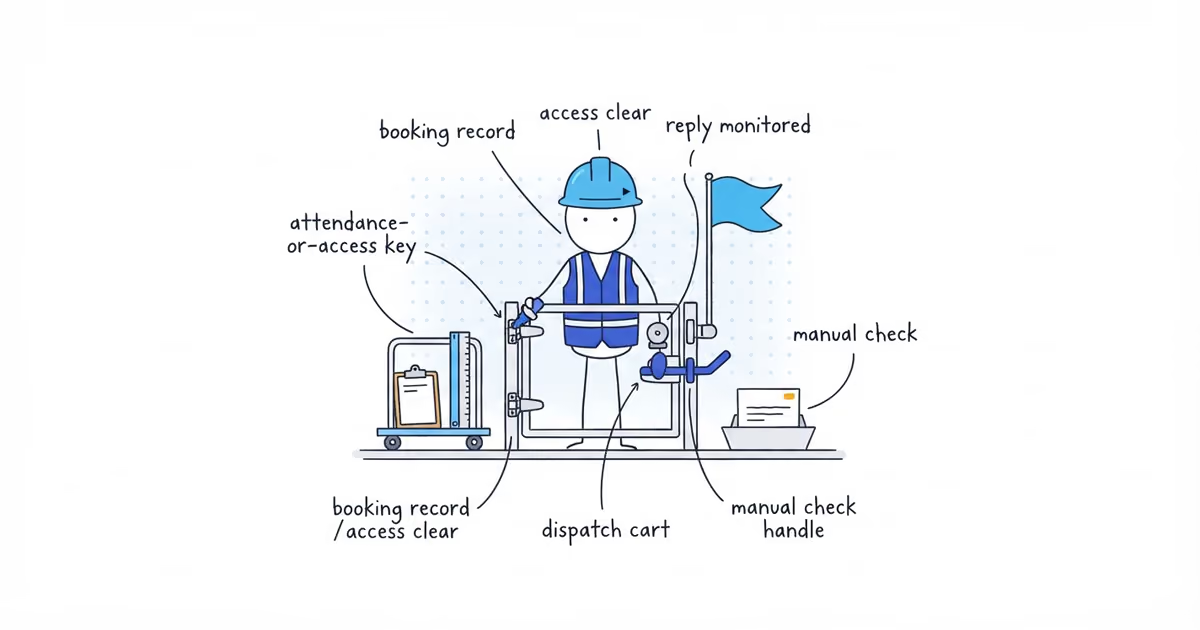
Create one list with three columns: expense, recovery method, and rate or fee containing it. Every overhead expense should appear once.
If your current labor rate already includes $25 of hourly overhead, use that rate in the job. Do not add another $25 per hour under a new overhead line just because the formula is correct.
When to recalculate your overhead rate
Update the overhead pool and denominator monthly or quarterly. Recalculate immediately after a meaningful change in office payroll, rent, software, fleet, insurance, or crew size.
Volume matters as much as expense. If monthly overhead stays at $12,000 but billable hours fall from 480 to 400, hourly overhead rises from $25 to $30. Keeping the old rate would leave $2,000 unrecovered that month.
The useful overhead number is not the percentage another contractor reports. It is the amount your business must recover, divided by the work that actually carries it.
Frequently asked questions
Is rented equipment overhead or a direct job cost?
Equipment rented for one customer is normally a direct job cost. Cost for shared equipment owned or rented across many jobs belongs in the overhead pool or another consistent equipment rate.
Are credit card processing fees overhead?
They can be treated as variable overhead or assigned to the transaction that creates them. Choose one method and make sure the fee is recovered once in the final price.
Are office staff wages part of overhead?
Yes, when the employee supports the business rather than one specific job. If someone splits office and field work, allocate the administrative hours to overhead and the traceable field hours to direct labor.
Sources
- pricing
- overhead-per-job
- calculate-overhead
- overhead-allocation
- overhead-per-billable-hour
- insurance-in-job-pricing