How do I get commercial HVAC contracts?
Learn how to get commercial HVAC contracts by finding named accounts, qualifying sites, checking capacity, and pursuing HVAC maintenance agreements that fit.
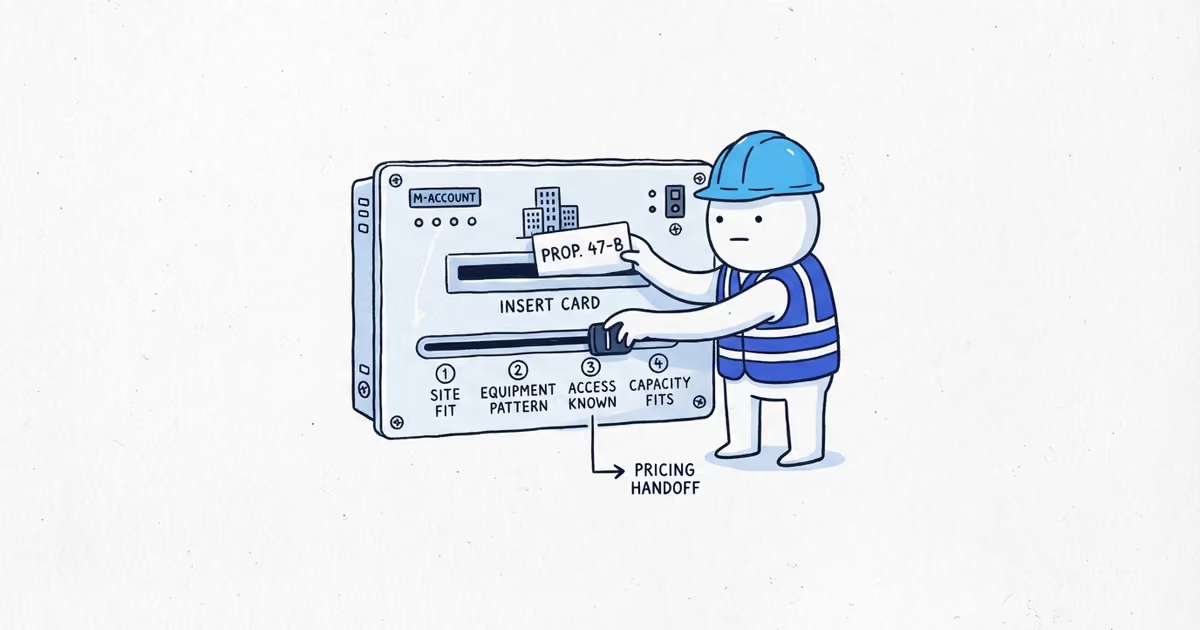
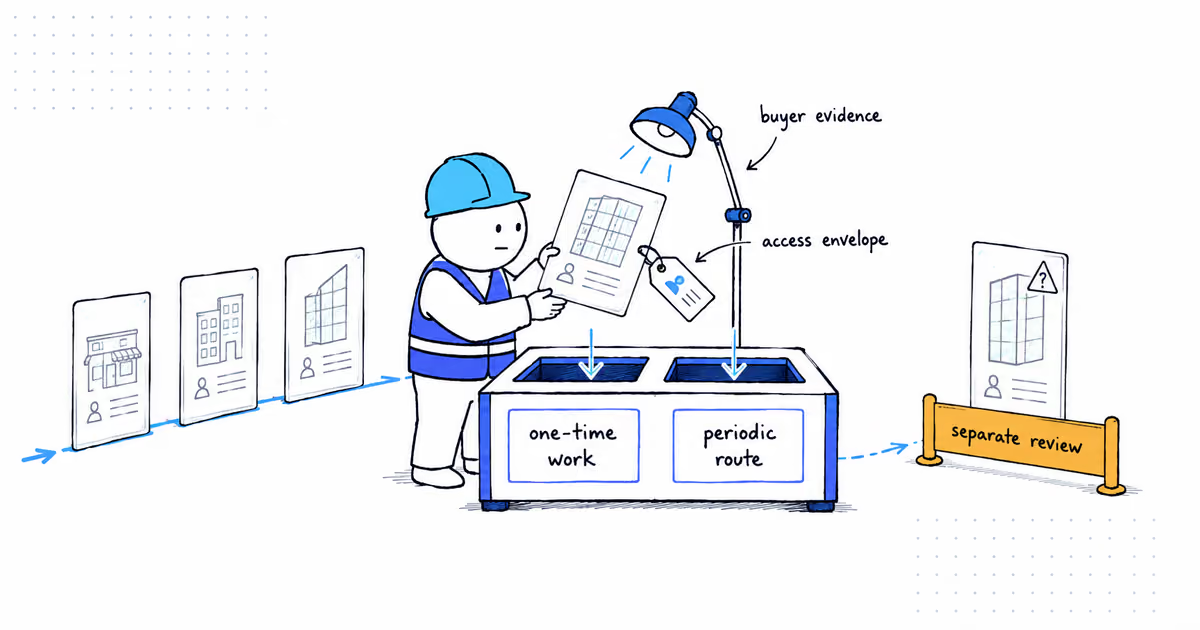
Get commercial HVAC contracts by choosing a property, equipment, and service pattern you can support now; finding named sites and the people behind the service decision; showing truthful, relevant proof; qualifying the site, access, buyer process, and coverage needs; surveying suitable opportunities; and advancing only work that passes an operating-fit gate into pricing and proposal stages. This creates qualified pursuits, not guaranteed awards.
The target is privately purchased HVAC service and preventive maintenance for businesses, managed properties, facilities, and local multi-site operators. Supported repair or response work may accompany it. Replacement and project work need a separate handoff. Government procurement, legal drafting, and technical HVAC instruction are excluded.
Keep the stages honest: a named account is not an opportunity; a contact is not a qualified site; vendor approval is not a work order; a survey is not a bid; a proposal is not an accepted agreement; and proposal value is not earned revenue.
How to choose commercial HVAC accounts
The U.S. Small Business Administration recommends checking demand, location, target customer, saturation, alternatives, and entry conditions. Apply this to your records and named properties. No segment or territory radius is universally best.
Record one initial service geography; property, operating, equipment, and service pattern; access limits; qualified-technician hours; equipped vehicles and tools; available backup; relevant proof; likely buyer; and no-fit rules.
Separate planned service, preventive maintenance, and supported repair or response work before prospecting. Each needs distinct scope and capacity facts. Pursue multi-site work only when every location fits. Keep projects separate.
Commercial HVAC Account Qualification and Pursuit Board
One row represents one account. A cell is complete when it gives a verified fact and source or names the unknown and who will resolve it.
| Account and site | Property and operating pattern | Buyer and stakeholder roles | Verified opportunity or review trigger plus source/date | Equipment or asset pattern known so far | Requested service model | Locations and service area | Access and operating constraints | Current response and backup capacity | Relevant permission-cleared proof | Buyer process and dates | Opportunity stage | Owner plus next action/date | Pass, hold, or decline reason |
|---|---|---|---|---|---|---|---|---|---|---|---|---|---|
| Cedar Office Center, fictional private site | Locally managed occupied property | Facility contact supplies facts and communicates; owner selects and approves; site contact controls access; accounts payable handles invoices | Buyer-confirmed maintenance review; direct confirmation dated September 2, 2026 | Buyer-supplied pattern recorded; part is outside documented support | Preventive maintenance; repair, response, and projects separated | One site inside current geography | Secured area and escort recorded; survey otherwise feasible | Technician and equipped-vehicle capacity checked; no backup promised | Permission-cleared commercial proof does not match the unsupported pattern | Review contact, due date, and decision date recorded | Qualified, then declined before survey | Sales owner: explain no-fit and close on September 5, 2026 | Decline: confirmed equipment pattern is outside documented support |
To complete a row, name every site and operating pattern; map selection, information, access, approval, communication, and invoice roles; source and date the trigger; record known equipment without guessing; separate service models; confirm location fit; and record access, capacity, matched proof, buyer dates, stage, owner, dated action, and evidence-based decision.
How to find commercial HVAC decision-makers
Buyer titles are hypotheses. The functions are what matter.
| Function to verify | Possible contact | Bounded starting channel |
|---|---|---|
| Select provider and approve work or supplier | Property or facility manager, owner, operations, procurement, or relevant general contractor/builder | Customer or supplier introduction, business connection, official site |
| Supply equipment and site information | Facility, operations, office, site, or project contact | Buyer-confirmed contact route or requested introduction |
| Control mechanical-area and occupied-site access | Facility, office, site, security, or project contact | Named-site contact route |
| Communicate operating issues | Facility, operations, office, or site manager | Confirmed buyer channel |
| Process invoices | Accounts-payable or buyer-designated contact | Buyer-supplied invoice route |
Use named sites, permission-safe referrals, current customer or supplier introductions, local relationships, relevant directories or events, official sites, private opportunities, and buyer notices. Require a sourced reason and date. A roofline, visible equipment, address, or guessed expiration proves nothing. Avoid scraped lists, purchased leads, and mass messages.
What commercial HVAC buyers need to verify
Be ready with exact business and contact details; supported service and geography; permission-cleared, matched proof; current qualified-technician hours; vehicle, tool, supplier, and backup capacity; and only current, relevant documents required by the buyer, work, or authority.
The Federal Trade Commission says advertising claims must be truthful, nondeceptive, and evidence-based. Apply this to credentials, experience, equipment, service area, response capacity, savings, uptime, results, and guarantees. Remove unsupported claims; never invent proof.
A restrained first email for the fictional example could say:
Subject: Cedar Office Center HVAC maintenance review
Your September 2 maintenance-review notice lists this address for vendor questions. We support commercial preventive-maintenance work in the surrounding service area. Who owns this review, and would a short qualification call be useful before either side schedules a site survey?
For U.S. commercial email, the FTC says CAN-SPAM has no business-to-business exception. Use accurate sender and subject information, a valid postal address, a clear opt-out method, and honor opt-outs. Check other rules; this is not legal advice or a cadence.
Last verified: September 2, 2026 (United States).
The SBA notes that license and permit requirements and fees vary by activity, location, and government rules. Verify the work, equipment, site, buyer, authority, and jurisdiction instead of using a universal list.
How to qualify commercial HVAC sites before a survey
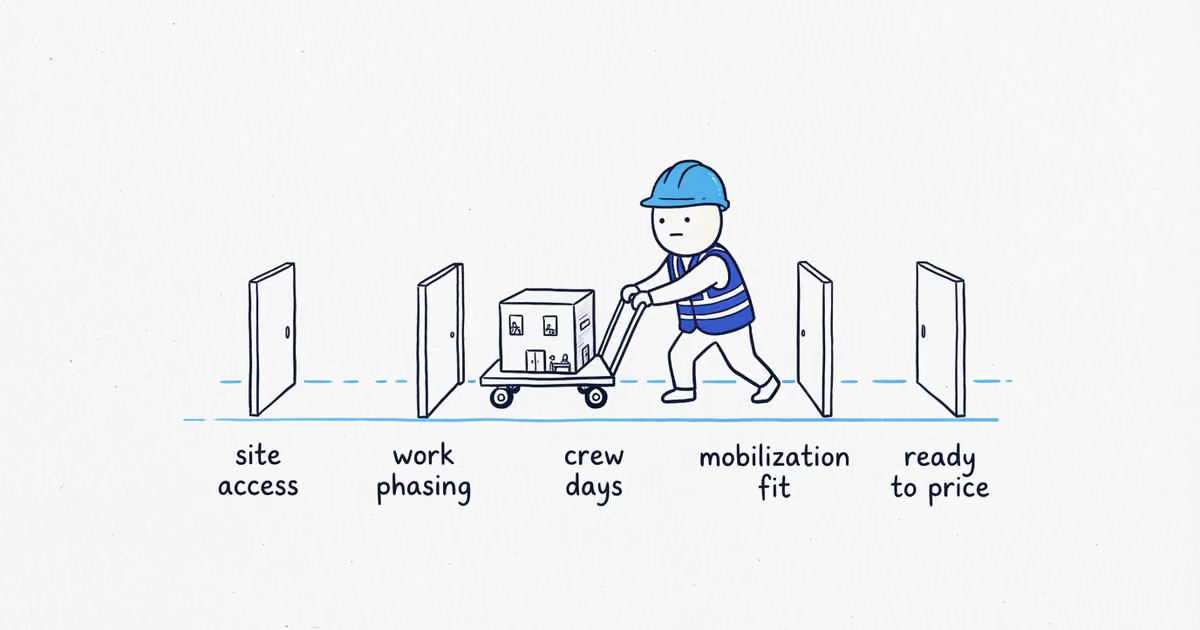
Confirm the sites; buyer roles; service model and review reason; known asset pattern; buyer-shared provider or trigger facts; requested service and response windows; review process; due, decision, and expected-start dates; vendor conditions; access; communication, escalation, and invoice paths; and operating fit. Mark unknowns.
At a survey, record appropriate asset identifiers; covered buildings, zones, and locations; roof or mechanical access; occupancy, security, escort, parking, loading, hours, communication, and shutdown constraints; customer responsibilities; documents; scope gaps; exclusions; specialist work; and assumptions. Do not add maintenance, diagnostic, safety, code, or repair instruction.
Commercial HVAC contract no-fit checklist
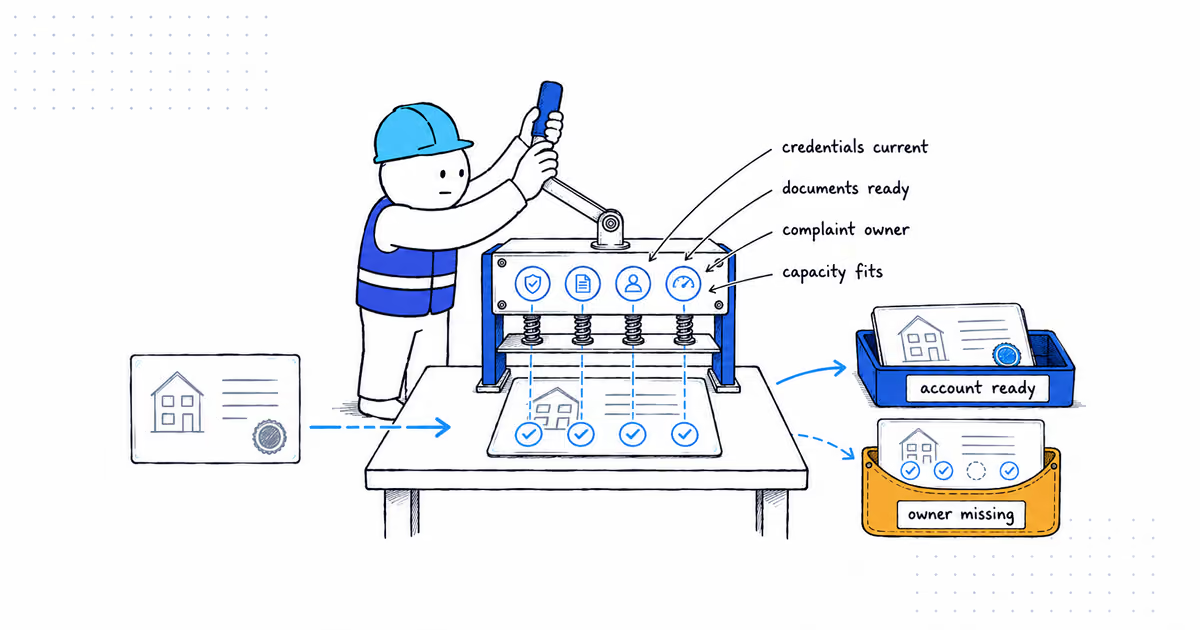
Run this before a survey or proposal and again before acceptance. The evidence column is the completion criterion. Cedar Office Center is fictional.
| Check | Evidence | Pass, hold, or decline |
|---|---|---|
| Geography and travel | Site inside current geography; travel checked in records | Pass |
| Supported equipment and site pattern | Confirmed pattern includes work outside documented support | Decline |
| Technician qualifications and available hours | Qualified hours checked for supported work | Hold; full pattern unsupported |
| Equipped vehicles and tools | Availability checked against confirmed pattern | Hold; unsupported work remains |
| Survey and access feasibility | Escort and secured-area requirements recorded; access otherwise feasible | Pass |
| Requested service or response window | Buyer request recorded; no unsupported response commitment made | Pass |
| Backup or on-call coverage, only if promised | None promised; current statement is accurate | Pass |
| Parts, supplier, or subcontractor dependency | Dependencies recorded; no availability invented | Pass |
| Buyer administration and invoice path | Review, approval, and invoice contacts recorded | Pass |
| Direct-cost and capacity fit | Calculation stopped after equipment no-fit | Hold |
| Unsupported specialist or regulatory scope | Unsupported equipment work separated rather than accepted | Decline |
| Remaining capacity | Current capacity checked; no future capacity assumed | Pass |
How to hand off a qualified commercial HVAC account
A passed handoff contains the account, contacts, sites, asset pattern, service model, buyer-supplied frequency or window, constraints, customer responsibilities, documents, assumptions, separate projects, buyer dates, owner, and action.
When a qualified maintenance account is ready for a number, use the HVAC maintenance pricing guide to calculate the visit, annual plan, and included-system pricing from actual delivery costs. If a property manager requires formal onboarding first, use the property-management vendor guide to follow its official documents and approval route before treating the account as ready for work. Estimates, proposals, capability statements, and generic commercial acquisition remain separate.
Confirm receipt, record the buyer’s process, answer questions, and stop after a decline or no-contact request. Before proposal or acceptance, compare sites and equipment, qualified hours, travel, vehicles and tools, access and windows, credible response and backup, supplier or subcontractor dependencies, specialist work, administration, invoice and payment process, startup commitments, direct costs, and remaining capacity. Use no rates, margins, service-level promises, response benchmarks, savings claims, or contract values.
For fictional Cedar Office Center, the decision is decline, not a survey or pricing handoff. The sales owner will explain that the confirmed equipment pattern falls outside documented company support and close the pursuit on September 5, 2026.
Frequently asked questions about commercial HVAC contracts
Do I need a capability statement to get commercial HVAC contracts?
Not for every account. Prepare accurate buyer-ready facts, matched permission-cleared proof, and current capacity first. Use a capability statement only when the buyer asks for one or the channel supports it; it does not replace site and equipment qualification.
How do I become an HVAC vendor for a property management company?
Use the company’s official vendor route and confirm which current documents, service areas, access rules, work-order steps, and invoice requirements apply. Approval may put the company on a vendor list, but it does not award an HVAC work order.
Commercial HVAC contract research sources
- commercial-contracts
- how-to-get-commercial-hvac-contracts
- commercial-hvac-accounts
- commercial-hvac-maintenance-agreements
- commercial-hvac-decision-makers
- hvac