How do I get commercial window cleaning contracts?
Learn how to get commercial window cleaning contracts by finding named properties, verifying frequency, and checking access, route, crew, and equipment fit.
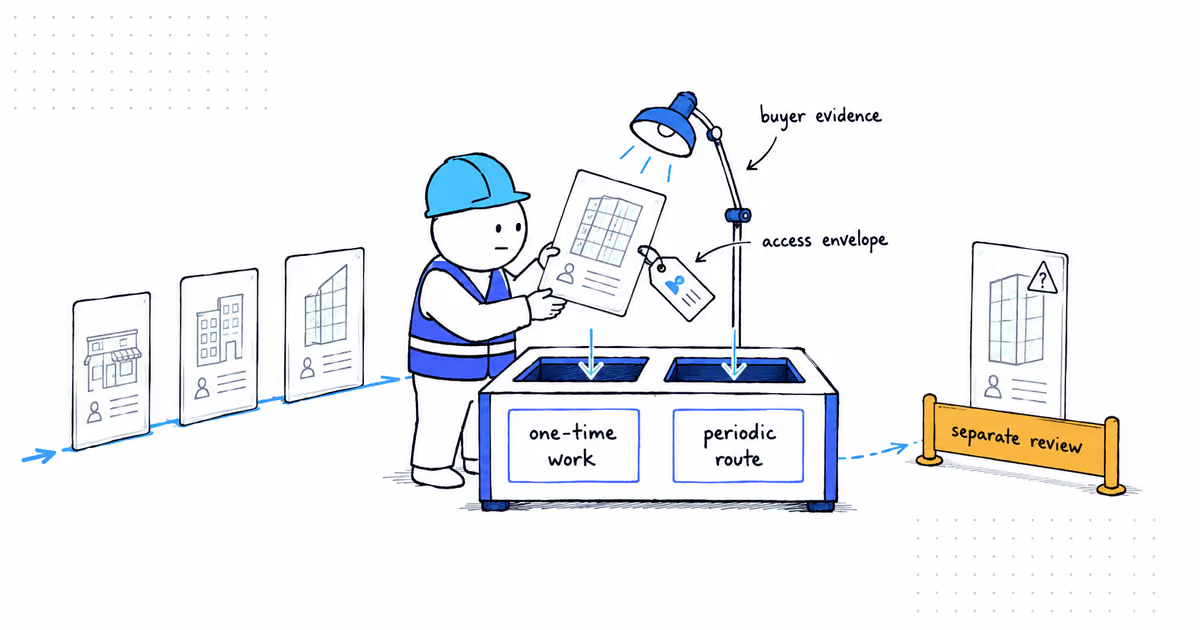
Get commercial window cleaning contracts by targeting supported private work, finding named properties with dated triggers, verifying the buyer, and qualifying the buyer-defined glass areas, operations, access, route, and capacity. Send only evidenced accounts to pricing.
Last verified: September 2, 2026 (United States).
Here, a contract means private one-time work or an evidenced periodic schedule inside your access envelope. It is not automatically recurring. Government procurement, agreements, pricing, technical work, and safety instruction are excluded.
A property or visible condition is not buyer intent. A contact may not decide. One-time interest is not periodic work. Vendor approval, site review, and quote invitation are not revenue.
Choose a commercial window cleaning property type
Choose a pattern fitting completed work, geography, hours, access, route, crew, supervision, and equipment. SBA guidance supports checking local demand, customer location, market size, saturation, and alternatives. No property type is universally best.
Use this map. Titles are roles to verify, not purchasing authority.
| Supported pattern | Buyer role to verify | Source channel | Acceptable trigger | One-time or periodic evidence | Matching proof | Supported access boundary | Stop signal |
|---|---|---|---|---|---|---|---|
| Street-level retail | Owner, site, property, or operations contact | Relationship, research, referral | Confirmed need or review | Dated status source | Approved retail example | All zones supported | Observation, unknown authority, unsupported access |
| Occupied office | Property, facility, office, or operations contact | Relationship, referral, research | Confirmed active review | One-time or schedule evidence | Approved occupied-site example | Zones/window supported | Assumed access, frequency, schedule |
| Multi-tenant common area | Owner, property, facility, or tenant contact | Site relationship or referral | Confirmed site/review | Site-specific evidence | Approved common-area example | Inside current envelope | Assumed portfolio authority or coordination |
Appearance, listings, weather, or foot traffic prove no authority, scope, timing, or frequency. Without an attributable, dated trigger, keep researching.
Research named commercial window cleaning accounts
Create one record per site. Combine a portfolio only after buyer confirmation.
| Record field | Completion evidence |
|---|---|
| Account and site | Property, use, operating pattern |
| Functional roles | Buyer, input, access, authorization, completion, invoice owners |
| Trigger | Source, date, status, next event |
| Frequency | Observable state, source, date |
| Outcome | Buyer-described result |
| Service boundary | Zones, sides, included, excluded, optional |
| Building facts | Areas, levels, public/tenant activity |
| Operations | Window, security, escort, interior access, coordinator |
| Logistics | Parking, loading, staging, storage |
| Access | Supported-envelope status; specialist flag |
| Documents | Received, missing, owner |
| Proof | Job, caption, date, permission, privacy, relevance |
| Delivery fit | Route, mobilization, crew, supervision, equipment |
| Administration | Dates, completion, approver, vendor steps, invoice |
| Dependencies | Unresolved fact and owner |
| Control | State, assumptions, owner, action/date, decision reason |
Fictional example: A small company records a locally managed street-level retail property after its manager confirms a vendor review. It invents no identity, count, frequency, price, method, result, or award. Roles, zones, operations, route, proof, crew, supervision, and equipment need evidence.
Verify the buyer and commercial window cleaning frequency
Verify who defines the need, schedule, site, and glass areas; controls access; provides documents; authorizes work; approves completion; and handles invoices. One person may hold several roles.
Use only these observable frequency states:
| State | Record it only when | Completion test |
|---|---|---|
one-time requested | Buyer requests one visit | Dated source recorded |
trial requested | Buyer requests a trial | No later visits implied |
periodic schedule under discussion | Buyer discusses repeat visits | Not yet accepted |
buyer-confirmed visit schedule | Buyer confirms visits | Source, date, role recorded |
accepted periodic schedule | Acceptance documented | Site and schedule identified |
not established | No state is evidenced | Owner and dated action visible |
Do not infer repeat or portfolio work from property type, a trial, estimate request, or completed visit.
A restrained first message can be:
Hi [name], I am contacting you about [named property] because [truthful trigger/source]. We support [boundary] in [area] and can share approved proof. Who owns the decision, and is this one-time or a periodic schedule under review? Can we hold a short qualification call or authorized site review?
The FTC’s CAN-SPAM guidance says commercial email has no business-to-business exception. Use accurate sender and subject information, a valid postal address, a clear opt-out, and honor requests. This is not legal advice.
Check commercial window cleaning account and route fit
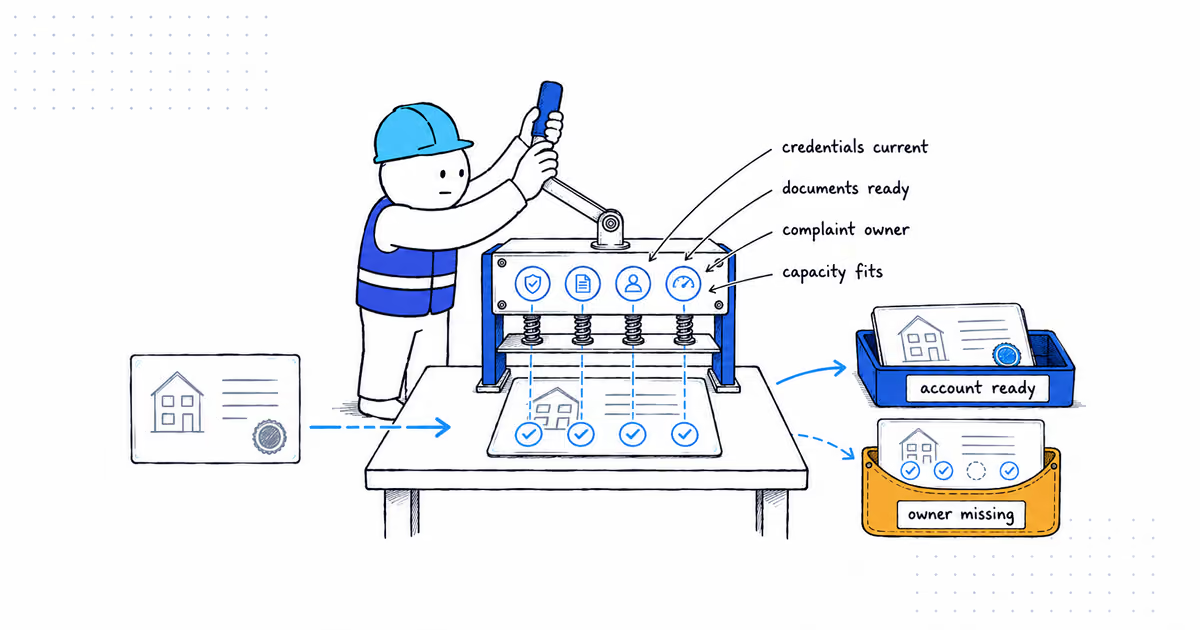
Complete every row before further estimating.
| Check | Evidence, source, and date | Owner | Status |
|---|---|---|---|
| Buyer and trigger | Authorized role; dated trigger | [name] | pass/hold/decline |
| Supported pattern | Request; work record | [name] | pass/hold/decline |
| Frequency | State; dated source | [name] | pass/hold/decline |
| Glass boundary | Zones, sides, inclusions, exclusions | [name] | pass/hold/decline |
| Operations | Use, hours, access, security, coordinator | [name] | pass/hold/decline |
| Access envelope | Included zones currently supported | [name] | pass/hold/decline |
| Service window | Buyer timing; committed schedule | [name] | pass/hold/decline |
| Route/mobilization | Travel, stop fit, constraints | [name] | pass/hold/decline |
| Proof | Item, caption, permission, privacy | [name] | pass/hold/decline |
| Crew and supervision | Eligible time; checkpoints | [name] | pass/hold/decline |
| Vehicle/equipment | Existing-set availability | [name] | pass/hold/decline |
| Documents/dependencies | Inputs, gaps, owners | [name] | pass/hold/decline |
| Administration | Approver, issues, process, invoice | [name] | pass/hold/decline |
| Economic/capacity fit | Cost plausibility; remaining capacity | [name] | pass/hold/decline |
| Specialist uncertainty | Separate qualified review | [name] | pass/hold/decline |
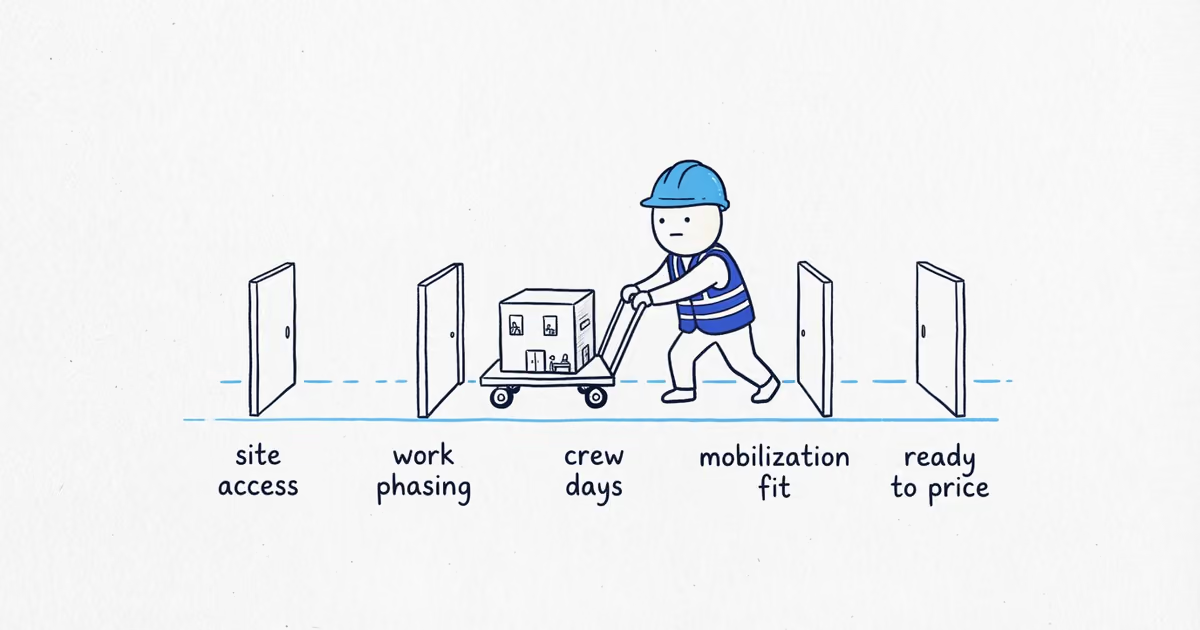
Route fit requires location, travel, mobilization, buyer-confirmed windows, committed-stop compatibility, and recorded return or replenishment constraints. Proximity does not pass.
Eligible capacity comes from a configured, supervised crew fitting the boundary, window, route, and access envelope with existing equipment. Headcount or open time does not pass.
Match proof to property use, access, operations, and service pattern. The FTC says claims must be truthful, nondeceptive, and evidence-based. Remove unsupported claims, credentials, logos, results, or capacity.
High-rise, rope descent, suspended or unknown elevated access, unfamiliar equipment, and safety questions trigger hold or decline for qualified review. OSHA’s standard confirms rope-descent requirements exist; none are interpreted here. Verify activity and location because the SBA says requirements vary.
Frequently asked questions about commercial window cleaning
How often should a commercial property schedule window cleaning?
There is no universal visit frequency. Record the buyer’s one-time request or accepted periodic schedule, along with its source and date; do not infer a cadence from property type, visible condition, or a trial.
How do I bid a commercial window cleaning job?
Begin only after the named site, functional roles, glass-area boundary, operating constraints, access status, frequency, route, and capacity are verified. Then use a separate bid process for the authorized site review, quantities, delivery plan, costs, price, and submission.
Track each commercial window cleaning account by stage
| State | Completion rule | Next move |
|---|---|---|
| Researched property | Site, fit reason, source | Verify buyer/trigger |
| Trigger/buyer verification | Authority/trigger confirmed | Qualify account |
| Qualified one-time opportunity | One-time and site evidence complete | Run gate |
| Periodic schedule unverified | Acceptance evidence missing | Assign dated action |
| Qualified periodic opportunity | Accepted site/schedule evidenced | Run gate |
| Site/access facts pending | Boundary or operating gap | Hold for owner |
| Account-fit review | Every check decided | Advance/hold/decline |
| Ready for pricing/bid | Required facts and capacity pass | Create handoff |
| Hold | Resolvable gap has owner/date | Resolve before pricing |
| Decline | Unsupported account | Record reason; close |
Sources
- SBA: Market Research
- SBA: Licenses and Permits
- FTC: Advertising Basics
- FTC: CAN-SPAM Guide
- OSHA: Rope Descent Standard
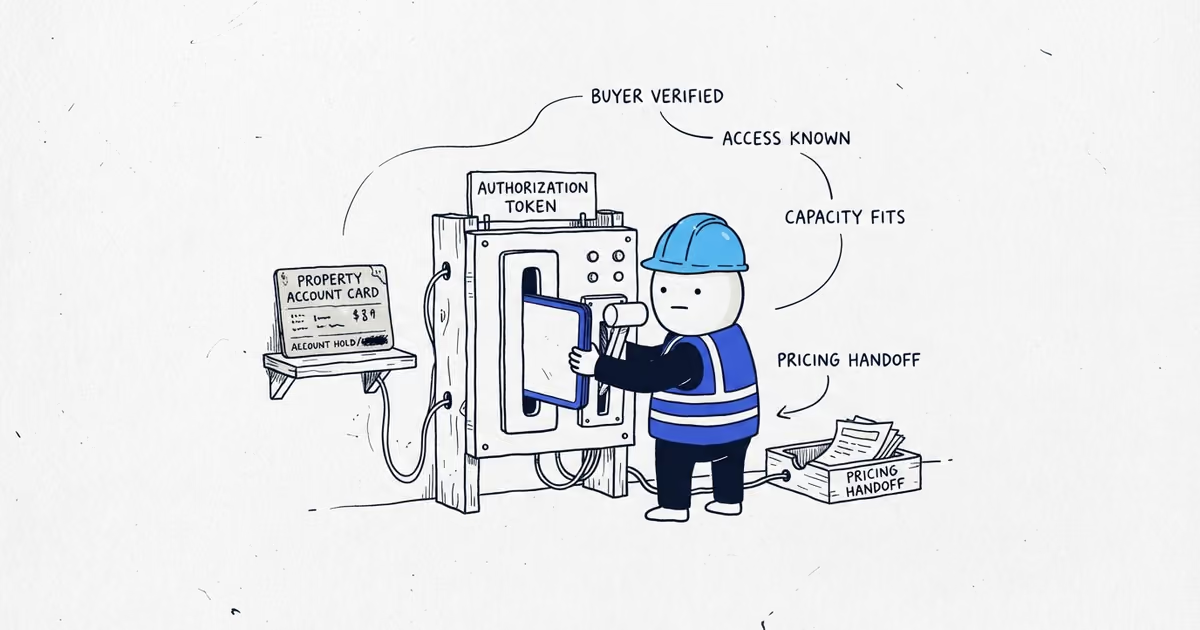
Prepare a commercial window cleaning bid handoff
| Handoff field | Completion criterion |
|---|---|
| Account/roles | Site and functional contacts verified |
| Boundary/status | Zones, inclusions, exclusions, sourced frequency |
| Operating facts | Use, access, window, buyer dates |
| Delivery | Route, crew, supervision, equipment, capacity passed |
| Evidence/inputs | Approved proof and buyer documents attached |
| Administration | Completion, issue, invoice contacts confirmed |
| Assumptions | Each has owner and date |
| Next step | Pricing/bid owner and date |
The handoff does not measure glass, calculate labor, select methods, set price, draft documents, choose terms, or plan safety. If you have not yet defined the account pattern and qualification gates, use the commercial contracts guide before pursuing more sites. When a property manager requires formal onboarding, use the property-management vendor guide to verify its documents, approval, work authorization, and invoice route. Route growth, capability statements, proposals, and pricing remain separate.
Weekly, remove unsourced prospects, verify actions, separate one-time from evidenced periodic work, group holds by owner, and check bid-ready capacity.
In the fictional row, the access owner and frequency status remain unknown. Route, crew, supervision, and equipment review is incomplete.
Decision: HOLD | Owner: Maya Ortiz, account lead | Action: obtain the manager’s written access-owner and frequency-status confirmation, then complete the Account-Fit Gate | Date: September 4, 2026.
- commercial-contracts
- how-to-get-commercial-window-cleaning-contracts
- commercial-window-cleaning-accounts
- commercial-window-cleaning-jobs
- commercial-window-cleaning-bids
- window-cleaning