How do I get commercial pest control contracts?
Learn how to get commercial pest control contracts by finding named sites, verifying buyer needs, and qualifying commercial pest control accounts that fit.
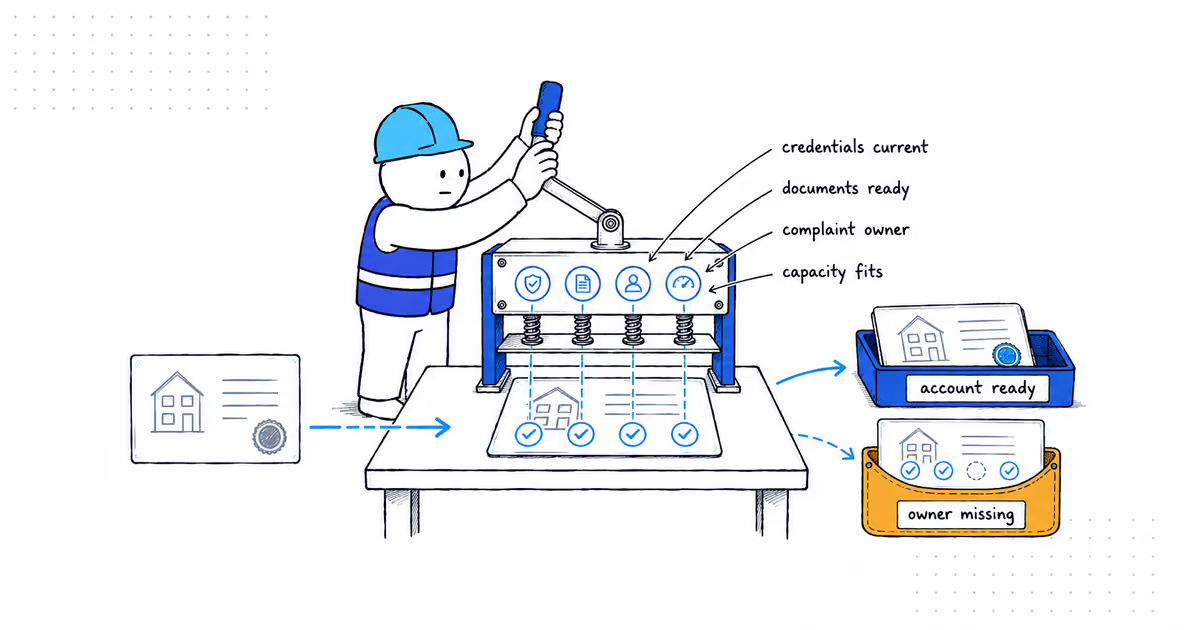
Get commercial pest control contracts by selecting a supportable private account pattern, finding a named site and buyer, verifying the trigger and need, showing truthful proof, then checking access, documents, complaints, route, credentials, and technician capacity before pricing. This does not guarantee an award.
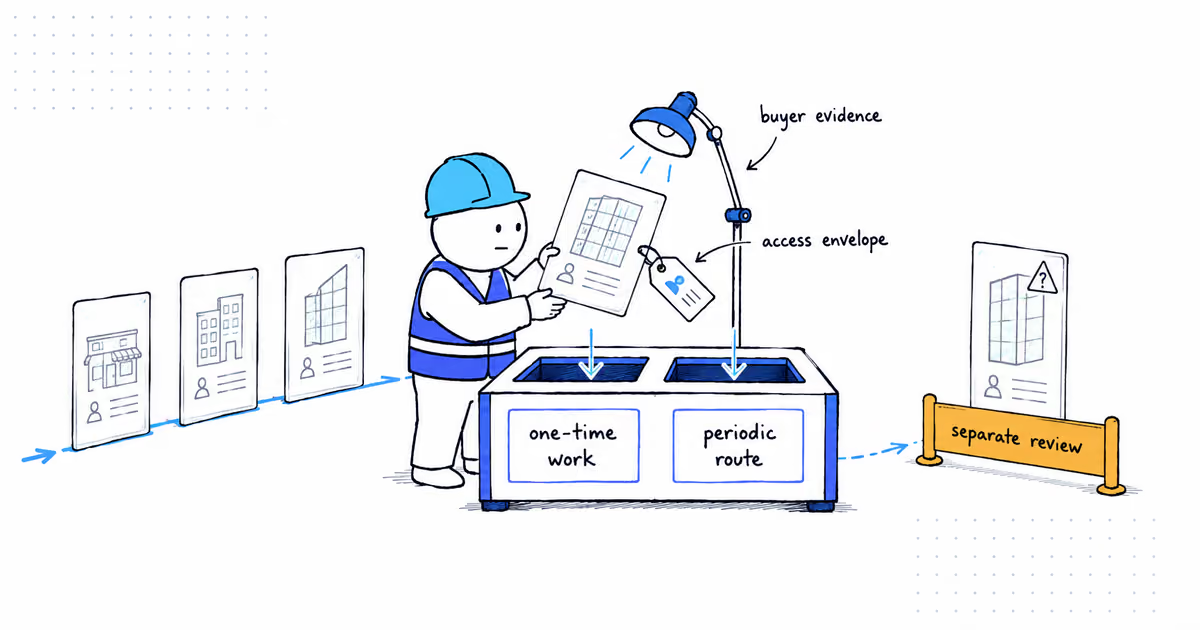
This covers privately purchased recurring or periodic work for a business, managed property, facility, HOA, or multi-site operator. Keep initial or one-time work separate. Procurement, pricing, agreements, identification, inspection, treatment, pesticide directions, safety guidance, and regulatory conclusions are excluded.
A property is not an opportunity; a contact is not the buyer; vendor approval is not authorization. A visit is not an inspection or bid; a proposal is not an agreement or revenue.
How to choose commercial pest control accounts
The US Small Business Administration’s market-research guidance recommends checking demand, location, customer, saturation, alternatives, and entry conditions. Apply these to company records and named properties, not a national “best” segment.
Define geography, route, property use, service model, buyer, access window, verified credentials, technician hours, supervision, vehicles, equipment, document and complaint capacity, proof, and no-fit conditions. No property type is inherently better.
Keep each requested service state separate:
| State | Complete when |
|---|---|
| Recurring | Stated need, scope, timing, proof, credentials, route, and capacity recorded. |
| Periodic | Supported periodic need has separate facts. |
| Initial | Buyer-requested initial work stays separate. |
| One-time or specialist | Separately qualify, hold, or decline. |
Every multi-site location must pass. Do not hide unsupported work inside “full-service commercial pest control.”
Commercial Pest Control Account Qualification Board
Copy per account. Any blank means hold.
| Field | Complete when | Your entry |
|---|---|---|
| Account and exact site or locations | Account and all locations recorded. | |
| Property use and operating pattern | Actual use and pattern have a source. | |
| Buyer and stakeholder roles | Selection, need, access, authorization, documents, complaints, escalation, and invoices assigned. | |
| Verified opportunity or review trigger plus source/date | Real trigger has source/date. | |
| Buyer-stated service need | Buyer’s words recorded without diagnosis. | |
| Requested recurring, periodic, or separate initial service pattern | Requested state selected; separate work stays separate. | |
| Route zone and geography fit | Route and travel limits checked. | |
| Access, occupancy, and service-window constraints | Access, occupancy, security, and window recorded. | |
| Current business and technician credential verification | Status, source/date, scope, and jurisdiction recorded. | |
| Documentation, communication, and complaint expectations | Records, recipients, channels, complaint and escalation owners named. | |
| Relevant permission-cleared proof | Verified proof matches use/service. | |
| Current delivery capacity | Technician hours, supervision, vehicles, equipment, suppliers, and seasonal load checked. | |
| Buyer authorization, review, and invoice process plus dates | Authorization, review, start, and invoice owners/dates. | |
| Opportunity stage | Observable stage recorded. | |
| Owner plus next action/date | Owner, action, and date assigned. | |
| Pass, hold, or decline reason | Decision cites gate evidence. |
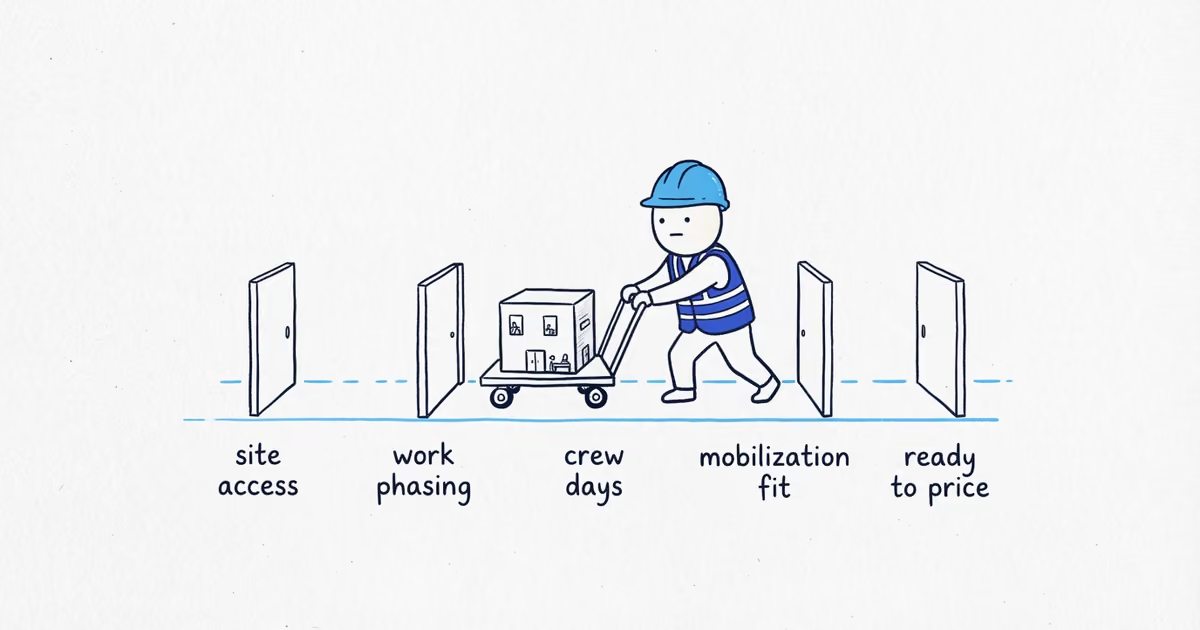
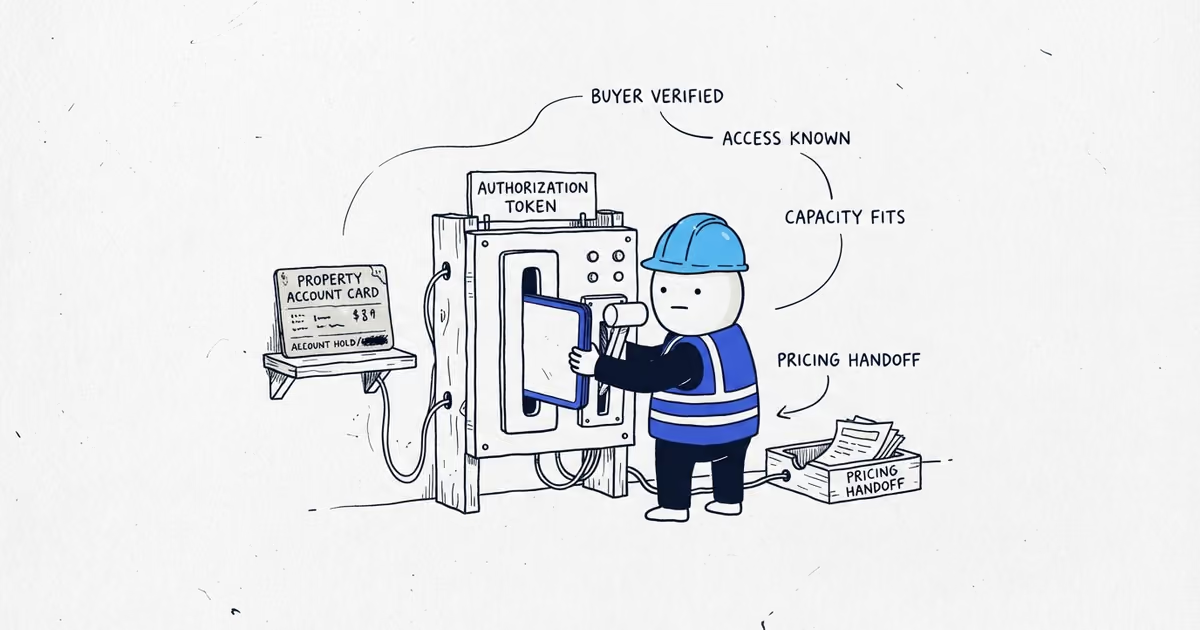
Run this gate before pricing or proposal.
| Check | Evidence required | Pass, hold, or decline |
|---|---|---|
| Buyer and authority | Named buyer and actual authority | |
| Trigger and need | Source/date and buyer-stated need | |
| Supported service pattern | Company record matches requested state | |
| Property use and locations | Use and all locations confirmed | |
| Applicable credential status | Business, branch, technician, applicator, or supervision verified for scope/jurisdiction | |
| Qualified technician hours | Reliable hours documented | |
| Route and travel | Zone and travel burden checked | |
| Access and service window | Access, occupancy, security, and window recorded | |
| Vehicles and equipment | Availability confirmed | |
| Supplier or inventory dependency | Dependency recorded as an operating fact | |
| Buyer records and completion evidence | Records, recipients, route, and timing known | |
| Communication, complaints, escalation, and included follow-up | Owners, channels, expectations, and inclusion recorded | |
| Work authorization | Authorized person and process named | |
| Administration and invoices | Buyer process and invoice route confirmed | |
| Unresolved regulatory scope | Issue, source, owner, and status recorded | |
| Direct costs and startup cash | Company records support proceeding; no formula | |
| Remaining capacity | Available capacity fits the request |
How to find commercial pest control decision-makers
Map each function.
| Possible role | Confirm this function |
|---|---|
| Property or facility manager | Selection, requirements, or review |
| Owner or operations manager | Need, approval, or authorization |
| Site or office manager | Access and site communication |
| HOA or association contact | Association review and authorized decisions |
| Procurement contact | Conditions and approval steps |
| Quality or documentation contact | Records, completion evidence, complaints, or escalation |
| Accounts-payable contact | Invoice routing |
Start with a named property or relationship: customer or supplier introductions, permission-safe referrals, owner or manager relationships, association directories/events, official sites, private opportunities, and buyer notices. Require a sourced reason. An address, complaint, guessed infestation, season, condition, or contract date does not qualify.
What commercial pest control buyers need to verify
Use exact business details, supported service and area, current capacity, and permission-cleared matched proof. Share only current verified documents the buyer or authority requests.
The Federal Trade Commission says claims must be truthful, nondeceptive, and evidence-based. Delete unsupported experience, scope, credential, response, documentation, capacity, or result claims.
Fictional example:
Jordan referred me regarding the buyer-confirmed service review at Harbor Point Offices. We support recurring commercial service in the North District. Who owns this review, and would a short qualification call or buyer-authorized site visit help with the next step?
Send it one to one, without diagnosis, treatment suggestions, attachments, automation, or cadence. The FTC’s CAN-SPAM guidance says there is no business-to-business exception. Commercial email needs accurate sender and subject information, a postal address, an opt-out method, and honored opt-outs.
Last verified: September 2, 2026 (United States).
The Environmental Protection Agency says people applying or supervising restricted-use pesticide use must be certified. State, territorial, and tribal authorities certify applicators and may set stricter requirements. Verify business, technician, supervision, scope, site, and jurisdiction with the relevant authority. Record source/status; make no compliance decision.
The EPA’s pesticide-label guidance says labels are legally enforceable and govern use conditions. Keep buyer-facing claims inside the company’s qualified label process. Do not interpret labels or give product, treatment, application, exposure, occupant, food, environmental, or safety guidance.
How to qualify a commercial pest control account
Before a visit or proposal, confirm locations, roles, need and service state, property use, current provider only when shared, window, separate work, review process, dates, documents, complaint/escalation path, authorization, invoice route, and fit.
At a qualification visit, record buildings, units, zones, and buyer-stated areas without inspecting or identifying pests. Record property use; buyer-controlled occupied, food-handling, tenant, customer, employee, animal, storage, or restricted areas; keys, escorts, security, parking, loading, window, communication, responsibilities, documents, complaint route, exclusions, and assumptions. Give no access, inspection, product, treatment, label, exposure, food, environmental, or safety method.
Before pricing, record requested documents, timing, route, recipient, complaint reporter, response/escalation owners, and included follow-up. Do not invent reports, response times, guarantees, or remedies.
Handoff: account, contacts, locations, property use, need, service state/window, constraints, responsibilities, credential boundary, proof/documents, complaint path, authorization, invoice route, assumptions, separate work, buyer dates, owner, and action. Confirm receipt, record the review path, and stop on decline or opt-out. If you have not yet defined the account pattern and qualification gates, use the commercial contracts guide to establish them before pricing. When a property manager requires formal onboarding, use the property-management vendor guide to verify the buyer’s document, approval, work-authorization, and invoice route. Residential pricing, future commercial pricing, capability statements, proposals, subscriptions, routing, agreements, and invoicing remain separate.
Frequently asked questions about commercial pest control contracts
Do I need a capability statement to get commercial pest control contracts?
Not for every account. Start with accurate business details, permission-cleared proof matched to the property and service pattern, credential verification sources, and current capacity. Use a capability statement only when the buyer asks for one or the channel calls for it; it does not replace account qualification.
How do I become a pest control vendor for a property management company?
Use the company’s official vendor route and confirm its requested documents, authorization controls, access process, completion evidence, complaint path, and invoice requirements. Vendor approval may place the company on a list, but it does not authorize service or award a contract.
How do I get restaurant pest control contracts?
Treat a restaurant as one possible private property-use pattern, not a shortcut. Proceed only after the buyer states the need and the company verifies scope, credentials, access, documentation, route, and technician capacity through its qualified process. Do not infer pests or prescribe inspections, frequency, products, treatments, or site requirements.
When to pursue a commercial pest control contract
In this fictional example, Northline Pest Services receives a permission-safe introduction to Harbor Point Offices after its manager confirms a recurring-service review. Maya maps selection, need, access, documents, complaints, escalation, authorization, and invoices. The buyer supplies property-use, window, and document facts. Maya verifies proof permission and credential status with the relevant authority, then checks route, technician hours, supervision, vehicles, equipment, suppliers, complaint capacity, startup cash, direct costs, commitments, and capacity.
The trigger, buyer, property use, route, proof, credentials, and capacity pass. The complaint-escalation owner is unconfirmed. Do not price around that gap.
Decision: HOLD. Owner: Maya Ortiz. Next action: ask the facility manager to name the complaint-escalation owner by September 4, 2026.
- commercial-contracts
- how-to-get-commercial-pest-control-contracts
- commercial-pest-control-accounts
- commercial-pest-control-decision-makers
- restaurant-pest-control-contracts
- pest-control