How do I get commercial electrical contracts?
Learn how to get commercial electrical contracts: find buyers, qualify maintenance accounts, and check authorization, access, and capacity before estimating.
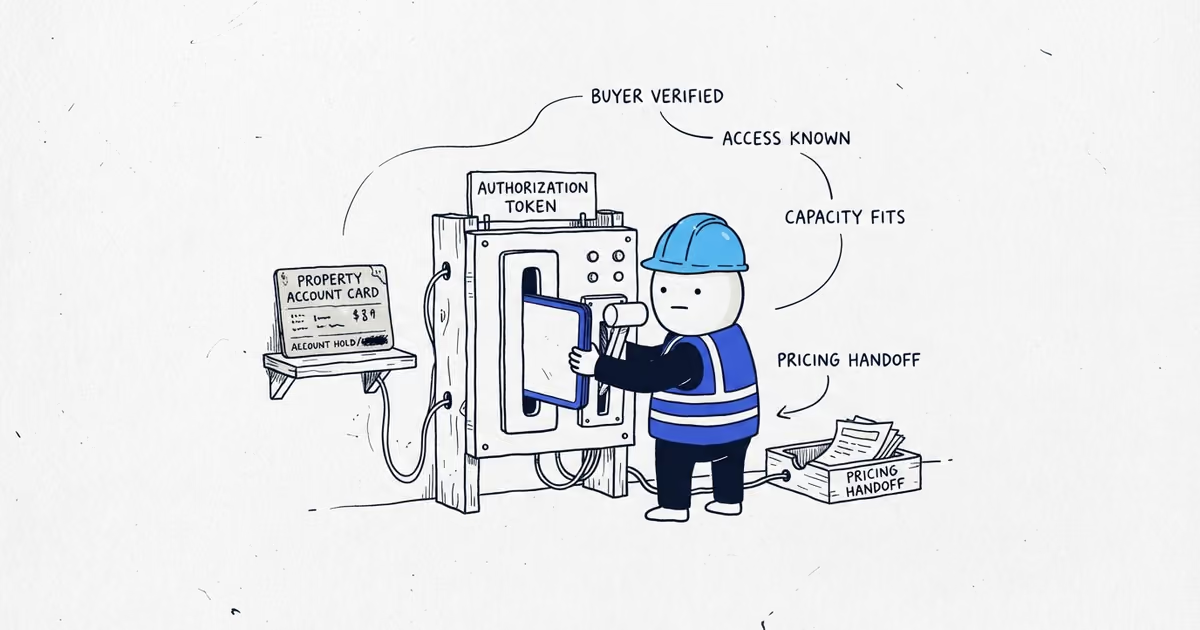
Get commercial electrical contracts by choosing a private property and work pattern you support, finding the people who select and authorize the contractor, showing relevant proof, and qualifying the site, access, buyer process, invoice route, and capacity before estimating. This creates qualified opportunities, not guaranteed awards.
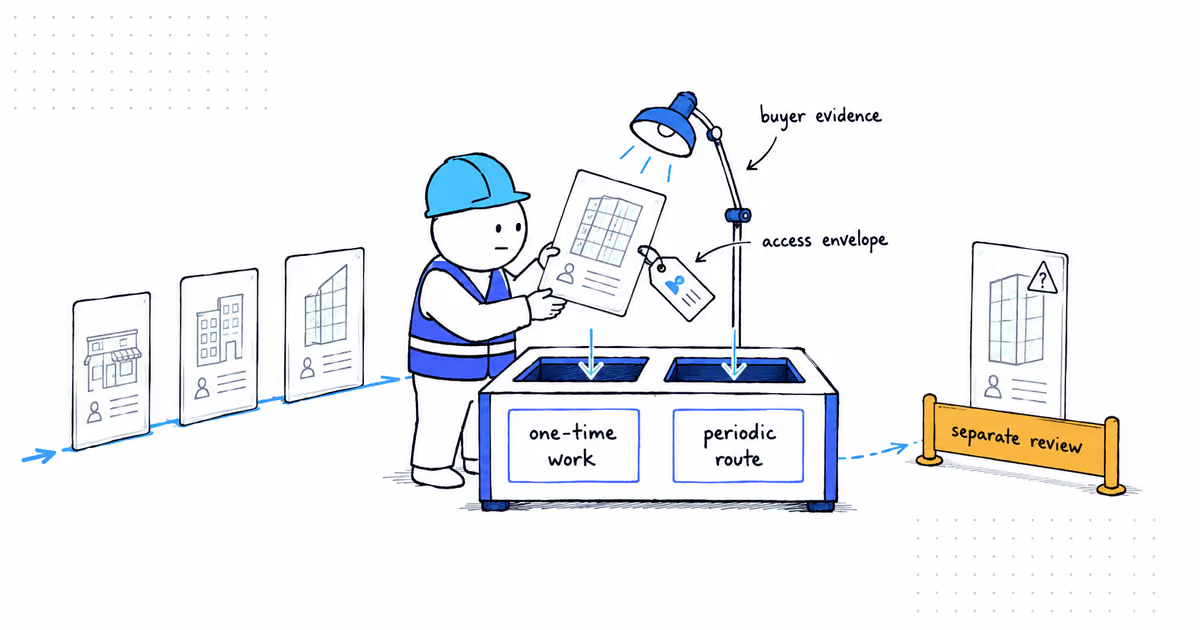
This covers private commercial service and maintenance relationships. Construction, tenant improvement, retrofit, replacement, and other projects need a separate qualification lane. Public procurement, legal drafting, estimating, and technical work are excluded.
An account is not an opportunity; a contact is not a decision-maker. Vendor approval is not work authorization. A site review is not an estimate, a proposal is not an agreement, and proposed value is not revenue.
Choose a commercial electrical contract target
Do not target “commercial buildings” as one market. Use your records and named properties to choose a property pattern, service area, work lane, likely buyer, and no-fit rules. Record available qualified-person and supervision hours, equipped vehicles, tools, dependencies, administration, and capacity.
The SBA recommends checking demand, location, target customer, saturation, alternatives, and entry conditions. Apply those questions locally; they do not reveal a universally best property type.
Keep three acquisition lanes separate:
- Planned service: supported need plus a workable request-and-authorization path.
- Maintenance relationship: an ongoing request that still needs site, access, documentation, and capacity checks.
- Separate project: buyer-issued facts move to a project site-review and estimate handoff. Do not turn service interest into a project promise.
For multi-site work, every included location must pass the same checks.
Build a commercial electrical contract pursuit board
Copy these tables into a spreadsheet. Write unknown for missing evidence; never guess.
1. Map the commercial electrical buyer and authorization
Job titles are clues, not authority. One person may fill several roles, but verify each function separately.
| Role or function | What this person may control | Named account or relationship source | Verified contact | Question to confirm ownership | Complete when |
|---|---|---|---|---|---|
| Contractor selection: property/facility manager, owner, procurement, or GC/builder/project manager | Shortlist or selection | Who selects the contractor? | Selector and route confirmed. | ||
| Site/system/project information: facility or maintenance/operations manager | Known facts and documents | Who supplies them? | Owner and records named. | ||
| Access/operations: office/site manager or security/access contact | Entry, escorts, keys, restrictions | Who coordinates access? | Coordinator and unknowns recorded. | ||
| Site-review/work authorization: owner, manager, or procurement | Permission to visit or order work | Who authorizes each, and how? | Both routes confirmed. | ||
| Changed-work approval | Requested scope changes | Who approves changes? | Approver and route confirmed. | ||
| Operational communication: maintenance, operations, office, or site manager | Updates and coordination | Who receives updates? | Owner confirmed. | ||
| Completion evidence contact | Buyer-requested evidence | Who reviews it? | Recipient and evidence known. | ||
| Invoice/rejection: accounts payable or buyer designee | Processing and corrections | Destination and rejection contact? | Route and references known. |
2. Record one commercial electrical account
| Field | Complete when | Entry |
|---|---|---|
| Account and sites | Every proposed site is named. | |
| Acquisition lane | Service, maintenance, or separate project selected. | |
| Property and operating pattern | Use and occupied/public conditions recorded. | |
| Buyer and stakeholders | Each map function has an owner or unknown. | |
| Verified trigger plus source/date | Confirmed review, referral, introduction, change, or private notice sourced and dated. | |
| Buyer-stated need | Buyer’s words recorded without diagnosis. | |
| Known system, asset, or issued project facts | Verified facts only; gaps say unknown. | |
| Locations and service area | Travel and coverage fit operations. | |
| Access, occupancy, and shutdown constraints | Applicable security, escort, key, parking/loading, hours, noise, communication, restricted-area, and buyer-stated shutdown facts recorded. | |
| Requested service, response, or project window | Buyer’s window recorded without a promise. | |
| Current people and operating capacity | Qualified-person, supervision, vehicle, tool, and offered backup availability checked. | |
| Permission-cleared proof | Verified, relevant proof cleared for use. | |
| Authorization and change approval | Visit, work, and change approvers and routes known. | |
| Work order and completion evidence | Buyer controls and requested evidence recorded. | |
| Invoice and rejection path | Bill-to, references, destination, review, and correction contact known. | |
| Buyer process and dates | Supplied review, due, decision, and start dates recorded. | |
| Site-review, estimate, or proposal handoff | Locations/areas, documents, responsibilities, exclusions, specialist work, gaps, and assumptions packaged. | |
| Opportunity stage | Exact buyer stage recorded. | |
| Owner plus next action/date | One person, action, and date present. | |
| Pass, hold, or decline reason | Evidence supports it; a hold names the gap. |
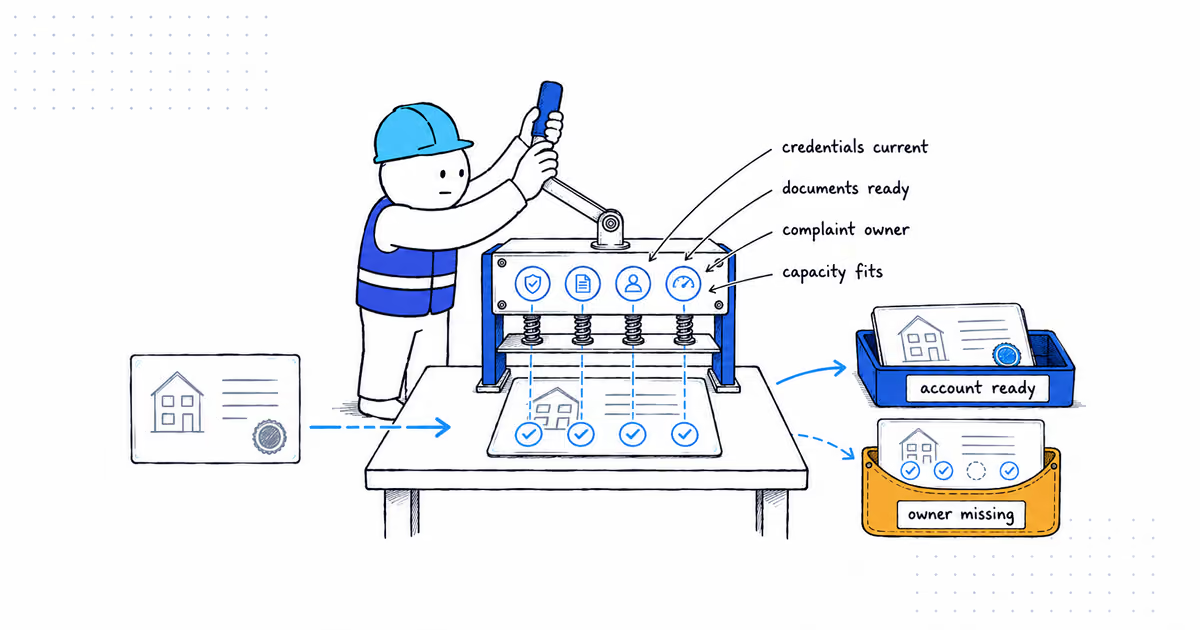
3. Check commercial electrical operating fit
| Check | Evidence | Pass, hold, or decline |
|---|---|---|
| Geography and travel | Every site fits actual coverage. | |
| Supported property and work pattern | Request matches supported work. | |
| Qualified people, supervision, and hours | Current calendar supports the request. | |
| Equipped vehicles and tools | Needed resources are available. | |
| Site-review and access feasibility | Permission, entry, and restrictions are clear. | |
| Occupancy and shutdown-window fit | Buyer-stated constraints are supportable. | |
| Service, project, and response windows | Requested lane and dates fit. | |
| After-hours or backup coverage | Only offered coverage is recorded. | |
| Supplier, material, equipment, or subcontractor dependency | Each dependency has an owner. | |
| Authorization and change control | Review, work, and change authority is clear. | |
| Work-order, completion, invoice, and rejection administration | Team can follow the confirmed route. | |
| Direct-cost and remaining-capacity fit | Internal records support delivery; pricing stays separate. | |
| Unsupported specialist, technical, or regulatory scope | Remove, hold, or refer it. |
How to contact commercial electrical buyers
Use customer or supplier introductions, permission-safe referrals, local relationships, relevant events, facility websites, private vendor opportunities, or buyer-issued notices. Require a named account and sourced reason. An address, visible equipment, permit record, guessed date, or incumbent claim is insufficient.
Here is a fictional, one-to-one email example:
Subject: Cedar Square electrical service review
Alex, our customer Sam Ortiz suggested I contact you about Cedar Square’s confirmed service-provider review. Northline supports planned commercial electrical service in the local service area. Do you own contractor selection for this review? If so, would a short qualification call be useful before a site review is scheduled?
Do not send unrequested attachments or offer a free technical inspection. Confirm receipt, record the buyer’s process, answer requests, and assign the next action. Stop after a decline or opt-out.
The FTC’s advertising guidance says claims must be truthful, nondeceptive, and evidence-based. Remove unverified claims about experience, qualifications, licensing, insurance, supported work, availability, response, savings, compliance, or results. The FTC’s CAN-SPAM guidance says there is no business-to-business exception. Commercial email needs accurate sender and subject information, a valid postal address, a clear opt-out, and honored opt-outs. Check other applicable rules.
The SBA notes that license and permit requirements vary by activity, location, and government rules. Verify the actual work, person, property, buyer, issuer, authority, and jurisdiction; do not use a universal checklist.
Last verified: September 2, 2026 (United States).
Frequently asked questions
How do I get commercial electrical maintenance contracts?
Choose a named private account with a confirmed maintenance review, then verify the buyer, supported work, sites, access, authorization, documentation, invoice route, and current capacity. Move it forward only when those facts pass the operating-fit gate; task frequency, pricing, and agreement terms belong in later processes.
How do I get electrical subcontracting work from general contractors?
Start with a named private project and verify that the general contractor, builder, or project manager controls the opportunity. Record the buyer-issued project facts, documents, dates, access, authorization, and your available people and equipment before sending it to estimating or bidding.
How fast should I respond to a commercial electrical lead?
Use the response coverage your business actually staffs and the buyer requests. Assign a named owner and dated next action, but do not promise a universal response time or after-hours coverage your qualified people, vehicles, and tools cannot support.
Qualify a commercial electrical contract opportunity
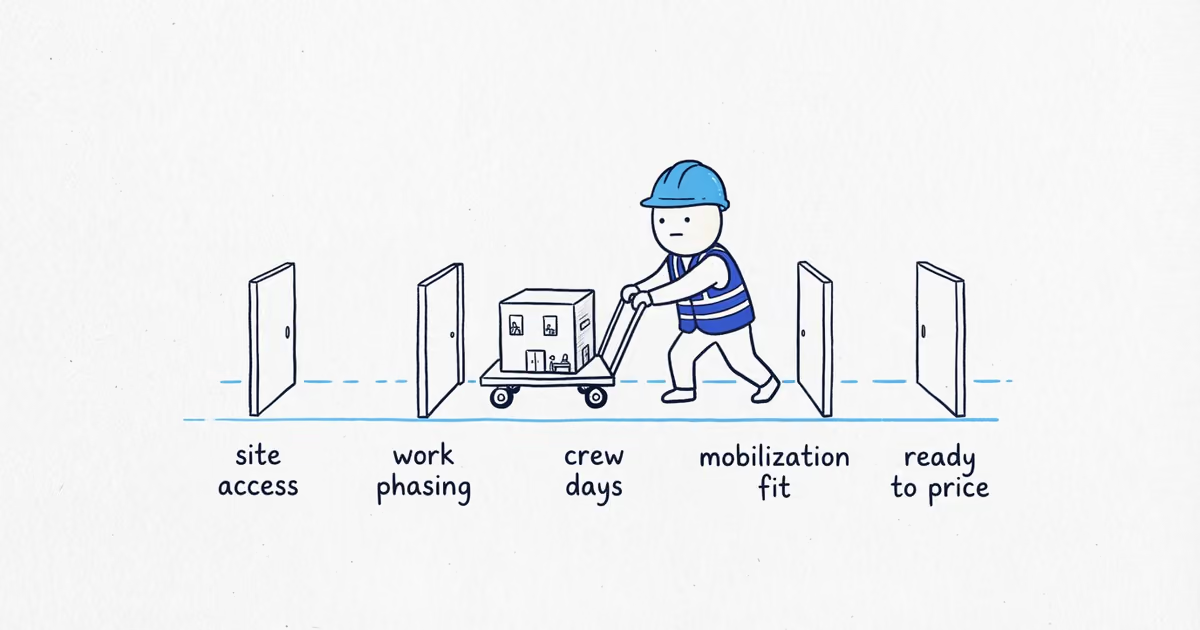
At site-review handoff, record the covered property, buildings, spaces, and known areas; occupancy and tenant/public conditions; security, escort, key, parking, loading, working-hour, noise, communication, restricted-area, and buyer-stated shutdown constraints; customer responsibilities; buyer documents; completion evidence; scope gaps; exclusions; specialist work; and assumptions. Do not turn that record into inspection, testing, diagnosis, design, installation, repair, isolation, shutdown, code, permit, or safety instructions.
When a passed account has a qualified handoff and is ready for a number, use the electrical pricing guide to build the service-call, labor, material, overhead, and price inputs from company records. When a managed-property buyer requires formal onboarding, use the property-management vendor guide to verify its documents, approval steps, work authorization, and invoice route before advancing. Electrical estimate, bid, capability-statement, proposal, and final-invoice articles own their respective processes. This pursuit ends at a checked handoff.
In the fictional Cedar Square record, Northline logs Sam’s introduction and the planned-service lane. The buyer confirms the site and occupied use but supplies no system assumptions. Access and the buyer-stated shutdown constraint are recorded as pending. Northline has permission-cleared proof of a similar work pattern and verifies current qualified-person, supervision, equipped-vehicle, tool, and remaining capacity internally. It also records the buyer’s work-order, completion-evidence, and invoice routes. The person authorized to approve work has not been identified.
Decision: Hold. Owner: Mia Chen. Next action: ask Alex to identify the work-authorizing person and the buyer-recorded authorization route by September 4, 2026.
- commercial-contracts
- how-to-get-commercial-electrical-contracts
- commercial-electrical-contracts
- commercial-electrical-maintenance-contracts
- electrical-subcontracting-work
- electrical