

How to Price an Electrical Job
Electrical pricing becomes unreliable when the same scope gets a different number each time. Here is how to build a consistent price from a service call, loaded labor, marked-up materials, overhead, and profit.

Electrical pricing becomes unreliable when the same scope gets a different number each time. The usual missing inputs are easy to identify: the truck, the drive, and the diagnosis before the first wire moves.
Pick one way to build the price and run it on every job. Start with the cost of showing up.
What to charge for an electrical service call
The truck roll and the first diagnosis consume fuel, drive time, and diagnostic labor whether or not the customer approves a repair. A disclosed service-call fee can recover that cost. Calculate the fee from your actual visit economics, explain what it includes before dispatch, and state whether you credit it toward approved work.
How to calculate your loaded labor cost
A journeyman’s wage is a fraction of what their hour costs you. On top of the wage sit payroll taxes, benefits, and workers’ comp; on top of that, the truck, insurance, your license, tools, and software, spread across the hours you bill. Add it up honestly and the rate you need to charge lands well above the wage on the check. Work that loaded number out once and put it on every quote. Guess low here and it costs you on every job after.
How to mark up your materials
Wire, breakers, boxes, and devices carry more cost than the supplier invoice alone. Set a material markup from the purchasing time, delivery, stock handling, normal waste, warranty administration, overhead, and profit your business actually needs. One copied percentage cannot account for both a high-cost panel and a box of low-cost devices.
Flat rate vs hourly electrical pricing
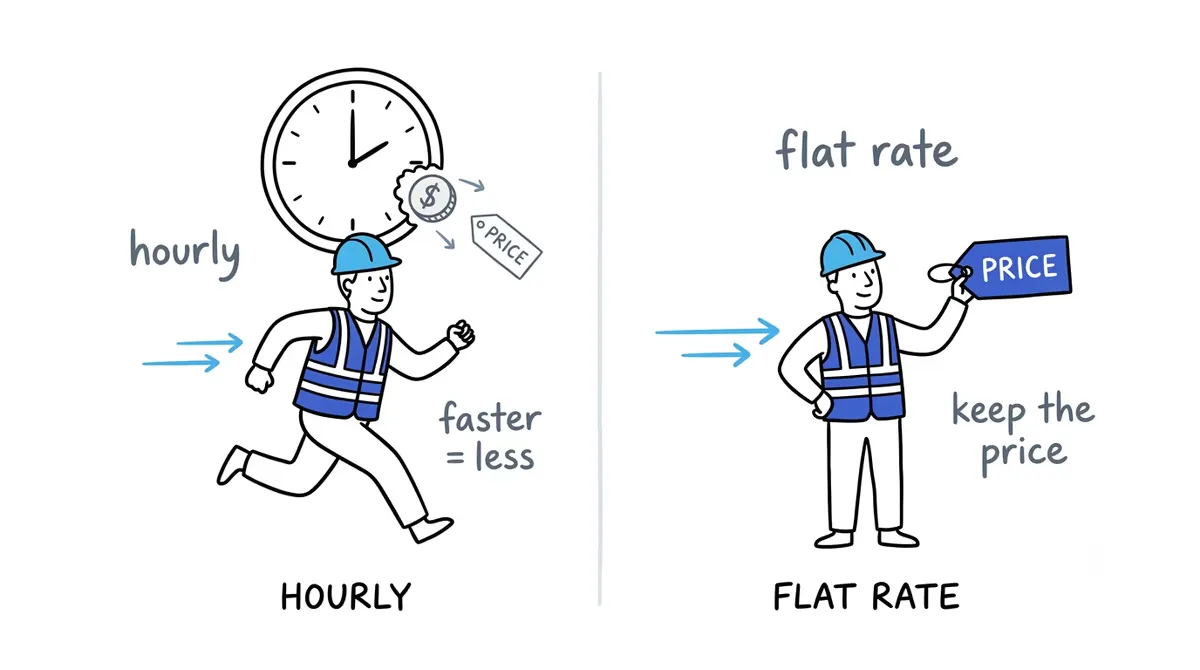
Price the jobs you do all the time — a circuit, an outlet run, a fixture swap — flat, from a number you build once. The better and faster you get, the more a flat price pays you; hourly does the reverse and docks you for finishing early. Save hourly, or a flat diagnostic fee, for troubleshooting, where you can’t honestly scope the work until you’ve opened the wall. Use the hourly-versus-flat-rate guide for the full decision and the unknown-scope pricing guide when the diagnostic cannot establish a fixed scope.
A simple electrical price formula
Price = (Service call + Labor + Materials with markup + Overhead) ÷ (1 − target margin)
A 30% margin is not the same as adding 30% to cost. Adding 30% is a markup and produces about a 23% margin. To price for a true 30% margin, divide cost by 0.70.
How much to charge to install a dedicated circuit
Take a straightforward 20-amp dedicated circuit. The service call is $100 and three hours of loaded labor is $135. The wire, breaker, box, and receptacle at cost-plus come to $80, and the overhead share is $60 — $375 in cost. For a 30% target margin, divide $375 by 0.70: the calculated price is about $536, which you might round to $540. Swap in your own figures; the method is the point, not these numbers.
The service call sits on the first line, not the last. Build the trip and diagnostic cost into the disclosed fee or approved job price instead of leaving it unrecovered.
Electrical emergency and after-hours rates
A 9 p.m. no-power call isn’t a daytime job with a surcharge tacked on — it’s a different price. Set a higher after-hours rate and a larger minimum, and tell the customer both before you get in the truck, not when the invoice arrives.
Set a minimum electrical price
Every job carries truck, drive, and setup cost, so calculate a floor no ticket drops below. The minimum service fee guide provides the full visit-cost formula. Compare genuinely similar local scopes after you have your own number, but do not assume a price difference proves that either contractor is wrong. Labor time, materials, overhead, warranty terms, and scope may differ.
You can quote perfectly and still lose the job to a dead phone number. Old addresses and wrong hours scattered across the sites that list you read as “out of business,” and the call goes to whoever looks current — we clean up those listings for service businesses.
Frequently asked questions
Should I charge a service call fee?
A disclosed service-call fee can cover the truck roll and initial diagnosis whether or not the customer approves a repair. Calculate it from your actual visit cost, explain what it includes before dispatch, and state whether you credit it toward approved work.
Should electricians charge flat rate or hourly?
Price common, repeatable jobs flat, from a number you build once, because the faster you get, the more flat rate pays. Keep hourly or a flat diagnostic fee for troubleshooting, where you can’t scope the work until you’re into the wall.
How much should I charge to install a dedicated circuit?
It depends on your costs. Built from a service call, loaded labor, materials, overhead, and a 30% target margin, the dedicated-circuit example works out to about $536 before rounding. Run your own numbers to get your figure.
- pricing
- electrical
- electrician
- quoting
- small-business



