Should I Charge Hourly or Flat Rate?
Flat rate rewards speed on predictable jobs; hourly protects you when the scope is unknown. See the math, a decision table, and two ways to combine the models.
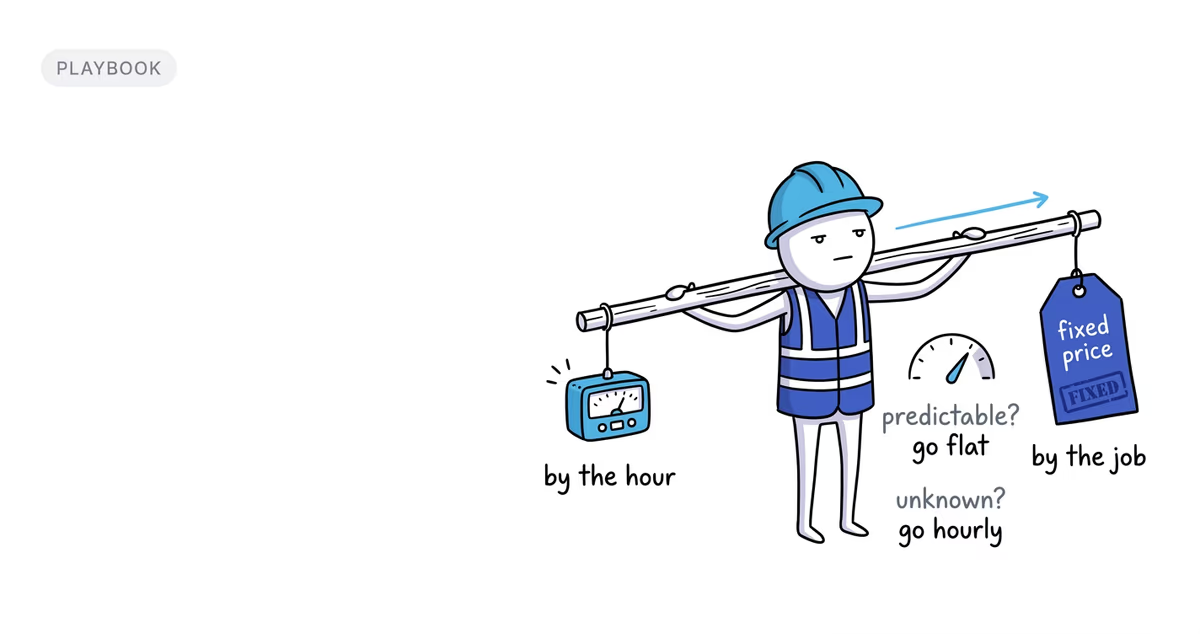
The right answer comes down to one thing: how well you can predict the job before you start it. Charge flat rate, also called by the project, when you can define the work up front. Charge hourly, billed by time and materials, when you can’t. A business can use both models for different job types. Here’s how to decide, and the efficiency math behind the choice.
Hourly vs. flat-rate pricing explained
Flat rate: you quote one fixed price for a defined scope. “$450 to replace the water heater.” The customer knows the number before you start, and you keep the difference if you work fast.
Hourly, or time and materials: you bill for the hours you work plus the materials you use, as the job goes. The customer pays for whatever the job takes.
“By the hour or by the project” is the same question in different words. By the project is flat rate.
Why hourly pricing can reduce profit
The efficiency effect is easy to miss. Under flat rate, getting faster increases the effective hourly revenue on the same job. Under hourly pricing, fewer billed hours reduce the job’s labor revenue.
Say a repair takes a newer team member 3 hours, and takes you, after fifteen years, 1.5. At a $120 hourly rate:
- Hourly: the fast expert bills $180, the slow beginner bills $360. You earn less for being better at the work.
- Flat rate at $360: you finish in 1.5 hours and your effective rate is $240 an hour. The job costs the customer the same either way.
Speed is the main thing experience buys you. Hourly billing hands it back to the customer for free.
When to use flat-rate pricing
Flat rate wins when the work is predictable and repeatable and you’ve done it enough to know how long it takes:
- Standard installs and swaps: water heater, disposal, thermostat, standard fixtures.
- Routine, repeatable service: a house clean of a known size, a seasonal tune-up, a standard mow.
- Any job where you can see the whole scope before you quote.
A fixed number gives the customer price certainty for a defined scope. Flat rate also rewards the efficiency you built and removes the need to track a running customer bill while the work is underway.
When to use hourly or time-and-materials pricing
Hourly protects you when you can’t see the whole job yet:
- The cause is unknown, like a leak behind a wall or an intermittent electrical fault.
- The scope could grow once you open things up.
- The work is genuinely open-ended, or a first of its kind for you.
On these jobs, a fixed price is a guess, and every hour past the guess comes out of your pocket. Billing by time moves that risk onto the meter, where it belongs. The trade-off is a nervous customer, and the next section handles that. When the unknown is the whole problem, see how to price a job when you don’t know how long it will take.
How to combine flat-rate and hourly pricing
You don’t have to pick one model for the whole business. Two hybrids give you the safety of hourly with the clarity of flat:
- Diagnostic or trip fee, then a flat quote. Charge a set fee to come out, find the problem, and scope it. Once you know the job, quote it flat, and credit the fee toward the work if they go ahead. You get paid to remove the unknown, then price the defined work.
- Time and materials with a not-to-exceed cap. Bill by the hour, but tell the customer the price won’t go above a stated ceiling. They get a budget limit, and you bill your actual time underneath it. State in writing what happens if the work reaches the cap, and notify the customer before continuing beyond the approved scope.
Hourly vs. flat-rate pricing example
Take a job you expect to run 4 hours, with $200 in materials, at a $120 rate:
- Hourly: 4 hours at $120 plus $200 in materials is $680, but the final number moves with the hours.
- Flat: you quote $680 as a fixed price. Finish in 3 hours and you earned back an hour. Take 5 and you eat one. Same starting number, but now you carry the risk of the hours and keep the reward for speed.
| Model | Use when | What the customer sees | Who carries the overrun | Best for |
|---|---|---|---|---|
| Flat rate | Scope is clear and repeatable | One fixed price up front | You | Installs, routine service, defined repairs |
| Hourly / T&M | Scope or cause is unknown | A meter; final price varies | Customer | Diagnostics, open-ended or evolving work |
| Hybrid (fee then flat, or T&M with a cap) | You need to look before you can price | A small fee, or a capped ceiling | Shared | Repairs you scope first, budget-sensitive unknowns |
When to build a flat-rate price book
Solo, you can quote flat by feel, because you know your own speed and it holds steady. The math lives in your head, and that’s fine.
Put a team member on the truck and that breaks. A newer team member works slower than you, so a flat price set from your own speed can lose money in their hands. Before you send anyone out to quote or bill on their own, write a flat-rate price book: your common jobs with set prices, built from your costs and a realistic time for an average team member, not your best time. It keeps quotes consistent and stops a slower crew from eating the margin. Still working out what your own rate should be? Start with how to price jobs as a solo owner.
What to do when a flat-rate job runs over
Flat rate only feels like a trap if you let scope grow for free. Two cases:
- The customer added work, or you found a genuinely new problem. That’s a change order. Stop, explain it, and quote the added scope before you do it.
- You simply under-scoped a job you should have understood. Eat it this time, and fix your price book so the next one’s right.
Keep those two straight and flat rate stays safe. For the smallest jobs, the floor under all of this is a minimum service fee.
Once the pricing model is clear, the next acquisition problem is helping local customers find and trust the business before they request a quote. ShiftFlow’s home-service marketing services cover Google profiles, reviews, listings, Maps visibility, and service websites.
Frequently asked questions
Is it better to charge by the hour or by the project?
Use a project, or flat-rate, price when you can define and estimate the work reliably; the customer gets a clear price and you keep the efficiency gain. Use hourly pricing when the scope is unknown and the time cannot be estimated reliably.
Do customers prefer flat rate or hourly?
A fixed price gives the customer certainty on defined work. For open-ended work, time and materials with a clearly written not-to-exceed cap can provide a budget ceiling without forcing a speculative flat price.
Can I switch from hourly to flat rate?
Yes. Track your real hours on your common jobs for a few weeks, then use those times to set fixed prices. Start with the jobs you do most and know best, and leave the unusual ones on time and materials.
What is a not-to-exceed price?
It’s a ceiling on a time-and-materials job. You bill your actual hours and materials, but the customer never pays more than the stated cap.
- pricing
- hourly-or-flat-rate
- flat-rate-vs-hourly
- flat-rate-pricing
- time-and-materials