How to Price a Job When You Don't Know How Long It Will Take
Can't tell how long a job will take? Price it with the right tool: a diagnostic fee, a not-to-exceed cap, a quoted range, or a deposit, plus scripts to explain it.
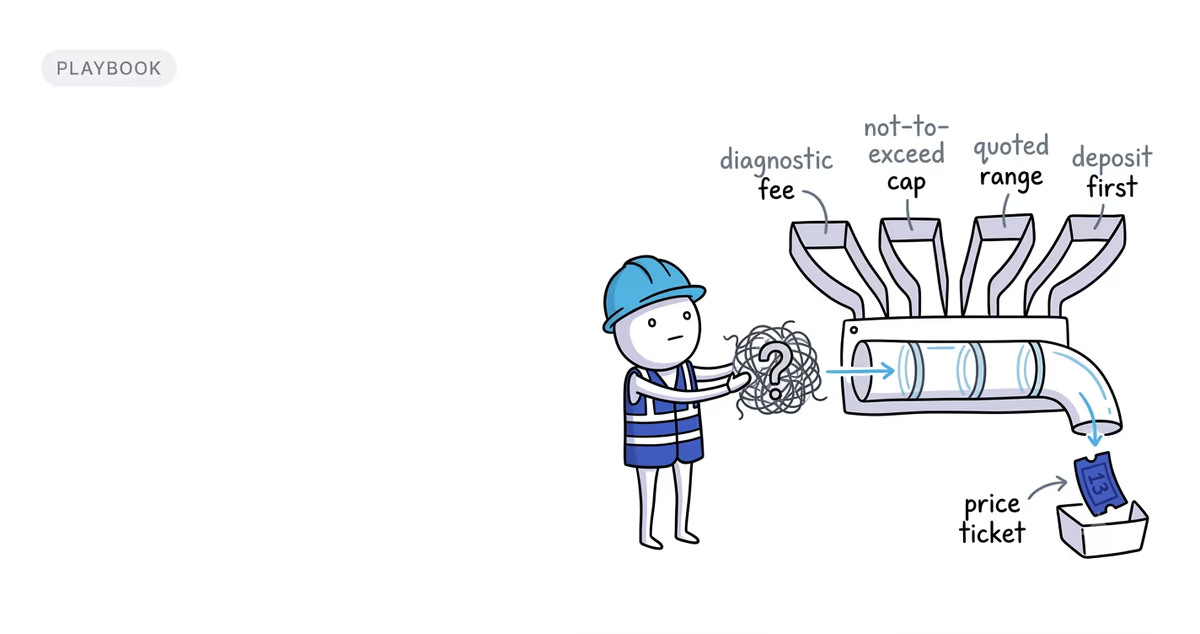
When you can’t tell how long a job will take, don’t force a fixed number and hope. Pick the tool that fits the unknown, then add a buffer for the risk. There are four tools, and the right one depends on how bad the surprise could be.
Why fixed pricing fails on an unknown job
The cost of guessing wrong runs one way. Quote too low and you eat every hour past your guess. Quote too high and you lose the job, or you win it and overcharged. You rarely get to go back and even it out. So on an uncertain job, the goal isn’t a better guess. It’s a pricing tool that moves the risk off you without scaring the customer away. Time and materials is the hourly side of the hourly-or-flat choice, and it’s where most of these tools live.
How to price a job with an unknown scope
1. A diagnostic or discovery fee
Charge a set fee to come out, find the problem, and scope the work. Once you know what the job is, quote it flat. If the customer proceeds, credit the fee toward the job. This is the cleanest tool when the unknown is “I won’t know until I look.” You get paid to remove the uncertainty, then price with confidence instead of guessing sight unseen.
2. Time and materials with a not-to-exceed cap
Bill your actual hours and materials, but give the customer a ceiling the price won’t cross. They get a budget they can trust, and you bill whatever the work really takes underneath it. A common practice is to tell them in writing as the running cost gets close to the cap, so the ceiling’s never a shock. Use this when the job could run long but you can still put a sensible top end on it.
3. A quoted range
When you can bracket the job but not pin it, quote a range instead of one fragile number. “Most jobs like this land between $800 and $1,200, depending on what we find behind the wall.” Say what moves the price within the range. A good, better, best set of options does the same thing: it gives the customer a real number to react to without you committing to a single guess.
4. Deposit first
For material-heavy or long jobs, take a deposit that covers your up-front materials before you’re exposed, then bill the rest on completion or at milestones. It doesn’t remove the uncertainty, but it keeps you from financing an open-ended job out of pocket while it drags. Deposits and progress billing get more depth in how to price big jobs without underbidding.
| Tool | Use when | What it protects | What the customer hears |
|---|---|---|---|
| Diagnostic fee | You can’t price it until you look | Your time to scope it | ”A set fee to find the problem, credited to the job” |
| T&M with not-to-exceed | It could run long but has a top end | You, from eating overruns | ”You pay for the time, but never more than X” |
| Quoted range or options | You can bracket but not pin the price | You, from one bad guess | ”It lands between X and Y, depending what we find” |
| Deposit first | Materials or timeline are heavy | Your cash | ”A deposit covers materials, the rest on completion” |
How much contingency to add for unknown work
Whatever tool you use, add a contingency for the risk, not a panic pad. A rough guide:
- Low-risk, mostly known jobs: around 5 to 10 percent.
- Medium-risk, some unknowns: around 10 to 15 percent.
- High-risk, real surprises possible: around 15 to 20 percent.
Treat these as a starting rule of thumb, not a law. What pushes a job toward high-risk: old systems, hidden conditions you can’t see until you open them, tight or unknown access, and long timelines exposed to price changes.
How to use change orders for unknown work
No tool survives a customer who keeps adding work for free. Before you start, put it in writing that any scope discovered mid-job, or added by the customer, gets billed separately, and that you’ll get approval before doing it. Then actually stop and get the yes when it happens. A change order isn’t a fight. It’s the thing that lets you say yes to “can you also…” without losing money. Use the change-order pricing formula to calculate the added labor, materials, schedule impact, overhead, profit, and credits.
How to explain uncertain job pricing to a customer
The tool only works if you can explain it without sounding evasive. Say the number and the boundary in the same breath:
Diagnostic fee: “There’s a $95 fee to come out, find the exact problem, and give you a firm price. If you go ahead with the repair, that $95 comes off the total.”
Not-to-exceed: “I’ll bill for the actual time and parts, but I’ll cap it at $1,200. You won’t pay a dollar over that, and if it’s going to get close, I’ll call you first.”
Range: “Jobs like this usually run $800 to $1,200. The difference is what we find once the wall is open. I’ll know for sure within the first hour, and I’ll tell you before anything changes.”
Delivered that way, the customer hears a pro setting expectations, not someone dodging the price.
Unknown-scope job pricing example
A homeowner calls about a slow, intermittent drain. You can’t price the repair blind, so:
- Quote a $95 diagnostic fee to find the cause, credited toward the work.
- On site, you find it could be a simple clog or a broken line under the slab.
- You offer a not-to-exceed: time and materials at your rate, capped at $1,400, with a 15 percent buffer built in because the cause is still uncertain.
- You’ll call before the running total nears the cap. If it turns out to be the slab line, that becomes a new flat quote and a change order, not a surprise on the invoice.
The customer got a clear path and a ceiling. You never committed to a guess. The dollar figures here are illustrative; the structure is what matters.
Transparent pricing helps once a prospective customer starts the conversation. If the larger problem is getting enough local customers to that point, ShiftFlow’s home-service marketing services cover the Google profile, reviews, listings, Maps visibility, and website they check before contacting a business.
Frequently asked questions
Should I charge to give an estimate?
For a simple, visible job, a free estimate’s fine. When the estimate takes real diagnostic work just to price it, charge a diagnostic fee and credit it toward the job. You’re being paid for the skill it takes to find the problem, not the paperwork. For the smallest visits, the floor is a minimum service fee.
What if I go over the not-to-exceed cap?
You stop and re-quote before you cross it. That’s the whole point of telling the customer as the cost approaches the cap. Work past it without approval and it’s on you, so build in enough buffer and call early.
How much buffer should I add to an uncertain job?
Start around 10 to 15 percent for a job with some unknowns, and up to 20 percent when real surprises are possible. Adjust from your own history rather than a fixed rule.
Isn’t time and materials a worse deal for the customer?
Not with a cap. A capped time-and-materials price is often fairer than a padded flat guess, because the customer only pays for the work the job actually needs, and still knows the most it can cost.
- pricing
- time-and-materials
- not-to-exceed
- diagnostic-fee
- contractor-estimating