How to Price Big Jobs Without Underbidding
Underbidding often begins with incomplete cost math. Build the price from full cost, get margin vs. markup right, size your contingency, and protect cash flow with lawful deposits and progress billing.
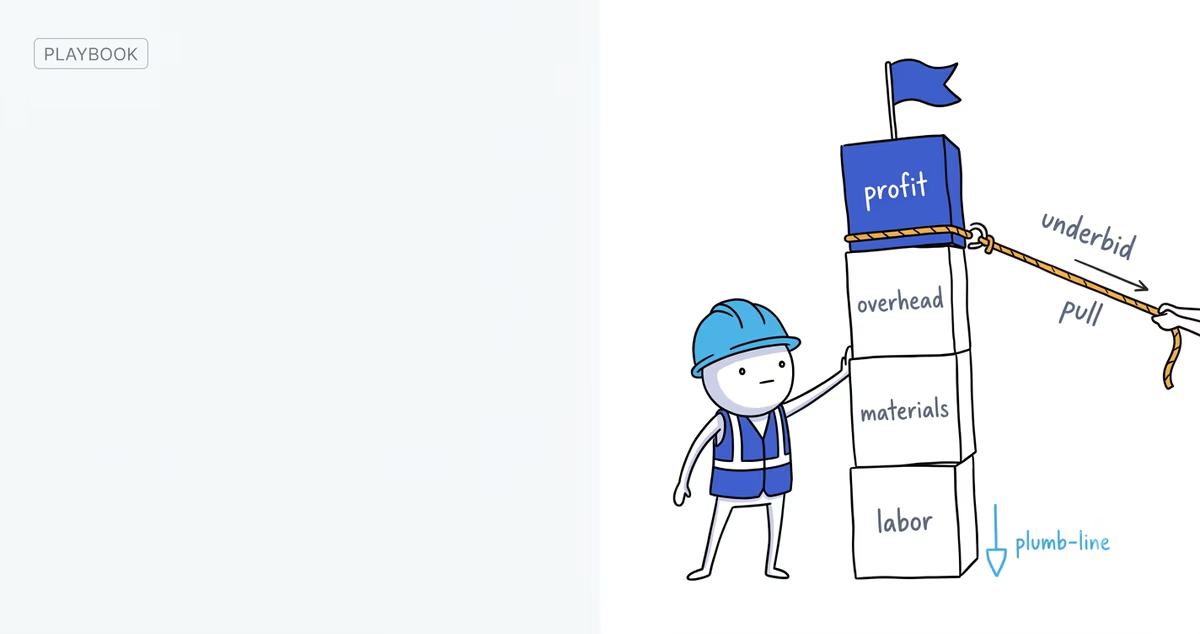
Underbidding a big job often starts with incomplete cost math. Costs that may look minor on a $300 call can add up across a $30,000 job and erase the expected profit. Build the price from full cost, protect the profit, and plan the cash flow before committing to the work.
How to calculate the full cost of a big job
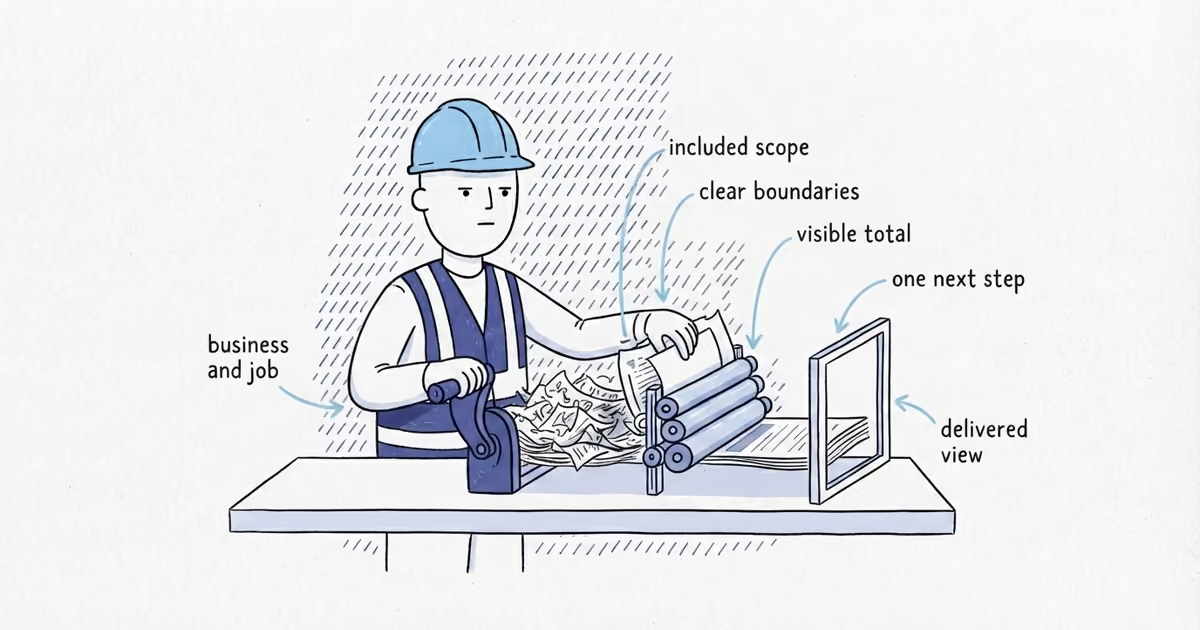
Small jobs let you price off materials and the hours on site. Big jobs punish that habit. Add up everything the job eats:
- Burdened labor. Not just the wage. Add payroll taxes, workers’ comp, and benefits on top. A common rule of thumb adds roughly 15 to 35 percent to the base wage, but use your own real numbers. Then multiply your burdened hourly cost by the hours the job will actually take, including the slow stretches and cleanup.
- Materials, with a waste allowance. Order more than the takeoff, because you’ll cut, break, and mis-measure. Add a waste percentage that fits the trade.
- Equipment. Rentals, fuel, wear on your own machines, dump fees, anything the job burns through.
- Overhead. The share of your fixed monthly costs, like insurance, phone, software, and the truck, that this job should carry for the days it ties you up.
That total is your cost, not your price. Stopping there, or quoting from what the job “feels like” without calculating the full cost, can produce an underbid.
How to add profit to a large job price
Profit isn’t what happens to be left over. It’s a number you add on purpose, on top of full cost. Decide your target margin and build the price to hit it.
Watch this next part, because it’s where a lot of money leaks. Margin and markup aren’t the same thing, and mixing them up thins your profit without you noticing. Markup is the percentage you add to cost. Margin is the percentage of the final price that’s profit. To hit a target margin, divide your cost by one minus the margin:
price = cost ÷ (1 − target margin)
| Target margin | Markup you actually need |
|---|---|
| 10% | 11% |
| 15% | 18% |
| 20% | 25% |
| 30% | 43% |
| 40% | 67% |
On a $20,000 cost, “adding 30%” gets you $26,000, which is only a 23 percent margin. Pricing for a true 30 percent margin means $20,000 ÷ 0.70, or $28,571. On a big job, that gap is thousands of dollars you either keep or give away.
How much contingency to add to a big job
Every big job hides surprises. Put a contingency in as its own line, sized to how risky the job is:
- Low-risk, well-understood work: around 5 to 10 percent.
- Medium-risk, some unknowns: around 10 to 15 percent.
- High-risk, real surprises likely: around 15 to 20 percent.
Treat these as a rule of thumb. What raises the risk on a big job: opening up an old structure, unknown substrate or soil, tight access, and a long timeline exposed to price changes. Keep the contingency visible in your own numbers so you know whether you actually spent it, even if you show the customer one total. When a job’s genuinely open-ended, the tools in how to price a job when you don’t know how long it will take go further.
How to use deposits and progress payments on big jobs
Cash flow needs its own plan. A job can be profitable on paper and still leave the business short of cash if expenses are due before customer payments arrive. You may need to buy materials and pay the crew for weeks before the final invoice lands.
Two moves fix it:
- Take a deposit that covers your up-front materials before you order them, so you’re not floating the job on your own cash. Some states cap how large a deposit you can ask for on residential work, so check the rule where you operate rather than assuming.
- Bill on progress. Break a multi-week job into milestones: a deposit, a payment at a defined mid-point, and the balance on completion. You get paid as you go, and you find out early if a customer can’t pay, before you’ve sunk the whole job into their property.
How long a big-job quote should remain valid
A number that was profitable in March can lose money in June if material prices jump. Put an expiration date on a big quote. Thirty days is a common window. State that the price holds until then and that material costs are locked only in that window. It protects you from a slow yes turning a good bid into a loss, and it gives the customer a gentle reason to decide.
Why contractors underbid large jobs
Underbidding is rarely about nerve. It’s usually one of three things:
- Invisible costs. Overhead, drive time, burden, and equipment never make it into the number.
- No history. Without records of what past jobs actually cost, every estimate is a guess.
- The scarcity mindset. When work feels scarce, you may quote to win instead of to profit. Do not use bid acceptance alone as proof that the price is sound; compare estimated costs and margins with the actual result after each job.
Big-job bid checklist before you send it
Run this list on any big job before it goes out:
- Is every cost line in: burdened labor, materials with waste, equipment, and overhead?
- Is profit a real number added on top, using margin, not markup?
- Is the contingency sized to the risk?
- Is there a deposit and a milestone schedule so you’re not financing the job?
- Does the quote have an expiration date?
- Gut check: what’s the least this job could cost you, and is your price comfortably above it?
Can’t answer the first two? Don’t send the bid yet. The number’s a guess, and guesses are how big jobs lose money. For the estimate document itself, start with the general contractor estimate guide, or use the worked examples for concrete, roofing, HVAC, and remodeling. When approved scope changes later, calculate the adjustment with the change-order pricing guide. And if your problem’s the opposite, small jobs that never seem to pay, that’s how to price small jobs.
For a high-value bid, customers may also verify past projects, reviews, services, and contact details before signing. Qualified home service businesses can apply for a free website that puts that proof and quote path in one place.
Frequently asked questions
What’s the difference between margin and markup?
Markup is the percentage you add to your cost. Margin is the percentage of the final price that’s profit. A 30 percent markup is only about a 23 percent margin. To hit a target margin, divide cost by one minus that margin.
How do I price a big job I’ve never done before?
Break it into the parts you do know and price each from a similar past job, then add a wider contingency for the parts you don’t. If too much is unknown to price safely, charge for a paid assessment first, or bid it time and materials with a cap instead of a blind fixed price.
How much deposit should I ask for on a big job?
Enough to cover the materials you have to buy up front, collected before you order. Check your state’s rules, because some cap the deposit you can require on residential work.
What if I already sent a bid that’s too low?
If it isn’t signed yet, tell the customer you found an error and re-quote before work starts; the customer can accept or reject the corrected bid. If you’re already committed, follow the agreement, protect the quality, bill only legitimate approved changes, and fix the estimating gap for the next job.
- pricing
- underbidding
- margin-vs-markup
- contractor-contingency
- progress-billing