
How to Price Small Jobs Without Losing Money
Small jobs lose money on drive time and setup, not the work. Cover the whole visit with a minimum, day rate, surcharge, bundling, or batching, or turn them down.
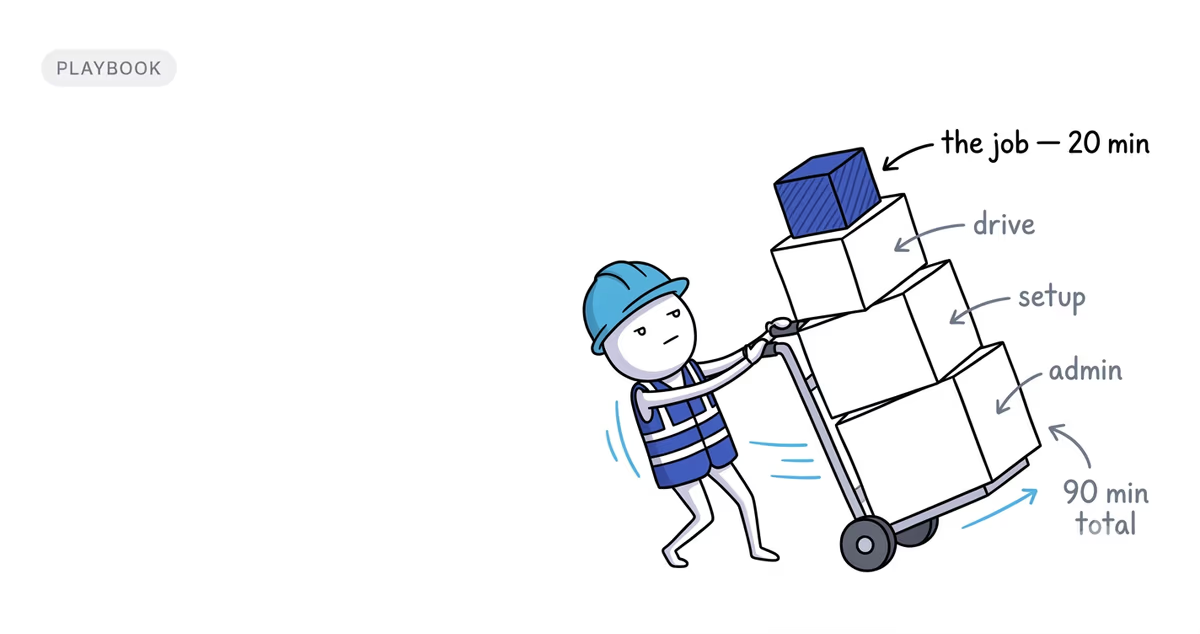
Small jobs lose money on the cost around the work, not the work itself. The drive, the setup, and the paperwork cost nearly the same whether the job’s twenty minutes or two hours, but a small job has far fewer billable minutes to cover them. Price a small job on wrench time alone and it loses money even when the invoice looks fine. You’ve got three ways out: price the whole visit, batch small jobs together, or turn them down.
What costs to include when pricing small jobs
A “twenty-minute” repair rarely costs you twenty minutes. Count the whole visit:
- 15 minutes to load and prep
- 20 minutes to drive there
- 20 minutes on site
- 20 minutes to drive back or reach the next job
- 15 minutes for payment, notes, and the invoice
That’s 90 minutes of your day for 20 minutes of work. Charge for the 20 and you gave away the other 70, plus the truck, the fuel, and the slot you could’ve sold to someone else. The numbers will differ for your trade and your drive. The point is the ratio: on a small job, the invisible time dwarfs the time on the tool. Run solo and every one of those 90 minutes is your own, which is why small jobs hit a one-person shop hardest. See how to price jobs as a solo owner.
Five ways to make small jobs profitable
1. A minimum charge
The cleanest fix for one-off small work is a minimum: the least you’ll charge to roll a truck, set so a short visit still covers its full cost. It’s got its own math, so rather than repeat it here, see should I charge a minimum service fee? for how to set the number. Use it as your floor for any small job you can’t batch.
2. A day rate or half-day rate
When a customer has a pile of small tasks that don’t fit neat per-item prices, sell a block of time instead. A half-day or full-day rate covers your fixed cost once and fills the slot with billable work, instead of pricing each tiny task and driving out for each one. It works best for handyman-style lists and punch-out work.
3. A small-job surcharge
Add a flat charge to any job under a set size. It’s a simpler cousin of the minimum: your normal price plus a fixed add-on for anything below your threshold, so a tiny job still carries its share of the day’s fixed cost without you re-pricing your whole menu.
4. Bundle several small jobs into one visit
One truck roll should cover as much billable work as possible. Give the customer a reason to combine tasks: “while I’m out, I can also handle X and Y for less than three separate visits.” It lifts the ticket, spreads your fixed cost over more work, and the customer gets more value from the trip. A bundle turns three unprofitable stops into one profitable visit.
5. Batch small jobs by area
This is the lever that changes the math. Cluster several small jobs in the same area on the same day and each one’s share of the drive and setup drops, so a price that would lose money on its own starts to work. If you can’t cluster them, that lone small job across town has to carry the whole trip by itself, which means it gets a higher price or gets declined. Group your small work into a small-jobs day in one part of town instead of scattering it across the week.
When to decline a small job
Some small jobs can’t be made profitable at any price the customer will accept: too far to batch, below your floor, and no bigger work attached. Decline those politely and early, before you drive out. Say your minimum plainly on the phone, and if it’s a no, it’s a no.
Don’t talk yourself into a loss solely because a small job might lead to bigger work. Treat future work as uncertain unless your own records show a reliable conversion pattern. Price the current job on its own economics.
Small-job pricing example
Say a customer wants a single fixture swapped. The work’s 30 minutes on site and $40 in parts, and the whole visit runs 90 minutes door to door.
- Priced on wrench time: half an hour at your $90 rate plus $40 in parts is $85. That doesn’t cover the 90 minutes the visit actually took, the truck, or the slot. You lost money on a paid invoice.
- Priced on the full visit: suppose your completed minimum-fee calculation produces
$150for this visit. That price covers cost and margin only because the time, truck, overhead, and target margin were included in the calculation. Or batch it with two nearby jobs, recalculate the shared drive cost, and see whether a lower price per stop still clears the target.
Same job. The price that counts the whole visit, or the schedule that shares it, is the one that makes money. The dollar figures are illustrative; use your own costs.
Route batching works best when more nearby customers can find the business. ShiftFlow’s Google Maps ranking service reviews and improves the local signals that support visibility, without promising a particular ranking.
Frequently asked questions
What is a minimum job charge?
It’s the least you’ll charge for a visit, calculated to cover the full cost of showing up and the target margin. See the minimum service fee guide for how to set yours from actual time and costs.
Should I charge a trip fee for small jobs far away?
For a job you can’t batch and can’t avoid, a travel charge that covers the extra drive is fair, as long as you tell the customer before you go. If the number doesn’t work for them, it’s usually a job worth declining.
Are small jobs ever worth it?
Yes, when they’re batched into a route, attached to bigger work, or priced at a real minimum. The trap is the scattered, one-off small job priced on wrench time. Fix the pricing or the scheduling and small jobs become steady, profitable filler.
How do I make small jobs profitable without scaring customers?
Quote one clear, disclosed number calculated to cover the visit, and offer to bundle compatible tasks when that reduces the cost per task. Explain what the price includes without promising how every customer will respond.
- pricing
- small-job-pricing
- minimum-job-charge
- day-rate
- trip-fee