
How to Price Jobs as a Solo Owner
Pricing as a one-person business? Set your rate on the hours you can really bill, pay yourself a wage before profit, and cover overhead and self-employment tax.
When you run a one-person business, your price has to cover four things: a real wage for your own hands, your overhead, your taxes, and profit. And it has to cover them across the hours you can actually bill, which is nowhere near forty a week. Every pricing guide written for a company with a crew skips the two moves that matter most for you. Here they are.
How many billable hours a solo contractor really has
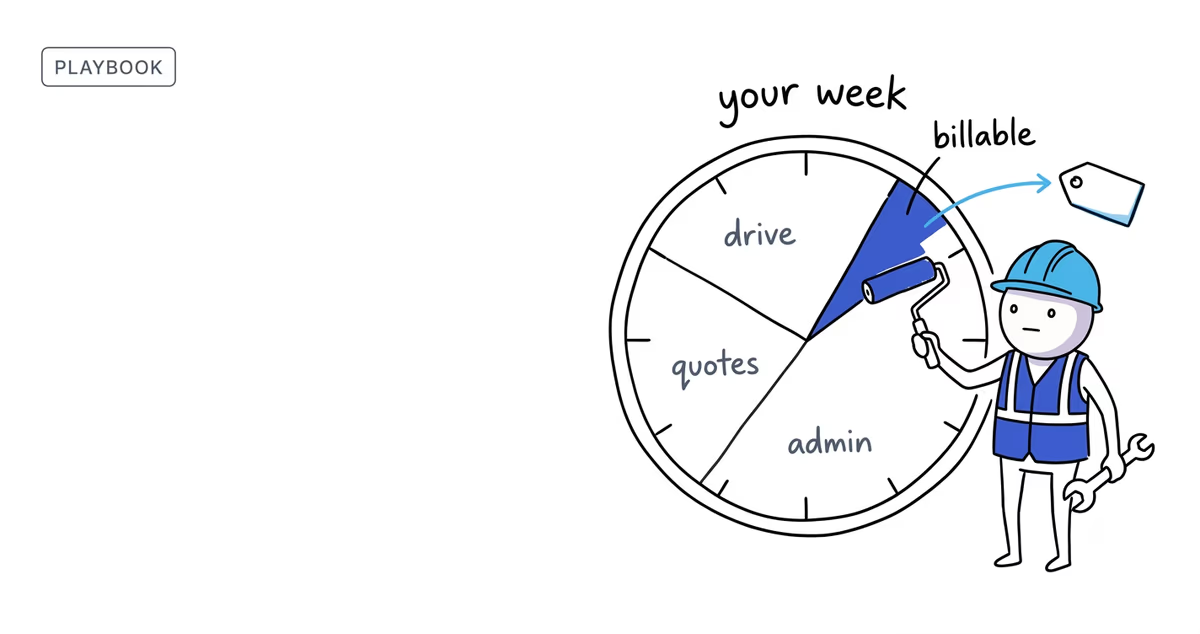
A solo week isn’t forty billable hours. You drive, you quote, you invoice, you run to the supply house, you answer the phone, and you chase the marketing. None of that’s billable, but all of it’s your week.
Start at the top and work down:
- A full-time year is about 2,080 hours (40 hours times 52 weeks).
- Subtract your time off: holidays, vacation, sick days.
- Subtract the unbillable work that fills a solo week: driving, quoting, invoicing, supply runs, admin.
What’s left is your realistic billable hours, and it’s the number every underpricing mistake starts with. Tradespeople commonly bill somewhere around 30 to 50 percent of their clocked time, though it varies widely, so the honest move is to track your own hours for a few weeks instead of trusting any single figure. Bill 25 hours in a 50-hour week and half your working time is unpaid, so your price has to carry it.
How to include your own wage in job prices
Plenty of solo owners stay broke no matter how busy they get, and the reason is almost always the same: they treat whatever’s left at month’s end as both their paycheck and their profit. Those are two different things. Your wage is what you’d pay a hire to do the work you’re doing, so put it in the cost stack as a real line. Profit sits on top of that. It’s the business’s return for the risk, the equipment, and the slow months, not your grocery money. Pay yourself only the leftovers and you work for free every time a job runs tight.
What costs solo contractors forget to price
Two more costs vanish when you price by feel:
- Overhead, even with no office. Insurance, phone, software, tools, fuel, and the truck cost money every month whether or not you booked work. Spread that across your billable hours and build it into your rate.
- Self-employment tax. As a solo owner you may owe Social Security and Medicare tax through self-employment tax rather than employee withholding. Entity type, wages, net earnings, thresholds, and deductions affect the calculation, so confirm the current treatment with the IRS self-employment tax guidance or a tax professional before building a set-aside into your rate.
Solo contractor hourly rate formula
Put it together and your rate isn’t a guess, it’s arithmetic:
realistic billable hours = (2,080 − time off) × your billable percentage

hourly rate = (owner wage + overhead + tax set-aside + profit) ÷ realistic billable hours

job price = hourly rate × job hours + materials (with markup)
The denominator is the part everyone gets wrong. Divide your yearly costs by 2,080 and you set a rate that can’t pay you, because you’ll never bill 2,080 hours.
Solo contractor pricing example
Round numbers, to show the shape:
- Owner wage you want: $70,000
- Business overhead for the year: $18,000
- Tax set-aside: $16,000
- Profit target: $10,000
- Total to cover: $114,000
Now the hours. A 48-week year after time off is about 1,920 clocked hours. At 45 percent billable, that’s about 864 billable hours.
$114,000 ÷ 864 = about $132 an hour
That’s your rate. A job you expect to take 6 hours, with $300 in materials, prices at 6 × $132 + $300, or about $1,092. See how far that is from a rate built on a 40-hour week: divide the same $114,000 by 2,080 and you get $55 an hour, a number that guarantees you never catch up. The figures here are illustrative, so run the chain with your own.
Common solo contractor pricing mistakes
- Pricing off a 40-hour week. You’ll never bill it. Divide by real billable hours.
- Matching a bigger competitor’s rate. They’ve got the volume and staff to spread costs you don’t. Price from your numbers, not theirs.
- Forgetting to pay yourself. If your wage isn’t a line in the cost, you’re the one who goes unpaid when a job runs tight.
- Not banking for taxes. Self-employment tax isn’t optional. Set it aside on every job.
A note on models: solo, flat rate usually beats hourly, because when you work fast you keep the gain instead of billing fewer hours. Which model fits which job is should I charge hourly or flat rate?. And once you’re quoting larger jobs, the full-cost buildup is in how to price big jobs without underbidding.
A solo owner rarely has time to diagnose every marketing channel separately. The free online presence audit reviews the Google profile, reviews, listings, website, and local competitors, then prioritizes what to fix first.
Frequently asked questions
How many hours can I actually bill in a week?
Fewer than you work. After driving, quoting, invoicing, and admin, many solo tradespeople bill roughly 30 to 50 percent of their clocked hours. Track your own for a few weeks and use that number, not 40.
Do I pay myself before or after profit?
Before. Your wage is a cost, the same as paying a hired hand. Profit’s separate and sits on top. Take only the leftovers and you work for free whenever a job runs tight.
How much should I set aside for taxes?
Enough to cover self-employment tax plus your income tax, set aside on every job instead of found at year-end. Confirm the current rates with the IRS or a tax pro and build the set-aside into your rate.
Should a solo owner charge hourly or flat rate?
Usually flat, once you know your times, because you keep the reward for working fast. Use hourly, or a capped time-and-materials price, when a job’s genuinely unpredictable.
- pricing
- solo-contractor-pricing
- owner-operator-rate
- billable-hours
- self-employment-tax