
How to Write an HVAC Estimate
Two 3-ton bids can describe different jobs. Write an HVAC estimate that connects the load, matched equipment, installation scope, and amount due.
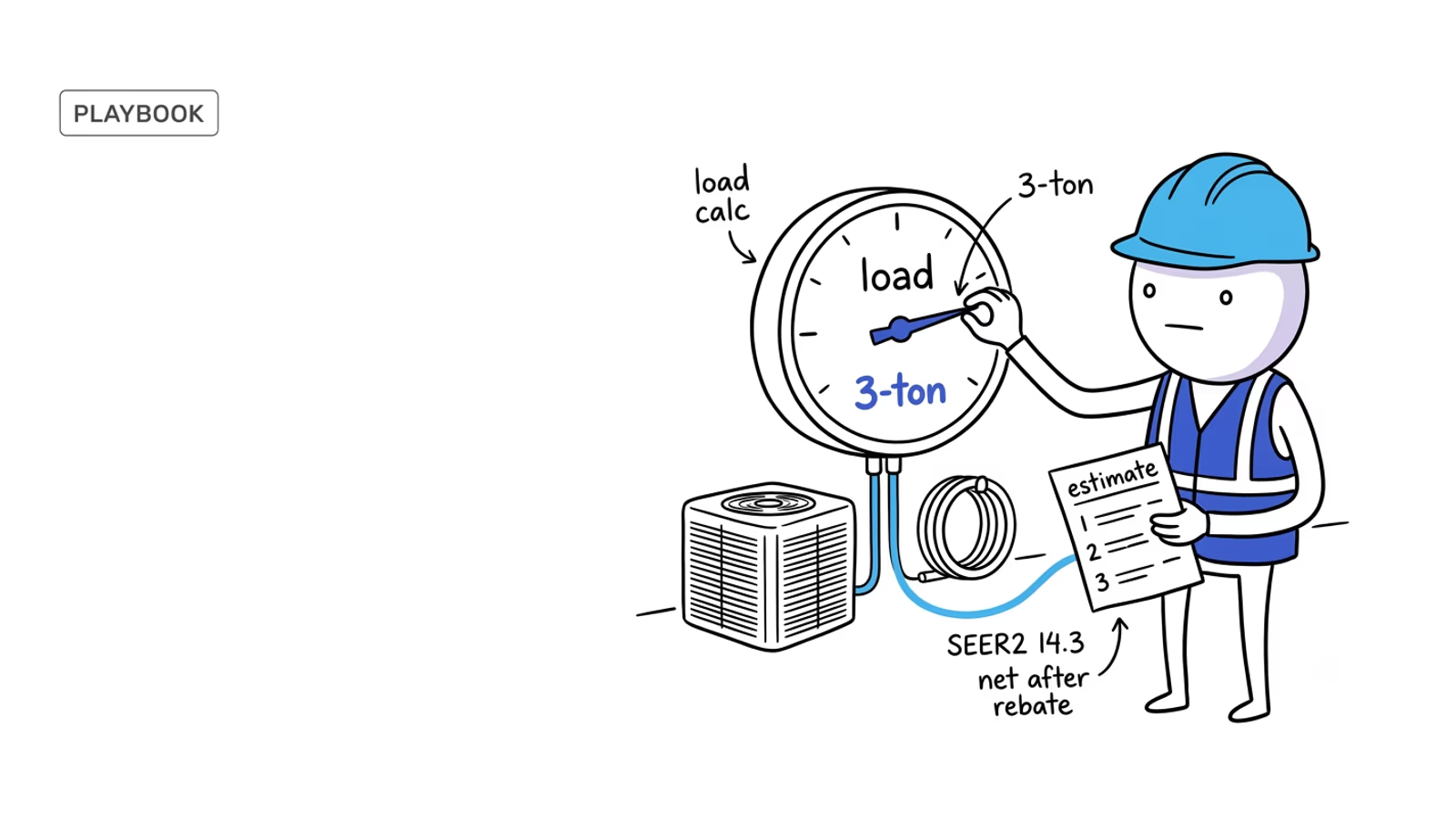
Two HVAC bids can both say “3-ton replacement” and still describe different jobs. One contractor copied the old nameplate and priced a condenser and coil. The other recorded the load, named the matched indoor and outdoor equipment, included the line set and commissioning, and separated a possible rebate from the amount due. The second bid gives the homeowner something real to compare.
That is what an HVAC estimate has to do: connect the technical basis for the system to the equipment, installation scope, and customer price. Guessing from the old nameplate can repeat an earlier sizing mistake; vague equipment and scope make two proposals impossible to compare.
The guide starts with the load and ends with the proposal. If you want to compare up to three equipment packages and export the selected proposal, use our HVAC estimate generator to build the customer PDF. If you already have the system details and prefer a spreadsheet, download the HVAC estimate template as a workbook or fillable form.
What a complete HVAC estimate includes
A homeowner should be able to find four things without decoding the document:
- Job and design basis: customer, installation address, estimate dates, load source, and supplied loads
- Equipment: matched models, capacity, efficiency ratings, AHRI reference, refrigerant, and warranties
- Installation: included work, allowances, optional upgrades, commissioning, and exclusions
- Price and terms: installed price, tax, deposit, incentive status, schedule, payment, and acceptance
That structure lets a homeowner compare actual systems and scope instead of comparing two unexplained totals.
Document the load and design basis
Everything on the estimate flows from the load, so the load comes first. A Manual J calculation — the ACCA residential load standard — takes the house’s square footage, insulation, window area and orientation, ceiling height, and climate zone and returns the actual heating and cooling load in BTU. That number sets your tonnage. You don’t guess from the old unit’s nameplate; the last contractor may have guessed too, and “match what’s there” just repeats their mistake.
Sizing errors create risk in both directions. Oversized equipment can short-cycle and reduce humidity control; undersized equipment may fail to meet the design load. Documenting the load calculation gives the equipment selection a traceable technical basis.
You do not need to reproduce the Manual J worksheet on the estimate. Record the load source, report reference, and the cooling and heating loads in Btu/h. A concise design-basis line reads:
Manual J by qualified designer | Report #4471 | 34,200 Btu/h cooling | 46,000 Btu/h heating
Put the selected capacity on the equipment package rather than presenting it as the load itself. The estimate records supplied design inputs; it does not replace the Manual J calculation or equipment-selection work.
Define the matched equipment and installation scope
Once tonnage is set, the takeoff is just naming every part that leaves your truck and goes into the job. Vague scope is where estimates die — “new condenser and coil” could be anything. Name the models and their ratings so the homeowner can compare apples to apples and so you’re protected on what you promised to install.
For a typical residential changeout, keep the matched system as one equipment package, not a separate customer price for every component. The package should carry the details a homeowner can verify:
- Outdoor model — condenser or heat pump make and model
- Indoor model — matched coil or air handler
- Furnace model — if it’s part of the job
- Capacity — the tonnage the load points to (e.g. 3-ton)
- SEER2 / HSPF2 — the rated efficiency of the matched combination, not the outdoor unit alone; give the HSPF2 too on any heat pump
- AHRI reference — the certificate that ties the rating to that exact combination
- Equipment warranty and Labor warranty — stated separately
- Installed price
Everything else is installation scope. Mark each line as included, an allowance, or optional:
- Load and selection review
- Equipment removal and recovery — recover refrigerant and remove the old equipment
- Equipment installation — set the matched package and accessories (pad, whip, disconnect, breaker, condensate drain and safety switch)
- Refrigerant line set — new set and length, or reuse and flush
- Duct transitions and modifications — if the load calc calls for them
- Electrical and disconnect
- Thermostat and controls
- Permit and inspection — carried as an allowance
- Startup and commissioning — evacuation, weigh-in charge to spec, startup
Every physical item and task belongs on the document so nothing reads as a surprise later. If the installed price is not built yet, use our HVAC job-pricing guide to add equipment, labor, materials, overhead, and margin before you turn those costs into the customer proposal.
Price comparable HVAC packages
When you offer good-better-best choices, keep the load and common installation scope constant so the homeowner is comparing equipment rather than three different jobs. Give each package its own matched system, rated efficiency, AHRI reference, split equipment/labor warranty, and installed price. This table is illustrative; verify current regional efficiency requirements, rated combinations, and manufacturer warranty terms for the actual products:
| Tier | Matched system | SEER2 / HSPF2 | AHRI ref | Warranty (equip / labor) | Installed price |
|---|---|---|---|---|---|
| Good | 3-ton single-stage condenser + matched coil | 14.3 SEER2 | #____ | 10-yr parts / 1-yr labor | $X,XXX |
| Better | 3-ton two-stage condenser + matched coil | 16.0 SEER2 | #____ | 10-yr parts, 10-yr compressor / 2-yr | $X,XXX |
| Best | 3-ton variable-speed heat pump + air handler | 18+ SEER2 · 9+ HSPF2 | #____ | 10-yr parts, 12-yr compressor / 2-yr | $X,XXX |
Keep true add-ons off the tier and on their own optional lines so the base number stays clear: smart thermostat, air purification or media filter cabinet, UV, or zoning. Confirm that each add-on is compatible and that any performance or warranty statement applies to the quoted combination.
Document incentives without discounting the price
Some qualifying systems and customers may have access to utility, state, manufacturer, or federal incentives. Keep the installed price whole and record incentives separately because eligibility, funding, and timing may be outside your control. Verify the equipment, installation date, customer eligibility, application process, and program funding before writing anything down.
On the estimate, that’s the Rebates and incentives line — a status, not a subtraction:
Rebates and incentives: not included / estimated / confirmed. State the type — instant discount, contractor rebate, post-purchase customer rebate, or tax credit — and who applies.
Do not deduct an unverified incentive from the amount due or guarantee the customer will receive it. If you help with the paperwork, list rebate administration as a separately priced optional service.
An HVAC estimate example you can copy
Here is the whole proposal for one job: a 3-ton AC and coil changeout on an existing 80% furnace.
HVAC PROPOSAL #2041 [Your Company] · License #[number] · [phone / email]
Prepared for: [name] — Installation: [install address] — Estimate details: Issued [today] · Valid until [+30 days]
AC + coil changeout on existing 80% furnace
Design basis: Manual J by qualified designer | Report #4471 | 34,200 Btu/h cooling | 46,000 Btu/h heating
Equipment package
- Outdoor: [brand/model] 3-ton condenser · Indoor: matched cased coil on existing furnace
- Capacity 3-ton | 14.3 SEER2 | AHRI #____
- Equipment warranty: 10-yr parts (registered) · Labor warranty: [X]-yr
- Subtotal $X,XXX · Tax (X%) $XXX · Total $X,XXX · Deposit (30%) $X,XXX
Common installation scope — status
- Load and selection review — Included
- Equipment removal and recovery — Included
- Equipment installation: pad, whip, disconnect, 30-amp breaker, condensate drain + float switch — Included
- Refrigerant line set, new 25 ft, brazed and evacuated — Included
- Electrical and disconnect — Included
- Thermostat and controls: Honeywell T4 Pro — Included
- Startup and commissioning: evacuation, weigh-in charge to spec — Included
- Permit and inspection — Allowance
Optional upgrades — not included in total
- Ecobee smart thermostat — [add]
- Media filter cabinet, 4-in — [add]
Rebates and incentives: not included / estimated / confirmed — state the type and who applies; not subtracted from the total.
Schedule: 1-day install, scheduled within [X] days of deposit. Payment terms: [deposit]% deposit, balance on completion. Estimate valid 30 days. Exclusions: electrical panel upgrades, duct replacement, drywall/paint, permits beyond mechanical, code corrections found on inspection. Warranty conditions: 10-yr manufacturer parts (registered) + [X]-yr labor.
Customer acceptance: **____** Date: **__**
Copy that shape for any changeout and swap in your own models, current-rated equipment, and pricing.
Add HVAC terms, exclusions, and an expiration date
Two lines that protect the scope are easy to leave off. Exclusions identify work not included, such as panel upgrades, duct replacement, drywall, or code corrections found at inspection. If you need help making those boundaries specific, use our estimate exclusions guide to state what is outside the price, what triggers a review, and what happens next. A valid-until date should match the period for which supplier pricing and confirmed incentives are reliable. State separately whether the price is approximate or fixed, the assumptions behind it, and the process for changes; locking equipment and permit costs does not automatically change the document’s legal effect.
Review the HVAC estimate before you send it
Read the proposal the way a homeowner will compare it with another bid. The load source should lead to the capacity; the capacity should lead to a verifiable matched system; and the installed price should lead to a specific scope. Confirm that allowances and optional upgrades sit outside the included work, and that unverified incentives have not quietly reduced the amount due.
Then check the practical details: current equipment pricing, validity date, deposit, schedule, commissioning, exclusions, and warranty conditions. If a discovered condition changes the installation, use our change-order pricing guide to document and price the added work before it disappears into the original scope.
When the load, equipment, scope, and price agree, compare the packages and export the proposal with the HVAC estimate generator, or download the HVAC estimate template to complete it offline.
Frequently asked questions
Should an HVAC estimate include a Manual J load calculation?
Use an ACCA Manual J residential load calculation rather than copying the old nameplate. It accounts for the building and design conditions to calculate heating and cooling loads, which support the equipment-selection process.
Do HVAC estimates expire?
Include a valid-until date tied to supplier pricing and incentive availability. State separately whether the price is approximate or fixed and what can change it; locking equipment and permit costs does not automatically change the document’s legal effect.
Should I give free HVAC estimates?
Choose a free or paid policy from the work required and expectations in your market. A straightforward sales estimate may be free, while a diagnostic visit, duct evaluation, detailed load calculation, or reusable design report can justify a disclosed fee.
Sources
- pricing
- hvac
- estimates
- quoting
- small-business