
How to Write a Roofing Estimate
A roofing estimate should show how the measured squares become materials, scope, options, exclusions, and price. Here is how to write one, with a roof takeoff and complete example.
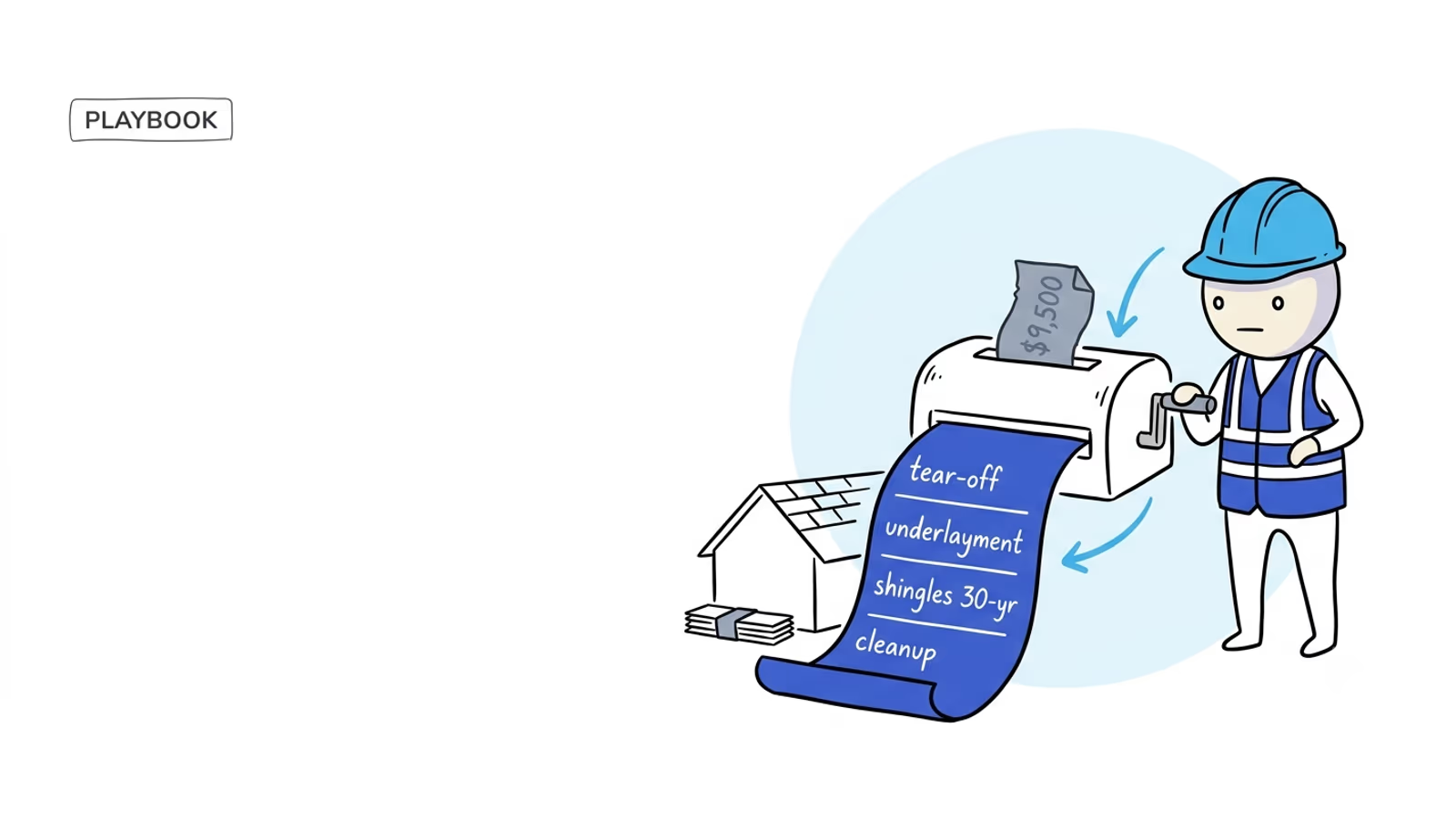
Three roofers walk the same roof this week and sit down at the same kitchen table. Two of them write “New roof — $9,500” on a page and shake hands. The third hands over one sheet: 18 squares of architectural shingle, one-layer tear-off, new underlayment and ice-and-water shield, ridge vent, cleanup — and three prices to choose from. Same house, same roof.
The third estimate is easier to evaluate because the homeowner can see what they are paying for and compare bids like for like. That’s the point of a strong roofing estimate: it is more than a price tag. Build yours on an accurate square count, itemize the scope, and use options when they represent genuine differences in materials or system performance.
The estimate starts on the roof, not at the price table. Work through the takeoff below, then carry those quantities into the scope. If you want the pitch, waste, squares, and bundles calculated as you enter the roof sections, use our roofing estimate generator and export the customer PDF. If you prefer to work from measurements you already have, download the roofing estimate template as a takeoff spreadsheet or fillable form.
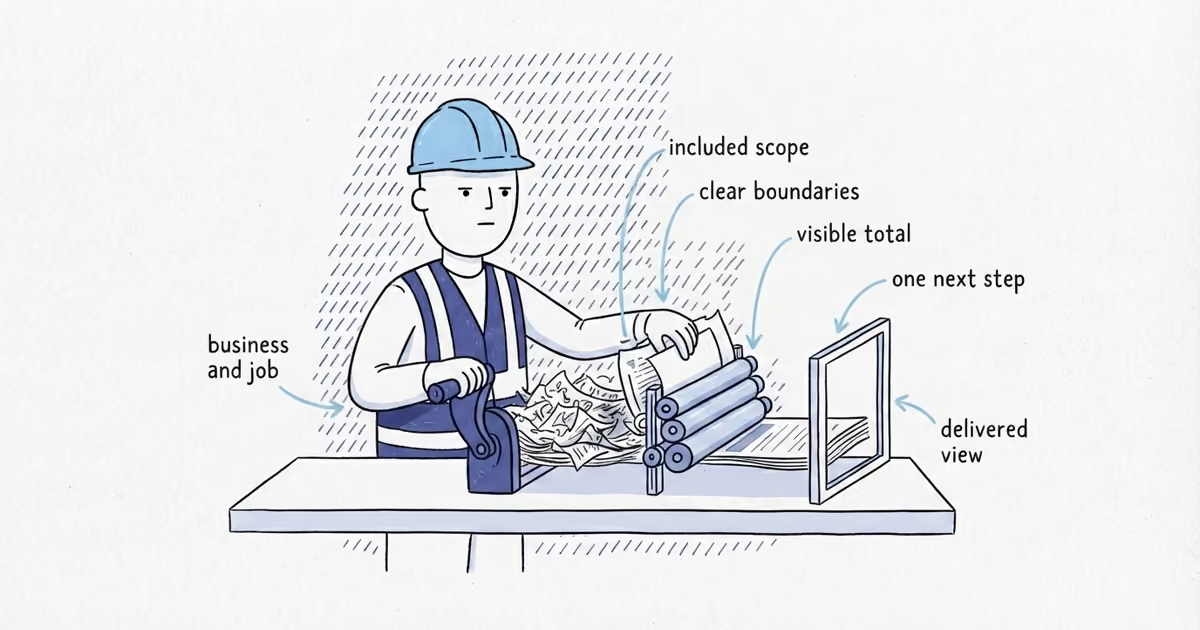
What a complete roofing estimate includes
A homeowner should be able to answer four questions from the document:
- What roof did you measure? Property, measurement source, existing layers, roof area, waste, and bundles
- What system are you installing? Tear-off, deck allowance, underlayment, flashing, ventilation, shingles, and cleanup
- What does it cost? Included work, customer prices, allowances, options, tax, total, and deposit
- What happens next? Schedule, payment, warranties, concealed conditions, exclusions, and acceptance
Use that structure whether the takeoff comes from field measurements, plans, or an aerial report.
Calculate and document the roof takeoff
Everything downstream depends on the takeoff, and roofing measures in squares. One square is 100 square feet of roof surface. Get this number wrong on the low side and you run short on bundles halfway through — then you either eat the extra material or drive back to the supply house while your crew stands around. Get it right and the rest of the estimate falls into place.
Work it in order:
- Area. Measure each roof plane and total it, or take the building footprint. Say the footprint comes to about 1,610 sq ft.
- Pitch. Footprint isn’t roof surface — a pitched roof has more area than the ground under it. Multiply by a slope factor: roughly 1.12 for a common 6/12, up to about 1.25–1.40 for anything 9/12 and steeper (steep also costs you time and adds risk). At 6/12: 1,610 × 1.12 ≈ 1,800 sq ft of actual roof.
- Squares. Divide by 100. 1,800 ÷ 100 = 18 squares.
- Waste. Add 10–15% for cuts at hips, valleys, rakes, and starter course. At 10%: 18 × 1.10 = 19.8 order squares. Keep that separate from the 18 roof squares used for tear-off and installation labor.
- Bundles. Architectural shingles run about 3 bundles per square. 19.8 × 3 = 59.4 → round up to 60 bundles.
- Layers. Count what’s already up there. One layer is a single tear-off pass; two layers roughly doubles tear-off labor and disposal, and drives your dumpster size.
The mini-worksheet, every time:
footprint area → × pitch factor → ÷ 100 = squares → + 10–15% waste → × 3 bundles/square
Those constants — 3 bundles per square, 10–15% waste, the pitch factors — are rules of thumb, not law. They shift with shingle type and how cut-up the roof is. A simple gable eats less waste than a roof full of valleys and dormers.
Use a measurement method that fits the roof and can be completed safely. An aerial measurement report is one way to get plane-by-plane numbers without walking a steep, complicated, damaged, or otherwise unsafe roof. Record the sequence — area → pitch factor → roof squares → waste → order squares → bundles — so the quantities in the priced scope are traceable.
Write and price the roofing scope
Itemize the scope so the homeowner sees the work, not just a number. A roofing estimate lists:
- Tear-off and disposal — number of layers, dumpster, and haul-away
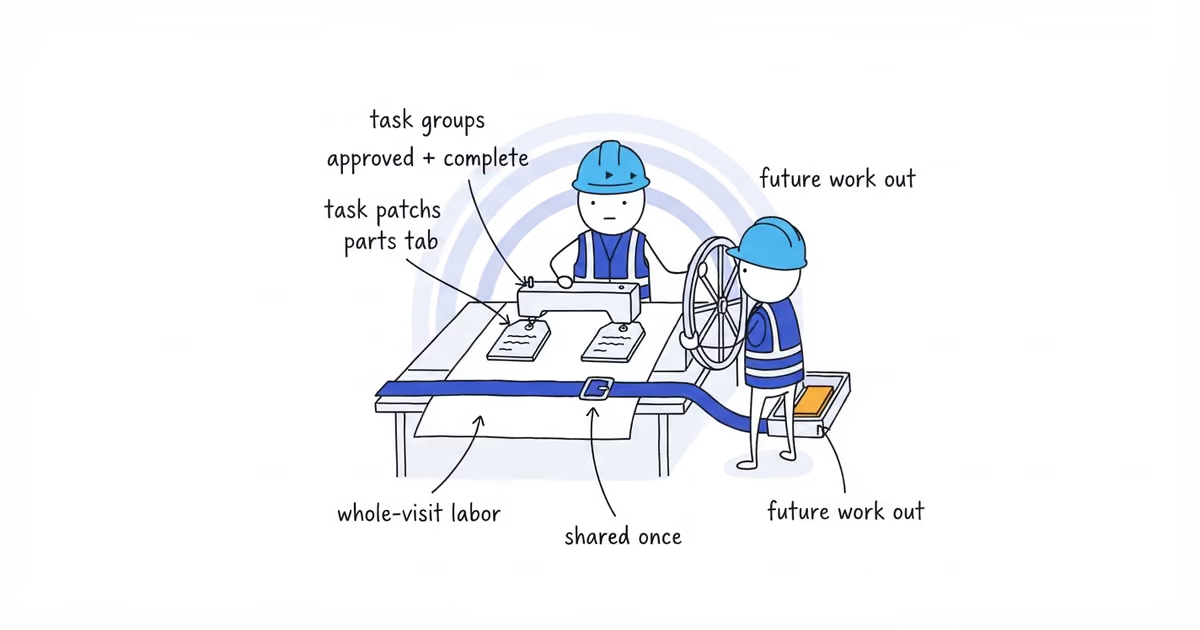
- Deck repair allowance — a set-aside amount for rotten sheathing found after tear-off, reconciled to the work actually approved
- Underlayment — synthetic or felt across the field
- Ice and water protection — eaves, valleys, and penetrations
- Drip edge and flashing — new metal, step and counter flashing at walls and chimney
- Ventilation — the ridge vent or other system you’re installing
- Shingles — brand, line, color, and the warranty that comes with them
- Installation labor — a separate line when it isn’t built into your shingle pricing
- Permit — who obtains it and how the fee is handled where local rules require one
- Final cleanup — debris haul and a magnetic nail sweep of the yard and drive
Then add the details that make the scope usable: an estimate number and date, an expiration date tied to supplier pricing, your business name and any required license or insurance information, a project-specific schedule, lawful deposit and payment terms, and clear exclusions. If you are unsure how to exclude chimney repair, code upgrades, or hidden damage without contradicting the roof system you included, use our estimate exclusions guide to write a specific boundary, trigger, and next step.
Separate the base system from optional upgrades
Give the homeowner a real choice when products create meaningful differences, rather than one unexplained price. Carry true upgrades as optional lines outside the base total so each one has a clear added price:
- Good — the code-compliant base system already in your priced scope, using the selected manufacturer’s entry product
- Better — an upgraded shingle, ventilation, or underlayment component supported by the roof design, added as an optional line
- Best — a premium shingle or complete manufacturer system with the applicable enhanced warranty
Verify that every option is compatible, code-compliant, and eligible for the warranty you describe. Product registrations, approved components, workmanship terms, and manufacturer requirements vary, so write the actual coverage rather than promising a generic “longer warranty.”
A roofing estimate example you can copy
Take that 18-square roof: single-family, one existing layer, 6/12 pitch, architectural re-roof. Here’s the lump-sum version those other two roofers left:
New roof — $9,500
Here is the same roof at the same price, with shingle material and installation labor on separate lines:
| Scope | Qty | Amount |
|---|---|---|
| Tear-off and disposal | 18 square | $1,300 |
| Deck repair allowance | allowance | $400 |
| Underlayment | 19.8 square | $450 |
| Ice and water protection | 1 job | $550 |
| Drip edge and flashing | 1 job | $600 |
| Ventilation | 1 job | $400 |
| Shingles — [brand/line], [color] | 60 bundle | $3,750 |
| Installation labor | 18 square | $1,650 |
| Permit | allowance | $250 |
| Final cleanup | 1 job | $150 |
Estimated total $9,500 · 30% deposit $2,850 due on scheduling Estimate #EST-1043 · Valid 30 days · License #____
Same $9,500. But the homeowner reading the second one knows their old layer is coming off, knows the deck is covered by a set-aside allowance, knows the valleys are getting ice-and-water, knows the shingle brand and warranty, and knows the yard gets swept for nails. The lump-sum roofer is asking for trust; the itemized roofer is showing the work. (The dollar figures here are illustrative — how you price each line off your per-square cost is its own subject.)
Add roofing exclusions and concealed-condition terms
You can’t see the decking until the shingles are off. That’s what the Deck repair allowance line on your estimate is for — a set-aside dollar amount, reconciled to the sheets you actually replace — paired with an exclusions line that spells out the boundary. Put both in writing:
Deck replacement is carried as a repair allowance, not in the base scope. Rotten or delaminated sheathing found after tear-off is replaced at $XX per 4×8 sheet, approved before installed and drawn from the allowance. Rotted fascia, chimney/masonry repair, and code-required upgrades are not included and will be quoted separately.
Pricing decking per sheet, with sign-off before you nail it down and each sheet drawn from the allowance, is what keeps a two-sheet surprise from turning into an argument at final payment. The homeowner isn’t shocked, and scope creep stays controlled because every add-on is a number you both agreed to. If the contract does not already set a unit price, use our change-order pricing guide to calculate the material, labor, overhead, and schedule impact before asking for approval.
Insurance and storm-claim estimates are a different animal — adjusters, supplements, ACV versus RCV — and worth their own write-up. Don’t try to fold claim work into a straight retail estimate.
Review the roofing estimate from ridge to cleanup
Before sending it, compare the document with the measurement report or field notes. The existing layers should match the tear-off quantity; roof squares should drive labor; waste-adjusted squares and bundles should drive material; and the named shingle, underlayment, flashing, ventilation, and warranty should describe one compatible roof system.
Then check the part most likely to cause an argument after tear-off: deck repair. Make the allowance, per-sheet price, approval step, and exclusions agree with each other. Confirm the customer total, deposit, validity date, schedule, and payment terms while supplier pricing and walkthrough details are still current.
When the takeoff and roof system agree, build the estimate and export the customer PDF with the roofing estimate generator, or download the roofing estimate template to complete it offline.
Frequently asked questions
How many squares is my roof?
Take your roof area in square feet and divide by 100 — that’s your number of squares. If you only have the building footprint, multiply it by a pitch factor first (roughly 1.12 for a 6/12, higher as the slope gets steeper), because a pitched roof has more surface than the ground under it. A 1,800 sq ft roof is 18 squares. Then add 10–15% for waste to get the material you actually order.
Do roofing estimates expire?
Include a valid-until date tied to the period for which supplier, labor, and subcontractor prices are reliable. Recheck those inputs before accepting work after that date.
Should I give free roofing estimates?
Choose a free or paid policy from the work required to produce the estimate and the expectations in your market. A straightforward sales estimate may be free, while a diagnostic inspection, engineered assessment, or reusable report can justify a disclosed fee.
Sources
- pricing
- roofing
- estimates
- quoting
- small-business