

Should I Include Reviews in an Estimate?
Learn how many reviews to include in an estimate, which customer quotes to choose, where to place them, how to attribute them, and when to refresh proof.
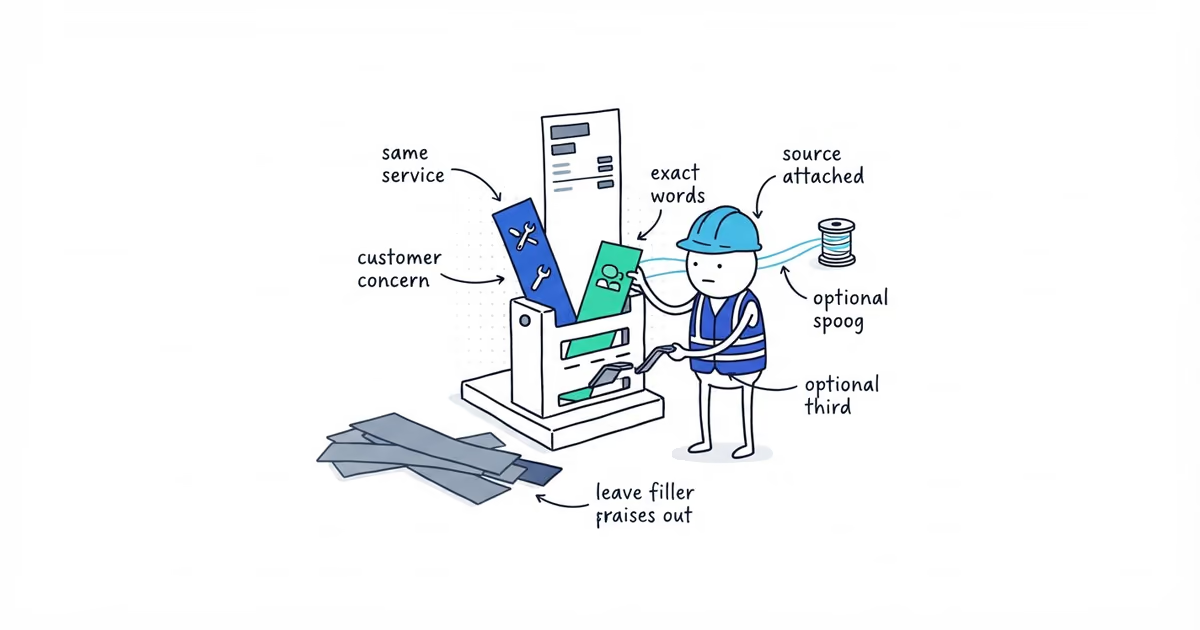
Yes. Include two strong customer reviews in an estimate when they are genuine, relevant, and traceable to a source. Use a third only when it proves something different. One relevant review beats padded generic praise.
Put the reviews in one compact block after the scope and price summary and before the terms or acceptance section. The estimate still needs to feel like an estimate.
Last verified: August 18, 2026 (United States).
How to choose customer reviews for an estimate
Choose the review that helps this customer judge this job, not the longest or most enthusiastic one.
| Test | Keep the review when | Reject or replace it when |
|---|---|---|
| Service match | It describes the same service or a similar project | It praises work unrelated to the estimate |
| Customer concern | It addresses communication, punctuality, cleanup, care, or follow-through | It repeats the first review without answering another concern |
| Specificity | It names something the crew actually did | It says only “great job” or “highly recommend” |
| Recency | It was posted in the past 12 months when recent choices exist | A newer, equally relevant review is available |
| Independence | It came from a genuine customer with no hidden connection | It came from an employee, relative, vendor, or rewarded reviewer |
| Claim risk | It describes the customer’s service experience | It promises unusual savings, speed, safety, warranty, or results |
| Source | The original review, author display name, and date can be verified | The source is gone, unclear, or different from the excerpt |
The 12-month preference is a maintenance rule, not a law or universal cutoff. BrightLocal’s 2026 survey found that recency affects local-business review decisions. An older review can still work when it is the best service match and remains accurate. Keep its date visible.
Give each slot a different job:
- Use the first review for the same service or project type.
- Use the second for the concern most likely to slow the decision, such as cleanup or communication.
- Add a third only for a distinct point the first two do not cover.
Where to put customer reviews in an estimate
Place the block after the customer has seen the work and price, but before dense terms or the acceptance control.
On a one-page estimate, use one or two short reviews below the total or in a clearly separated proof area. Do not insert testimonials between line items, exclusions, allowances, or signature fields. Photos, before-and-after examples, license details, warranties, and pricing options belong in separate guides.
Use this placeholder-only format:
What customers say about [service]

"[Paste a 25–45-word exact excerpt from a review about the same service or project type.]"
- [Public display name], [Platform], [Month Year]

"[Paste a 25–45-word exact excerpt that addresses communication, punctuality, cleanup, care, or follow-through.]"
- [Public display name], [Platform], [Month Year]

Optional third review
"[Use only when this excerpt supplies a different useful point.]"
- [Public display name], [Platform], [Month Year]
Build the block from reviews you can trace to their original pages. Do not replace the placeholders with invented praise.
How to quote and attribute customer reviews
Use quotation marks only for the customer’s words. If you shorten a review, remove a complete passage or use an ellipsis without changing its meaning. Do not polish casual wording into a stronger promise.
Use the public display name exactly as shown, the platform name in text, and the original month and year. Keep the full URL in your source log. A digital estimate may link to it when useful.
Do not add a full name, photo, address, project detail, or feedback that was not public. Get written permission before using private content or extra identifying details. Attribution does not automatically settle every reuse, privacy, copyright, or platform-term question.
FTC rules require honest experiences and prohibit material misrepresentations about a reviewer or experience. Avoid a review about exceptional savings, speed, safety, price, or guaranteed results unless the business can support the message the estimate would convey.
Leave undisclosed employee, family, vendor, and incentivized testimonials out. Those cases have separate federal and platform rules.
If software retrieves reviews through the Google Places API, Google requires the returned author attribution and source access. The text block above is for a manual template; it is not automatically API compliant.
How to track and refresh estimate reviews
| Field | What to record |
|---|---|
| Source | Original review URL and platform |
| Reviewer and date | Public display name and posted date |
| Review text | Full original text and exact excerpt used |
| Fit | Service match and customer concern covered |
| Connection | Any known employee, family, vendor, or incentive issue |
| Permission | Approval for any nonpublic content or added detail |
| Maintenance | Last-checked date and active or replace status |
Review the ledger quarterly. Confirm that each source exists and the excerpt has not materially changed. Replace proof tied to a discontinued service, former team member, old identity, expired offer, or unsupported claim. Use a newer service-matched review when it is stronger.
If that refresh keeps finding too little recent, service-matched feedback, our Google review management setup can help establish a consistent request process so current reviews keep arriving.
If the estimate shows an average star rating or total review count, add “as of [date]” and verify it during each template refresh. If nobody owns that maintenance job, leave the aggregate out and use the attributed excerpts.
Customer review checklist for an estimate
- Two reviews by default; no more than three
- Each review proves a different point
- The block sits after scope and price, not inside the job details
- Every excerpt uses the customer’s actual words without a distorted meaning
- Public display name, platform, and original month and year are present
- The source URL and last-checked date are in the ledger
- No undisclosed connection or incentive appears in the proof
- Any star average or review count has a current
as ofdate
Frequently Asked Questions
Should every contractor estimate include customer reviews?
No. Use the block when you have relevant, verified feedback that fits without crowding the work and price. Omit it when the only available reviews are generic, unrelated, or untraceable.
Can I use a Google review in a customer estimate?
You can consider a short attributed excerpt, but a public Google review does not automatically settle every reuse or platform-term question. Preserve its meaning and record the public display name, Google as the source, the date, and the original URL. Software using the Places API must also follow Google’s API attribution rules.
Can I include an employee or family review in an estimate?
Leave it out of the customer-proof block. Connected testimonials raise disclosure and platform-policy questions; use independent customer reviews here and handle insider reviews under the separate relationship rules.
Sources
- 16 CFR Section 255.1 - General considerations
- 16 CFR Section 255.2 - Consumer endorsements
- 16 CFR Section 255.5 - Disclosure of material connections
- 16 CFR Section 465.2 - Fake or false consumer reviews and testimonials
- Google Places API policies and attributions
- Google Maps user-generated content policy
- BrightLocal Local Consumer Review Survey 2026
- pricing
- should-i-include-reviews-in-estimate
- should-i-include-reviews-in-an-estimate
- customer-reviews-in-contractor-estimates
- testimonials-in-an-estimate
- review-proof-in-a-contractor-proposal
- google-reviews-in-an-estimate



