Should I match a competitor's price?
Normalize both quotes, calculate what the lower number does to profit, then choose match, hold, re-scope, or walk using a documented decision matrix.
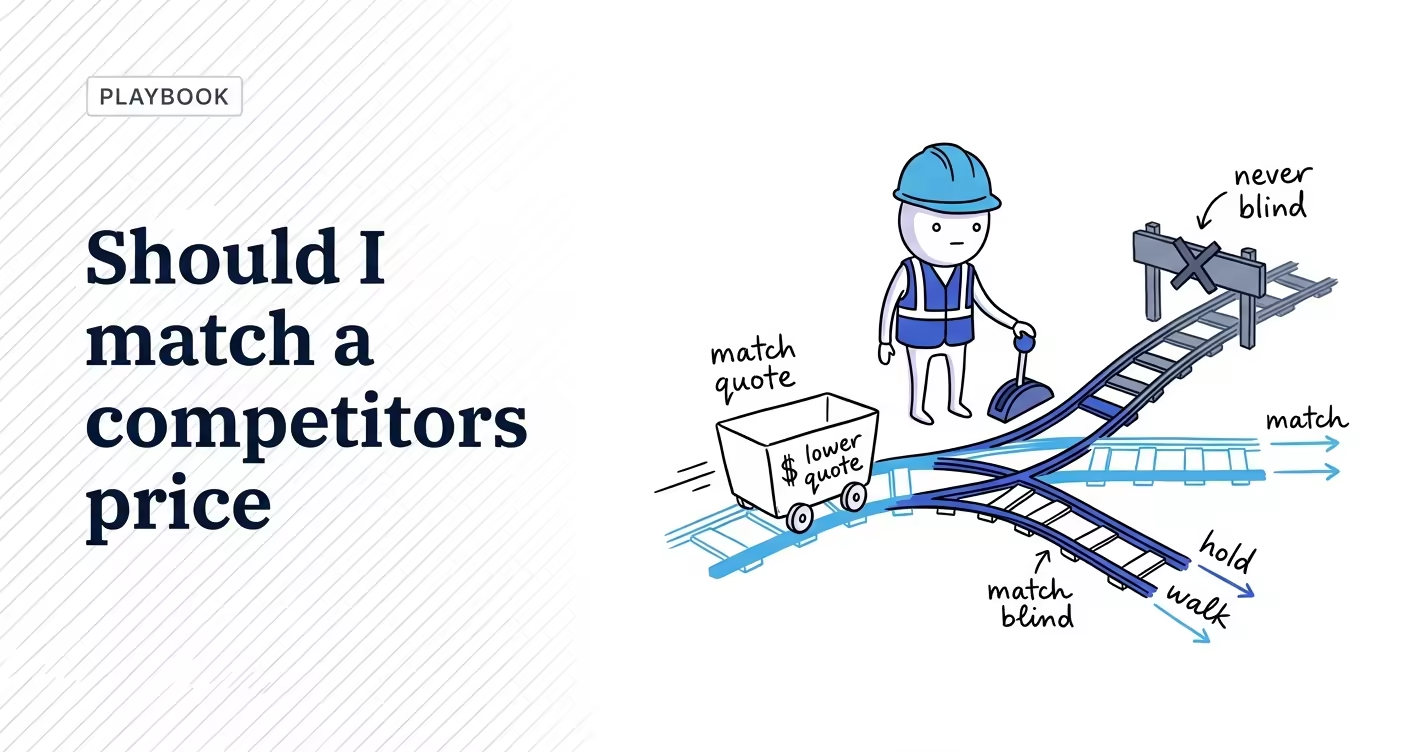
A 10% price match can wipe out half the profit on a job. Quote $10,000 on $8,000 of full cost and you stand to make $2,000. Match a $9,000 competitor and only $1,000 remains. Same crew days. Same job risk. Half the return.
Before touching the price, find out whether the written scopes really match and run the lower number through your own costs. The answer will usually be one of four things: match, hold, re-scope, or walk.
Make the two quotes comparable
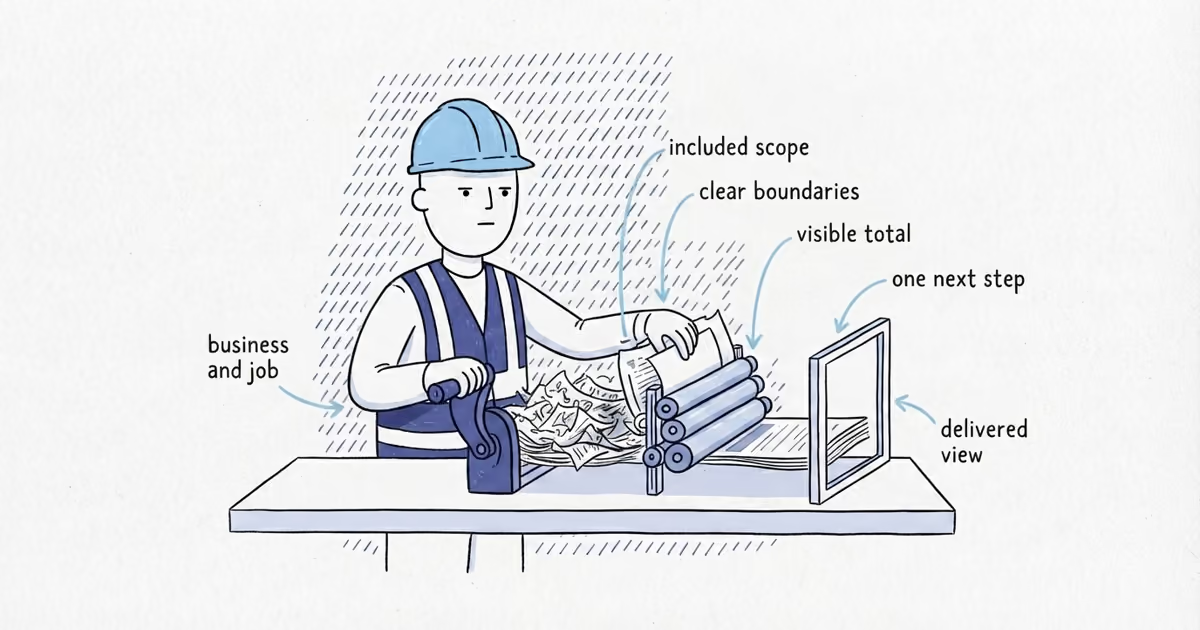
A customer may call two proposals “the same job” even when they divide responsibility differently. Compare the documents before comparing the totals.
| Check | Questions to answer |
|---|---|
| Scope | Do both quotes include the same quantities, preparation, installation, finish, cleanup, and restoration? |
| Specifications | Are the manufacturer, model, grade, efficiency, color, and allowance amounts equivalent? |
| Compliance | Who handles required permits, inspection, license, engineering, and code corrections? |
| Site cost | Are protection, access, equipment, demolition, hauling, disposal, and travel included? |
| Schedule | Are start assumptions, duration, working hours, and completion responsibilities comparable? |
| Risk | Are exclusions, concealed conditions, change orders, and price-validity terms equally clear? |
| Aftercare | What do the parts and labor warranties cover, for how long, and who handles a callback? |
| Payment | Are deposits, milestones, financing cost, retainage, card fees, and due dates comparable? |
A lower quote isn’t automatically incomplete. It may be smaller, it may allocate more work to the customer, or another business may simply be able to perform comparable work for less.
If the customer has only a verbal number, say:
“Send me the written quote and I’ll compare it with mine. Without that, I can walk you through my number, but I can’t match a price when I don’t know what it covers.”
A small discount can take a large bite
Price cuts come entirely out of profit until a real cost or scope change offsets them.
Suppose your quote is $10,000 and the full job cost is $8,000:
job profit = $10,000 - $8,000 = $2,000
job margin = $2,000 / $10,000 = 20%
The customer asks you to match a quote that is 10% lower, or $9,000:
matched profit = $9,000 - $8,000 = $1,000
matched margin = $1,000 / $9,000 = 11.1%
A 10% price cut reduced profit dollars by 50%. At the original economics, one job produced $2,000; at the matched price, you need two comparable jobs to produce the same $2,000, using twice the production capacity and taking twice the job risk.
This is why “it’s only 10%” is the wrong calculation. Rebuild the job with current cost, then show the matched price, profit dollars, margin, cash requirement, and capacity use side by side.
Four choices after the math
| Decision | Use it when | Do not use it when |
|---|---|---|
| Match | The scopes are comparable, the lower price still meets the approved economics, and you can document why the exception makes business sense | You are guessing about cost, hoping for future work, or avoiding an uncomfortable no |
| Hold | Your scope and cost are correct and the current price produces the required margin | The comparison reveals a real estimating error or unnecessary scope |
| Re-scope | The customer’s budget is real and a smaller, phased, or differently specified job still solves a defined need | The lower option would be unsafe, noncompliant, or misleadingly incomplete |
| Walk | Winning requires a price below the approved floor, unacceptable terms, or risk the price cannot support | The customer merely asked a reasonable comparison question |
This fourth option, re-scope, matters. A lower price for a smaller job is not a discount on the original promise.
The few times matching can make sense
Matching is not automatically wrong. It can be a rational decision in a limited set of cases.
Your quote contains an error
If you duplicated a line item, used the wrong quantity, or carried an old supplier price, correct it. That is not price matching; it is fixing the proposal. Withdraw or revise the quote in accordance with its terms before acceptance.
The job cost genuinely changed
Working next door may remove a mobilization cost. Combining two visits may reduce setup. The customer may take responsibility for a clearly defined item. Recalculate the job and document the reason.
The lower price still meets the approved margin
Some jobs are priced above the minimum for reasons that no longer apply. A match can be acceptable when the comparable scope still covers full cost and the required return. Record the exception so it does not silently become the new standard price.
You are making a deliberate capacity decision
An otherwise idle crew can change the short-term opportunity cost, but it does not erase rent, insurance, vehicles, office payroll, or the annual profit requirement. Check both contribution margin and full-cost recovery. Set a time limit, service, geography, or capacity condition so temporary pricing does not become permanent.
The account has measurable strategic value
Future maintenance, multiple properties, or lower acquisition and mobilization costs can matter only when they are specific enough to model. “This could lead to lots of work” is not evidence. Put the expected volume, cost-to-serve, payment history, term, and exit condition in the decision.
When not to match
- The competitor’s number is not supported by a written comparable scope.
- The matched price falls below the floor established by your cost and operating plan.
- The customer wants the original scope, warranty, schedule, and risk allocation for less money.
- The job already has uncertain access, scope, payment, or change-order risk.
- The match would violate an existing pricing agreement or create an exception the team cannot administer.
- You are relying on a referral, review, add-on, or future project that the customer has not committed to.
Never exchange a discount or anything else of value for a positive review. Keep review requests neutral and separate from price negotiation.
Four ways to answer the customer
Match
“I compared the scopes and reran the job. I can match
$[price]because [specific reason]. I’ve put the revised scope and terms in a new quote. This price is for this job only.”
Hold
“I checked the scope and our cost, and I’m staying at
$[price]. The other quote costs less. The question is whether [two or three relevant differences] matter enough to you to cover the gap.”
Re-scope
“I can’t do the original job for
$[target]. I can price a smaller version by removing [item], changing [specification], or leaving [later work] for another phase.”
Walk
“Thanks for the opportunity, but I can’t take this scope down to that price. I’m going to leave my quote where it is, and I understand if you choose the other one.”
None of these scripts attacks the other contractor or tells the customer they will regret their choice.
Put the price-match rule in writing
Even without an advertised price-match promise, team members need to know how to handle the request:
- A current written quote is required.
- Scope and terms must be normalized before price is discussed.
- The estimator recalculates cost and margin; sales team members do not improvise.
- Exceptions require approval from a named role.
- Every concession has a reason code and expiration date.
- The revised proposal identifies any scope or term change.
- Results are reviewed: close rate, profit dollars, margin, callbacks, and repeat work.
The policy prevents the answer from depending on who happened to answer the phone.
When customers have little information about either business, price becomes the easiest comparison. A clear website, relevant reviews, documented credentials, and comparable project proof give them something else to evaluate. Our free website service is designed for businesses that do not yet have that foundation.
Frequently asked questions
A loyal customer got a lower quote: should I match it for them?
Loyalty is a reason to review the decision, not a reason to skip the math. Compare the scopes and recalculate the job. If you offer a project-specific match, document the reason and expiration. A “small” add-on belongs in that calculation too; it still carries labor, material, scheduling, and warranty cost.
The competitor’s price seems too low to be real. What do I say?
Keep the accusation out of it. Say: “That’s a meaningful difference. Let’s compare the written scope, specifications, responsibilities, warranty, schedule, and payment terms.” The quote may cover different work, or the other contractor may simply be cheaper.
Isn’t walking away just handing the job to the cheaper guy?
Sometimes. You aren’t supposed to win every quote. A job below the approved floor consumes capacity without producing the required return. Record why the quote was lost and use patterns across comparable bids to improve pricing or positioning.
Sources
- pricing
- price-objections
- price-shoppers
- competing-on-value
- estimates