

When Should I Send a Statement of Account to a Customer?
Learn when to send a statement of account, reconcile invoices, payments, and credits, and clearly separate the closing balance from the overdue amount.
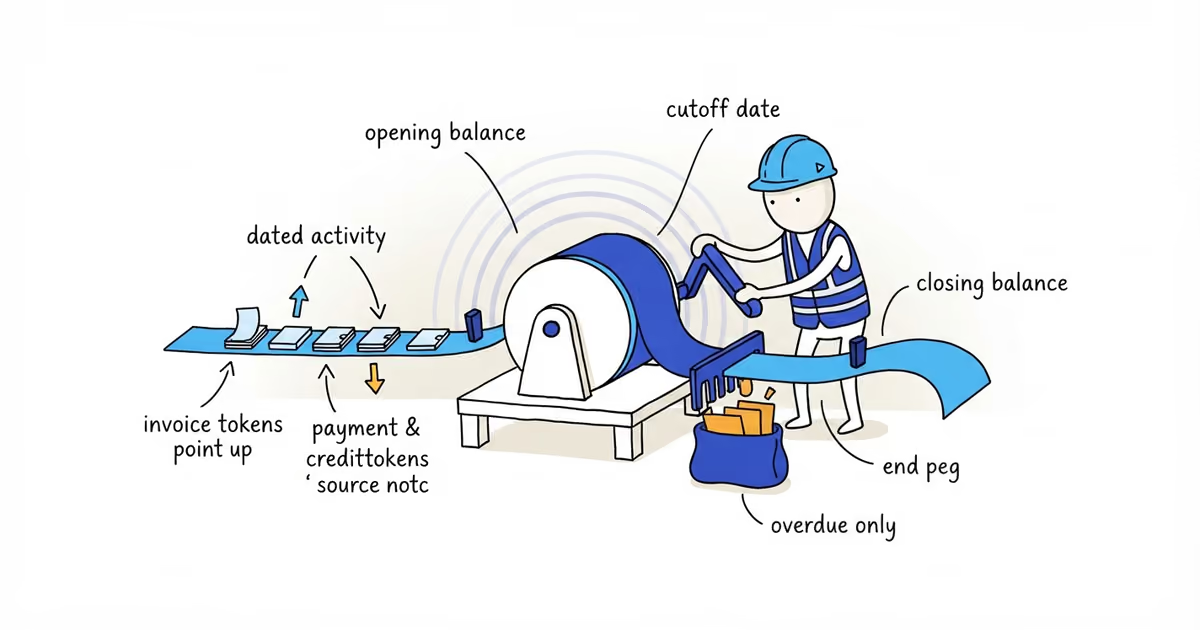
Send a statement of account when a customer needs one view of several transactions or a defined account period, and only after every invoice, payment, credit, refund, and supported adjustment through the cutoff date has been posted and reconciled. If one correct invoice already explains the charge and amount due, send the invoice instead.
An invoice requests payment for one sale or billing event. A statement summarizes the opening balance, dated account activity, closing balance, and amount already overdue; it does not replace the invoices behind those figures.
Last verified: August 25, 2026 (United States; ShiftFlow tool features).
When to send a statement of account
Choose the document from the account situation, not from a fixed monthly routine.
| Situation | Send | Condition before sending |
|---|---|---|
| Recurring customer account | Periodic statement at the agreed or established account cadence | Reconcile all activity through the period end |
| Several account transactions | Ad hoc statement | Match invoices, partial payments, and credits |
| Account closeout | Zero-balance or closeout statement when confirmation is useful | Post final activity and verify the closing position |
| One billing event | The invoice, not a statement | The invoice explains the charge, due date, and route |
| Incomplete account record | Nothing yet | Resolve the account record first |
Choose a statement end date, post supported activity through it, and verify the closing and overdue amounts. Use a regular cadence only when the account routine calls for it; otherwise send one when several transactions need reconciliation.
A statement may close with a balance, zero, or customer credit. It cannot change a due date, add a fee, correct an invoice, settle a dispute, or make an amount enforceable.
How to prepare a statement of account ledger
Start with the account record, not a blank statement. The Customer Account Reconciliation Ledger must reconstruct the period:
| Ledger part | What must agree |
|---|---|
| Account and period | Customer plus statement start and end dates |
| Opening balance | Verified prior closing balance and source |
| Dated account rows | Type, invoice/payment/credit/refund/adjustment reference, description, debit, and credit |
| Running balance | Opening balance plus each debit minus each credit |
| Closing balance | Opening balance plus total debits minus total credits |
| Amount overdue | Past-due invoices after traceable payments and credits, calculated separately |
Do not rebuild the opening balance from whichever unpaid invoices are easiest to find. Start from the verified prior close. If an earlier invoice is already inside that opening balance, adding the invoice again in the current period doubles the charge.
Next running balance = previous running balance + debit - credit
One dated row per transaction must carry its type, source reference, description, debit or credit, and resulting balance. Total movement must produce the closing balance shown on the statement.
How debits and credits change a customer statement
Invoices are debits because they increase the customer balance. Payments and credit notes are credits because they reduce it. Record a refund as a debit only when its source confirms what was returned and the account effect. Put an adjustment on one side only, using a record that states its reason, amount, reference, and direction.
Never invent either entry to force the balance. Stop when the source or account effect is unclear.
Statement closing balance vs overdue amount
The closing balance is the account position at period end. The overdue amount includes only unpaid invoice amounts past their due dates after traceable payments and credits. A new invoice can be part of the closing balance without being overdue.
Statement of account example with closing and overdue balances
These are fictional inputs, not billing norms. The statement covers August 1-31.
| Date | Type | Reference | Description | Debit | Credit | Running balance |
|---|---|---|---|---|---|---|
| Aug 1 | Opening | INV-099 | Prior balance, due July 25 | $1,200 | ||
| Aug 3 | Invoice | INV-104 | Current invoice, due August 24 | $800 | $2,000 | |
| Aug 10 | Payment | PAY-61 | Applied to INV-099 | $1,000 | $1,000 | |
| Aug 15 | Credit note | CN-07 | Applied to INV-104 | $150 | $850 | |
| Aug 20 | Invoice | INV-108 | Current invoice, due September 19 | $600 | $1,450 |
The closing-balance check is:
$1,200 + $800 - $1,000 - $150 + $600 = $1,450
Now calculate overdue amounts from the invoice records and allocations:
- INV-099 started at $1,200 and PAY-61 reduced it by $1,000, leaving $200 overdue.
- INV-104 was due August 24, and CN-07 reduced $800 by $150, leaving $650 overdue.
- INV-108 is not due until September 19, so its $600 is current, not overdue.
The amount overdue at August 31 is $200 + $650 = $850. The $1,450 closing balance is therefore $850 overdue plus $600 current.
How to fix a statement of account that does not reconcile
| Problem | Required action |
|---|---|
| Payment has no invoice allocation | Match it to the receipt and invoice before calculating overdue |
| Invoice or credit note is missing | Find the source document; do not recreate it on the statement |
| Transaction appears twice | Keep one supported row and remove the duplicate |
| Refund or adjustment lacks support | Remove it until the source and account direction are confirmed |
| Opening balance differs from prior close | Reconcile the previous period first |
| Debits and credits miss the closing balance | Trace dates, amounts, sides, and duplicate rows |
| Overdue amount lacks due-date support | Rebuild it from invoices and payment or credit allocations |
An expected payment, promised credit, unissued invoice, or unexplained correction is not account activity yet.
When to use a statement of account generator
After the ledger and overdue amount agree, the Statement of Account Generator can format the statement period, opening and overdue balances, business and customer details, and dated invoice, payment, credit, refund, and adjustment entries. It displays debit and credit columns, calculates running balances, totals, and closing balance, and provides a preview, print option, and PDF. It does not decide whether an entry is valid.
Before sending, confirm that:
- The customer and statement period are correct.
- The opening balance traces to the prior close.
- Every row has a date and source reference.
- Debits and credits reproduce the closing balance.
- The overdue amount traces to past-due invoices after allocations.
- No unsupported, unexplained, or duplicate entry remains.
- The customer can identify the invoices, payments, and credits behind the balance.
When every check passes, save the statement with the supporting records and send it through the customer’s document channel.
Frequently asked questions
Should a statement of account include invoices that are not overdue?
Yes, when they fall within the statement period or account view. Include them in the closing balance, but keep the amount overdue limited to unpaid invoice amounts whose due dates have passed.
Can I correct an invoice on a statement of account?
No. Correct the source invoice through the appropriate documented invoice correction or credit note, then add that supported transaction to the statement. Do not change an issued invoice by editing only the statement.
Can a statement of account show a customer credit balance?
Yes, when the verified payments and credits exceed the debits on the account. Show the resulting credit balance clearly and do not label any part of it overdue.
Sources
- ShiftFlow Statement of Account Generator, current tool configuration and implementation.
- pricing
- when-to-send-statement-of-account-to-customer
- when-to-send-a-statement-of-account
- customer-statement-of-account
- statement-of-account-example
- invoice-vs-statement-of-account
- statement-closing-balance



