When Should I Stop Paying for a Lead Source?
Decide when to stop paying for a lead source by separating lead quality from response problems, then checking close rate, job gross profit, and source spend.
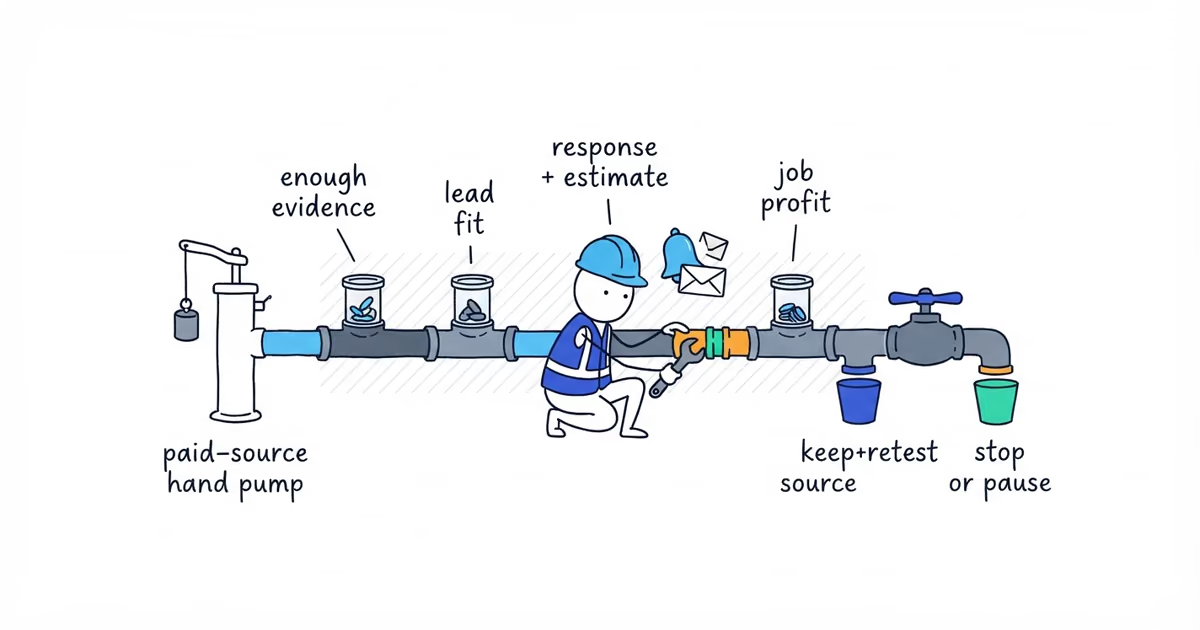
You should stop paying for a lead source when you have enough comparable leads to judge it, your normal response and estimating process has had a fair test, and the completed jobs still do not produce enough gross profit to justify the source spend.
Do not cancel after one awful lead or keep paying because one large job rescued the month. Diagnose the leads, your handling process, and the job economics.
Use this rule:
| What the evidence shows | Decision |
|---|---|
| The leads fit, the normal process was followed, and completed jobs leave acceptable gross profit after source spend | Keep |
| Qualified leads are being lost through missed calls, slow replies, weak estimating, or inconsistent follow-up | Fix and retest |
| Lead quality or job economics remain unacceptable after a fair test and one relevant retest | Stop or pause |
| Too few comparable leads have completed the full sales and payment cycle | Not enough evidence |
That last result needs a spend limit and another review date. “More data” is not permission to pay forever.
How long to test a paid lead source
There is no honest universal test of 30 days, 20 leads, or five jobs. Different services do not move from inquiry to collected payment on the same schedule.
Give leads time to move from inquiry to collected job. Base the window on usual lead volume, decision time, production schedule, and meaningful seasonality. Write down:
- the service and territory being tested;
- the maximum test spend;
- the next review date; and
- what will count as a qualified lead, estimate, won job, and direct job cost.
The U.S. Small Business Administration recommends tracking marketing costs, measuring consistently, and setting a review date. If you change the service, territory, offer, and follow-up halfway through this test, you will not know what produced the result.
One or two frustrating inquiries are not a useful sample. If the review date arrives before multiple comparable leads finish the cycle, mark the result inconclusive. Run one capped extension or pause because the volume is too low to judge within your loss limit.
What to track for each lead source
Ignore dashboard clicks and open-estimate value. Record what happened inside your business.
| Scorecard field | What it helps you see |
|---|---|
| Source spend | What the test actually cost |
| Total leads | How many attributable inquiries arrived |
| Qualified leads | Whether inquiries fit the service, area, and customer need |
| Response time and missed contacts | Whether your team gave those leads a fair chance |
| Estimates sent | Whether qualified inquiries reached a real buying step |
| Jobs won | What became scheduled work |
| Collected job revenue | What customers actually paid |
| Direct job costs | What it cost to deliver those jobs |
| Job gross profit and source spend | Whether the work could carry its acquisition cost |
Use the same definitions for the whole window. A lead should not become “unqualified” after rejecting an estimate. Mark quality from observable facts: wrong service or territory, duplicates, spam, invalid contact details, or mismatched work.
How to decide whether a lead source is working
1. Do you have enough leads to judge the source?
Confirm that leads share a source, service, territory, and comparable period, then let recent leads finish the cycle. A thin sample gets Not enough evidence, not a forced answer.
2. Are the paid leads a fit for your business?
Look at the qualified leads, not just the lead count. Repeated wrong-service requests, out-of-area jobs, duplicates, spam, or unusable contact details point to a source-quality or targeting problem.
A person who does not buy is not automatically a bad lead. A late reply, weak estimate, unclear next step, or wrong price belongs in the process check.
3. Did your response and estimate process get a fair test?
Review first-response time, missed-contact attempts, estimates sent to qualified leads, and normal follow-up.
Estimate rate and close rate are diagnostic signals. Compare them with your own recent results or another source handled under similar conditions, not an online benchmark from a different business.
If qualified leads go unanswered or never reach an estimate, fix that step first. Change one factor, such as response ownership, then run one capped retest while keeping source settings and tracking stable where practical.
Use the separate guides for the full cost-per-estimate and close-rate calculations. This decision only needs their results and what changed between comparable periods.
4. Did the jobs cover the lead source cost?
Define job gross profit here as collected revenue from completed jobs minus consistently classified direct job costs. Then subtract source spend. Classifications vary, so use your normal method instead of copying another company’s margin.
Booked revenue and unpaid invoices do not prove the source works. Judge what completed, collected work left after direct job costs and acquisition spend. Use the separate lead-source ROI guide for the full calculation.
Paid lead source decision example
These are hypothetical inputs, not benchmarks.
A painting business spends $1,200 on one source during its planned window. It records 14 leads, 11 of which match its service and territory. Five qualified leads wait until the next day for a first response, six receive estimates, and two become completed, collected jobs. Those jobs produce $2,500 in job gross profit before marketing, leaving $1,300 after the source spend.
The leads mostly fit and the work covered the spend, but delayed responses spoiled the process test. The decision is Fix and retest: assign response ownership, cap the source, and review the same scorecard at the pre-set date. Canceling would blame a known handling problem; calling it a keeper would lean too heavily on two jobs.
What to do before canceling a lead source
If the evidence reaches Stop or pause:
- Export the lead and customer records you are allowed to retain.
- Preserve the source on each customer record so later payments are still attributable.
- Check the provider’s contract, notice period, and cancellation terms.
- Record the final review window and reason for the decision.
- Decide whether the budget stays paused or moves to a separate, planned test.
Allow another window only when you can name the process problem, single change, spend limit, and next review date. Otherwise, enough poor-fit leads or weak gross profit is the signal to stop paying.
Frequently asked questions
Should I stop buying leads if my close rate is low?
Not automatically. First check whether the leads fit, whether your team responded consistently, and whether qualified leads received estimates and normal follow-up. A low close rate tells you where to investigate; it does not identify the cause by itself.
Why am I getting bad leads from lead sites?
Tag the observable problem on each inquiry: wrong service, outside territory, duplicate, spam, invalid contact details, or mismatched work. Also check your missed calls and response delays before blaming the source for every lead you could not reach.
How fast should I respond to paid leads?
Respond as soon as your operating setup reliably allows, but do not use an outside speed claim as the pass mark for this decision. Record actual response time and compare the source under the same response process during the next review window.
Sources
- pricing
- when-to-stop-paying-for-lead-source
- when-should-i-stop-paying-for-a-lead-source
- when-to-cancel-a-lead-source
- bad-leads-from-lead-sites
- lead-source-roi
- paid-lead-close-rate