Best Time Tracking Software for Electrical Contractors in 2026
Compare the 8 best time tracking apps for electrical contractors in 2026, scored on license-hierarchy tagging, apprentice-to-journeyman ratios, specialty cert tracking, IBEW fringe allocation, AIA billing, and the real bill for a 20-electrician shop.

Electrical time tracking is not one problem — it’s three, stacked inside the same company. A small-to-mid electrical contractor is often running residential service calls, small commercial tenant-improvement projects, and new-construction prewire simultaneously. Each workstream has its own cadence: service is per-ticket, projects are per-milestone with rough-in and trim-out phases, new-construction is daily hours against a cost code. On top of that, electrical contracts carry a license hierarchy that construction and plumbing don’t enforce as strictly: apprentice, journeyman, master, with prevailing-wage and union jobs enforcing apprentice-to-journeyman ratios set by the approved apprenticeship program (commonly 1 apprentice per 3 journeymen on IBEW inside agreements).
The three product categories that try to solve this pull in different directions. Field service management tools (Jobber, Housecall Pro) are built for residential service and don’t handle multi-day commercial projects well. Construction-focused time trackers (Workyard, ExakTime) are built for project cost codes and prevailing wage but are thin on residential service. Electrical-native platforms (Knowify, Simpro) handle AIA progress billing and project job costing but cost several times more than pure time trackers.
This guide compares 8 apps that small and mid-sized electrical contractors are actually using in 2026, scored on license-level tagging, apprentice-to-journeyman ratio tracking, specialty cert management, IBEW fringe allocation, arc-flash PPE logs, permit milestone tracking, AIA billing support, and the real monthly bill for a 20-electrician shop.
Best time tracking software for electrical at a glance
| Brand | License-Level Tag | Specialty Cert Tracking | AIA Progress Billing | Best For | Starting Price |
|---|---|---|---|---|---|
| ShiftFlow | Via job codes | ✗ | ✗ | Mixed-workstream small-to-mid electrical contractors | $5.99/user/mo |
| Knowify | ✓ | ✓ | Native | Electrical contractors doing AIA progress billing to GCs | From $99/mo (annual) |
| Simpro | ✓ | ✓ | ✓ | Commercial electrical and combined mechanical-electrical | Quote-based |
| Workyard | ✓ | License fields | ✗ | Prevailing-wage and public-works electrical projects | $6/user/mo + $50 base |
| Jobber | Tech profile | Tech profile | ✗ | Residential service-call electrical shops | From $21/mo (annual, 1 user) |
| Connecteam | User field | Training logs | ✗ | Small electrical teams needing arc-flash and OSHA training | Free up to 10; from $29 |
| Buddy Punch | User field | ✗ | ✗ | Compliance-heavy shops with complex IBEW PTO rules | $5.49/user/mo + $19 base |
| QuickBooks Time | User field | ✗ | Via add-on | Electrical shops already running QuickBooks Online + Payroll | $8/user/mo + $20 base |
How we picked
Electrical time tracking is different from construction or field service because the same company often runs three workstreams in parallel, and the license hierarchy is enforced more strictly than in adjacent trades. We weighted eight criteria:
- License-level tag per punch: apprentice, journeyman, or master on every clock-in
- Apprentice-to-journeyman ratio tracking: real-time compliance view for prevailing-wage jobs
- Specialty cert management: NABCEP (solar), BICSI (low voltage), NICET (fire alarm is the most common track for electrical), state EV charger certs
- IBEW union fringe allocation: per-hour contributions for health & welfare, pension, apprenticeship funds
- Arc-flash PPE job-briefing log: NFPA 70E job-briefing attendance and PPE check records
- Permit milestone tracking: hours allocated to rough-in, trim-out, and final inspection phases
- AIA progress billing for GC subs: schedule-of-values percent-complete billing
- Multi-workstream handling: one tool across service, project, and new-construction work
Prices reflect publicly listed plans as of April 2026. Quote-based and per-tier pricing can vary; check the vendor’s pricing page before committing.
ShiftFlow
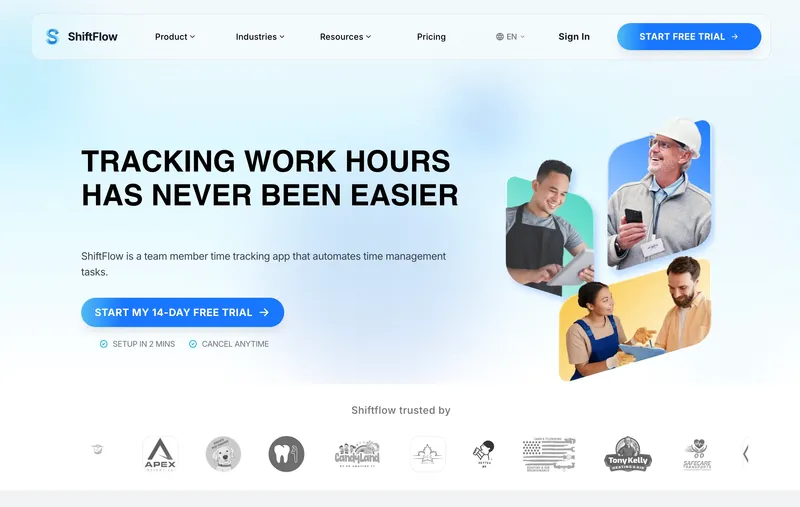
ShiftFlow handles the part of electrical work that generalist FSM tools and construction payroll tools each do only halfway — the time clock itself. Across residential service, commercial project work, and new-construction prewire, one set of job codes keeps the hours allocated correctly at $5.99 per seat flat with no base fee. License level can be encoded into job codes or user groups so that the Friday timesheet export shows which hours came from which classification, useful for prevailing-wage payroll reconciliation. GPS geofencing at each site, offline mode for new-construction sites with poor signal, and kiosk mode for gated projects are included. AIA progress billing, NABCEP and NICET cert expirations, and native IBEW fringe calculation live in the electrical-specific platforms and construction-payroll tools further down this list — ShiftFlow pairs with whichever of those you already use for billing and payroll. For a 20-electrician contractor running mixed work, the time-tracking layer alone is $119.80/month.
Best for: Small-to-mid electrical contractors (5 to 50 electricians) running a mix of residential service, small commercial projects, and new-construction prewire.
Pricing
| Plan | Price |
|---|---|
| Monthly | $5.99/user/month |
| Annual | $60/user/year (saves ~17%) |
Free trial: 14 days, no credit card required.
Ratings
- Apple App Store: ⭐⭐⭐⭐⭐ 4.8/5
- Google Play: ⭐⭐⭐⭐⭐ 4.8/5
Knowify

Knowify is the most electrical-native tool on this list. It was built for specialty trade contractors — electrical, plumbing, HVAC, framing — with the job-costing and AIA progress billing workflow at the center of the product. For an electrical contractor whose revenue is mostly new-construction or commercial-project work billed to a general contractor against a schedule of values, Knowify’s AIA application-for-payment workflow pays back on its own. Time tracking is per-project with license-level tags, WIP reporting is built in, and the QuickBooks two-way sync is tight. The trade-off is that Knowify is weaker on the residential service side — if 30% or more of your work is service-call electrical, you’ll still want a separate dispatch tool like Jobber alongside it.
Best for: Electrical contractors whose revenue mix is primarily new-construction or commercial-project work billed to GCs via AIA progress billing.
Pricing
| Plan | Price |
|---|---|
| Core | From $99/month (annual, 1 user) |
| Advanced | From $249/month (annual) |
| Enterprise | Custom pricing |
Per-user add-on pricing is quote-based in 2026. Free trial: Available via Knowify.
Ratings
- Capterra: ⭐⭐⭐⭐⭐ 4.5/5
- G2: ⭐⭐⭐⭐ 4.5/5
- Apple App Store: ⭐⭐⭐⭐ 4.3/5
Simpro

Simpro targets commercial electrical and mechanical contractors — the kind of shops bidding tenant-improvement projects, data center builds, or combined M&E scopes. Project management, quoting, scheduling, service work, and time tracking are all in one platform, and the job-costing engine handles the complexity of multi-phase electrical work (rough-in, trim-out, commissioning) better than generic FSM tools. When I tested Simpro against Knowify, the split was clear: Knowify wins on AIA billing for smaller specialty-trade subs, Simpro wins on project management depth for larger commercial scopes. The trade-off is cost and complexity. Simpro is quote-based and priced for teams of 15 and up; implementations take weeks.
Best for: Commercial electrical contractors (20+ electricians) bidding tenant-improvement, data center, or combined mechanical-and-electrical projects.
Pricing
Quote-based. Per-user monthly pricing with implementation and training included. Minimum team sizes apply; check the vendor for current rates.
Ratings
- G2: ⭐⭐⭐⭐ 4.2/5
- Capterra: ⭐⭐⭐⭐ 4.0/5
- Apple App Store: ⭐⭐⭐⭐ 4.3/5

Workyard
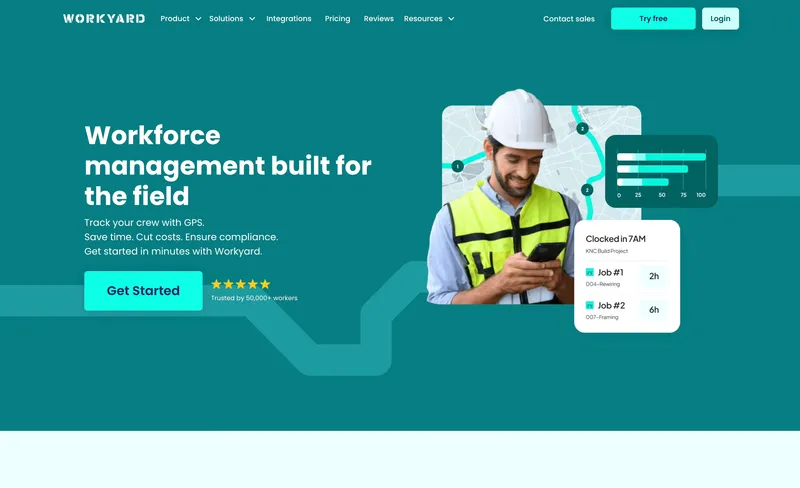
Workyard was covered in our construction and plumbing roundups for the same reason it lands here: it has the deepest prevailing-wage and certified-payroll workflow outside of enterprise construction payroll. For electrical contractors doing public-works jobs, Davis-Bacon work, or union prevailing-wage projects, Workyard’s license-level tags and cost-code auto-assignment make the certified-payroll reporting cleaner than almost anything else at this price. Pricing is $6/user plus a $50 monthly base fee; the fit is strongest for shops where prevailing-wage work is a significant share of revenue and the certified-payroll workflow earns back the extra cost.
Best for: Electrical contractors with 20+ electricians whose revenue mix leans toward prevailing-wage and public-works projects.
Pricing
| Plan | Price (annual billing) |
|---|---|
| Starter | $6/user/month + $50 base |
| Pro | $13/user/month + $50 base |
Monthly billing runs higher (Starter $8, Pro $16 per user). Free trial: 14 days.
Ratings
- Apple App Store: ⭐⭐⭐⭐ 4.1/5
- Google Play: ⭐⭐⭐⭐ 4.0/5
- Capterra: ⭐⭐⭐⭐⭐ 4.7/5
Jobber
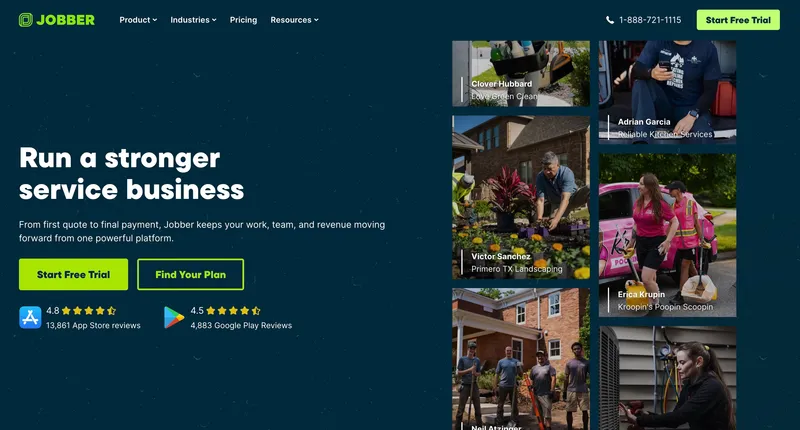
Jobber is the FSM tool most residential electrical shops evaluate first. It handles the service-call workflow end-to-end — customer CRM, scheduling, dispatch, quoting, invoicing, and per-ticket time tracking — with a polished mobile app that technicians adopt quickly. For a residential electrician running panel upgrades, fixture installs, outlet repairs, and EV charger installs out of a truck, Jobber’s per-ticket time tracking is good enough that a separate time clock isn’t needed. What’s missing is everything on the project side: no AIA billing, no prevailing-wage workflow, no multi-phase project tracking. If 30% or more of your revenue is commercial or new-construction work, you’ll outgrow Jobber on the project side.
Best for: Residential electrical shops with 3 to 25 electricians who do mostly service calls and small residential projects.
Pricing
| Plan | Price (annual billing) |
|---|---|
| Core | $21/month (1 user) |
| Connect | $70/month (up to 5 users, +$29/add’l) |
| Grow | $105/month (up to 10 users, +$29/add’l) |
| Plus | $371/month (up to 15 users, +$29/add’l) |
Monthly billing runs higher (Core $49, Connect $139, Grow $199, Plus $699). Free trial: 14 days.
Ratings
- Apple App Store: ⭐⭐⭐⭐⭐ 4.8/5
- Google Play: ⭐⭐⭐⭐ 4.5/5
- Capterra: ⭐⭐⭐⭐⭐ 4.5/5
Connecteam
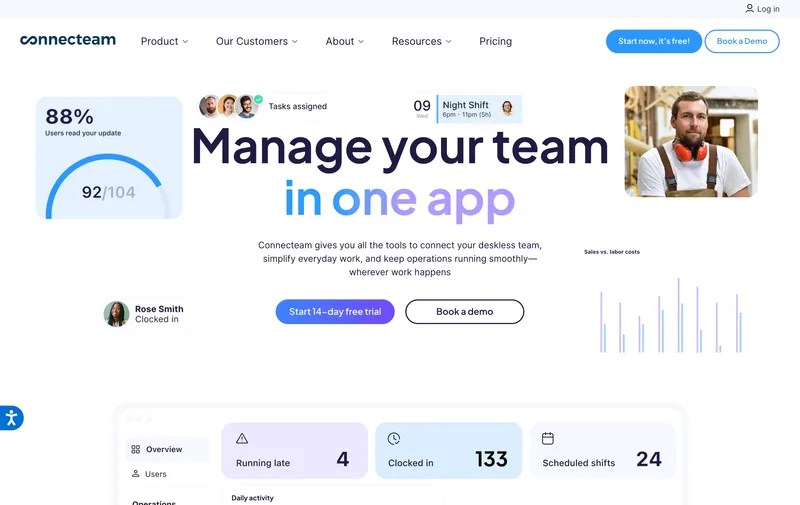
Connecteam is a deskless workforce platform with a solid time clock underneath. For electrical specifically, the value shows up in the safety and training modules that adjacent trades care less about: arc-flash job-briefing checklists (NFPA 70E), lockout/tagout procedure delivery, annual OSHA refresher training, and incident reporting. The free plan for up to 10 users is unusually generous — a small electrical shop can stand up safety briefings, training logs, checklists, and a time clock for $0. What’s missing is any real project or job-costing workflow. Connecteam knows hours by day, not hours by AIA schedule-of-values or permit milestone. For a small shop where safety and training are pressing needs and project billing is handled elsewhere (or doesn’t apply), it fits.
Best for: Small electrical shops (5 to 30 electricians) who weight safety training, arc-flash checklists, and OSHA documentation alongside time tracking.
Pricing
| Plan | Price |
|---|---|
| Small Business (up to 10) | Free (all features) |
| Basic (up to 30) | From $29/month per hub |
| Advanced (up to 30) | From $49/month per hub |
| Expert (up to 30) | From $99/month per hub |
Ratings
- Apple App Store: ⭐⭐⭐⭐⭐ 4.9/5
- Google Play: ⭐⭐⭐⭐⭐ 4.7/5
- Capterra: ⭐⭐⭐⭐⭐ 4.6/5
Buddy Punch
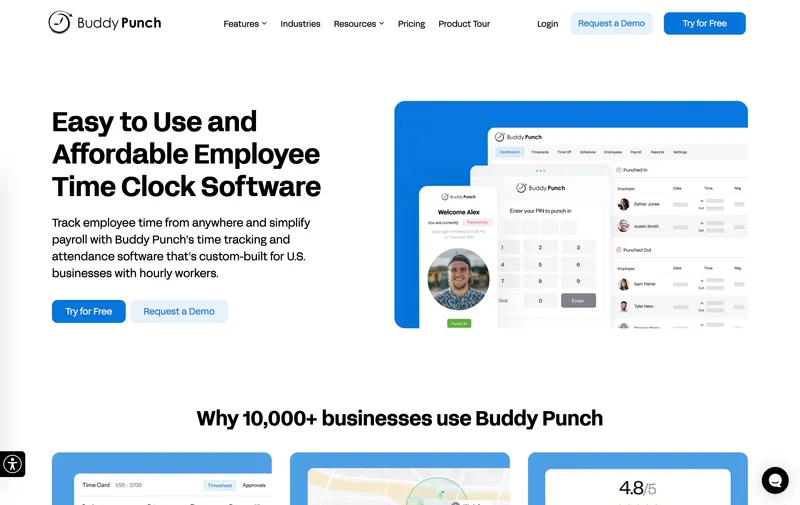
Buddy Punch’s strength for electrical is its pay-rule engine. IBEW local contracts allocate different per-hour contributions to health & welfare, pension, annuity, apprenticeship funds, and working dues — with rates that vary by local and by classification (apprentice, journeyman, foreman). Buddy Punch’s custom pay rules can model the accrual depth more cleanly than most competitors, which matters when your payroll provider applies the fringe rates downstream. PTO accrual is equally deep — tenure-based multipliers for senior journeymen, state-specific sick leave, classification-based differentials. The limitation that bites for electrical specifically: no true offline clock-in (drops punches on new-construction sites with no signal) and no license-ratio compliance view.
Best for: Small-to-mid electrical shops (5 to 30 electricians) with IBEW-union payroll or complex state-level overtime rules, running jobs with consistent cell service.
Pricing
| Plan | Monthly | Annual |
|---|---|---|
| Starter | $5.49/user + $19 base | $4.49/user + $19 base |
| Pro | $6.99/user + $19 base | $5.99/user + $19 base |
| Enterprise | $11.99/user + $19 base | $10.99/user + $19 base |
Ratings
- Apple App Store: ⭐⭐⭐⭐⭐ 4.9/5
- Google Play: ⭐⭐⭐⭐ 4.5/5
- Capterra: ⭐⭐⭐⭐⭐ 4.8/5
QuickBooks Time
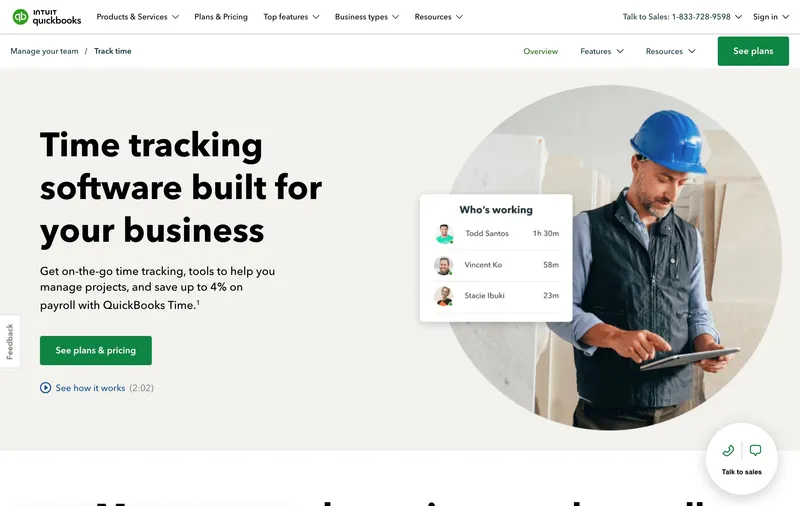
QuickBooks Time (formerly TSheets) has one clear advantage for electrical contractors already deep in QuickBooks: native two-way sync with QuickBooks Online and QuickBooks Payroll. QuickBooks Online Advanced supports generic progress invoicing against an estimate, which is not the same as a true AIA G702/G703 pay application with retainage tracking — most QBO shops doing AIA bolt on a third-party tool like Knowify, Werx, or Cloud-PM for the schedule-of-values workflow. What pairing QuickBooks Time with QuickBooks does well is eliminate the manual labor-hour export each pay period. The feature gaps show up on the construction and specialty-trade side: no license-level tags, no specialty-cert tracking, no IBEW fringe modeling. For a shop running QuickBooks Payroll and just needing a labor-hour feed, it fills the gap cleanly.
Best for: Small-to-mid electrical shops already using QuickBooks Online and QuickBooks Payroll who need a simple labor-hour feed, not a construction-specific billing suite.
Pricing
| Plan | Price |
|---|---|
| Premium | $8/user/month + $20/month base |
| Elite | $10/user/month + $40/month base |
Included free with QuickBooks Payroll Premium or Elite. 30-day free trial.
Ratings
- Apple App Store: ⭐⭐⭐⭐⭐ 4.7/5
- Google Play: ⭐⭐⭐⭐ 4.1/5
- Capterra: ⭐⭐⭐⭐⭐ 4.7/5
How to choose the best electrical time tracking software
The decision comes down to three questions: what’s your revenue mix, how much of your work is union or prevailing-wage, and how important is AIA progress billing.
Revenue mix. If 70% or more of your revenue is residential service calls, the FSM-first tools (Jobber, Housecall Pro) win — per-ticket tracking and customer CRM outweigh project features you don’t need. If 70% or more is commercial or new-construction project work, the project-first tools (Knowify, Simpro, Workyard) win because AIA billing and multi-phase job costing compound value over time. If your mix is genuinely split, ShiftFlow’s flat pricing and flexible job codes make it easier to cover both with one tool — just plan to pair it with a separate billing solution for AIA if you do any.
Union or prevailing-wage weight. If IBEW contracts or Davis-Bacon jobs are material to your revenue, you need license-level tags per punch plus certified-payroll reporting. Workyard and Knowify handle this natively. ShiftFlow and Buddy Punch can model it through custom fields and pay rules but require setup work. Generic time clocks (Jobber, Housecall Pro without construction add-ons) are not the right fit here.
AIA billing need. If you regularly invoice a GC against a schedule of values with percent-complete progress billing, Knowify or Simpro will save more office hours than any cheaper time tracker. If your billing is mostly direct-to-customer or you handle AIA through a third-party add-on layered onto QuickBooks, the pure time trackers (ShiftFlow, Buddy Punch, QuickBooks Time) are 2 to 4x cheaper.
Real monthly bill for a 20-electrician shop
| Tool | Monthly bill for 20 electricians |
|---|---|
| Connecteam Basic (one hub, up to 30) | $29 |
| ShiftFlow | $119.80 |
| Buddy Punch Starter (monthly) | $128.80 |
| Connecteam Basic (all three hubs) | $87 |
| Workyard Starter | $170 |
| QuickBooks Time Premium | $180 |
| Knowify (20 users) | Quote-based (Core plan starts at $99/mo, 1 user) |
| Jobber Grow (20 users, annual) | $395 |
| Simpro | Quote-based, typically $1,000+ |
Project tools (Knowify, Simpro, Workyard) bundle AIA billing, job costing, or certified-payroll reporting, which shifts how the value compares against pure time trackers.
Best electrical time tracking software by use case
- Mixed workstream (service + project + new-construction): ShiftFlow
- AIA progress billing to GCs: Knowify
- Commercial electrical and combined M&E projects: Simpro
- Prevailing-wage and public-works projects: Workyard
- Residential service-call electrical shops: Jobber
- Arc-flash and OSHA training depth: Connecteam
- Complex IBEW fringe and PTO rules: Buddy Punch
- Already running QuickBooks Online + Payroll: QuickBooks Time
Final recommendation
Best Overall for Mixed-Workstream Small-to-Mid Electrical Shops: ShiftFlow. Flat $5.99/seat with no base fee, GPS geofencing, offline mode, and a single job-code framework across service, project, and new-construction work. Best when you don’t want to stand up a separate tool for each workstream.
Best for AIA Progress Billing and Project Electrical Work: Knowify. Deepest schedule-of-values workflow, WIP reporting, and license-aware job costing. Core plan from $99/month (annual, 1 user); per-user add-on pricing is quote-based in 2026.
Best for Prevailing-Wage and Public-Works Electrical: Workyard. Native license-level tags, cost-code auto-assignment, and certified-payroll reporting for Davis-Bacon jobs. $6/user + $50 base.
Ready to see ShiftFlow in action? Start your 14-day free trial today. No credit card required.
Frequently asked questions
What is the best time tracking software for an electrical contractor?
For small-to-mid electrical contractors running a mix of residential service, commercial projects, and new-construction prewire, ShiftFlow is the best overall pick because it pairs flat $5.99 per seat pricing with a single job-code framework that covers all three workstreams. For project-heavy shops that need AIA progress billing, WIP reporting, and native license-level tagging against a GC contract, Knowify is the electrical-native leader. Simpro fits commercial electrical contractors with large mechanical-and-electrical project scopes.
How do electrical contractors track apprentice-to-journeyman ratios on prevailing-wage jobs?
Prevailing-wage and union jobs set apprentice-to-journeyman ratios through the approved apprenticeship program — commonly 1 apprentice per 3 journeymen for IBEW inside agreements, though job-site ratios and state rules vary. Apprentice hours worked above the allowed ratio must be paid at the journeyman rate. The time tracking tool needs to tag each punch with the worker license level (apprentice, journeyman, master) so the office can see in real time whether the ratio is compliant before an inspector shows up. Workyard ships native license-level tagging, Knowify tracks it through the job-cost workflow, and Simpro models it in the project hierarchy. Other time trackers typically handle this by convention — encoding the license level into a job code or user group — which gives you the classification tagging for payroll export and historical reconstruction, without a live compliance dashboard.
Can time tracking software track specialty electrical certifications like NABCEP or NICET?
Some tools do, most do not. NABCEP (solar PV), BICSI (low-voltage cabling), and NICET (fire alarm is the most common track for electrical) all have expiration dates and renewal requirements that gate which electricians can do which work. Knowify, Simpro, and Workyard have technician profile fields for certifications with expiration alerts. ShiftFlow, Connecteam, Buddy Punch, and QuickBooks Time do not ship specialty-cert tracking natively; you would track those in a separate HR tool or spreadsheet.
How do time tracking apps handle IBEW union fringe benefits?
IBEW contracts allocate per-hour contributions to health & welfare, pension, annuity, apprenticeship funds, and working dues, with different rates by local and by classification (apprentice, journeyman, foreman). The time tracking tool exports hours tagged with the right classification so the payroll system can apply the correct fringe rates. Workyard and Knowify support this natively; Buddy Punch models it through custom pay rules. Other time trackers export hours by user with classification tagging handled through user groups or job codes, which is enough to feed a specialized construction-payroll tool where the actual IBEW fringe calculation happens.
What does time tracking software cost for an electrical contractor with 20 electricians?
At April 2026 pricing for 20 electricians: Connecteam Basic $29 (one hub) or $87 (all three hubs), ShiftFlow $119.80, Buddy Punch Starter $128.80, Workyard Starter $170 (annual billing), QuickBooks Time Premium $180, Jobber Grow around $395 annual (10 users included plus $29 per additional user). Knowify and Simpro are tier or quote-based; check the vendor for current rates. FSM and project tools include CRM, estimating, and AIA billing, which shifts how the value compares against pure time trackers.
What is the best free time tracking app for a small electrical business?
Connecteam offers the strongest free plan for electrical: up to 10 users get full access to GPS clock-in, geofencing, arc-flash job-briefing checklists, scheduling, and team chat at $0. It does not include AIA billing or specialty-cert tracking, so you will need separate tools for those. Homebase is another free option for single-location electrical shops with up to 10 team members.
- electrical
- electrical-contractors
- time-tracking
- time-clock-software
- prevailing-wage
- ibew
- aia-billing
- software-comparison