How Philippine Construction Companies Track Worker Hours On-Site
How Philippine construction companies track worker hours on-site in 2026. Foreman workflow, multi-site rotation, weather delays, DOLE compliance, and tools.

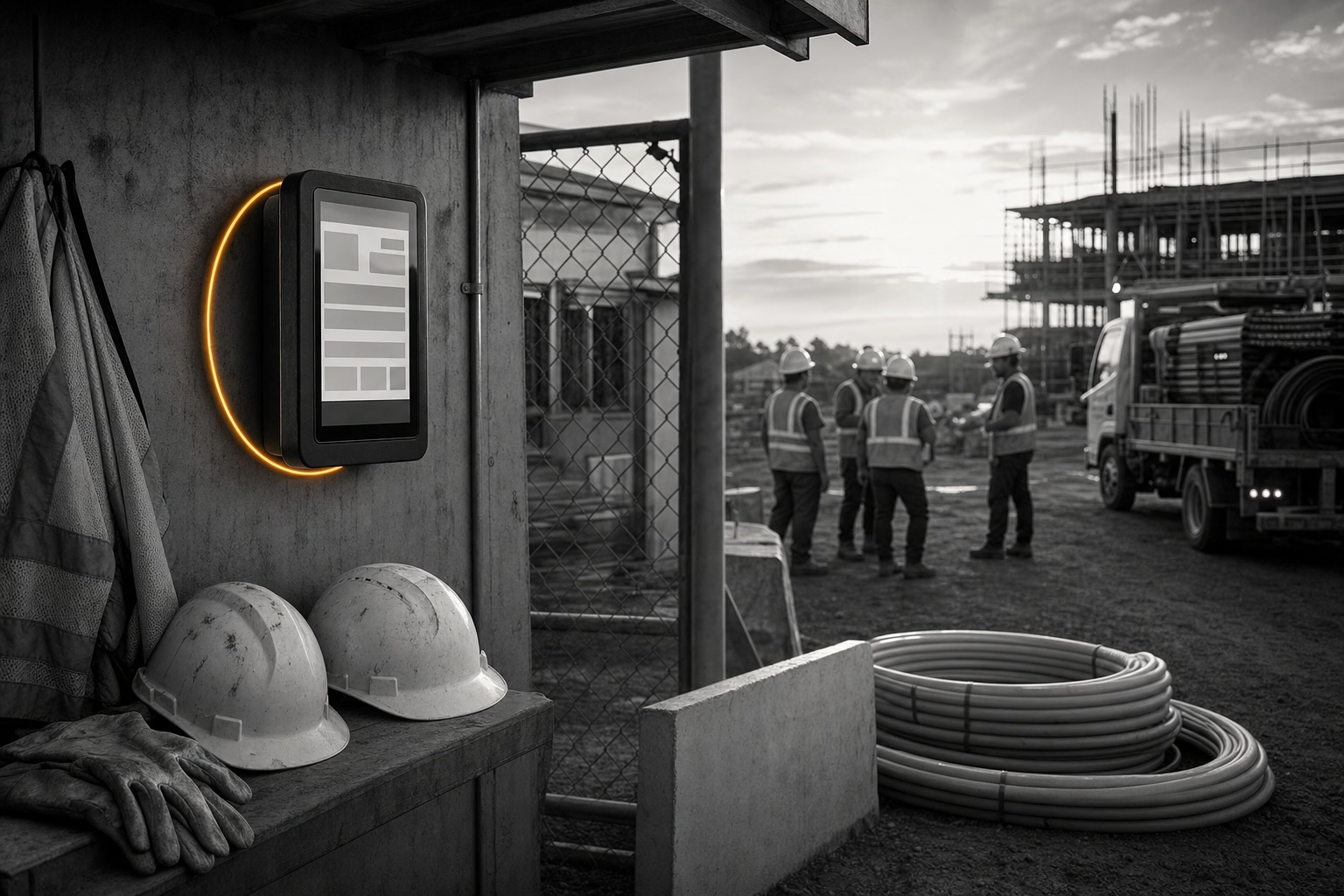
Friday 6:30am, Cavite. The foreman at a residential GC’s two-site project drops 38 paper time cards on his pickup’s dashboard, drives to the office in Bacoor, hands them to the bookkeeper, and disappears back to site. By Monday, half the cards have a smudged column or a missing initial. By Wednesday, payroll is wrong for at least two workers. The GC owner is reconciling a WhatsApp screenshot against a foreman who is now installing tile at the next project. This is how most Philippine construction crews still track worker hours in 2026. It is also why this post exists. Below is how the workflow actually breaks, what construction-specific time tracking has to do differently, and the tools that hold up on a real PH job site.
Where the manual workflow breaks down
Five points in the typical PH GC’s payroll flow generate most of the errors and disputes.
Site-to-office handoff. A foreman who is also operating equipment, supervising 8 to 15 workers, and managing materials deliveries is not a reliable timesheet clerk on top of all that. Paper time cards lose entries, get rained on, or never make it to the office at all. The bookkeeper backfills from memory or a WhatsApp text.
Multi-site worker rotation. A skilled finisher who spent Monday and Tuesday at the Cavite site and Wednesday at a QC site appears on two foremen’s time cards. The office may or may not catch the duplicate when payroll runs.
Weather delays and rain days. A typhoon shuts down the site at 11am Tuesday. Some workers are paid through the full day under the contract. Some are sent home and paid only for hours worked. The manual system has no consistent way to record the difference.
Overtime and night differential stacking. A concrete pour from 2pm Saturday to 4am Sunday spans rest-day rates (130% regular, 169% OT) and night differential (+10%) on part of the hours. The Labor Code applies the rules in a specific order. A foreman doing the math by hand on Monday morning gets it wrong roughly half the time.
DOLE inspection readiness. The Labor Code requires employers to keep daily time records, which DOLE inspectors verify during labour standards inspections. A pile of smudged time cards in a folder technically satisfies the rule. It rarely satisfies the spirit. An NLRC complaint quickly exposes which records are credible and which were backfilled.
What construction time tracking actually has to do
Construction is not retail or BPO. The clock-in tool has to handle four scenarios office-attendance tools were never built for.
Site-based GPS with permissive geofences. Construction sites cover larger physical areas than offices. A 50m geofence around the project trailer rejects workers clocking in from the perimeter wall. Start at 200m to 500m around the project boundary. Tighten only if you see abuse.
Foreman approval workflow. Workers clock in on their own phones or at a shared site tablet. The foreman reviews the day’s punches at end of shift, approves the legitimate ones, flags anything off (no-show, late, wrong site), and submits the approved daily log to the office. The bookkeeper now receives clean data, not raw punches.
Job code and cost code tagging. A worker logged for 8 hours on “the Cavite site” is one number. The same 8 hours tagged “Cavite Site / Phase 2 / Tiling” is data the GC owner can use to bid the next project. Without job-code tagging at clock-in or per timesheet line, the data feeds payroll but never feeds estimating.
Weather and idle-time tagging. When the site shuts down for rain, the worker needs a way to mark the remaining hours as “weather delay” or “site idle” rather than worked hours. The foreman approves. The bookkeeper applies the right pay rate, whether that is full day, half day, or paid-for-show-up-only per the worker’s contract.
How the workflow looks on a system that works
End-to-end flow for a 25-worker PH GC running two active sites on modern time tracking.
- 6:45am. Each worker uses the app on their phone, or taps in at a site kiosk tablet. Clock-in captures GPS, verifies the selfie, and auto-tags the site based on which geofence the worker is inside.
- Mid-shift. A foreman moves a worker from the Cavite site to a small repair job in Las Piñas. Worker clocks out of Cavite, drives, clocks in at Las Piñas. Both events carry GPS proof. The bookkeeper does not need to know any of this.
- 5:00pm. Workers clock out as they leave. The system applies the right Labor Code multiplier per timesheet line. 125% for ordinary-day OT, 130% for regular hours on a rest day or special non-working day (with OT on those days at 169%), 200% for regular holidays (260% for OT), and a +10% night differential between 10pm and 6am that stacks on top.
- 5:30pm. The foreman opens the supervisor dashboard, reviews the day’s punches, approves them, and flags anomalies (no-show, missed clock-out, geofence violation) with a one-line note.
- End of week. The bookkeeper exports the approved week to CSV and pulls it into Sprout, PayrollHero, or whatever payroll service runs the cut-off. BIR, SSS, PhilHealth, and Pag-IBIG filings come from the same data.
- End of project. The GC owner pulls hours by job code, sees actual time by phase, and bids the next project from real numbers instead of memory.
Tools that fit Philippine construction
Four tools clear the on-site bar in the PH market.
ShiftFlow. ₱99 per seat per month, single plan, no base fee. GPS clock-in with permissive geofences, selfie verification, kiosk mode for shared site tablets, scheduling, job code tagging, Labor Code OT rules, and CSV export to PH payroll. All in one plan. Best fit for GCs and specialty contractors with 5 to 50 workers across 1 to 5 active projects.
Jibble. Free for unlimited users with GPS, kiosk, and facial recognition. Free tier capped at two geofences. Tight for a GC running three or more concurrent sites. Premium at ≈₱228 per seat removes the cap. Best for small GCs under 10 workers, or contractors validating the workflow before committing to paid.
Sprout Solutions. PH-native HR suite. Native BIR, SSS, PhilHealth, and Pag-IBIG filing inside one product, with attendance, payroll, and statutory compliance on a single rail. From ≈₱10,000 a month. Best fit for established GCs of 30+ workers where consolidating attendance and filings pays back the setup investment within a quarter.
Hubstaff. Starter at $7/user/mo monthly ($5.83 annual, ≈₱399 per seat) with a 2-seat minimum. GPS, geofencing, idle detection, screenshot monitoring on higher tiers. Not the most natural construction fit. More popular with PH VA and remote teams than crews. Workable if a client requires the monitoring stack.
Best Time Tracking Software in the Philippines (2026 Guide) runs the full vendor comparison for SMEs.

Labor Code math for a real concrete-pour weekend
A worker who works 4pm Saturday to 4am Sunday on a continuous pour stacks three Labor Code rules.
- Saturday is the worker’s rest day under their contract. Regular hours pay 130%. OT on a rest day is 169% (130% × 30% OT premium).
- Hours between 10pm and 6am fall into night differential. +10% on top of the applicable rate.
- Hours beyond the 8-hour shift qualify as overtime on a rest day.
Combined effective rate for the 10pm-to-4am window on a rest-day overtime shift is roughly 185.9% of base wage (169% × 1.10). Most PH GCs on paper time cards do not calculate this correctly without a payroll service to double-check. A time tracker that applies the multipliers at the timesheet level removes the manual math entirely. How Philippine SMEs track employee attendance without manual timesheets covers the configuration in depth.
What changes for the foreman
The biggest workflow shift is simple. The foreman stops being a part-time timesheet clerk and becomes a part-time supervisor of timesheets. The day looks like this.
- 30 to 60 seconds at site arrival to confirm all workers clocked in
- 5 to 10 minutes at end of shift to review and approve the day’s punches on the supervisor app
- Anomalies get a one-line note (worker A had medical, worker B flat tire) and a supervisor override
Roughly 15 minutes a day, replacing 1 to 2 hours every Friday of typing time cards into a spreadsheet. The foreman gets the time back. The bookkeeper gets clean data. The office gets a defensible audit trail.
Grab the ShiftFlow app, no card needed
If you are still on paper time cards
The realistic migration path for a PH GC moving off paper.
- Pick one active project as the pilot site. Smaller crew, single foreman, low-risk schedule.
- Roll out the app on personal phones plus a shared tablet at the project trailer.
- Train workers in a 15-minute pre-shift briefing on day one.
- Run two parallel pay periods (new system plus old paper) and reconcile worker by worker.
- Once parallel runs match, cut over the second project.
- Keep the last three months of paper records as backup until the digital audit trail is established.
Most PH GCs report the cutover takes 4 to 6 weeks across two pilot pay periods. GPS attendance tracking for Philippine field teams covers the field-team setup specifics, and how to prevent time theft in Philippine small businesses covers the defensive layer.
Sources
- DTI MSME Statistics 2024 (DTI/PSA) for MSME share and employment baseline
- Philippine Labor Code Book III (PD 442) for overtime, rest day, night differential, and daily time record requirements
- DOLE National Wages and Productivity Commission for the NCR ₱695 minimum wage and regional wage orders
- DataReportal Digital 2025: Philippines for mobile speed and coverage context
- ShiftFlow pricing, Jibble pricing, Hubstaff pricing, Sprout Solutions
- philippines
- time-tracking
- construction
- field-teams
- gps-clock-in
- foreman-workflow
- job-costing
- mofu