Time Tracking for Agencies: Complete Guide
Agencies lose 15–25% of billable time to poor tracking. This guide covers how to set up time tracking that improves utilization, simplifies invoicing, and gives you real visibility into project profitability.

Why Agencies Need a Different Approach to Time Tracking
Agency time tracking goes beyond simple attendance — it measures profitability, informs pricing, and determines which clients and projects are actually making money.
Quick Answer
Agencies lose 15–25% of billable revenue when time tracking is inconsistent. The fix: classify every hour as billable or non-billable, tag hours to specific clients and projects, capture time daily (not weekly), and review utilization rates every week. For field service agencies, GPS-verified time clocks automate the process entirely.
Most agencies know they should track time. Fewer do it well. And the ones that do it poorly — batching entries on Friday, rounding to the nearest hour, skipping non-billable time entirely — are making business decisions based on data that is fundamentally wrong.
The consequences show up everywhere: projects that looked profitable in the proposal but lost money in execution, team members who are overloaded while others have capacity, and invoices that do not reflect the actual work delivered. All because the time data was incomplete, late, or inaccurate.
This guide is for agency founders and operations leaders who want to fix that. It covers why agencies need a different approach to time tracking than other businesses, how to set up a system that your team will actually use, and how to turn time data into better pricing, staffing, and profitability decisions.
Why Agencies Need Time Tracking More Than Most Businesses
An agency’s product is its team’s time. Unlike a manufacturer that sells widgets or a retailer that sells inventory, an agency sells hours — directly (hourly billing) or indirectly (fixed-fee projects priced based on estimated hours). That makes time the most important metric in the business.
Profitability is invisible without it. A $50,000 project sounds great until you discover the team spent 600 hours on it instead of the estimated 400. Without time tracking, you would not know until the project wrapped — or worse, you would never know at all.
Pricing depends on it. Every proposal an agency writes is based on an estimate of how long the work will take. If you do not track actual hours on past projects, your estimates are guesses. Guesses get more wrong over time, not less.
Staffing decisions depend on it. Are you understaffed or is the work poorly distributed? You cannot answer that question without knowing how your team’s hours break down between billable and non-billable work, across clients and projects.
Client relationships depend on it. When a client asks “where did the hours go?” and you cannot give a clear answer, trust erodes. Detailed time records protect both sides.
The Agency Time Tracking Framework
Layer 1: Billable vs Non-Billable Classification
Before choosing a tool, define what counts as billable in your agency. This classification drives everything downstream: utilization calculations, project profitability, pricing models, and invoicing.
Create a simple taxonomy:
| Category | Examples | Classification |
|---|---|---|
| Client delivery | Design, development, writing, strategy, consulting | Billable |
| Client management | Client calls, status updates, feedback reviews | Billable (usually) |
| Project management | Internal planning, resource allocation, QA | Billable or non-billable (varies by contract) |
| Internal operations | Team meetings, admin, HR, finance | Non-billable |
| Business development | Pitches, proposals, networking | Non-billable |
| Professional development | Training, conferences, certifications | Non-billable |
| Rework | Fixing errors not caused by the client | Non-billable |
Publish this taxonomy and train the team on it. Ambiguity in classification is the primary source of under-billing in agencies.
Layer 2: Project and Client Tagging
Every hour logged should be tagged to a specific client and project. This is what enables project-level profitability analysis. A simple hierarchy works:
Client → Project → Task type
Example: Acme Corp → Website Redesign → UX Design
Without this structure, you know how many total hours your team worked but not where those hours went. That is like knowing your total revenue but not which products generated it.
Layer 3: Time Capture Method
How your team records time determines data quality. There are three approaches, ranked by accuracy:
Real-time timers (most accurate): Team members start a timer when they begin a task and stop it when they switch. The tool logs the duration automatically. This works well for focused, task-based work but can be disruptive for people who context-switch frequently.
Daily time entry (moderately accurate): Team members log their hours at the end of each day, allocating time across the projects and tasks they worked on. Less precise than real-time tracking but more practical for teams that resist timers.
Weekly time entry (least accurate): Team members reconstruct their week on Friday. This is the most common practice in agencies — and the least reliable. Studies show that time recalled from memory underestimates billable hours by 5–15%. If your team logs weekly, you are almost certainly leaving revenue on the table.
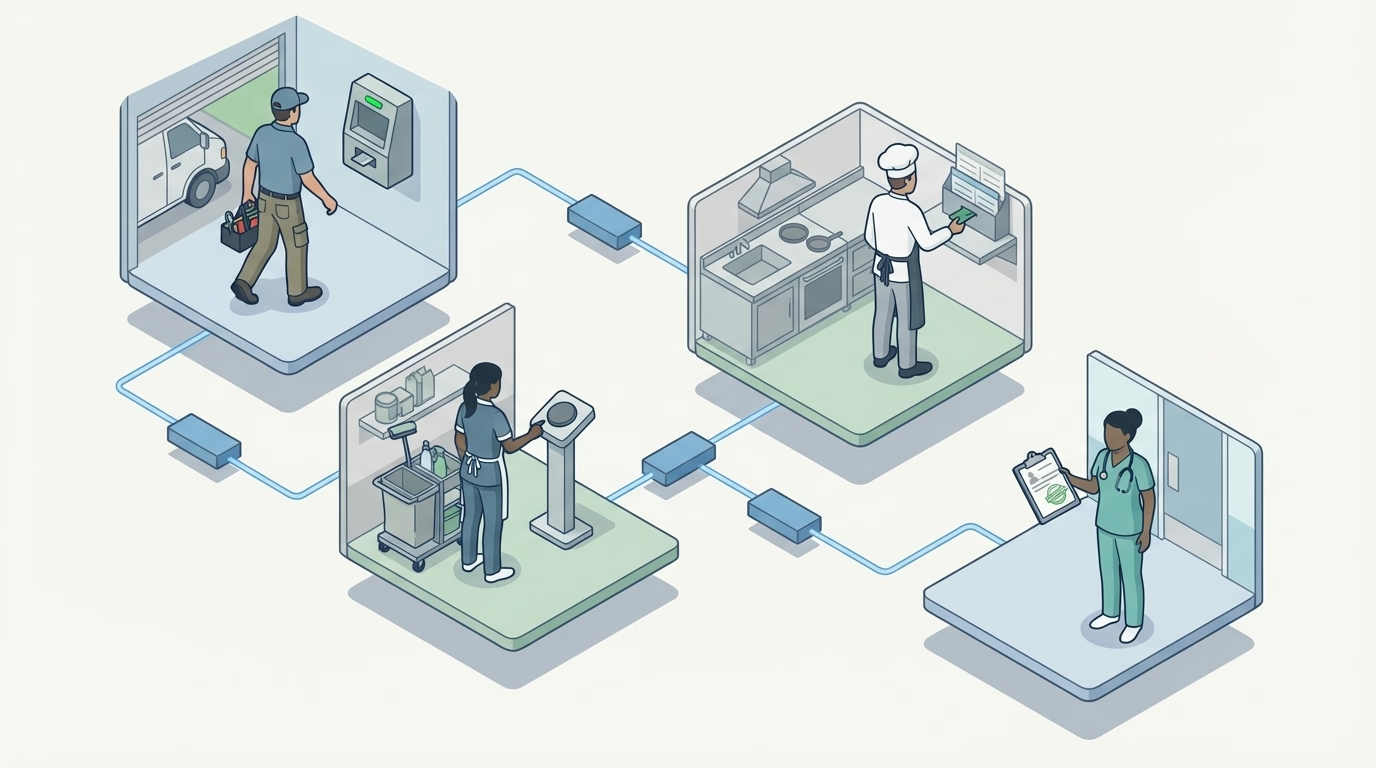
For agencies with field workers — cleaning crews, maintenance teams, on-site consultants — a time clock with GPS verification automates the capture entirely. Team members clock in when they arrive at a client site and out when they leave. No timers, no memory, no data entry.
Layer 4: Review and Approval
Raw time data needs a review step before it feeds into invoicing or reporting.
Weekly manager review. Project leads should review timesheets weekly, looking for: unlogged days, hours against the wrong project, suspiciously round entries, and work that exceeded estimates without explanation.
Pre-invoice reconciliation. Before generating a client invoice, compare logged hours against the project estimate and contract terms. Flag any overages for discussion with the client before they show up on the bill.
Monthly utilization review. Once a month, review utilization rates by team member and by department. Compare against targets. Investigate outliers in both directions — chronic under-utilization may indicate capacity problems, while chronic over-utilization signals burnout risk.
How to Improve Agency Utilization Rates
Tracking time reveals the data. Improving utilization requires acting on it. Here are the highest-impact levers.
Reduce internal meeting load
Internal meetings are the single largest consumer of non-billable time in most agencies. Audit your meeting cadence: How many recurring meetings does each team member attend? What is the total weekly cost in non-billable hours? Cut meetings that do not produce decisions, shorten the ones that remain, and protect blocks of uninterrupted time for billable work.
Fix the pipeline of non-billable tasks
Track which non-billable activities consume the most hours. Common culprits: manual reporting that could be automated, admin tasks that could be delegated, and rework caused by unclear briefs or insufficient QA. Each one is an opportunity to recover billable capacity.
Right-size project scoping
If your team consistently exceeds estimates, the problem is not efficiency — it is scoping. Compare estimated vs actual hours on every completed project. Identify which project types, clients, or deliverables consistently run over, and adjust future estimates accordingly.
Staff to utilization targets, not headcount
Instead of hiring based on “we are busy,” hire based on utilization data. If your creative team is averaging 85% utilization for three consecutive months, that is a data-driven case for a new hire. If they are at 60%, you need to understand why before adding headcount.

Time Tracking for Different Agency Types
Creative and digital agencies
Primary need: project-based hour tracking with client and task tagging. The tool should support timers, manual entry, and project budgets. Integration with project management tools (Asana, Monday, Jira) is a significant workflow benefit.
Marketing and PR agencies
Primary need: tracking time across retainer clients with monthly hour allocations. The tool needs to show hours consumed vs hours remaining on each retainer in real time, so account managers can flag overages before they hit the invoice.
For marketing and PR agencies, time data explains where team capacity goes, but campaign delivery also depends on how quickly the team can turn creator research into client-ready recommendations. For agencies building that creator selection workflow, CrowdCore’s agency creator discovery guide explains how to move from broad search to recommendation-ready shortlists.
Field service agencies (cleaning, maintenance, staffing)
Primary need: GPS-verified clock-ins at client sites. Team members arrive at a location, clock in via a time clock app, and the system records the site, time, and duration automatically. Hours feed into timesheets and can be exported for client invoicing. This eliminates the manual logging that field workers typically skip or do inaccurately.
Consulting firms
Primary need: billable hour tracking at the engagement and task level, with approval workflows and integration into billing systems. Consultants often work on multiple engagements per day, so the tool needs fast switching between projects with minimal friction. Learn more about calculating billable hours for service firms.
Common Agency Time Tracking Mistakes
Making it optional. If time tracking is “encouraged but not required,” adoption will be consistently low. Make it a non-negotiable part of the job, review compliance weekly, and address gaps the same way you would address a missed deadline.
Tracking only billable time. You need both sides of the equation. If you do not track non-billable hours, you cannot calculate utilization or identify where non-billable time is going. Track everything.
Using the wrong tool. A project management tool with a time tracking bolt-on is not the same as a purpose-built time tracking system. If the tracking feature is buried three clicks deep in your PM tool, people will not use it. Pick a tool where logging time is fast and primary, not secondary.
Punishing honesty. If a team member logs 12 hours on a task estimated at 8, the response should be “let us figure out why” — not “you should have done it faster.” Punishing accurate reporting teaches people to underreport, which makes your data useless.
Never acting on the data. Time tracking that does not inform decisions is just overhead. If you collect the data but never adjust pricing, staffing, or processes based on what it shows, the team will (rightly) question why they are doing it.
Frequently Asked Questions
Why is time tracking important for agencies?
Time tracking is how agencies measure profitability. Without accurate time data, you cannot calculate utilization rates, determine project margins, price future work accurately, or identify which clients and services are most profitable. Agencies that do not track consistently typically leave 15–25% of billable revenue on the table.
How do you get agency team members to track time?
Make the tool fast and low-friction. Set clear expectations in writing through a timekeeping policy. Review compliance weekly and address gaps immediately. Frame time tracking as a business tool that improves pricing and staffing — not a surveillance mechanism.
What is the best time tracking software for agencies?
It depends on agency type. Creative and digital agencies often use tools like Harvest, Toggl Track, or Clockify for project-based timer tracking. Field service agencies that dispatch workers to client sites benefit from GPS-verified time clock apps that record arrival and departure automatically.
Should agencies track non-billable time?
Yes. Tracking non-billable time is essential for understanding where capacity goes. If 35% of a team member’s time is consumed by internal meetings, admin, and rework, that number needs to be visible so you can manage it. You cannot improve utilization if you only measure one side of the equation.
How do agencies handle time tracking for fixed-fee projects?
Track hours even on fixed-fee work. You will not bill the client by the hour, but you need to know what the project actually cost in labor. Comparing estimated hours to actual hours on fixed-fee projects is how you refine pricing for future proposals. Without tracking, you are guessing whether the project was profitable.
Agency profitability starts with knowing where the hours go. The right time tracking system gives you that visibility without adding overhead to your team’s day. If your agency manages field teams, on-site staff, or distributed workers, ShiftFlow connects scheduling, clock-ins, and timesheets so every hour is accounted for — from job site to invoice.
Further Reading
- How to Track Employee Time Effectively in 2026 — Six methods compared with a decision framework
- Understanding Labor Costs — How time data feeds into cost analysis and pricing