Bad Google review response templates by complaint type
Copy-and-adapt replies for the six complaints a trades business actually gets, each with the move that defuses it and the line to delete before you post.
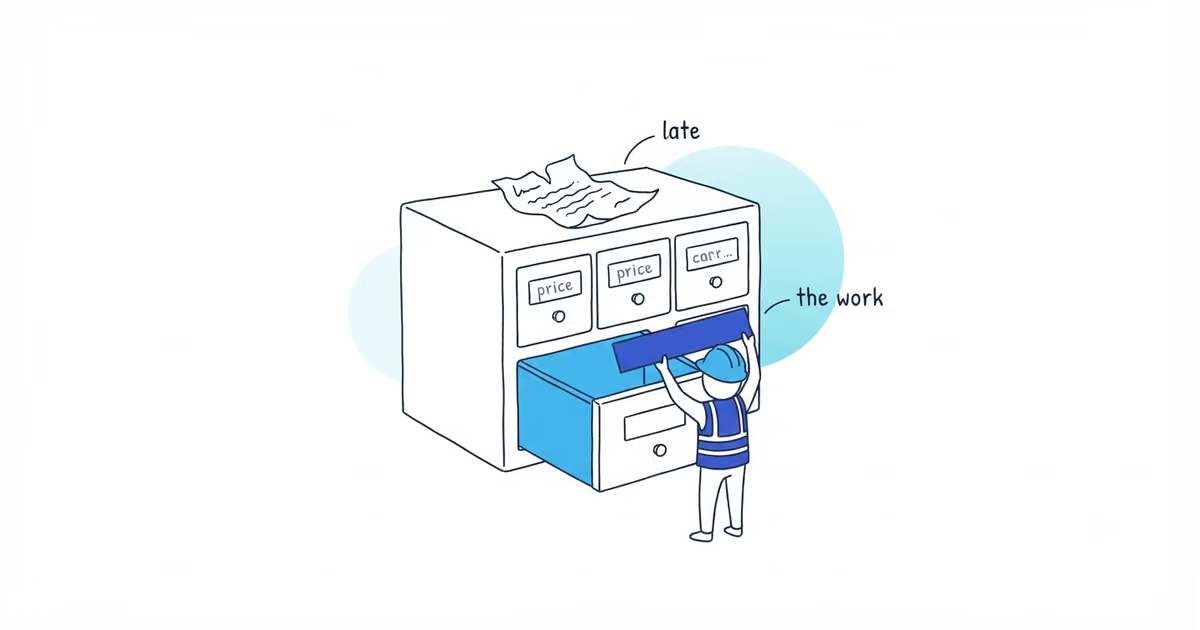
Every Google review response template below has three fill-ins — the customer’s name, the specific job, and a number that gets answered — plus one line to delete when it doesn’t apply. Before you post, read it once as somebody who has never heard of you. If it reads like an argument, cut the sentence that argues. That is usually the sentence you most want to keep.
These all assume you’ve already decided this review gets a reply. If you’re not sure whether to answer it, report it, or pick up the phone, our guide to replying or reporting sorts the review into a type first.
| The complaint | What the customer actually wants | The move that defuses it | Delete this line |
|---|---|---|---|
| Late, or a no-show inside the arrival window | To hear that you know you did it | Name the window you missed, in their words | ”We were held up on another job” |
| Final price above the estimate | The explanation nobody gave them at the time | Say what changed, and that the call should have come first | Anything restating your terms and conditions |
| Quality problem that needs a callback | To know you’re coming back | Offer the return visit in the first line, with a day | ”Our work meets industry standard” |
| A change order they say they never approved | To not be called a liar in public | Move it to a phone call without conceding or disputing | Any mention of a signature or a document |
| Mess or damage left on site | To be made whole | Say what you’ll put right, and by when | ”Some dust is unavoidable with this work” |
| The reviewer wasn’t your customer | Nothing — this reply is for the people reading it | Say plainly you can’t find a record, and give them a way to reach you | Any claim that the review is fake |
Google documentation checked: August 10, 2026 (United States).
Review response examples for six common complaints
Late, or a no-show inside the window
Hi [Name] — [Your name] from [Business]. You had a [12–3] window on [Tuesday] and we didn’t get there until [after 5], and nobody rang you. The call is the part we should have made. I’d like to put it right — I’m on [555-0142] and I’ll pick up.
The apology is for the missed call, not for the delay. Delays happen on every job in this trade and customers know it; being left to wonder is the part they mind.
Final price above the estimate
Hi [Name] — [Your name] from [Business]. You were quoted [$420] and the final bill came to [$610]. What changed was [the second shut-off valve]. The mistake was ours: that call should have come before we did the work, not with the invoice. Ring me on [555-0142] and I’ll take you through it line by line.
Name the figure and the reason. An owner who won’t put the number in the reply reads like an owner with something to hide, and the next customer is deciding whether your quotes can be trusted.
Quality problem that needs a callback
Hi [Name] — [Your name] from [Business]. We’ll come back and look at [the leaking joint] — I can have someone there [this week] if that suits you. You shouldn’t have had to chase us for it. [555-0142] gets me directly.
Lead with the return visit. Everything else — what went wrong, whose fault it was, whether it’s under warranty — is a phone conversation. Putting any of it here makes the reply longer and more defensive without helping.
A change order they say they never approved
Hi [Name] — [Your name] from [Business]. We clearly didn’t end up on the same page about [the extra circuit], and I’d rather work that out with you directly than in public. I’m on [555-0142] most of the day. — [Your name], owner
This is the one where owners lose the most and post the most. You have the paperwork; posting it publicly still loses. “We didn’t end up on the same page” concedes nothing and disputes nothing, and it’s the only sentence that gets you to a phone call.
Mess or damage left on site
Hi [Name] — [Your name] from [Business]. We left [the hallway carpet] in a state we’re not happy with either. We’ll come back and [clean it] at our cost — [Thursday] works from our side if it works from yours. [555-0142].
“At our cost” is the phrase that matters and it is not the same as offering compensation. You’re paying to undo your own mess, which any reader understands, and it commits you to nothing beyond that.
The reviewer wasn’t your customer
[Business] here. We’ve checked our records for the last [12 months] and can’t find a job under this name. If we have worked for you and it’s booked under something different, ring us on [555-0142] and we’ll look again — if we got something wrong we’d want to fix it.
Never write that the review is fake, even when you’re certain. The reader can’t verify your records and can’t verify their story, so a flat accusation just makes it two people arguing. “We can’t find a record, and here’s our number” lets them draw the conclusion themselves. If you’re confident it isn’t a customer, the reply is only half of it — our fake review removal guide covers which policy to report it under and what happens when Google says no.
What not to put in a Google review reply
No personal information, ever. Google’s content policy prohibits personal information in user content, and that covers what you write as much as what they wrote. No street addresses, no job numbers that identify a household, no employee surnames. If a review names one of your crew, do not repeat the name in your reply — a review that publishes an employee’s personal details may itself be reportable on those grounds.
Keep it under about seventy words. Every template above is, and that’s deliberate. A long reply reads as a defence no matter how reasonably it’s written, because length signals how much the complaint got to you. Somebody scanning several reviews quickly will take in a short calm reply and skim a long one.
When to explain yourself in a review response
The standard advice is never explain, only apologise. That’s wrong, and following it costs you.
There’s a real line, and it’s this: context a neutral reader needs in order to follow the story is legitimate. A defence of your own performance is not.
“The reviewer was not the person who hired us — we were working for the landlord, and we weren’t able to give a tenant scheduling information” is context. Without it the review makes no sense to anyone reading it, and supplying it isn’t defensive, it’s the only way the story parses.
“We were running late because the job before overran, which happens in this trade” is a defence. It explains your day to a customer who was waiting in theirs, and every reader hears it as an excuse regardless of it being true.
The test that sorts them: does this sentence exist to help the reader understand what happened, or to make me look better? If it’s the second one, cut it — and cut it even when it’s the truest sentence in the reply.
What to do after you post the reply
The most common failure in this whole process isn’t a badly written reply. It’s a well-written one that nothing follows.
Owner posts a careful reply offering to make it right, feels the matter has been dealt with, and never calls. The customer reads a public promise that produced no phone call, which is worse than no reply at all — and the next reader, months later, sees an unanswered offer sitting under a complaint.
Post the reply the same day, then do the private half. On the phone you can dispute the change order, explain the delay, and talk about money — none of which belongs in the public text.
One thing to expect once you post: your reply goes through Google’s own policy check before it appears. Google says this “usually take[s] up to 10 minutes to review, but sometimes a review can take up to 30 days.” Write it once, then leave it. Rewriting and reposting a reply that hasn’t shown up yet doesn’t speed anything up.
Frequently asked questions
What if the review names one of my technicians?
Don’t repeat the name in your reply, even to defend them. A review that publishes an employee’s personal details can breach Google’s rules on personal information, which makes it worth reporting — but your reply is public either way, and repeating the name spreads it further.
Can I use the same reply for two different reviews?
The wording, yes; the details, no. Readers scroll, and two identical replies under two different complaints read as a form letter — which tells them nobody actually looked at their job. Keep the shape and change the specific thing that went wrong.
Do I still need to reply publicly if I’ve already sorted it out on the phone?
Yes. The reply isn’t for the customer you’ve already spoken to. It’s for the person reading the profile in three months, who has no way of knowing the call ever happened. Two lines saying it’s been resolved is enough.
Sources
- google-reviews
- review-response-templates
- negative-reviews
- customer-complaints
- home-services