Best Google Business Profile Categories for HVAC Contractors
Choose the best Google Business Profile category for an HVAC contractor, compare heating, cooling, repair, and mechanical options, and avoid seasonal switching.
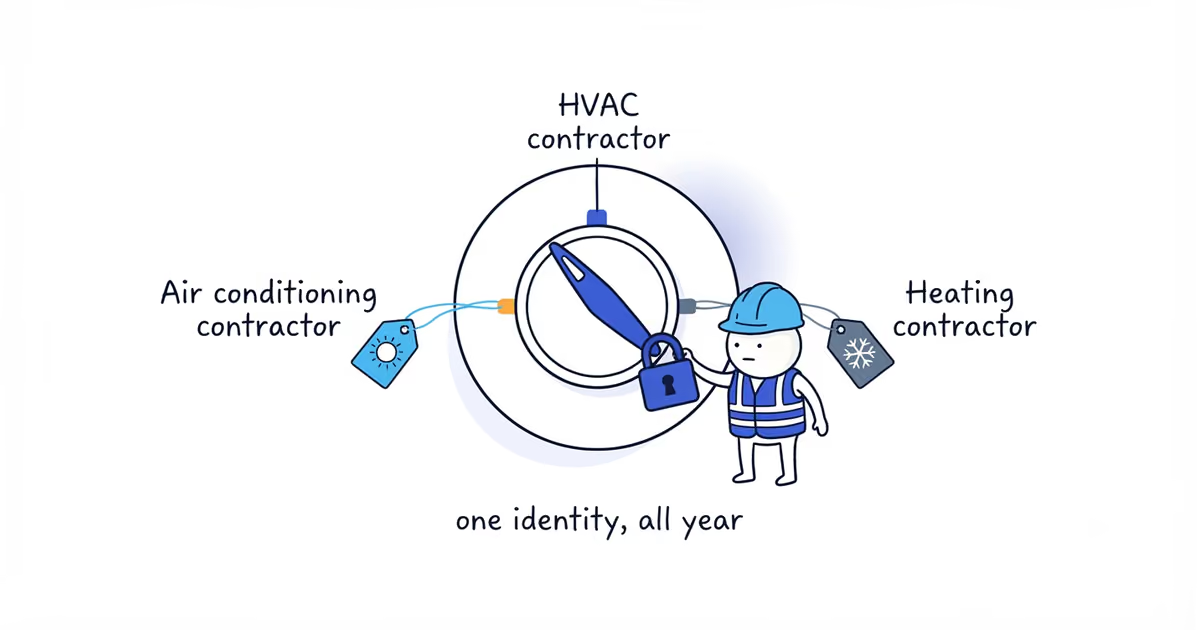
For a company that installs, maintains, and repairs both heating and cooling systems, HVAC contractor is the direct primary starting point. Current public US category candidates also include Air conditioning contractor, Air conditioning repair service, Heating contractor, Furnace repair service, Mechanical contractor, and Air duct cleaning service.
A cooling-only company, heating-only company, commercial mechanical contractor, repair specialist, installation contractor, or genuine equipment supplier may reach a different answer. The deciding facts are the company’s normal work, trained team, equipment, customer path, and sales model.
Google guidance checked: July 21, 2026. Public US category-name cross-check: July 21, 2026. Confirm the final names in the live account selector before publication or an edit.
Which Google Business Profile category fits an HVAC company?
Read these branches from top to bottom. Stop at the first one that accurately describes how customers experience the business.
- Customers hire the company for both heating and cooling. The same business installs, maintains, diagnoses, and repairs both sides through the year. Start with
HVAC contractor. - The operation is genuinely cooling-only. Cooling accounts for the company’s public identity, team capability, equipment, completed work, and customer intake. Compare
Air conditioning contractorwithAir conditioning repair serviceand choose the one that accurately describes the business. - The operation is genuinely heating-only. Heating is not merely the winter half of a mixed company; it is the durable business. Compare
Heating contractorwithFurnace repair service. - The company is built around repair. For an AC-repair business, test
Air conditioning repair service; for a furnace-repair business, testFurnace repair service. A mixed repair company may still fitHVAC contractorbest. - The company is built around installation and replacement. The reviewed public list did not show a generic HVAC-installation category. A whole-system installation company may still fit
HVAC contractor, while a cooling-only installer may fitAir conditioning contractor. - Commercial or mechanical work is a real division. Test
Mechanical contractoronly when the business actually operates that way; one commercial service call is not enough. - The company genuinely supplies equipment. Customers can buy equipment from the business as a supplier or store, not merely receive equipment as one part of an installed HVAC project.
The words “repair,” “contractor,” and “supplier” are not interchangeable. They describe different customer experiences. A company should not choose among them based on which search phrase looks most valuable.
The branch test is ShiftFlow’s conservative way to interpret Google’s accuracy rule. Google does not require a separate crew, webpage, or intake form for an additional category. Those facts are evidence, and the full picture should show that the category accurately describes the business.
Should an HVAC company change categories by season?
Seasonal call volume is normal in HVAC. A mixed-climate company may receive mostly no-cool calls in July and mostly no-heat calls in January. The work arriving this week does not redefine the company.
Switching the primary category from an air-conditioning repair identity in summer to a furnace repair identity in winter creates three problems:
- It makes the profile describe demand rather than the durable business.
- It encourages the owner to judge categories by short-term ranking movement instead of accuracy.
- Each edit introduces processing and possible reverification risk without a real operating-model change.
Use seasonal revenue and call data to understand the business, but read a full year. If the same cross-trained team handles heating and cooling, the same dispatcher accepts both, the same website presents both, and customers know the company as a full HVAC contractor, the broad identity remains true in every season.
The answer changes when the operation changes. A company that has stopped offering heating, removed it from intake, reassigned its team, and rebuilt the business around cooling may need a category review. A heat wave does not create that change.
When to add heating, cooling, repair, or mechanical categories
This table is a decision tool, not a recommendation to add every candidate.
| Primary starting point | Exact adjacent candidates to test when accurate | Keep in Services |
|---|---|---|
HVAC contractor for a year-round heating-and-cooling operation | Air conditioning contractor, Air conditioning repair service, Heating contractor, Furnace repair service, Mechanical contractor, or Air duct cleaning service | AC repair, furnace repair, heat-pump installation, tune-ups, maintenance plans, thermostat replacement, system diagnosis, and other customer jobs |
For each additional candidate, write down the proof:
- Share of completed jobs across the last 12 months
- Team members trained and scheduled for the work
- Equipment and vehicles assigned to it
- Licenses or credentials where applicable
- A dedicated page or navigation path that reflects a real offer
- Intake questions, estimates, and dispatch rules that support it
- The customer experience after the call is booked
Revenue can be useful evidence, but it is not enough by itself. One replacement job may produce more revenue than many service calls. That does not automatically make the business an equipment supplier or installation-only contractor.
Repair and installation
Most full HVAC companies repair and install equipment. Those are jobs within the operation.
A repair-led identity is stronger when the business is designed around diagnosis and repair, lacks or rarely uses installation crews, and refers major replacements elsewhere. An installation-led identity is stronger when the company has a distinct sales process, project estimators, installation teams, equipment logistics, and a customer journey built around replacements or new systems.
If both sides are material parts of one full-service operation, keep the primary focused on the overall HVAC business and list the jobs under Services.
When repair, installation, maintenance, and equipment terms still overlap after that decision, use the profile Services guide to group material jobs and remove duplicate wording before adding them.
Commercial or mechanical work
One rooftop-unit repair for an existing residential customer’s shop does not create a commercial division.
Commercial or mechanical identity needs repeated work and a supporting operation: appropriate team capability, bid or account processes, equipment, credentials where applicable, and a public offer aimed at those customers. If commercial work is occasional and handled through the residential service operation, it is evidence of capability, not necessarily another business type.
Equipment supplier categories
HVAC contractors install furnaces, condensers, air handlers, boilers, heat pumps, and other equipment. That does not mean they operate as suppliers or stores.
Ask what a customer can buy. If the company provides a complete installed project, the equipment is part of contracting work. If it also sells equipment independently, supports equipment shoppers, carries or presents inventory, and has a customer path for supply transactions, a supplier candidate may be accurate. Confirm the exact label in the live selector before using it.
Hypothetical Google Business Profile category example for HVAC
Summit is fictional, and its annual percentages are illustrative rather than Google-defined thresholds. It has eight field team members: five service technicians and three installers. All service technicians are trained to diagnose both heating and cooling systems. The installation crew replaces furnaces, central air systems, and heat pumps.
Over the last 12 months, 46% of completed jobs involved cooling, 38% involved heating, and 16% involved maintenance, controls, or indoor-comfort diagnosis. Summer revenue is higher because replacement work clusters around hot weather. Winter call volume shifts toward furnaces, but Summit keeps the same phone number, dispatch team, service technicians, and website navigation throughout the year.
The company also services six small commercial accounts. Those calls go through the residential dispatcher, and Summit does not have a commercial estimator, commercial project crew, bid process, or dedicated commercial page. It supplies and installs equipment as part of projects but does not sell equipment by itself.
Its decision follows the operation:
Primary: HVAC contractor, because it describes Summit’s year-round team, work, website, and customer experience.
Air conditioning repair service and Furnace repair service: reject as seasonal primary categories. Repair remains a material Service, but neither label describes the whole company through the year.
Installation work: keep it in Services. Summit has a real installation capability, but the reviewed public list did not show a generic HVAC-installation category, and the same brand is sold as a full heating-and-cooling operation.
Mechanical contractor: reject for now. Six accounts handled through the residential operation do not make that label an accurate description of Summit.
Equipment supplier candidate: reject. Customers buy installed HVAC projects, not equipment from Summit as a supplier.
Services: AC diagnosis and repair, furnace diagnosis and repair, heat-pump installation, system replacement, maintenance, thermostat work, and other jobs Summit currently delivers.
If Summit later creates a commercial estimating team, assigns trained field team members and equipment, builds a commercial intake path, and completes a material volume of commercial work, it can review that identity again. The decision should follow the rebuilt operation rather than a target lead.
How to change an HVAC Google Business Profile category
Google warns that category changes can lead to another verification request. Before correcting the profile:
- Record the current primary and additional categories.
- Pull a full year of completed jobs instead of one season of calls.
- Confirm the exact proposed labels in the live US selector.
- Match each candidate to the team, equipment, licenses where applicable, website, estimates, and intake supporting it.
- Make the justified category edit without combining it with unrelated major changes.
- Be ready to complete reverification if requested.
There is no need to calendar a spring and fall primary-category swap for a company whose identity remains stable. Review the profile when the operation materially changes.
Google Business Profile category checklist for HVAC contractors
Before finishing, answer these five questions:
- Durable identity: Would the primary category describe the company accurately in both its busiest cooling month and busiest heating month?
- Selector accuracy: Has every exact category label been confirmed in the current US selector?
- Division evidence: Does each additional category have material completed work, trained team members, equipment, website support, and a real customer path?
- Field placement: Are repair, installation, maintenance, diagnosis, controls, and individual equipment jobs kept in Services unless they support a genuine business identity?
- Customer consistency: Does the category decision match what callers are told, how jobs are estimated and dispatched, and what the field team actually delivers?
If the primary answer changes only when the weather changes, it is probably describing demand rather than the business.
Google Business Profile category FAQs for HVAC contractors
Should I use HVAC contractor or Air conditioning contractor?
Use HVAC contractor when the company installs, maintains, and repairs both heating and cooling systems. Air conditioning contractor is a better fit for a cooling-led contractor whose business is not a full heating-and-cooling operation.
Is HVAC installation a Google Business Profile category?
The public US list reviewed for this article did not show a generic HVAC-installation category. A whole-system installer may still fit HVAC contractor; confirm the available wording in the live account selector.
Can an HVAC company add both heating and cooling categories?
It can use a few accurate additional categories, but more is not automatically better. Add Heating contractor or an air-conditioning category only when it truthfully adds another business identity beyond the primary category.
Sources
- best-google-business-profile-categories-for-hvac-contractors
- google-business-profile-category-for-hvac-company
- hvac-contractor-google-business-profile-category
- air-conditioning-contractor-category
- heating-contractor-google-business-profile
- hvac-category-seasonal-switching