Can Employees or Family Members Leave Reviews for My Business?
Learn why employees, relatives, and other connected people should not leave Google or Yelp reviews, how FTC disclosure differs, and what to do with existing insider reviews.
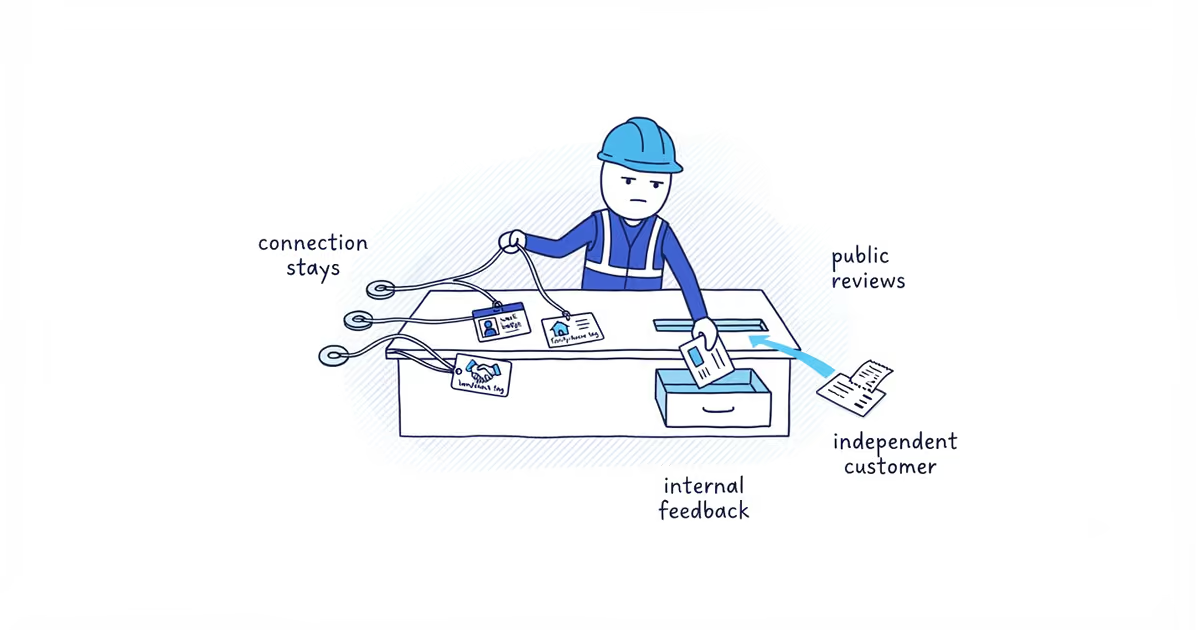
For Google and Yelp, the practical answer is no: do not ask current or former team members, family members, contractors, vendors, referral partners, or other people connected to the business to leave a review.
Their opinion may be honest, and they may even have paid for the service. US federal rules do not make every insider review automatically illegal, but disclosure does not override a platform’s conflict-of-interest policy.
Last verified: August 10, 2026 (United States).
Which business insiders should not leave Google or Yelp reviews?
| Relationship | Google treatment | Yelp treatment | FTC question | What the owner should do |
|---|---|---|---|---|
| Current team member | Employment creates a conflict | Do not review an employer | An insider relationship may require disclosure | Keep the feedback internal |
| Former team member | Former employment can still create a conflict | Yelp says businesses should not ask anyone | Context and continuing involvement matter | Do not organize the review |
| Spouse or other relative | Family is a personal connection | Do not review a friend’s or relative’s business | Clear disclosure may be required | Do not request a Google or Yelp review |
| Contractor or consultant | Contract or consulting work creates a conflict | Yelp’s no-request rule still applies | Agents can create disclosure duties | Keep the endorsement out of customer-review profiles |
| Vendor or referral partner | A professional affiliation can bias the review | The no-request rule applies; networking reviews are barred | A material connection may require disclosure | Do not trade reviews |
| Competitor | Competitor content can be a conflict | Do not review peers or competitors | The surrounding facts may still matter | Do not post; document and report when appropriate |
| Connected person who also purchased | A real purchase does not erase the connection | A purchase does not cancel the relationship or no-ask rule | Disclosure may still be required | Do not treat the purchase as a Google or Yelp workaround |
The practical answer stays the same across the table: independent customer-review profiles are not the place for organized insider support.
Does disclosing an employee or family relationship make the review allowed?
The Federal Trade Commission’s Consumer Review Rule addresses certain reviews and testimonials by officers, managers, team members, agents, and immediate relatives. In covered circumstances, the relationship may need to be disclosed clearly and conspicuously.
FTC staff also says a small business may ask family members for reviews if they clearly disclose the relationship. That answer concerns the federal rule. It does not require Google or Yelp to host the review.
A sentence such as “the owner is my sister” may answer one disclosure question while the review still violates a platform’s conflict-of-interest policy. Disclosure is not a pass that overrides the destination’s rules.
If the question is whether an insider review creates federal-law risk rather than whether Google or Yelp will host it, the illegal reviews guide separates those legal categories from platform-only violations.
Can an employee or family member review a service they purchased?
This is the edge case owners most often use to justify the review: the team member, relative, subcontractor, or vendor really did buy the service.
The purchase proves an experience occurred. It does not erase the employment, family, contractual, commercial, or competitive relationship. Do not use a receipt as a workaround or move the review to another account to make the connection less visible.
What should I do with an employee or family review already posted?
Stop any coordinated request first. Record who posted the review, how that person is connected to the business, whether anyone requested or rewarded it, where it appeared, and whether the connection was disclosed.
When appropriate, ask the reviewer to remove the prohibited review through their own account. Do not offer anything for removing or changing it, and do not ask for a rewrite that hides the relationship.
If the business cannot correct the content directly, use the platform’s current process. Reporting a review asks the platform to evaluate it; it does not guarantee removal.
Where should employee and family feedback go instead?
Use internal channels for team feedback and private channels for vendor feedback. A clearly labeled team-member testimonial may belong on a careers page. An attributed endorsement may fit marketing after its disclosure and advertising treatment have been checked. Save Google and Yelp for independent customers.
Frequently asked questions
Can employees leave testimonials on the company website?
Yes, when the testimonial is clearly attributed and any required relationship disclosure is handled. Do not present a team member’s endorsement as an independent customer review, and check its advertising treatment before publishing it.
Can vendors or referral partners trade reviews?
Not on Google or Yelp. The commercial relationship means the reviews are not independent, and Yelp also tells businesses not to ask for reviews. Keep vendor feedback private or use an attributed endorsement after checking disclosure requirements.
Sources
- employee-reviews
- family-reviews
- insider-reviews
- review-policies
- home-services