What Reviews Are Illegal?
Separate platform violations from federal review-law risk, identify the practices covered by FTC rules, and respond safely when a vendor offers fake reviews.
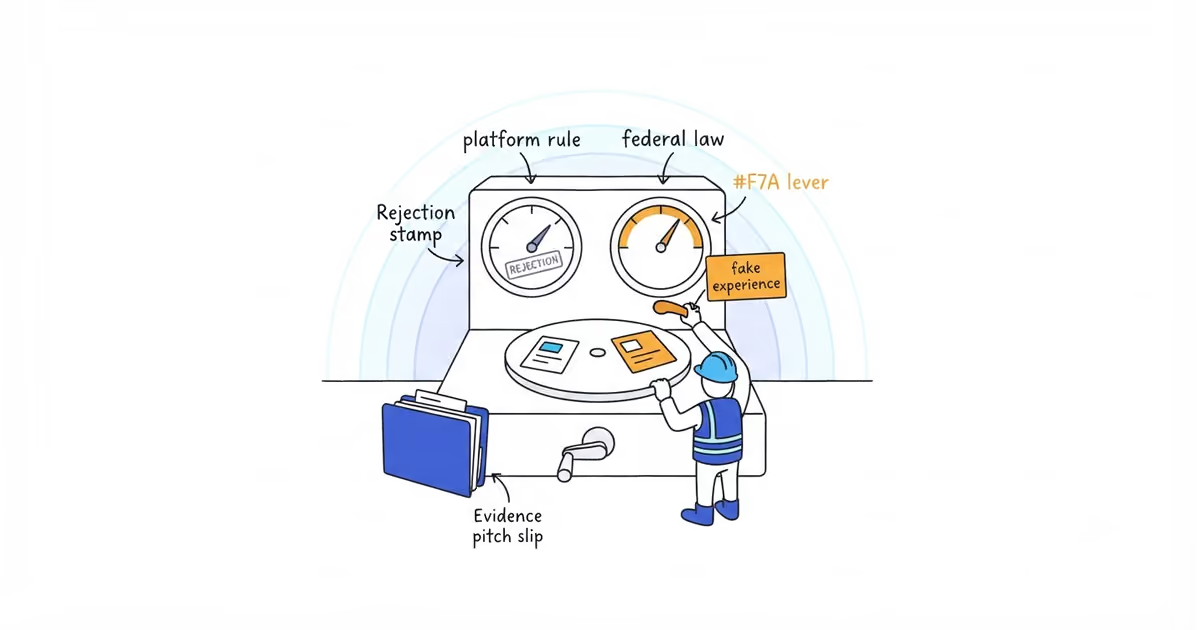
Under US federal law, fake reviews, buying or selling fake reviews, payments tied to positive or negative sentiment, certain undisclosed insider reviews, deceptive company-controlled review operations, prohibited suppression, and knowing misuse of fake social indicators can be illegal.
A review that merely violates Google or Yelp policy is not automatically illegal. Platforms can prohibit more than the FTC Consumer Review Rule, while conduct outside that rule may still raise broader FTC Act issues.
Last verified: August 10, 2026 (United States).
Which review practices create platform or federal risk?
| What happened | Platform risk | Possible federal issue | First action |
|---|---|---|---|
| A vendor writes a customer review for a job that never happened | Fake engagement; removal or account action | Creating, selling, or buying a fake or false review can violate the FTC rule when its conditions are met | Refuse it and save the proposal |
| A customer gets a gift card only for a five-star review | Incentivized or manipulated review | Compensation conditioned on positive sentiment is prohibited by the FTC rule | Stop the offer and save recipient and payment records |
| Every honest review earns the same reward | Google and Yelp prohibit incentives more broadly | The rule does not categorically prohibit it without a sentiment condition; other FTC issues may remain | Do not use it for Google or Yelp |
| A team member posts without disclosing the connection | Conflict-of-interest content | Certain insider reviews require clear and conspicuous disclosure | Stop insider solicitation and document the relationship |
| The business owns a review site presented as independent | Deceptive presentation | Misrepresenting a controlled review entity as independent can violate the rule | Correct the ownership claim and get legal advice |
| The business asks only likely-positive customers | Google prohibits selective positive solicitation | The rule has no specific prohibition, but FTC staff says the practice may violate the FTC Act | Remove the sentiment filter |
| The business uses an unfounded legal threat to force removal | Harassment or manipulation risk | Certain intimidation and unfounded threats used to suppress reviews are prohibited | Stop the threat and save the communication |
| The same relevant rule applies to positive and negative submissions | Depends on the hosting policy | Neutral moderation is not automatically prohibited | Apply and document the rule consistently |
| A vendor sells bot followers to make the business look more influential | Fake or misleading engagement | Knowing use of fake indicators to misrepresent influence can violate the rule | Refuse, preserve the pitch, and remove unnecessary access |
Use the table for triage, not a verdict. Knowledge, instructions, payment, and the exact conduct still matter.
What makes a review fake or false?
A review is fake when the experience did not happen or the speaker is misrepresented. Examples include an invented customer or job, an owner writing under a customer’s identity, a noncustomer review, or a material lie about a real job.
Businesses and brokers that create, sell, or buy false reviews can be covered by the rule. Outsourcing the posts does not make them legitimate.
An unsolicited suspicious review does not automatically make the business liable. Preserve evidence of who knew about, instructed, bought, or authorized it.
When do incentives and insider reviews create federal risk?
An incentive violates the rule when positive or negative sentiment is expressly or implicitly required. “Tell everyone how much you loved the service and receive $25 off” ties the reward to positive sentiment without saying “five stars.”
FTC staff says the rule does not categorically ban an incentive for an honest review with no sentiment condition, although an undisclosed incentive may still violate the FTC Act. Google and Yelp use broader rules, so the federal distinction does not make an incentivized review acceptable there.
If the business is deciding whether a specific discount, gift card, or promotion is safe, the review incentive guide compares Google, Yelp, private feedback, and unrelated offers.
Reviews by certain officers, managers, team members, agents, and immediate relatives may require clear and conspicuous disclosure. That does not force a platform to accept conflict-of-interest content.
If the reviewer is an employee, relative, contractor, vendor, or other connected person, the insider review guide shows how each relationship is treated and what to do with a review already posted.
When is review suppression illegal?
A business can answer criticism and apply a neutral moderation rule. Risk changes when it uses intimidation or an unfounded legal threat, or hides negative submissions and claims the published set represents most or all reviews received.
Apply the same relevant rule to positive and negative content. Document threats, exposed private information, or out-of-scope material instead of using star rating as the test.
What should I do if a review company asks for fake reviews?
Refuse the proposal. Do not pay a deposit, provide customer identities, or grant account access.
If the vendor claims the service is legitimate, require these details in writing:
- Who will write each review and what real experience that person had
- Whether anyone will be paid or rewarded
- Whether a rating or sentiment is required
- Which account and platform will be used
- What the vendor will create, buy, change, suppress, or remove
- Which business accounts or customer records it wants to access
Save the proposal, messages, samples, contract, invoice, and access request. Refuse a vendor that will not identify where its reviewers come from.
What should I do if fake reviews may already be live?
Preserve the record before anyone starts deleting messages, invoices, accounts, or logs.
- Save contracts, invoices, messages, recipient lists, review URLs, dates, and screenshots.
- Export account-access and activity records.
- Identify what the vendor posted, bought, changed, or removed.
- Revoke unnecessary access and secure affected accounts.
- Send a written stop instruction and request a complete activity record.
- Use the platform process for prohibited content or compromised access.
- Report suspected fraud at ReportFraud.ftc.gov when appropriate.
- Speak with US counsel when the business authorized, paid for, knew about, or may be responsible.
Platform support can handle platform content and account access. The FTC accepts reports. Counsel can assess business-specific exposure. None of those routes promises a particular outcome.
Frequently asked questions
Can a business be responsible for fake reviews posted by a vendor?
Potentially. Knowledge, instructions, payment, approval, and account access all matter; an unsolicited suspicious review does not create automatic liability. Preserve the records and get US legal advice when the business authorized, paid for, knew about, or may be responsible for the work.
Can a business ask a customer to update or remove a bad review?
A simple request after genuine service resolution is different from paying, intimidating, or using an unfounded threat. Do not offer value, pressure the customer, or make a benefit depend on changing or removing the review.
Sources
- illegal-reviews
- fake-reviews
- ftc-review-rule
- review-suppression
- insider-reviews
- home-services