What should a contractor capability statement include?
Learn what a contractor capability statement should include and use a one-page template for services, commercial fit, proof, capacity, credentials, and contact.
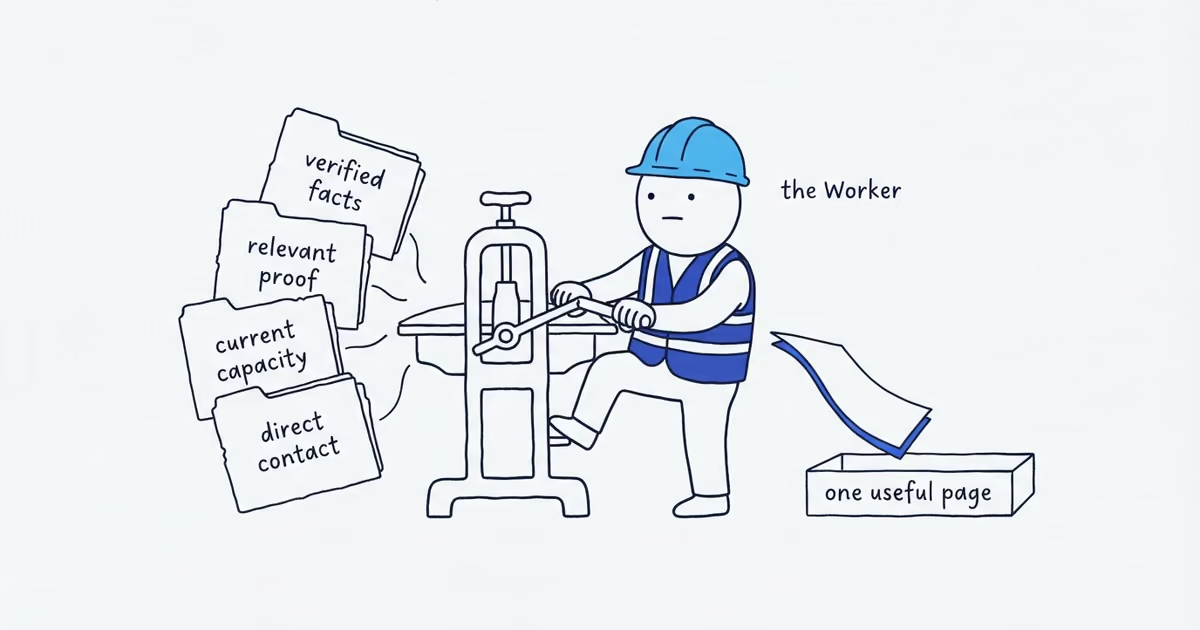
A small contractor’s capability statement should fit on one useful page. Include an accurate company summary, specific services, real service area and commercial fit, relevant completed-work proof, current capacity, fact-based differentiators, applicable verified credentials, and one named contact.
This reusable pre-sale qualification sheet shows service fit and helps a buyer decide whether to start a conversation, request onboarding information, invite a walkthrough, or ask for a proposal. It does not win work by itself.
Last verified: September 2, 2026 (United States).
Copy-ready commercial contractor capability statement template
Replace brackets with checked facts. Delete lines that do not apply.
[EXACT PUBLIC BUSINESS NAME]
[Optional: insert your logo only]

[Business name] provides [specific services] for [commercial property or customer types] across [real service area].

Service area: [List cities, counties, route area, or a truthful radius.]
Website: [Add a useful current URL, or delete this line.]
Last verified: [Month D, YYYY] | Version: [Clear document version]

SPECIFIC SERVICES
- [Name a service or service package a buyer can purchase.]
- [Add four to six relevant services total.]
- [Service]
- [Service]

COMMERCIAL FIT
- [List only property or customer types you are prepared to serve.]

SERVICE AREA AND COVERAGE
- [Cities, counties, radius, or route area where you accept this work]
- [Relevant verified route, service-window, or coverage fact, or delete]

RELEVANT WORK AND PROOF
1. [Property or job type] | [Work completed] | [Known scale or constraint] | [Verified result or completion fact]
2. [Property or job type] | [Work completed] | [Known scale or constraint] | [Verified result or completion fact]
3. [Optional third entry; anonymize the customer if you lack name or logo permission.]

CAPACITY AND OPERATING FIT
- [Current normal service windows]
- [Current crew or route coverage]
- [Equipment actually available or recurring-visit capability]
- [Occupied-site experience or issue-escalation contact, if relevant]

FACT-BASED DIFFERENTIATORS
- [Specific process, documented capability, or repeated relevant work]
- [Second checked fact, or delete.]

APPLICABLE VERIFIED CREDENTIALS
- [Current, relevant license, registration, insurance or bonding fact,
  certification, safety qualification, or business classification; delete
  unless checked against its source record and suitable to disclose.]

DIRECT CONTACT
[Full name], [Role]
Direct phone: [Number]
Direct email: [Email]
Use this opening-line formula: “[Business name] provides [specific services] for [commercial property or customer types] across [real service area].” Delete any customer type or area you are not ready to serve.
Under Specific services, name four to six things the buyer can purchase. “Preventive HVAC maintenance” says more than “full-service solutions.” List offices, retail sites, apartment common areas, HOAs, clinics, restaurants, or multi-site operators only when you fit that setting.
Keep geography separate from service promises. Real county or route coverage does not prove emergency response, round-the-clock, or nationwide service.
What proof and capacity to include in a capability statement
Each proof entry needs a job or property type, work performed, known scale or constraint, and a verified result or completion fact. Client names are optional. Never invent a project, result, contract value, review, or logo.
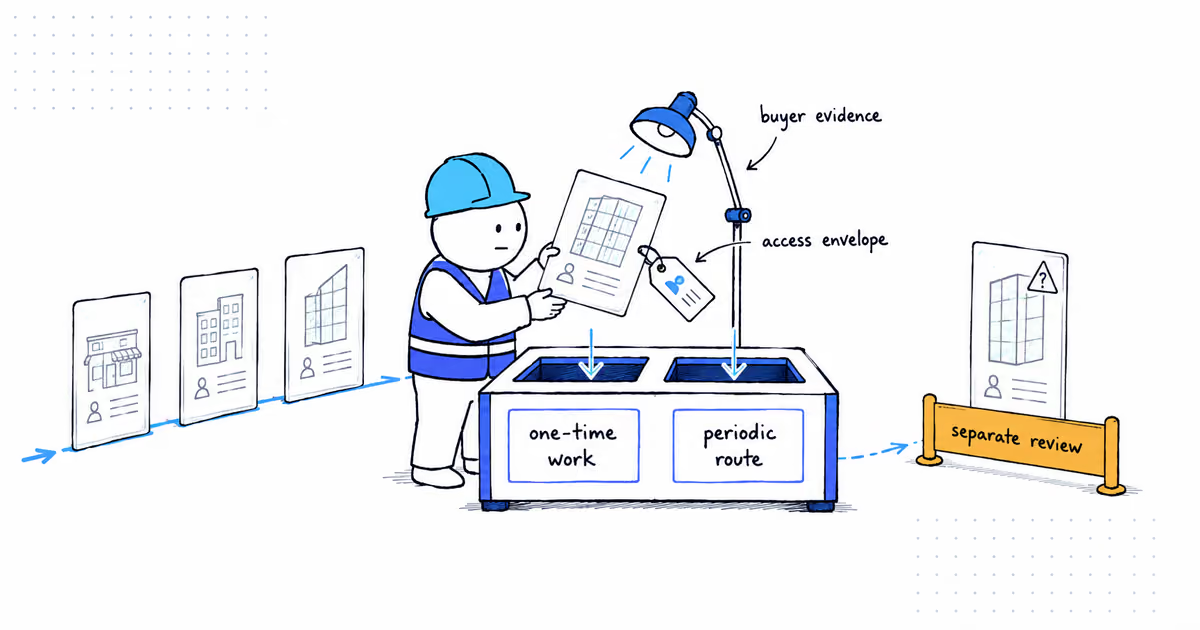
If your job evidence is larger than the two or three entries this page can hold, use the contractor proof guide to select current, permission-cleared evidence that answers the buyer’s main concern.
Capacity means what you support now, not your hoped-for size. Use current service windows, staffed routes, available equipment, recurring-visit ability, occupied-site experience, or an escalation contact.
Vague differentiators waste space. Rewrite or remove them:
| Vague claim | Replace it with |
|---|---|
| Reliable | A specific scheduling, check-in, reporting, or escalation process |
| Quality | A documented inspection or closeout step |
| Experienced | A relevant, verifiable pattern of completed work |
| Fast | A response or service-window fact you currently meet, or delete it |
| Full service | Four to six services the buyer can actually purchase |
The Federal Trade Commission says advertising claims must be truthful, nondeceptive, and evidence-based. Substantiate a differentiator or delete it.
What credentials to include in a contractor capability statement
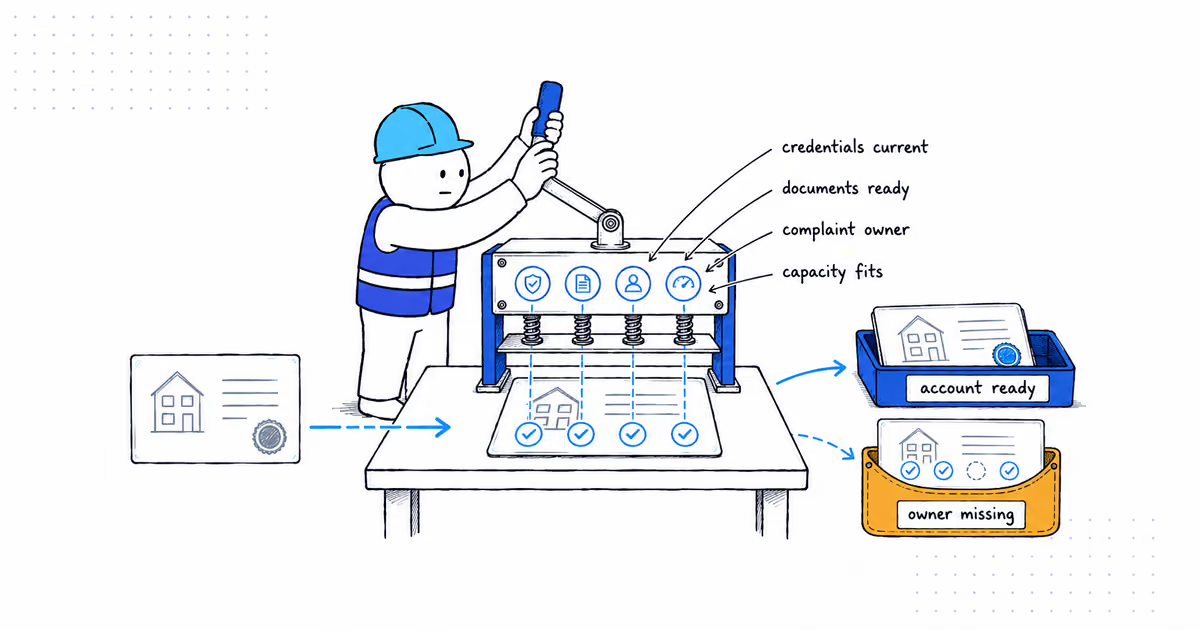
Add credentials only when they are true, current, relevant, suitable to disclose, and checked against source records. This applies to licenses, registrations, insurance, bonding, trade certifications, safety qualifications, and business classifications.
This template is for private commercial buyers. Government opportunities may request a separate version with NAICS, UEI, CAGE, contract vehicles, or set-aside status. U.S. Department of Health and Human Services guidance includes these fields. Keep them out of the commercial version by default. Build a government version only from actual records and agency or opportunity instructions.
Capability statement vs. proposal, website, and proof pack
| Document | Its job |
|---|---|
| Capability statement | Reusable summary of company fit, relevant proof, and current capacity |
| Proposal | Response to a specific opportunity, with scope, price, boundaries, and acceptance |
| Website | Persistent public destination for services and contact paths |
| Resume or brochure | Broader company history, people, brand, or marketing story |
| Proof pack | Larger library of reviews, photos, records, and project evidence |
Keep price, site-specific scope, schedule, terms, warranty, and acceptance in the proposal.
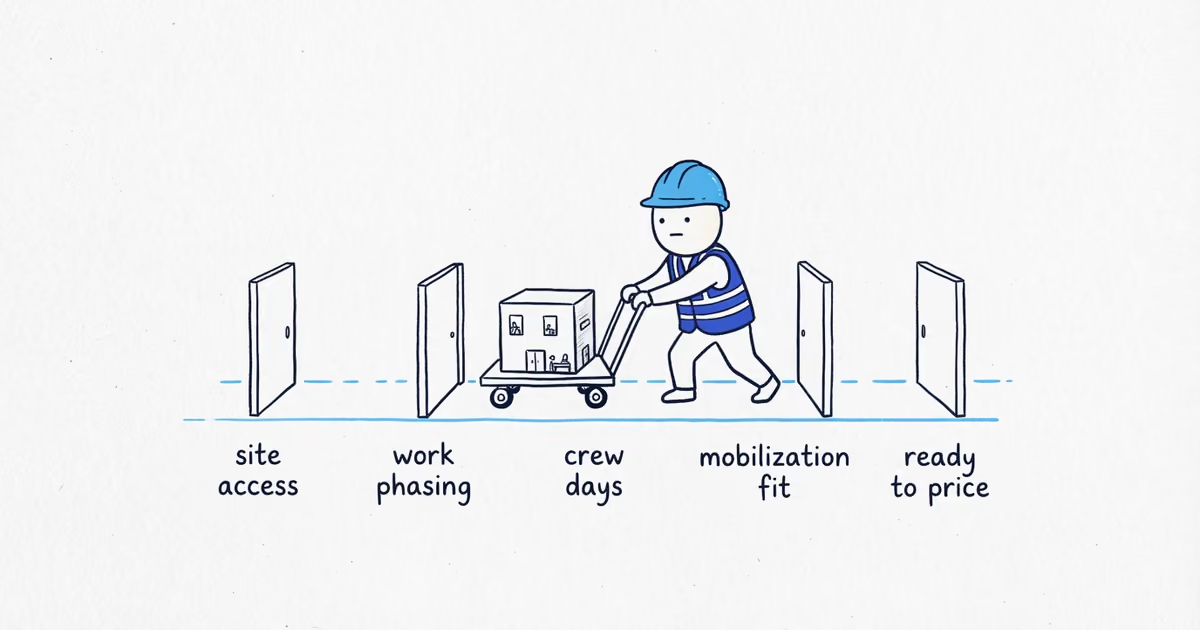
When a buyer moves from company fit to a site-specific scope and price, use the contractor estimate guide to organize the job basis, included work, allowances, exclusions, and customer total.
How to tailor a contractor capability statement
- Name the buyer and property type.
- Keep only the services and evidence relevant to that property.
- Match current operating capacity to the likely work.
- Add only buyer-requested credentials you have verified.
- Rewrite the opening line for this buyer.
- Save the tailored file with a clear name and date.
For example, a fictional HVAC contractor approaching a property manager for [two small office buildings in a verified county] would keep [preventive maintenance], [occupied-office experience supported by records], and [its current weekday service window]. It would delete residential work, unverified response times, unused credentials, government codes, and unauthorized logos. Its finished page would use checked facts, not these placeholders.
Contractor capability statement checklist before sending
Every answer below must be yes:
- Can the buyer identify the service, property fit, area, relevant evidence, workable capacity, and real contact in one scan?
- Do the business name, phone, email, website, and date match current records?
- Are the listed services sold now in the stated service area?
- Are project facts, results, capacity, and differentiators supported by a current source?
- Do you have permission to use every client name and logo?
- Are credential status and dates, including insurance or bonding wording, checked against source records?
- Do all links work?
- Have you removed every placeholder, unsupported claim, expired credential, unauthorized logo, irrelevant government code, price, site-specific scope, and acceptance term?
If one answer is no, correct or delete the line. Do not guess.
Frequently Asked Questions
Can a new contractor create a capability statement without commercial clients?
Yes, but do not invent commercial clients or results. Use only relevant completed work you can verify, and anonymize it when needed. If no proof entry is relevant, delete it and keep the services, current capacity, credentials, and contact details accurate.
How often should a contractor update a capability statement?
Update it whenever the services, area, capacity, contact, credentials, or selected proof changes. Check every field before sending a tailored copy and give the document a current last-verified date or version. There is no universal update schedule.
Can a capability statement replace property management vendor approval?
No. A capability statement can support an introduction by showing service fit, proof, capacity, and a direct contact. The property management company still controls its vendor application, document requests, onboarding checks, and approval process.
- commercial-contracts
- contractor-capability-statement-template
- what-should-a-contractor-capability-statement-include
- commercial-contractor-capability-statement
- how-to-write-a-capability-statement-for-contractors
- contractor