
How Much Do Electrical Business Owners Make?
No reliable national average exists. Compare three electrical contractor scenarios modeling $119,808, $169,386, and $305,640 in owner compensation.
There is no reliable national average salary for an electrical business owner. Public business data reports receipts and employment, employee wage data excludes owners, and salary sites do not have a representative view of contractor books. None directly measures what electrical owners pay themselves and leave in the business.
A disclosed operating model is more useful. In three residential and light-commercial electrical contractor scenarios, the business supports $119,808, $169,386, or $305,640 in planned annual owner compensation before personal tax.
| Planning scenario | Collected revenue | Owner compensation | Retained cash | Owner field hours |
|---|---|---|---|---|
| Owner-operator | $288,000 | $119,808 | $29,952 | 120/month |
| Small mixed-work team | $870,000 | $169,386 | $72,594 | 40/month |
| Established mixed team | $2,460,000 | $305,640 | $203,760 | 0 |
These are different operating shapes, not low, average, and high owner salaries. Each model combines service calls with quoted projects. The first two owner compensation figures pay for management and the owner’s remaining field labor.
Is Electrical Business Revenue the Same as Owner Income?
Collected revenue is customer money received. A signed estimate, scheduled project, or unpaid invoice is not yet collected revenue.
Non-owner payroll is the loaded cost of electricians and apprentices, including the employer costs built into the scenario rate.
Operating costs include materials, permits, subcontractors, tools, vehicles, insurance and bonding, merchant fees, estimating, rework, office support, marketing, and overhead.
Owner compensation is the planned wage, draw, or distribution paid to the owner. The model does not recommend an entity type or payment method.
Retained cash stays in the business for collection gaps, payroll, vehicles, project deposits, equipment, and growth. It is not current owner take-home.
How Much Can a Small Electrical Business Owner Make?
The small-team scenario completes 900 service calls at a $650 collected ticket and 30 quoted projects at a $9,500 average collected value. Together, those two work streams produce $870,000 in annual revenue.
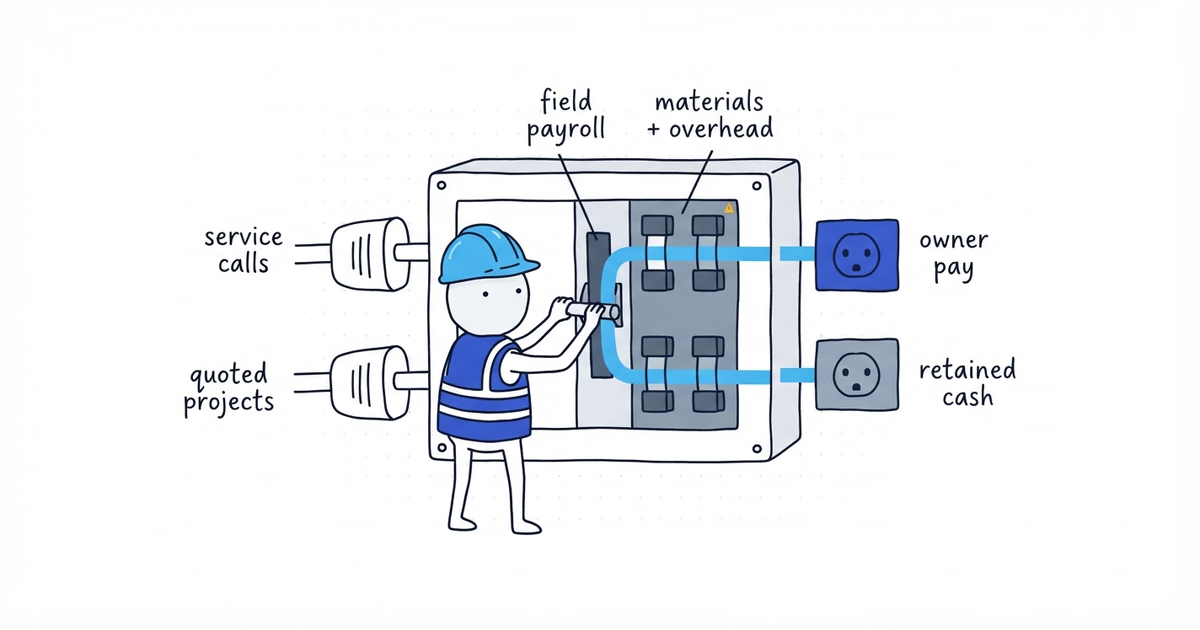
Where $870,000 of Small-Team Revenue Goes
Source: ShiftFlow planning model. Percentages use collected revenue.
The payroll line uses 3,840 paid non-owner field hours at a loaded cost of $48 per hour. Materials and permits take 25% of revenue, other direct costs take 8%, and overhead takes 18%. That leaves $241,980 before owner compensation. The scenario pays 70% of that subtotal to the owner and retains 30%.
The subtotal is not labeled profit because the owner still works about 40 field hours per month on estimates, difficult jobs, overflow, and quality control.
Electrical Business Owner Earnings Model Assumptions
These August 2026 planning inputs are replaceable. They are not survey averages or performance promises.
| Input | Owner-operator | Small mixed team | Established mixed team |
|---|---|---|---|
| Service calls per year | 384 | 900 | 1,800 |
| Collected service ticket | $625 | $650 | $700 |
| Quoted projects per year | 12 | 30 | 60 |
| Collected value per project | $4,000 | $9,500 | $20,000 |
| Paid non-owner field hours | 0 | 3,840 | 9,600 |
| Loaded field labor cost | N/A | $48/hour | $52/hour |
| Materials and permits | 22% | 25% | 32% |
| Other direct costs | 9% | 8% | 8% |
| Overhead | 17% | 18% | 19% |
| Owner field hours | 120/month | 40/month | 0 |
| Pre-owner cash paid to owner | 80% | 70% | 60% |
The model treats service and project revenue separately before combining them. Actual capacity depends on job size, apprentice supervision, permit inspections, drive time, estimating, project sequencing, and rework.
How Service Calls and Projects Affect Electrical Owner Earnings
| Question | Service work | Quoted project work |
|---|---|---|
| Revenue driver | Completed calls x collected ticket | Collected contract value plus approved change orders |
| Main variable costs | Field labor, parts, travel, and callbacks | Field labor, materials, permits, and subcontractors |
| Capacity measure | Calls completed per paid field hour | Estimated versus actual labor hours and crew-days |
| Common cash risk | Schedule gaps and unpaid diagnostic time | Deposits, material timing, change orders, and collections |
A blended revenue number can hide opposite problems. Service work may have a healthy ticket but too much drive time. A project may look large while an underestimated labor allowance or unrecovered material increase removes the margin. Review each work stream before judging total company performance.
Cash timing needs its own check. A project can appear profitable while customer collections lag behind material bills and weekly payroll. A deposit improves cash on hand, but it does not prove the estimate will recover the final labor and material cost. Review receivables, payables, project commitments, and the remaining work before increasing an owner draw. The annual model above simplifies that timing, so it should be paired with a short rolling cash forecast.
What Census Data Shows About Electrical Contractors
The 2023 Census Nonemployer Statistics data reports 159,693 U.S. nonemployer establishments and $9.18 billion in aggregate receipts for NAICS 238210. Dividing the two figures produces an arithmetic mean of $57,485 in receipts per establishment.
That is not an owner salary, profit figure, or full-time revenue benchmark. Nonemployer businesses can be part-time, and receipts are measured before expenses. NAICS 238210 also covers Electrical Contractors and Other Wiring Installation Contractors, so it is broader than one residential electrician business model.
If the number you need is employee pay rather than ownership income, the electrician salary guide compares the $30.38 national median with hourly and annual wages across every state.
What Changes Electrical Business Owner Earnings?
Collected service ticket. A 10% increase in the small-team service ticket adds $58,500 in revenue. After the model’s percentage-based costs, about $28,665 reaches cash before owner compensation.
Paid hours and estimating. Ten percent more paid field hours with no additional completed work removes $18,432 from small-team pre-owner cash. Track travel, material runs, estimating, inspection waits, and rework instead of assuming all paid time is billable.
Materials, change orders, and rework. A project deposit can improve cash timing without improving margin. Compare estimated and actual labor and materials, approve change orders before extra work, and separate warranty hours. Reducing the modeled other-direct allocation from 8% to 7% adds $8,700 before owner compensation.
Retained cash. Project payroll and material purchases may be due before the final customer payment. The three scenarios retain 20%, 30%, and 40% of pre-owner cash. Those percentages are planning choices, not universal targets.
When paid hours are difficult to match with the service call or project that produced them, time tracking for electrical teams makes estimating gaps and rework visible before they lower owner pay.
How to Calculate Your Electrical Business Owner Income
Use the last 12 months of collected service revenue, service calls, project collections, and completed projects. Then total paid field hours at a loaded cost and group spending into materials, other direct costs, and overhead using the same definitions every month.
Record owner estimating and field hours even when they are unpaid. Run service and project work separately, combine the results, and choose a retained-cash amount before testing owner compensation. The goal is not a perfect forecast. It is to expose which assumption must be true for the planned owner payment to be affordable.
Frequently Asked Questions
How much does an electrical business owner make?
No reliable public national average exists. These three planning scenarios produce $119,808, $169,386, and $305,640 in owner compensation before personal tax. They are models, not a market salary range.
How much can a solo electrical contractor make?
The owner-operator model produces $288,000 in collected revenue, $119,808 in owner compensation, and $29,952 in retained cash from 384 service calls and 12 small projects.
Is electrical contractor revenue the same as owner income?
No. Revenue comes before payroll, materials, permits, vehicles, insurance, estimating, rework, overhead, and retained cash.
What affects electrical business owner earnings most?
Collected tickets, project estimates, billable hours, material recovery, approved change orders, rework, collection timing, overhead, and retained cash policy are major levers.
Sources
- electrical-business-owner
- electrical-contractor-income
- owner-earnings
- electrical
- job-costing