
How Much Does an Electrician Make?
Electricians earn a median $30.38 per hour and $63,190 per year. Compare the pay range and median wages across every U.S. state.
The national median electrician salary is $30.38 per hour, or $63,190 per year, according to the latest U.S. Bureau of Labor Statistics wage data. That converts to approximately $1,215 per week or $5,266 per month when the official annual median is divided by 52 or 12.
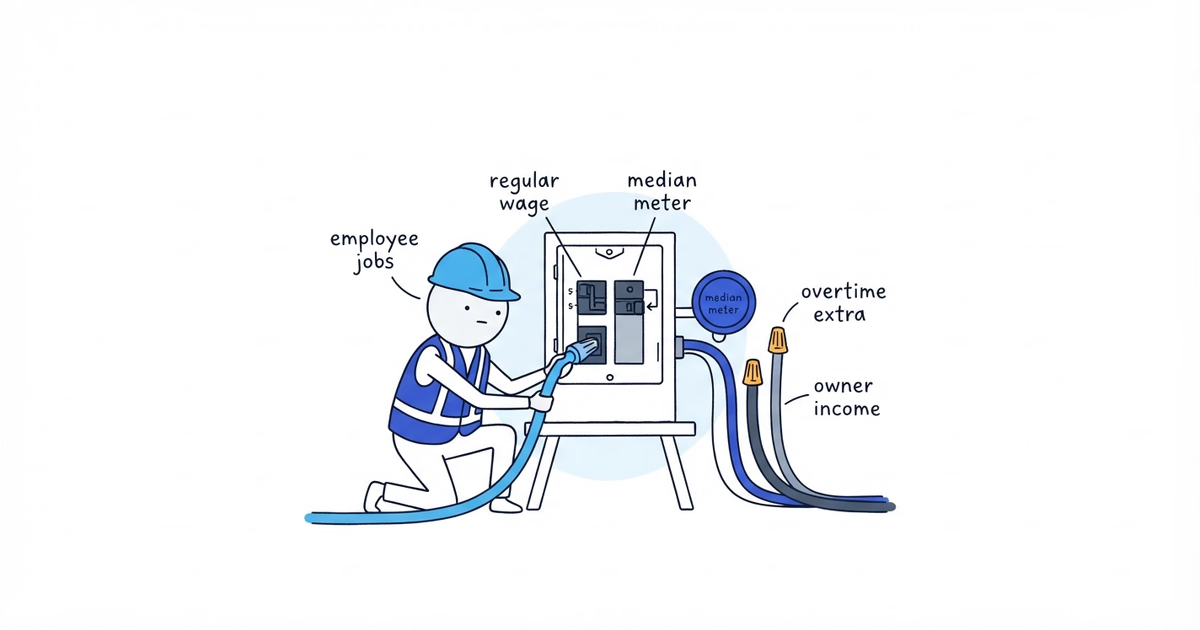
This article uses SOC 47-2111, Electricians. It does not include electrical engineers, electrical power-line installers, or the broader group of electrical and electronics installers and repairers. The data covers wage-and-salary jobs, not self-employed electricians or electrical business owners, and excludes overtime premium pay and employer benefits.
| Pay period | National median |
|---|---|
| Hourly | $30.38 |
| Weekly | $1,215 |
| Monthly | $5,266 |
| Annual | $63,190 |
The weekly and monthly values are calculated from the annual median. Actual pay depends on scheduled hours, overtime, classification, local licensing rules, and the work available in a particular market.
What Is the Typical Electrician Pay Range?
The national distribution runs from $42,640 at the 10th percentile to $108,510 at the 90th percentile. The median sits at $63,190.
These points show the spread of covered wages. They are not official apprentice, journey-level, and master electrician salary bands. BLS does not report license level, years of experience, or union status in this percentile table.
Electrician Wage Distribution
Source: U.S. Bureau of Labor Statistics, May 2025 OEWS, SOC 47-2111
Median pay versus average pay
The median of $63,190 means half of covered jobs paid less and half paid more. The mean was $71,490 per year and $34.37 per hour. Higher-paid positions can pull an arithmetic average upward, so the median is the clearer starting point for comparing an offer with the national market.
Which States Pay Electricians the Most?
Oregon had the highest median annual wage at $101,310, followed by Illinois at $99,560. Hawaii and Washington also had medians above $95,000, while Alaska reached $89,440.
Highest Median Electrician Pay by State
Source: U.S. Bureau of Labor Statistics, May 2025 OEWS, SOC 47-2111. Nominal wages, not adjusted for cost of living.
The table does not adjust for rent, taxes, commuting costs, or purchasing power. It also cannot explain whether a state median reflects construction demand, industrial work, collective bargaining coverage, licensing rules, or a different mix of employers.
Electrician salary by state
| State | Median hourly | Median annual |
|---|---|---|
| Alabama | $26.78 | $55,690 |
| Alaska | $43.00 | $89,440 |
| Arizona | $29.36 | $61,060 |
| Arkansas | $23.59 | $49,070 |
| California | $36.62 | $76,160 |
| Colorado | $29.92 | $62,230 |
| Connecticut | $37.28 | $77,540 |
| Delaware | $30.63 | $63,700 |
| District of Columbia | $37.97 | $78,970 |
| Florida | $27.52 | $57,250 |
| Georgia | $28.04 | $58,320 |
| Hawaii | $46.38 | $96,460 |
| Idaho | $30.29 | $63,000 |
| Illinois | $47.87 | $99,560 |
| Indiana | $32.93 | $68,490 |
| Iowa | $29.26 | $60,860 |
| Kansas | $31.66 | $65,860 |
| Kentucky | $28.71 | $59,720 |
| Louisiana | $29.59 | $61,540 |
| Maine | $36.24 | $75,380 |
| Maryland | $35.33 | $73,490 |
| Massachusetts | $38.18 | $79,420 |
| Michigan | $36.67 | $76,270 |
| Minnesota | $37.58 | $78,160 |
| Mississippi | $29.26 | $60,860 |
| Missouri | $31.45 | $65,410 |
| Montana | $36.90 | $76,760 |
| Nebraska | $29.24 | $60,820 |
| Nevada | $35.37 | $73,570 |
| New Hampshire | $30.21 | $62,840 |
| New Jersey | $37.14 | $77,250 |
| New Mexico | $28.07 | $58,390 |
| New York | $37.86 | $78,750 |
| North Carolina | $27.31 | $56,800 |
| North Dakota | $31.59 | $65,710 |
| Ohio | $31.11 | $64,700 |
| Oklahoma | $29.33 | $61,010 |
| Oregon | $48.71 | $101,310 |
| Pennsylvania | $32.50 | $67,600 |
| Rhode Island | $35.62 | $74,090 |
| South Carolina | $28.24 | $58,740 |
| South Dakota | $29.51 | $61,390 |
| Tennessee | $29.37 | $61,090 |
| Texas | $28.16 | $58,570 |
| Utah | $29.81 | $62,000 |
| Vermont | $30.49 | $63,430 |
| Virginia | $30.24 | $62,900 |
| Washington | $45.78 | $95,220 |
| West Virginia | $31.16 | $64,810 |
| Wisconsin | $36.80 | $76,540 |
| Wyoming | $36.59 | $76,120 |
What Changes an Electrician’s Pay?
Local market. Statewide medians combine residential, commercial, industrial, and construction employers. Compare jobs in the same area and work segment before treating the state figure as a likely offer.
Apprenticeship and license progression. Many electricians enter through a multi-year apprenticeship and build supervised experience before journey-level licensing. Exact requirements vary by state and locality. Advancing can qualify an electrician for more independent work and responsibility, but the national BLS table does not publish a fixed pay increase for a particular license. If a program requires verified experience hours, the apprentice-hours guide explains what to record and how to preserve supervisor evidence.
Work and responsibility. Residential service, commercial construction, industrial controls, maintenance, solar, fire alarm, low voltage, estimating, and supervision do not all price labor the same way. A specialty may improve an individual opportunity, but the national percentiles do not isolate those premiums.
Overtime and schedule. Shutdowns, project deadlines, emergency calls, and travel can increase gross pay. OEWS excludes overtime premiums and shift differentials, so the annual median should not be read as a total-compensation ceiling. Ask about normal hours, overtime frequency, travel pay, and on-call policy.
How to Compare an Electrician Job Offer
Compare the regular hourly rate with the $30.38 median first. Do not fold possible overtime, bonuses, per diem, or project-completion incentives into the base unless they are guaranteed. Confirm the normal paid schedule and whether orientation, travel between sites, material runs, and on-call standby count as paid time.
Then compare the whole package. Health insurance, retirement contributions, paid leave, apprenticeship tuition, tools, vehicle use, and union dues can change the value of two offers with similar rates. OEWS excludes employer benefits, so its median cannot measure those differences for you.
Use a market that resembles the actual job. A residential service position, a commercial construction role, and an industrial maintenance job may carry different schedules and responsibilities even within the same state. For a quick annual check, multiply the hourly rate by expected regular paid hours. A $35 rate over 2,080 hours equals $72,800 before overtime, taxes, unpaid time, or benefits, but the offer should confirm whether those hours are realistic.
Employee Pay Is Only One Part of Electrical Labor Cost
The $30.38 median is an employee wage benchmark, not the amount an electrical contractor bills a customer. A billing rate must also recover employer payroll costs, nonbillable travel, vehicles, tools, permits, estimating, rework, office support, and retained cash.
If you are setting customer labor rates rather than comparing employee offers, the labor cost guide shows what to add beyond the base wage. When field hours also need to be tied to the right job, ShiftFlow for electrical teams connects scheduled and actual time so those differences remain visible.
Frequently Asked Questions
How much do electricians make per hour?
The national median was $30.38 per hour in May 2025. The mean was $34.37 per hour.
How much do electricians make per year?
The national median annual wage was $63,190, equal to about $5,266 per month or $1,215 per week when divided evenly.
What is the electrician salary range?
The 10th-percentile annual wage was $42,640, the median was $63,190, and the 90th-percentile wage was $108,510. These percentiles do not represent official license or experience levels.
Which state pays electricians the most?
Oregon had the highest median at $48.71 per hour and $101,310 per year. Illinois was next at $47.87 per hour and $99,560 per year. The figures are not adjusted for living costs.
Sources
- electrician-salary
- electrician-hourly-pay
- electrical
- salary-by-state
- skilled-trades
- apprenticeship